Chōryū-ji Temple: A Tendai Buddhist Temple and Hakusan Pilgrimage Base in Japan


Site at a Glance
- Rating
- 4.2
- Popularity
- Very Low
- Country
- Japan
- Primary era
- Early Modern
- Eras represented
- Early Modern
- Civilizations
- Tokugawa
- Site type
- Religious
- Remains
- Monastery
On this page10 sections
History
Chōryū-ji Temple is a Tendai Buddhist temple in Gujō, Gifu Prefecture, Japan, traditionally founded in 718 and closely associated with Hakusan worship. Tendai is a major Japanese Buddhist school centered historically on Enryaku-ji on Mount Hiei. The temple’s principal image is a Shaka triad, and its mountain name is Hakusan.
Foundation and Hakusan pilgrimage
Tradition attributes the temple’s foundation to the religious figure Taichō, who established it under an imperial order in 718. It was originally regarded as a Hossō Buddhist temple, a school based on East Asian Yogācāra thought. The temple is said to have adopted Tendai teachings in 828.
Chōryū-ji became part of the religious tradition centered on Mount Hakusan, where reverence for the mountain and its deities was combined with Buddhist institutions and pilgrimage. Historically called Hakusan Chūgū Chōryū-ji, it served as the Mino pilgrimage base for an ascent route to Mount Hakusan. It was one of three principal bases for Hakusan ascents, together with Nagataki Hakusan Shrine and Heisenji Hakusan Shrine.
The temple’s name, Chōryū, means “long waterfall” and is traditionally connected with a waterfall in the surrounding mountains. Taichō is said to have entered the mountains after a goddess revealed a sacred spring to him in a dream. He then discovered the waterfall now known as Amida Falls.
Expansion and medieval influence
At the height of its influence during the Kamakura period, the institution was said to encompass six valleys, six monastic precincts, more than thirty shrines, and 360 monastic quarters. From this extensive religious base, it exercised considerable influence across the former Gujō district.
In 1450, Chōryū-ji became a subsidiary temple of the Nan’o Issaikyōzō-in institution in the Western Pagoda precinct of Enryaku-ji on Mount Hiei. This affiliation connected the temple with one of the principal centers of Tendai Buddhism.
Warring States and Edo-period decline
During the Warring States period, Jōdo Shinshū influence spread through Gujō. Many of Chōryū-ji’s clerical compounds converted to the Honganji branch of Jōdo Shinshū. The temple also lost power after the Asakura clan looted it during an invasion of Gujō.
Further losses followed during the Edo period, when the Inoue family, rulers of the Gujō domain, confiscated the temple estate. Chōryū-ji also lost the right to issue Hakusan talismans through the Nitaibō institution in Hamamatsu. The office of Hakusan administrator passed to Heisenji in Echizen, developments that contributed to the temple’s decline.
Rebuilding and institutional separation
The Great Lecture Hall was rebuilt in 1825 after the earlier hall had become dilapidated. Its size was exceptional in Gujō, giving rise to the popular description Chōryū Lecture Hall, meaning that it was “too grand for Gujō.”
In 1868, a government policy separating Buddhism and Shinto dismantled the former Hakusan Chūgū Chōryū-ji institution as a single religious establishment. The policy assigned Buddhist and Shinto institutions, buildings, and personnel to separate organizations. Chōryū-ji Temple and Nagataki Hakusan Shrine were formed within the same precinct and continued to share the approach. The three Hakusan shrines and the worship hall became part of Nagataki Hakusan Shrine, while the Great Lecture Hall, Yakushi Hall, Benten Hall, bell tower, and sutra repository became part of Chōryū-ji.
A fire in 1899 destroyed temple buildings and some of the temple treasures. The buildings now standing at Chōryū-ji were reconstructed during the Shōwa period. Chōryū-ji and Nagataki Hakusan Shrine continue to preserve numerous cultural properties associated with Hakusan worship, with some of the temple’s holdings kept and displayed at the Hakusan Taki Treasure Hall and the Hakusan Culture Museum.
Branch temples and historical records
Several branch temples preserve connections with the former temple-shrine institution. Amyōin is dedicated to Amida Buddha and formerly served as the administrative temple of Nagataki Hakusan Shrine. It was revived in 1529 by a monk named Dōga and later received a 20-koku estate from the Endō family. A koku was an early-modern measure used to assess rice-based land income and estate value.
Kyōmanbō is another Amida temple. Its foundation is traditionally linked to the sound of continuous sutra recitation heard from a nearby house in 719. The Endō family granted it a 200-koku estate in 1625, before the Inoue family later confiscated the estate. Kyōmanbō and Hōdōbō both served as shrine clergy institutions before the 1868 separation of Buddhism and Shinto.
Hōdōbō is dedicated to Avalokiteshvara. Tradition holds that Taichō opened it during the Yōrō period. Its lineage was lost in 1533, then revived and renamed in 1559. A record called the Steward’s Register of the Shōgon Lecture Association covers the years from 1248 to 1868 and is designated as a cultural property of Gifu Prefecture.
Remains
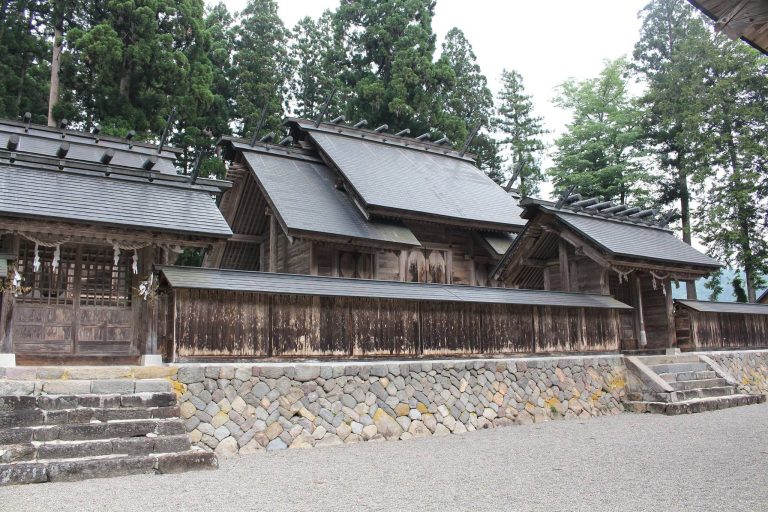
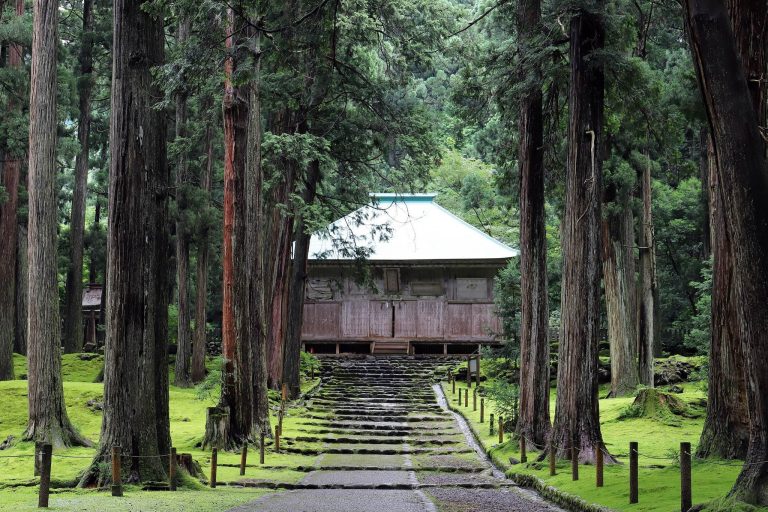
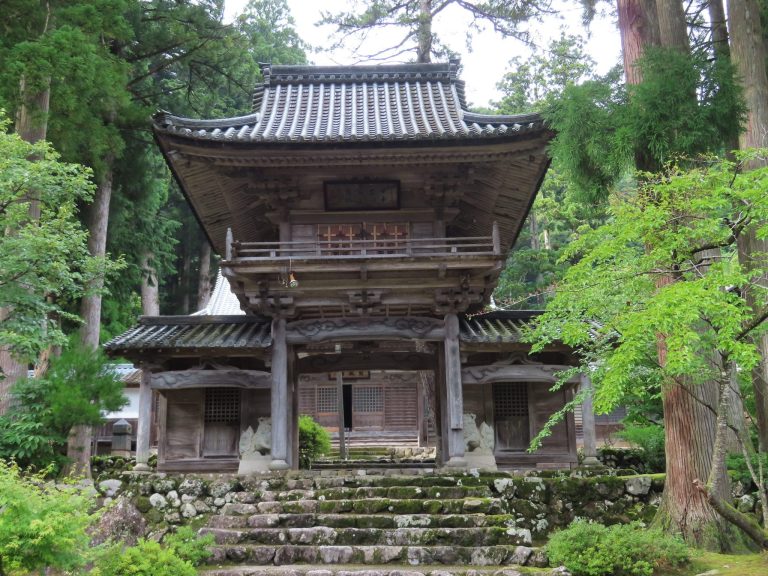
Chōryū-ji and Nagataki Hakusan Shrine occupy the same temple-shrine precinct and share the approach. Seen from the approach, Chōryū-ji stands on the left and Nagataki Hakusan Shrine on the right. The present temple buildings are Shōwa-period reconstructions, while the Great Lecture Hall had already been rebuilt in 1825.
Temple buildings
The temple complex includes the main hall, Great Lecture Hall, Yakushi Hall, Benten Hall, bell tower, and sutra repository. The Great Lecture Hall rebuilt in 1825 measured 18 ken across its frontage, approximately 33 meters, and 14 ken in depth, approximately 25 meters. A ken is a traditional Japanese architectural measurement based on the spacing between structural posts, whose exact length could vary.
Sculptures and religious furnishings
The principal image is a wooden Shaka triad, a sculptural group showing Shaka Buddha with two attendants. Other wooden Buddhist sculptures include standing figures of the Four Heavenly Kings, guardian deities associated with the four directions, as well as Idaten and Sudhana. The collection also includes a wooden standing image of Jizo Bodhisattva and a seated wooden image of the novice monk Gyōken.
Among the temple’s religious furnishings are an ox-hide ornamental hanging, a gilt-bronze ornamental hanging, and a Buddhist reading desk accompanied by a woodblock-printed Lotus Sutra. These objects form part of the cultural-property collection associated with the temple and its Hakusan religious setting.
Paintings and Buddhist texts
Chōryū-ji possesses paintings on silk depicting Taichō, Amida Buddha, the Buddha’s Nirvana, Avalokiteshvara with Two Figures, the Thirteen Buddhas, Dōga, Kōbō Daishi, the Blue Fudō, Fudō Myōō, Kōjin, the Eight-faced Kōjin, Aizen Myōō, the Twelve Devas, Kangiten, and the Eight Victorious Kings. The collection also contains paintings of the Buddha-Eye Mandala and the Hiyoshi Sannō Mandala.
The temple holds a Song-dynasty edition of the Buddhist canon comprising 3,754 fascicles. Two fascicles were added to the designated corpus in 2019, increasing the recorded total from 3,752 to 3,754. Some of the temple’s cultural properties are preserved and displayed at the Hakusan Taki Treasure Hall and the Hakusan Culture Museum.