Nagataki Hakusan Shrine: A Central Center of Hakusan Worship in Japan


Site at a Glance
- Rating
- 4.4
- Popularity
- Low
- Country
- Japan
- Primary era
- Medieval
- External website
- Open
- Eras represented
- Medieval
- Civilizations
- Japanese
- Site type
- Religious
- Remains
- Sanctuary
On this page11 sections
History
Nagataki Hakusan Shrine is a Shinto shrine in Japan and one of the central centers of Hakusan worship, the religious tradition focused on Mount Hakusan and its associated shrines and temples. Its predecessor, Hakusan Chugu Nagataki Temple, was traditionally founded by the Buddhist monk Taicho in 717. Mount Hakusan is revered as the shrine’s sacred mountain and divine body, while the shrine’s principal deities are Kikuri-hime-no-kami, Izanagi-no-Mikoto, and Izanami-no-Mikoto.
Foundation and Hakusan Pilgrimage
The early institution became associated with prayers for the recovery of Empress Gensho, an eighth-century Japanese sovereign. In the sixth year of the Yoro era, prayers were believed to have succeeded, and images regarded as the Buddhist counterparts of Hakusan were enshrined. These included Eleven-Headed Kannon, Sho-Kannon, and Amitabha. The institution was then renamed Hakusan Honji Chugu Nagataki Temple.
In 828, Nagataki changed its affiliation from the Hosso school to the Tendai school, a major Japanese Buddhist tradition that became influential in court and mountain religion. In 832, it became one of the three principal starting points for pilgrimages to Mount Hakusan. These starting points, known as baba, were the Mino, Kaga, and Echizen approaches.
Medieval Expansion and Damage
During the Heian period, Nagataki Temple reportedly grew into a large religious complex of more than 30 halls and other buildings. Its buildings included three Hakusan shrines, Wakamiya Shrine, a great lecture hall, a bell tower, a hall for Buddhist fire rituals, a hall for ritual music and dance, a three-story pagoda, a Lotus Sutra hall, and Yakushi Hall, which was dedicated to Yakushi, the Medicine Buddha. The complex was also said to contain six valleys, six monastic compounds, and 360 subsidiary quarters.
A fire in 1271 destroyed half of the buildings. The main sanctuary was rebuilt in 1290. In 1450, the temple became a subordinate institution of a scripture repository in the Western Pagoda precinct of Enryaku-ji, the major Tendai headquarters on Mount Hiei near Kyoto.
Control of Mount Hakusan
During the Edo period, Nagataki Temple’s Mino pilgrimage center disputed control of the summit of Mount Hakusan with the Kaga center, Hakusan-dera Hakusan Hongu, and the Echizen center, Heisenji Hakusan Shrine. More than half of Japan’s Hakusan shrines were said to follow the Nagataki Temple tradition, reflecting the reach of the Mino center within Hakusan worship.
Separation of Shrine and Temple
In 1868, the policy of separating Buddhism and Shinto divided Hakusan Honji Chugu Nagataki Temple into Nagataki Hakusan Shrine and Nagataki Temple. The three Hakusan shrines and the worship hall became part of Nagataki Hakusan Shrine. The great lecture hall, Yakushi Hall, Benten Hall, bell tower, and sutra repository became part of Nagataki Temple. The shrine and temple have remained within the same precinct and continue to share the same approach.
A fire in 1899 destroyed the shrine buildings, which were reconstructed during the Taisho period. In 1954, Nagataki Hakusan Shrine received the designation Kinpeisha, meaning that it was selected for an official visit by the head of the Gifu Prefectural Shrine Association. The shrine is also known as Hakusan Nagataki Shrine, while its registered religious-corporation name is Hakusan Shrine.
Collections and Observances
Nagataki Hakusan Shrine, Nagataki Temple, and the Buddhist temple Anain jointly established a treasure hall called Takihoden. In 2018, the hall was donated to Gujo City and became the municipal Hakusan Takihoden facility. Cultural properties associated with Hakusan worship continue to be transmitted by the shrine and Nagataki Temple, including objects designated at national, prefectural, and municipal levels. Some treasures were lost in the Meiji-period fire.
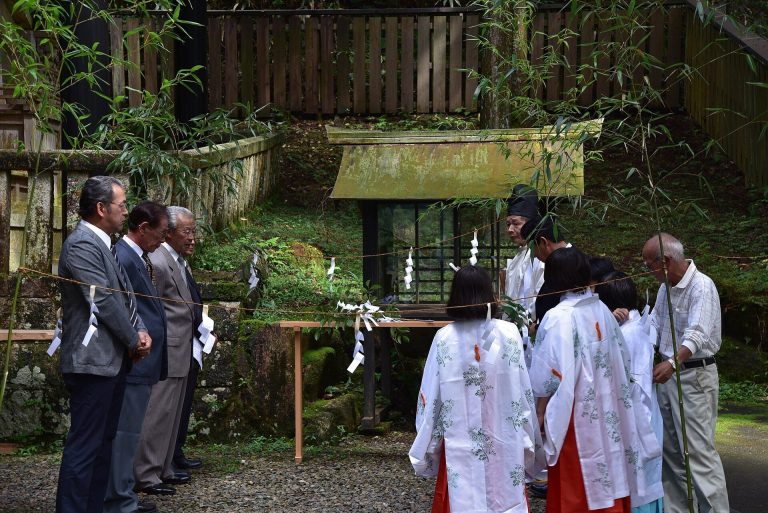
The shrine’s major observances include the Rokkasai, or Flower-Taking Festival, held on January 6, and the Dededen Festival on May 5. These events form part of the continuing religious life of a sanctuary whose history developed through the combined presence of Buddhist and Shinto traditions.
Remains
Shared Precinct and Approach
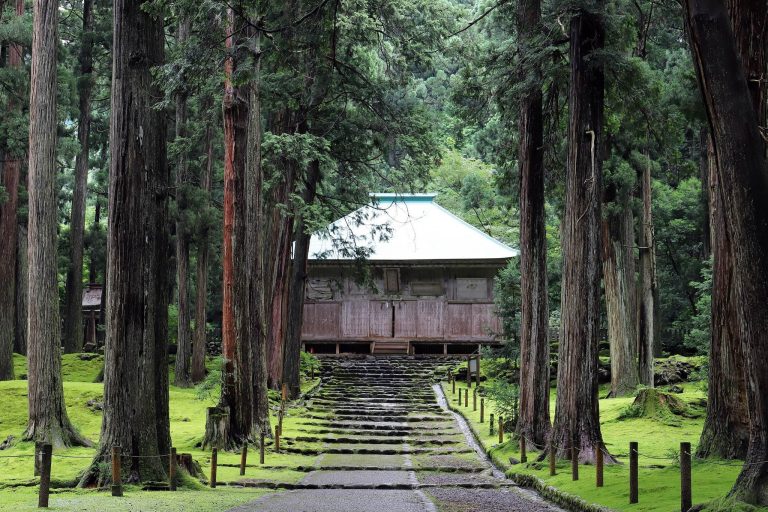
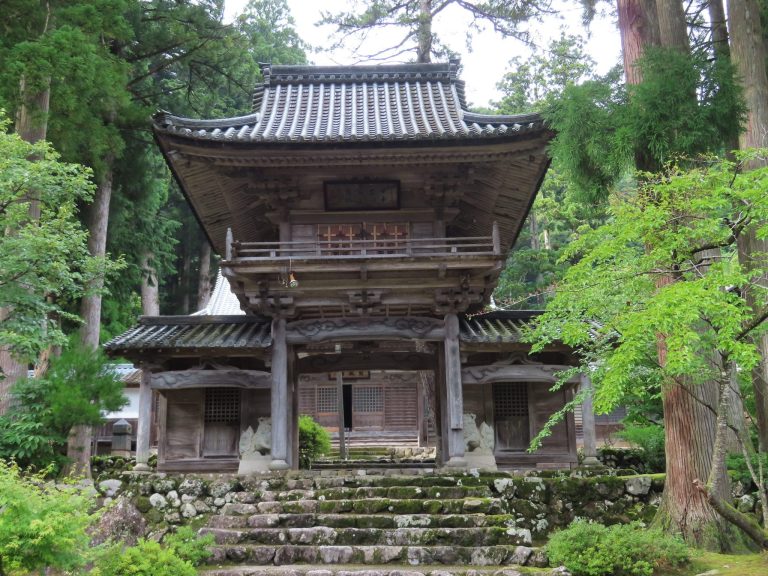
Nagataki Hakusan Shrine and Nagataki Temple occupy the same precinct, preserving the physical relationship that remained after their nineteenth-century separation. They share a common approach. Viewed from that approach, Nagataki Temple stands on the left and Nagataki Hakusan Shrine on the right. This arrangement places the present shrine and temple within the same historic religious landscape, even though their institutional identities were divided in 1868.
Shrine Sanctuary
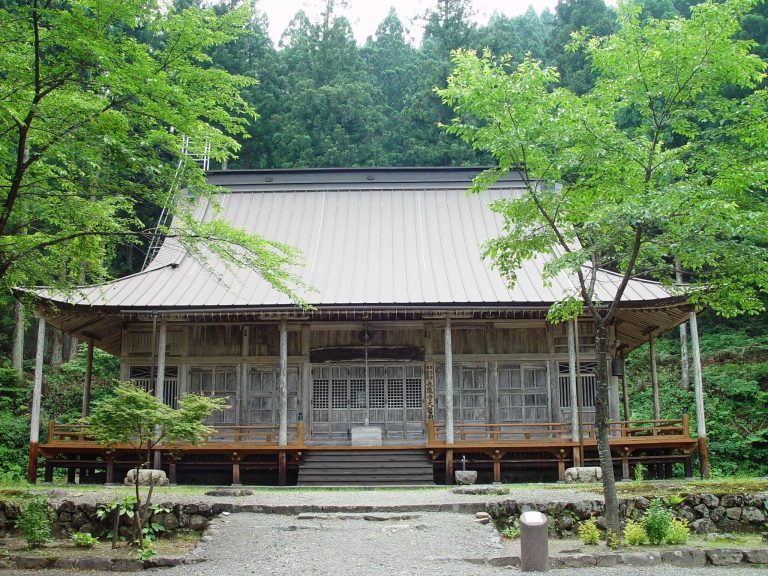
The main sanctuary is built in the Shinmei-zukuri style, a Shinto form characterized by a simple raised timber structure, a gabled roof, and strong horizontal and vertical lines. The shrine’s present buildings belong to the Taisho-period reconstruction that followed the fire of 1899. They represent the shrine buildings that developed from the three Hakusan shrines and the worship hall assigned to the shrine during the separation of Buddhism and Shinto.
Former Temple Buildings
The buildings assigned to Nagataki Temple after the 1868 division included the great lecture hall, Yakushi Hall, Benten Hall, bell tower, and sutra repository. The former complex also included a hall for Buddhist fire rituals, a hall for ritual music and dance, a three-story pagoda, a Lotus Sutra hall, Wakamiya Shrine, and other halls and buildings. Together, these features preserve the architectural categories associated with the larger temple complex described for the Heian period.
Hakusan Collections
The shrine and Nagataki Temple are associated with a collection of treasures preserved and partly displayed at Hakusan Takihoden and the Hakusan Cultural Museum. These collections support the continuing transmission of material connected with Hakusan worship. The surviving cultural properties complement the buildings by preserving objects linked to the religious history shared by the shrine and temple.