Hauterive Monastery: A Cistercian Abbey in Switzerland
Site at a Glance
- Rating
- 4.7
- Popularity
- Low
- Country
- Switzerland
- Primary era
- Medieval
- External website
- Open
- Eras represented
- Medieval, Early Modern, Modern
- Civilizations
- Unclassified
- Site type
- Religious
- Remains
- Monastery
On this page15 sections
History
Hauterive Monastery is a Cistercian abbey in Switzerland, founded in 1138 during the Romanesque period. It stands in the canton of Fribourg under the Diocese of Lausanne, Geneva and Fribourg, and its origins are closely connected with the Glâne family and the political landscape of medieval western Switzerland.
Foundation and early development
Between 1132 and 1137, Guillaume de Glâne, lord of Villars-sur-Glâne and Arconciel, donated land for a monastery. He brought monks from Cherlieu Abbey, a Cistercian house in the Clairvaux network, and obtained permission from the Bishop of Lausanne. The new monastery was consecrated on 25 February 1138 as the Abbey of Saint Mary of Altaripa, and Pope Innocent II confirmed it in 1142.
The foundation served both religious and political purposes. Guillaume de Glâne demolished his castle and reused its materials in the abbey’s construction. His endowment was intended to prevent his territory from passing to the Zähringen, a medieval ducal dynasty with influence in western Switzerland and nearby southwestern Germany. Disputes also arose with the Counts of Gruyère over inherited property. Guillaume died at Hauterive in February 1142 or 1143 as a lay brother, a member of the community primarily engaged in manual work and estate management, and was buried in the church choir.
The monks lived near the future abbey for about twenty years before the principal complex developed. Hauterive remained a daughter house of Cherlieu within the Clairvaux filiation, the Cistercian network of monasteries linked through founding or supervision. It later established Kappel Abbey in 1185. In 1261, the La Maigrauge nunnery near Fribourg was placed under Hauterive’s authority.
Protection, estates, and medieval prosperity
Hauterive acquired protection from several powerful neighbours. From 1157, the Zähringen granted it protection and exemption from tolls. The abbey also secured the support of the Counts of Neuchâtel, the Counts of Aarberg, and the city of Fribourg. From 1452, Fribourg exercised overlordship over the monastery. A burg-rights agreement with the city was concluded in 1341, while citizens of Fribourg had been entitled to burial at Hauterive since 1182.
Donations from noble families, the Bishop of Lausanne, and the Zähringen gave the abbey estates, tithes, and rights to rents. Its holdings extended from the Three Lakes region toward the Alpine foothills and included vineyards near Lake Geneva. Sheep raising for wool, agriculture, dairy production, winegrowing, milling, and related activities connected the monastery economically with a wide surrounding region.
The abbey flourished especially during the thirteenth and fourteenth centuries. In the late twelfth and early thirteenth centuries, its community included about 30 to 40 monks and approximately 50 lay brothers, who managed many of the estates. As the number of lay brothers declined during the fourteenth century, some farms were leased instead.
War, scholarship, and decline
Hauterive supported Fribourg during the Sempach War. In 1387, the abbey was plundered, and its library was looted. Bernese troops pillaged the monastery during the 1448 war between Bern and Fribourg. Damage to the abbey and its lands, together with internal conflicts, contributed to a period of decline.
The monastery nevertheless retained an important intellectual role. Its scriptorium, the area where monks copied and sometimes illuminated manuscripts, and its library supported cultural activity from the mid-twelfth to the fourteenth century. The library was badly damaged by the fire of 1578, but Hauterive continued to possess one of the largest collections of medieval manuscripts among monasteries in western Switzerland.
Fribourg reorganized the abbey during the sixteenth century. In 1618, Hauterive joined the Upper-German Cistercian Congregation, a regional administrative grouping of Cistercian monasteries. Abbot Guillaume Moënnat, who served from 1616 to 1640, reorganized the nunneries of La Maigrauge and La Fille-Dieu.
Dissolution and return of the community
A second period of prosperity ended after the French invasion of 1798. The abbey paid a war indemnity, lost its right of self-government, and surrendered numerous properties. After the Sonderbund War, the 1847 conflict between Swiss federal authorities and a separatist alliance of predominantly Catholic cantons, the radical government of Fribourg dissolved Hauterive in 1848.
The buildings were converted into an agricultural school in 1850 and a district teacher-training college in 1859. The priest and educator Abbé Bovet taught there. Hauterive’s archives and library were transferred to Fribourg, and most of the medieval manuscripts are now held by the Cantonal and University Library of Fribourg.
Monks from Wettingen-Mehrerau Abbey returned in 1939 under Prior Sighard Kleiner, restoring monastic life. Hauterive became an abbey again in 1973 and joined the Mehrerau Congregation, another regional Cistercian administrative grouping. Its abbots after the restoration of monastic life included Sighard Kleiner, Bernhard Kaul, Mauro-Giuseppe Lepori, and Marc de Pothuau, who took office on 14 September 2010.
The monastery continues to maintain a Cistercian community and liturgical life. The liturgy is partly sung in Latin using the traditional Cistercian Gregorian repertory and partly in French. The community has included priests and brothers, with figures given as eight priests and sixteen brothers in 2003, and eighteen Cistercian monks in another account. The buildings and lands are held by a foundation and farmed by the monks, while hospitality and the accommodation and care of guests remain principal activities. Hauterive is recognized as a Swiss heritage site of national significance, and the entire area forms part of the Inventory of Swiss Heritage Sites.
Remains
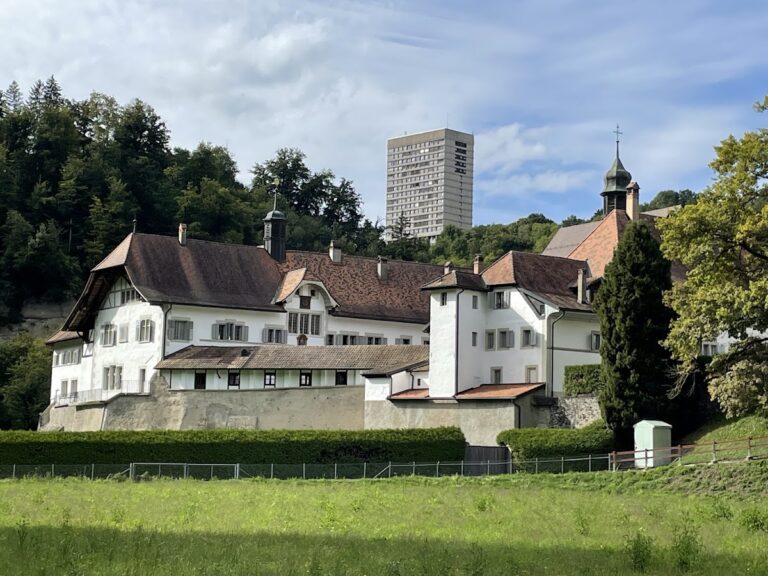
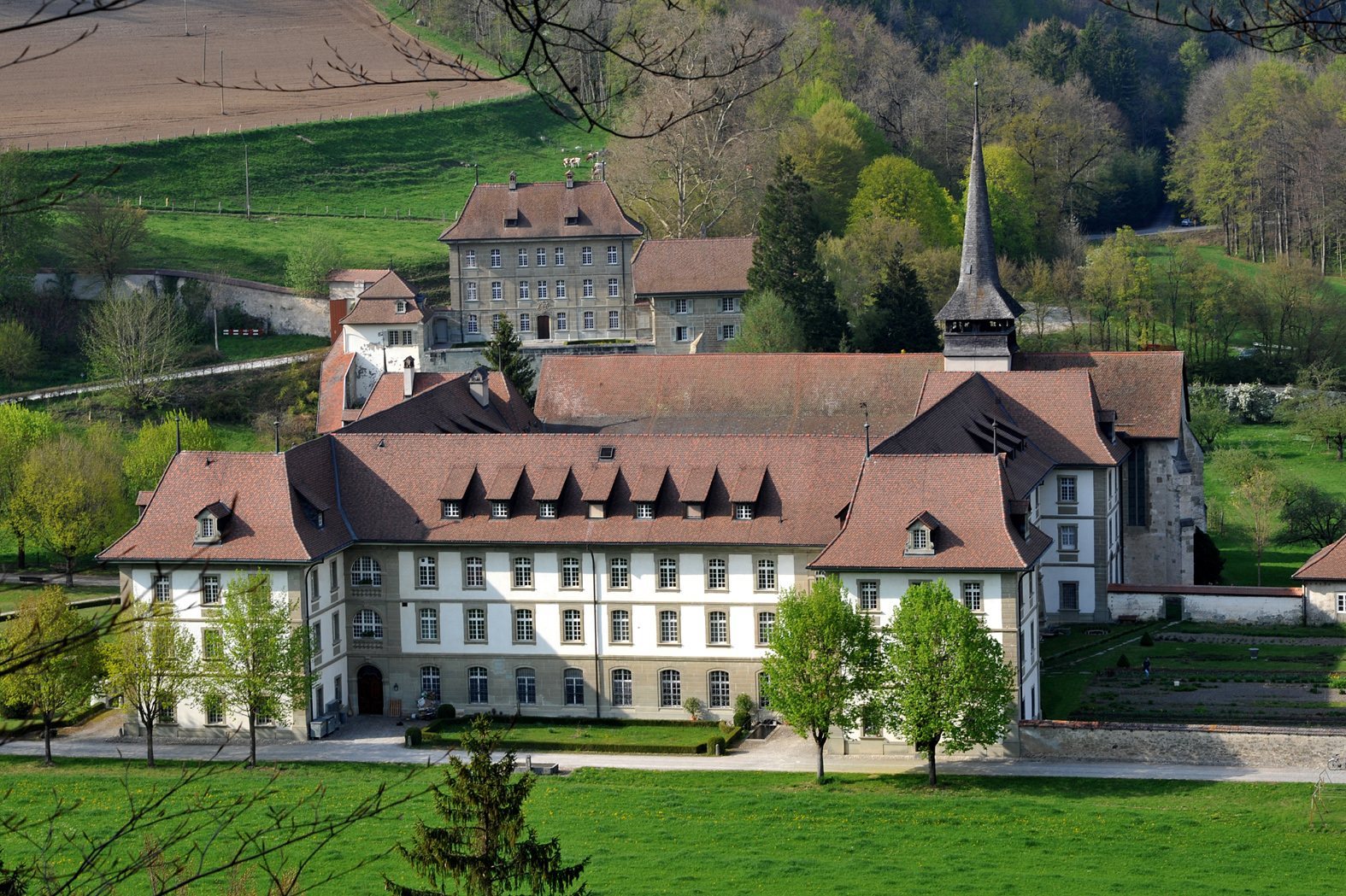
Hauterive stands at approximately 579 metres above sea level in a loop of the Saane River. The river has cut deeply into surrounding Molasse, a sedimentary rock formed from material eroded from rising mountains. Steep banks, partly covered with sandstone, rise as much as 100 metres around the site. This high-bank setting explains the name Hauterive. The surviving complex combines a Romanesque church, a medieval cloister, later conventual buildings, working water installations, and structures associated with hospitality and estate management.
Abbey church
Romanesque structure and Gothic changes
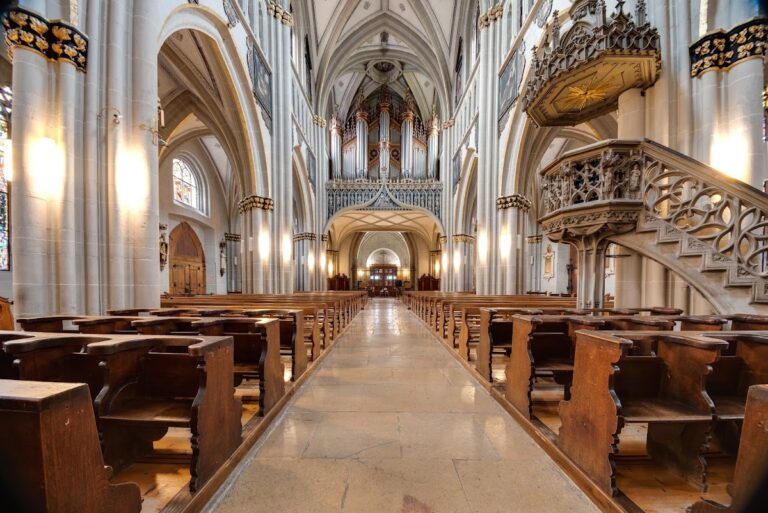
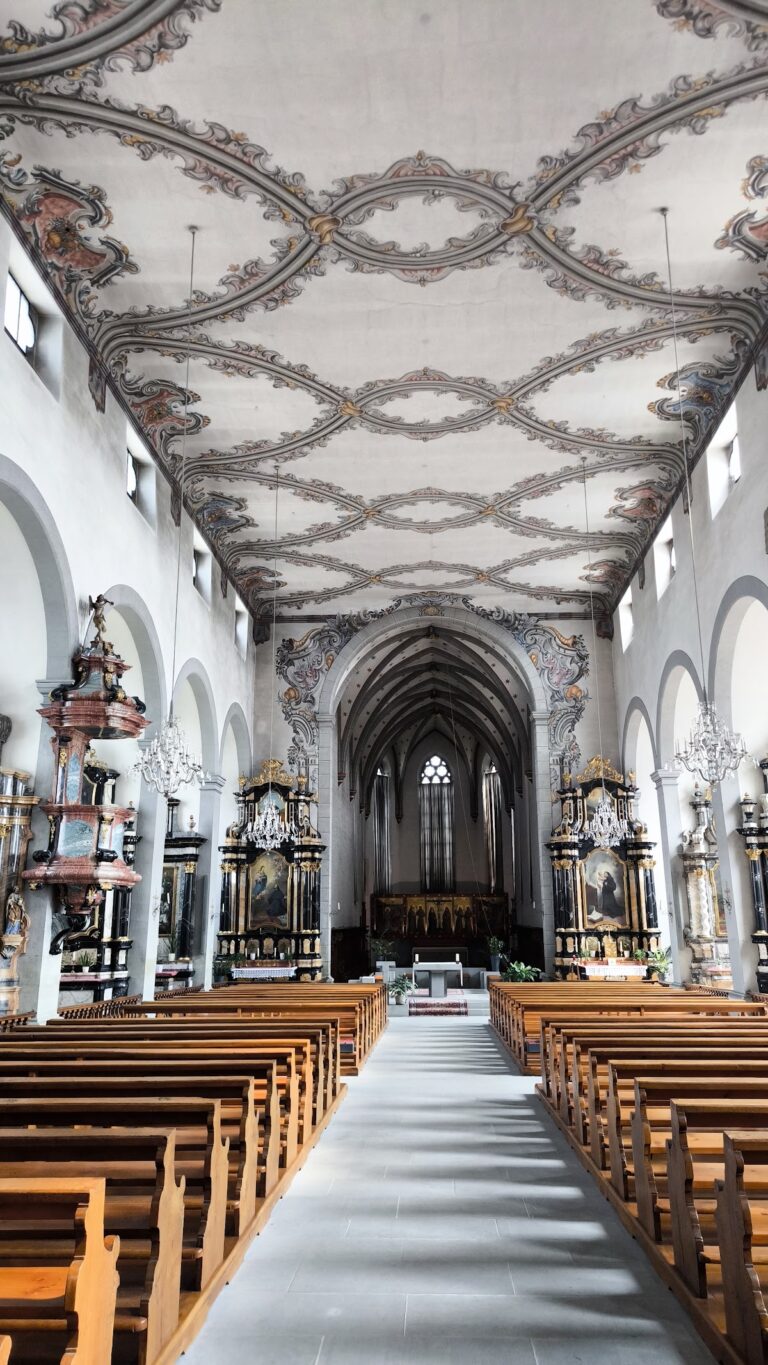
The church is dedicated to Saint Mary and was begun in 1138, with its principal construction phase between 1150 and 1160. It is a Romanesque pseudo-basilica, meaning that its central nave rises above the side aisles without the separate clerestory arrangement of a fully developed basilica. A pointed barrel vault covers the nave, while transverse barrel vaults span the bays of the aisles. The choir ends in a rectangle and is flanked on each side by two chapels opening onto the transept.
The thirteenth-century west façade is early Gothic. Between 1320 and 1330, the choir was remodelled with rib vaults, tracery, the ornamental stone framework of Gothic windows, and coloured stained glass. The church does not have a tall tower, in keeping with Cistercian architectural practice. A roof turret rises above the crossing and has been altered several times. The north-transept roof is substantially lower than the nave roof, while the south-transept roof now runs parallel to the nave.
Choir, furnishings, and organ
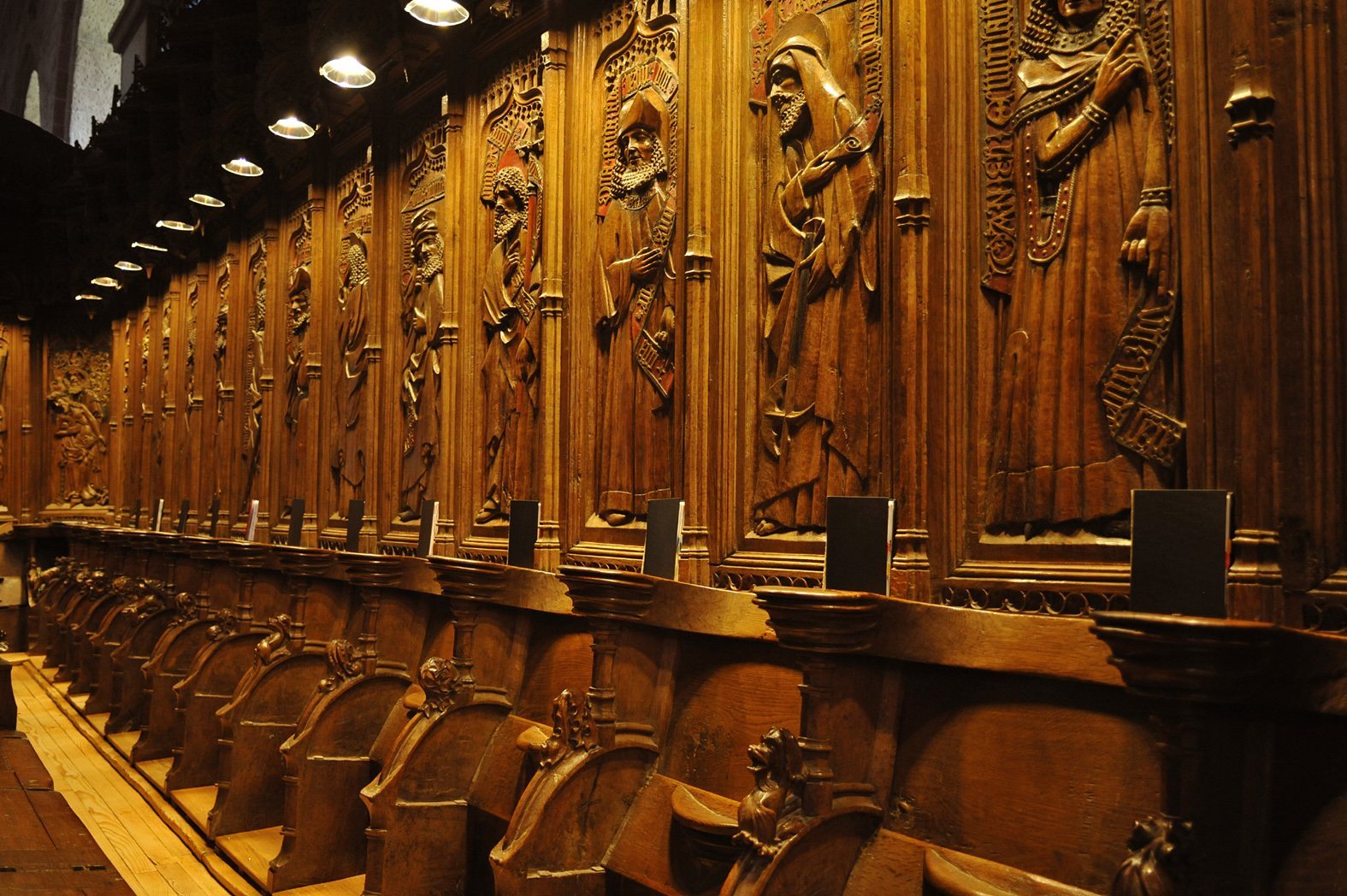
The choir contains the fourteenth-century tomb of Ulrich of Treyvaux. Its Gothic main altar and late-Gothic choir stalls date from 1472 to 1486, and the stalls comprise approximately 700 pieces. The nave vault is made of natural stone with an applied brick-like surface structure over the stone blocks, giving it an unusual appearance.
During the restoration of 2021 to 2025, the removal of the choir stalls revealed Mannerist Renaissance painted decoration concealed by nineteenth-century Neoclassical altars. The liturgical space was reorganized by the architect Jean-Marie Duthilleul, including the opening of the former grille between the stalls and the nave. The large choir window, made during the first half of the fourteenth century, had been damaged during the Baroque renovation of 1755 to 1775. Its missing lower section was completed with a new work by the Fribourg artist Catherine Liechti. The restored church was formally inaugurated on 4 September 2025.
Organs supported the sung Office, the cycle of daily Christian prayers observed by monastic communities, from at least the fourteenth century. Hauterive possessed two organs in the seventeenth century, and the nineteenth-century organ builder Aloys Mooser created an instrument noted for its exceptional sound. The Mooser organ was transferred in 1954 to Saint Michael’s Church in Fribourg for cultural-heritage management reasons. A smaller replacement installed in 1957 proved unsuitable after liturgical and musical changes following the Second Vatican Council. A new Kuhn organ was blessed and inaugurated on 20 November 2011.
Cloister and conventual buildings
Medieval cloister
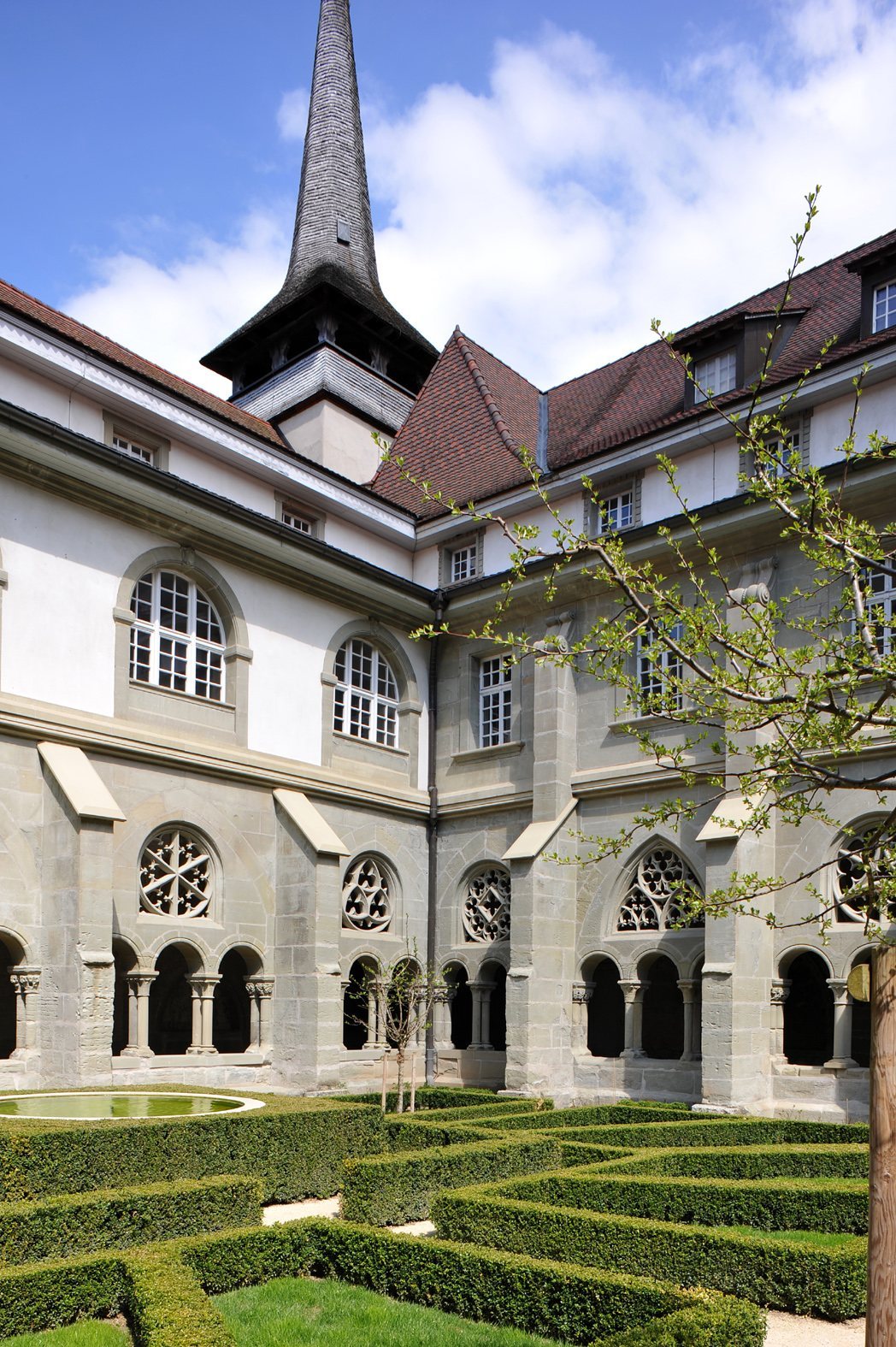
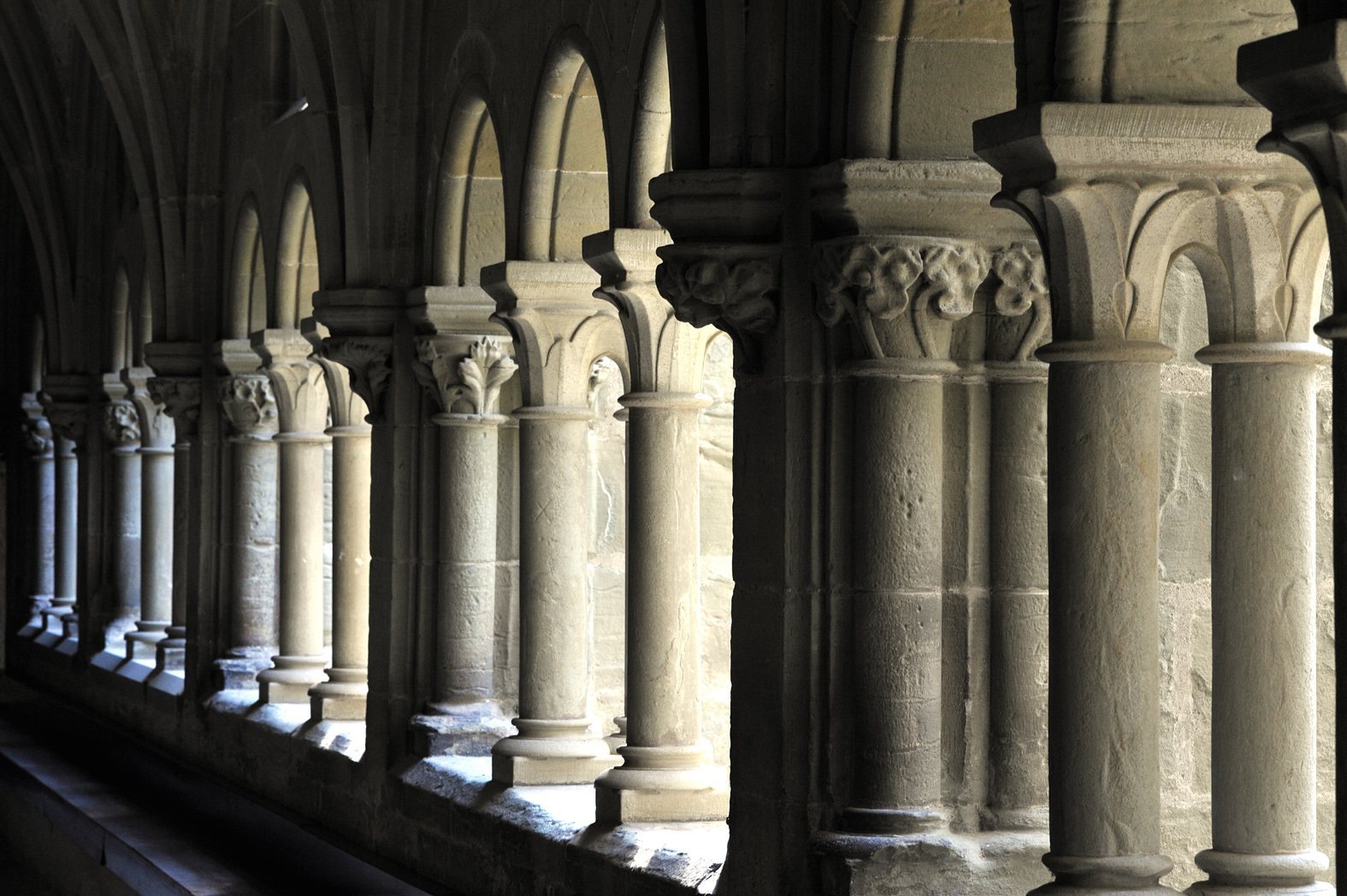
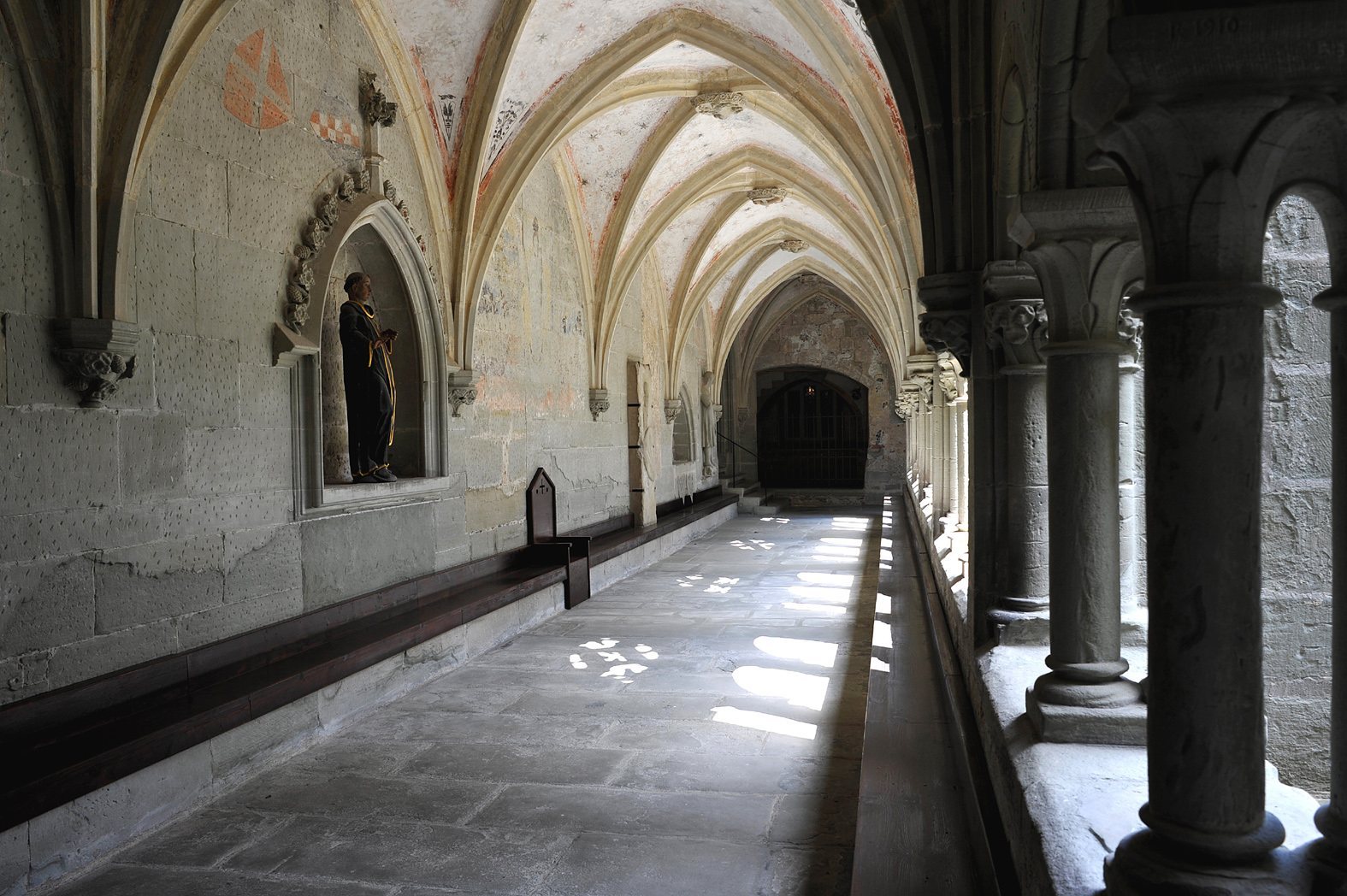
The cloister lies south of the church and preserves arcades on three sides. Its lower sections contain twelfth-century Romanesque paired columns and round arches. The upper arcades have fourteenth-century tracery, while Gothic rib vaults cover the cloister. The cloister, part of the conventual buildings, and the church were rebuilt in stone between 1310 and 1330 under Abbot Peter Dives. About thirty stonecutters involved in the work had previously worked on Saint Nicholas Cathedral in Fribourg.
Baroque conventual buildings
The conventual buildings were completely rebuilt during the eighteenth century according to an overall plan by the Vorarlberg architect Franz Beer. The Baroque reconstruction began in 1715 under Abbot Henri de Fivaz and was completed in 1770 under Bernhard Emmanuel of Lenzburg.
Waterworks and estate structures
Mills and canals
Canals built in the twelfth century supplied several grain mills and a fulling mill, a water-powered installation used to clean and thicken woollen cloth. A paper mill was added in 1445. These facilities formed part of the abbey’s agricultural and craft economy and contributed to the development of local crafts.
Chapel and guesthouse
Above the abbey are the former Saint-Loup Chapel, now converted into a dwelling, and the former monastic guesthouse, built in 1732. Together with the church, cloister, conventual buildings, and waterworks, they preserve the range of religious, residential, hospitality, and economic functions that shaped the monastery’s physical complex.