Vers-les-Châteaux: A Medieval Abandoned Village and Castle Settlement in Switzerland


Site at a Glance
- Rating
- 4.5
- Popularity
- Very Low
- Country
- Switzerland
- Primary era
- Medieval
- External website
- Open
- Eras represented
- Medieval
- Civilizations
- Holy Roman Empire
- Site type
- Military
- Remains
- Fortified Town
On this page11 sections
History
Vers-les-Châteaux is an abandoned medieval village in Switzerland associated with the ruins of Arconciel Castle and settlement. The castle and town were an aristocratic seat and market centre in the territory of Arconciel, first appearing in written records in 1082. Their precise foundation date is unknown, although the site may have been fortified during Roman times.
Imperial possession and the Lords of Glâne
In 1082, Henry IV, a medieval German king who later became Holy Roman Emperor, granted the existing castle and settlement, called castrum Arconciacum, to Cono, probably Cono of Oltigen. The grant shows that Arconciel was then an imperial possession directly dependent on the emperor. The lordship, a territorial jurisdiction governed by a lord, included Farvagny and Sales at that time. By 1291, it also encompassed Treyvaux, Ecuvillens, Magnedens, and Corpataux.
The settlement developed into a market town, probably under the protection of the castle. A crossing of the Sarine lay nearby, but its precise part in the foundation of the castle remains uncertain. Arconciel later came under the Lords of Glâne and was probably already connected politically with Illens, whose castle stood across the river.
When William III of Glâne died in 1143, the lordship passed through the marriage of his sister Emma to Rudolf of Neuchâtel. Members of the Neuchâtel family later adopted the title “Lord of Arconciel.” During the twelfth and thirteenth centuries, a ministerial family appears to have administered the castle. A ministerial was a medieval administrative and military official who could manage a lord’s castle or territory.
Neuchâtel-Aarberg and the rise of Fribourg
Arconciel passed to Ulrich III of Neuchâtel and, after his death in 1226, to his son Ulrich IV, who founded the Neuchâtel-Aarberg line. For this family, Arconciel was a secondary possession held together with Strassberg and Illens. The foundation of Fribourg in 1157 created a nearby competitor and increased Arconciel’s vulnerability. Illens may later have been developed as a bridgehead against threats from that direction, although this interpretation remains uncertain.
In 1251, Ulrich IV swore fealty to Peter II of Savoy, probably to strengthen his position. In 1271, he granted Arconciel town rights modelled on those of Fribourg. The measure appears to have been intended to encourage similar economic development at Arconciel.
Sales, feudal ties, and destruction
Between 1292 and 1296, William of Neuchâtel-Aarberg sold Arconciel and Illens to the Fribourg noble family of Englisberg. The Englisbergs held the lordship for about half a century and enlarged it with Ependes, Praroman, Rossens, and Plaffeien. They continued to recognize Savoy as their overlord in 1298, 1314, and 1335.
From about 1342 to 1350, the castles belonged to the noble family of Oron. Through marriage, they then returned to the Neuchâtel-Aarberg family. Peter II of Aarberg became indebted and pawned Arconciel, later withdrawing to neighbouring Illens.
In 1380, Peter’s widow, Luquette of Gruyère, sold the Arconciel-Illens lordship to the knight Anton of La Tour. By then, Arconciel Castle was already being described as a ruin, although its lordly title continued. Anton’s conflict with Fribourg led to the destruction of Arconciel. Plague and war damage then contributed to the abandonment and decline of both the town and the castle.
Abandonment and later preservation
After Anton of La Tour died in 1405, the lordship passed by marriage to the de La Baume family. The castle had ceased to serve as a lordly residence and was abandoned as a castle by about 1450 at the latest. During the Burgundian Wars of 1474–1477, conflicts that brought major political and military changes to western Switzerland, Fribourg and Bernese forces destroyed Illens. This brought the Arconciel-Illens lordship to its final end.
In 1484, Arconciel was incorporated into Fribourg’s Old Landscape, the territory administered by the city beyond its immediate urban jurisdiction. Part of the former lordship was reorganized as the Fribourg bailiwick of Illens. After the lordship ended, the castle and settlement became a source of building stone. Material was taken for construction in Fribourg, for the church at Treyvaux in 1620, and for the church in the present village of Arconciel in 1784. Quarrying continued through the nineteenth century.
Archaeological work in 1975 established that the settlement had two rows of houses. Drawings by Jean-Joseph Combaz from around 1800 and a lithograph by Jean Frédéric Wagner from around 1840 preserve views of the surviving ruins and entrance area. The castle is classified as an A-category property of national importance in the Swiss Inventory of Cultural Property of National and Regional Significance, under KGS no. 9594. Founded in 2018, the Association Arconciacum works to preserve the settlement and consolidate the western tower.
Remains
Setting and overall layout
The ruins occupy a plateau or peninsula about 50 metres above the Sarine. The river bends around three of the promontory’s four sides, while Illens Castle stands on the opposite bank. From the inhabited area, the approach known as “Vers-le-Château” passes the farm called Gotalle, whose relationship to the medieval complex remains uncertain. The route reaches a former moat that can now be crossed by a dam.
The castle occupied the northeastern part of the complex in an area approximately 20 by 80 metres. The settlement lay to the southwest on an esplanade described as about 200 by 80 metres, or approximately 40 by 200 metres in an alternative description. Archaeological investigation showed that its houses were arranged in two rows. The overgrown site survives in ruined and fragmentary form after destruction, stone quarrying, and vegetation growth, and only part of it is accessible.
Castle structures
Main tower
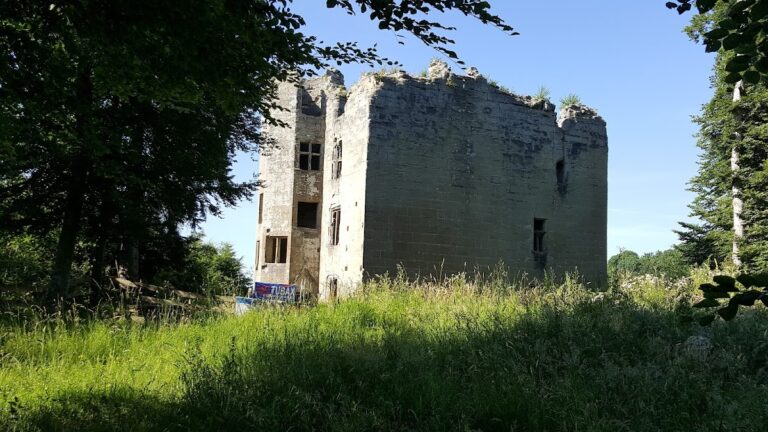
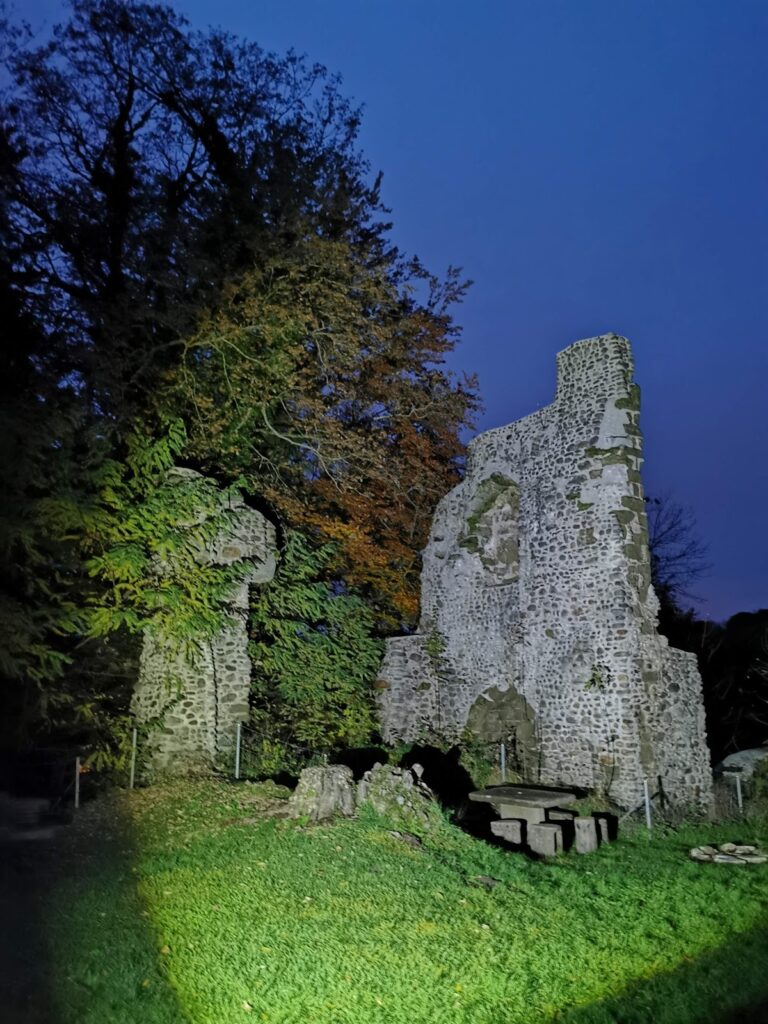
Visible remains include the keep, or donjon, the principal fortified tower of a medieval castle, together with another tower and an entrance structure. The main tower is thought most likely to have stood in the northwestern part of the castle complex. The identity of the tower shown on the modern Arconciel coat of arms remains uncertain. The surviving castle fabric is fragmentary, and the western tower is the subject of planned consolidation by the Association Arconciacum.
Stone outcrop and entrance works
A smooth central sandstone outcrop carries surviving building remains, showing that a structure once stood on it, probably another tower. Remnants of wooden beams remain visible in the sandstone block. Sections of the former moat, the entrance structure, and the approach across the dam also survive among the overgrown ruins.
Settlement gates and house rows
The medieval settlement extended southwest of the castle and consisted of two rows of houses. A gate structure at its western end provided access toward the river, while another gate stood on the northeastern side facing the present village. The western gate was still standing when Jean Frédéric Wagner depicted the entrance area around 1840. Together with the house rows and surviving gateways, these remains define the settlement’s relationship to the castle and its approaches.
Nearby sites