Cordeliers Convent: A Franciscan Religious and Civic Complex in Fribourg


Site at a Glance
- Rating
- 4.8
- Popularity
- Very Low
- Country
- Switzerland
- Primary era
- Early Modern
- Eras represented
- Medieval, Early Modern, Modern
- Civilizations
- Habsburg, Swiss
- Site type
- Religious
- Remains
- Monastery
On this page16 sections
History
The Cordeliers convent and church in Fribourg, Switzerland, were founded by the Franciscans in 1256 through a bequest from the citizen Jakob von Riggisberg. He gave the friars his property beside the Church of Our Lady on the condition that construction begin within three years. The complex was largely complete by 1275 and finished by 1281, combining a Franciscan foundation with the Gothic architecture of the later thirteenth century.
Foundation and incorporation into the city
Elisabeth of Châlons, widow of Count Hartmann the Younger of Kyburg, was buried in the convent church in 1275 wearing the habit of Saint Clare. On 1 June 1281, Fribourg hosted a major chapter of the Upper German Franciscan Province, an assembly that indicates that the convent complex was complete by that time. The Franciscan property initially stood outside the city walls, but the construction of the third city wall around 1275 brought it within the fortified town. The families of Chénens and Kyburg were among its benefactors, commemorated by their coats of arms in the convent and church.
Franciscan prosperity and civic administration
The convent reached its greatest prosperity during the fifteenth century and the first two decades of the sixteenth. Scholars and artists enriched it with manuscripts and artworks, while confraternities established altars in the church. In 1425, the church became the first in Fribourg to possess an organ.
The complex also became closely connected with the city government. The state kept its archive there, probably until 1433, and established its chancellery within the convent. The friars bound chancery registers and carried out manual work for the government. They administered the city, welcomed emperors and princes in the guesthouse, and hosted civic assemblies in the church from the early fifteenth century until 1798. These assemblies appointed municipal authorities.
On 10 October 1431, the General of the Conventual Franciscans placed the convent’s secular affairs under the supervision of the local magistracy. The Conventual Franciscans were a branch of the Franciscan Order, also historically called Cordeliers after the three-knotted cord associated with their vows. Following this change, the state assumed part of the cost of regular repairs.
Artistic expansion and Baroque rebuilding
The convent’s artistic holdings expanded especially during the fifteenth century. Peter Maggenberg painted frescoes in the cloister around 1438–1440, and the church acquired the High Altar retable, the Saint Anthony retable, and the Furno Altar. A retable is an elaborate altarpiece set behind an altar, while a winged retable has hinged panels that open and close to reveal different scenes.
From 1712, the convent was remodeled in the prevailing Baroque taste. In 1745, the medieval nave was rebuilt for safety reasons as a broader single nave with side chapels. The convent buildings that had been arranged around the cloister were largely replaced by a single building, which was enlarged in 1937. Hans Fasel the Younger directed the nave reconstruction, Anton Pfister created the colored-stucco side altars, and Johann Conrad Speisegger built the new organ installed in 1747. The Hermit Chapel on the north side of the nave was renewed in 1748.
Modern use and conservation
The convent operated a boys’ boarding school until 1969. It now contains student housing, while part of the complex remains occupied by the Franciscan community. The Eucharistein community holds evenings of adoration in the church. A seventeen-year restoration campaign concluded in 2005. The church and convent are listed together as a Category A cultural property of national importance under designation number 02074. The church remains a Roman Catholic Franciscan-Conventual institution under the patronage of the Holy Cross.
Remains
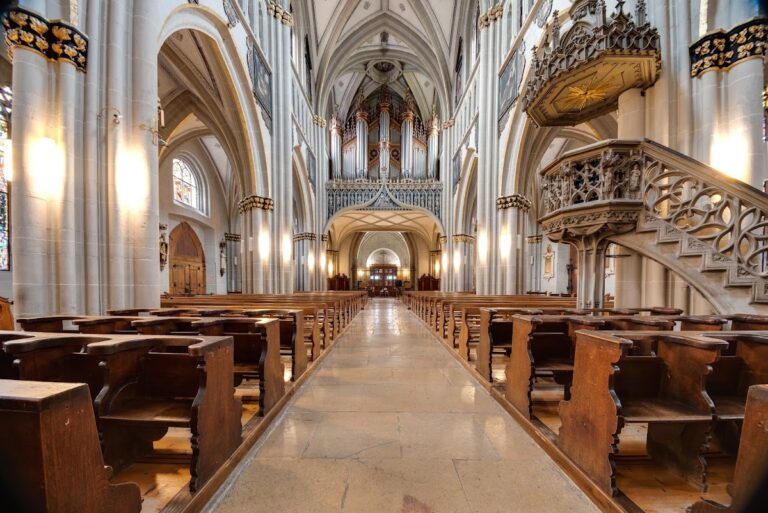
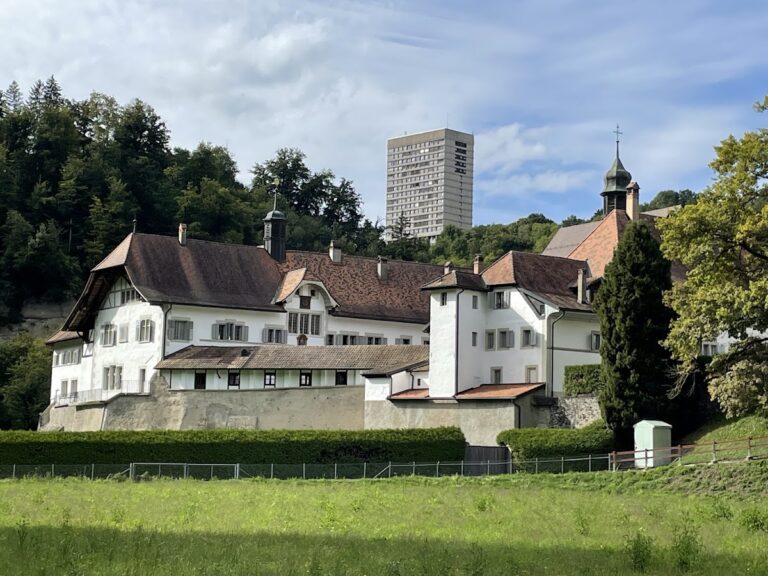
The Cordeliers convent and church stand in the northeastern part of Fribourg’s old town, between the Church of Our Lady to the south and the Museum of Art and History to the north. The complex lies between the foot of Bisée Hill on the west and the Grabensaal gorge on the east, through which the Saane flows. Its surviving fabric brings together a tall medieval choir and a wider eighteenth-century nave, with the cloister, altars, paintings, sculpture, and exterior doors preserving successive stages of the complex’s development.
Medieval choir and Baroque nave
Gothic choir
The church retains the basic form of its medieval predecessor in the relatively narrow, tall Gothic choir. Dating from the later thirteenth century or around 1300, it ends in a five-sided polygonal apse and has pointed vaults. The choir contains 66 oak stalls arranged in two rows. Their backs, armrests, and misericords carry carved decoration. A misericord is a small carved support beneath a hinged choir-stall seat, allowing a standing worshipper to rest discreetly. The stalls date from around 1300 or the late thirteenth century and are among Switzerland’s oldest and most complete surviving choir-stall ensembles.
Baroque nave and façade
Rebuilt in 1745, the nave is broader than the choir, has a flat ceiling, and is lined with side chapels. Its interior contains a Baroque trompe-l’oeil scheme and numerous side altars in colored stucco made by Anton Pfister, a Conventual Franciscan from Lucerne. The eighteenth-century west façade is divided into three unequal horizontal zones. Volutes connect the first and second zones, while curved triangular elements with vases connect the second and third. A further curved gable crowns the composition, above which rises a nineteenth-century wrought-iron cross painted black with gold rays.
The west and south exterior entrances have identical single-leaf oak doors attributed to the carpenter Wully Zumwald. Dated 1745 and made in the Regency style, they are divided into three diminishing zones with Corinthian pilasters, double volutes, consoles, and a curved cornice. Their ornament includes interlace, acanthus leaves, fruit, roses, shells, and an upper glazed section formed from small leaded panes.
Altarpieces
High Altar retable
The High Altar is a Gothic winged retable made in 1479–1480 by the artists known as the Nelkenmeister, or Carnation Masters. Open, it measures approximately 8.10 metres wide and 2.07 metres high. It was the largest altarpiece painting in Switzerland in its time and is regarded as the oldest surviving work of the group associated with the red-and-white carnation sign, as well as a major work of fifteenth-century Swiss painting.
The open retable places the Crucifixion at the centre, with the Virgin Mary and Saint John the Evangelist. Saint Bernardino of Siena and Saint Anthony of Padua appear on the right wing. Three mitres and three bishops’ staffs at Bernardino’s feet recall the ecclesiastical dignities he refused. The left wing shows Saint Francis of Assisi beside Saint Louis, Bishop of Toulouse, together with the coat of arms of the donor Jean Favre and the arms of his parents.
The four principal saints are Franciscan figures. They stand in three-quarter profile, except for Saint Francis, who faces forward on a strip of flowered ground. A damask pattern decorates the gold background. Gothic capital-letter texts from the Ave Maria and Salve Regina run along the Virgin’s mantle hems, while the Crucifixion includes an inscription containing almost the complete Salve Regina and Gloria Patri.
The inner face of the left wing depicts the Nativity before a stable, with a landscape resembling the Fribourg Pre-Alps and a gold damask background. The inner face of the right wing presents the Adoration of the Magi in a corresponding setting. Both paintings bear red and white carnation marks. When closed, the wings show the Annunciation in a room with a ribbed vault resting on four smooth columns with cushion capitals. Mary holds a book of hours beside a vase of lilies, while the kneeling angel carries a scepter and a banner bearing the opening words of the Ave Maria. Pink and red carnations at the angel’s feet identify the artist. Through the rear window, a lake landscape may include recognizable views of Geneva and the Salève.
Saint Elizabeth of Hungary and Saint Clare of Assisi flank the closed Annunciation. Each life-sized figure, approximately 170 centimetres high, stands in three-quarter profile within a small architectural frame with a narrow window opening onto a rural landscape. The retable’s program combines the Crucifixion with scenes of Christ’s birth rather than chiefly with other episodes from the Passion. The leading artist associated with the work painted the Annunciation, Saints Clare and Elizabeth, and the angel choir in the Nativity. No other work by this artist is known in Switzerland. The carnations have been interpreted both as artistic marks and as possible votive offerings, while their red-and-white coloring has also been connected with the colors of the Swiss Confederation.
Saint Anthony retable
The Saint Anthony of Padua retable stands in the choir. Fribourg painter Hans Fries made it in 1506. Its two outer wings and predella survive, showing episodes from the saint’s life, including the death of a usurer. A predella is the lower section beneath the main panels of an altarpiece.
Furno Altar
The Furno Altar stands in the rearmost chapel on the south side, also called the first right-hand chapel. Dedicated to the Holy Cross, it is a late Gothic carved wooden triptych with a Baroque antependium, a decorated hanging or facing for the front of an altar. The carving dates from the early sixteenth century. With its wings open, the altar measures 238 by 255 centimetres. Its central panel shows the Crucifixion, the left wing the Nativity, and the right wing the Adoration of the Magi. The painted predella depicts the Dormition of the Virgin.
The sculptor of the Furno Altar is unknown. It takes its name from the donor Jean Furno, secretary to Charles III of Savoy, whose seat was then in Fribourg. Its reliefs incorporate figures and compositions derived from prints by Albrecht Dürer and Israhel van Meckenem the Elder. The Crucifixion echoes Dürer’s Little Calvary, including John, Mary Magdalene, grieving women, Longinus on horseback, and another rider. The Nativity and Adoration reliefs borrow architectural and figural elements from van Meckenem’s prints.
Sculpture and cloister paintings
Christ at the Column
The rearmost south-side chapel contains a life-sized sandstone Christ at the Column. The figure turns to the right in three-quarter profile, with its hands bound to an octagonal column taller than the figure. It has a slender but sturdy body, a somewhat heavy triangular head, and a large nose. Gothic minuscule on the left corner of the base gives the donor’s inscription, “i mossu,” identified as Jean Mossu. The date 1438 appears on the front.
The sculptor is unknown and is conventionally called the Mossu Master or Master of the Mossu Family. Armand Niquille applied new polychromy in 1950 and revised it in 1957. The figure forms part of the church’s concentration of surviving medieval works in and around the choir and side chapels, alongside the altarpieces and stalls.
Cloister frescoes
The surviving cloister contains a cycle of wall paintings by Peter Maggenberg, a Fribourg painter active in the fifteenth century. Executed around 1438–1440, the cycle presents scenes from the Life of the Virgin, including the Marriage of the Virgin and the Birth of the Virgin. Much of the painted surface has been lost, leaving the preparatory sinopia, or underdrawing, visible. Together with the church’s retables, sculptures, and choir stalls, these paintings preserve the artistic richness that developed in the convent during its fifteenth-century period of prosperity.
Nearby sites