Fribourg Cathedral: A Gothic Cathedral and Historic Parish Church in Switzerland


Site at a Glance
- Rating
- 4.7
- Popularity
- Medium
- Country
- Switzerland
- Primary era
- Medieval
- External website
- Open
- Eras represented
- Medieval, Early Modern, Modern
- Civilizations
- Habsburg, Holy Roman Empire
- Site type
- Religious
- Remains
- Cathedral
On this page21 sections
History
Fribourg Cathedral is a Roman Catholic Gothic church in Switzerland, dedicated to Saint Nicholas and developed between the late twelfth and late fifteenth centuries. It began as the parish church of the city founded in 1157 by Duke Berthold IV of Zähringen on a terrace above the Sarine. Bishop Roger de Vico Pisano consecrated the first church on 6 June 1182, although work may still have been unfinished. The church became the principal religious sanctuary of the medieval city and later the cathedral of the Diocese of Lausanne, Geneva, and Fribourg.
From parish church to civic institution
The dedication to Saint Nicholas appears in a letter of 1177 from Berthold IV. The church was probably established soon after the city’s foundation on land with no known earlier religious building. It rapidly acquired canonical autonomy, meaning that it was not subordinate to a neighboring parish. A deanery, an ecclesiastical district under a dean, is recorded from 1228. A dispute over the church’s land brought Berthold IV into conflict with the Cluniac priory of Payerne.
Saint Nicholas remained the city’s principal parish sanctuary, and for a long period it was the only one. Its position continued despite the arrival of Franciscan, Augustinian, Hospitaller, and Cistercian institutions nearby. A second parish was created only in 1511, at the Hospitallers’ church of Saint John. The parish territory was reduced again through later foundations, including a division affecting the smiths’ street in 1570, the Saint Maurice and Saint Peter rectories in 1872, and the Christ the King and Saint Theresa parishes in 1943 and 1960.
After the Zähringen dynasty ended in 1218, the Counts of Kyburg inherited suzerainty over Fribourg and its church. The city charter of 1249 gave the burghers the right to elect the parish priest and to be buried in the cemetery around the church. Habsburg rule from 1277 temporarily removed these privileges. During the later dynastic crisis, Fribourg recovered the right of collation, the authority to appoint a cleric to a benefice, and became the first city in Switzerland able to exercise that right over its parish church.
The Gothic building campaign
Construction of the present church began around 1283, when the city controlled both the parish and the church fabric. Donations and other parish resources supported the work, which proceeded in successive campaigns until 1490 and replaced the earlier Romanesque sanctuary. The main body was substantially complete by about 1430, while the entrance tower was finished in 1490. The project’s three-level elevation, triforium, a narrow gallery or arcaded passage above the main nave arcades, and two-tower conception expressed ambitions beyond those of an ordinary parish church. Its design drew particularly on Lausanne Cathedral and on French Gothic forms.
The church also developed an active liturgical and educational life. Medieval endowments supported priests serving its altars, and the clergy grew from seven vicars in 1382 to twelve priests in 1417 and nearly eighteen in 1464. An organ was acquired in 1426–1428, stained glass was installed in 1423 and in 1461–1462 for the rose window, and choir stalls were made in 1462–1465. The parish probably maintained a school that provided religious instruction to laypeople.
In the late fifteenth century, Saint Nicholas increasingly functioned as a collegiate church. In 1512, Avoyer Peter Falk secured a papal privilege from Julius II, confirmed by Leo X, establishing the collegiate chapter of Saint Nicholas. A collegiate chapter is a body of canons serving a collegiate church. It consisted of a provost, dean, cantor, and twelve canons. The provost was elected by the Council of Two Hundred and invested by the pope.
Religious change and the cathedral diocese
During the Protestant Reformation, Catholic Fribourg supported Bern’s seizure of the Lausanne bishopric’s possessions in Vaud while maintaining only limited cooperation with the bishop. In the second half of the sixteenth century, the collegiate church and its clergy became centers of the Counter-Reformation, the Catholic renewal that followed the Protestant Reformation. They supported clerical reform and renewed devotional life, while the Jesuits were admitted to assist in establishing Saint Michael’s College.
The bishop of Lausanne, exiled from the city in 1536, was permitted to reside in Fribourg from 1601. He had no temporal authority there and no fully recognized cathedral chapter. The collegiate chapter of Saint Nicholas performed the chapter’s practical functions until the French revolutionary invasion and the creation of the Helvetic Republic in 1798.
After political changes in the nineteenth century, the canton retained ownership of the church building in 1800 while the city kept the right to elect the parish priest. The city’s remaining privileges were abolished in 1894. Parish administration and finance passed to the parish council in 1920, and the right to elect the priest was transferred to the city’s Catholic electors in 1924. That privilege was abandoned in 1972.
In 1924, the collegiate church became the cathedral of the newly designated Diocese of Lausanne, Geneva, and Fribourg. Its collegiate chapter became the cathedral chapter, taking the place of the former Lausanne chapter whose members had fled to Evian during the Reformation. The cathedral remains the seat of the bishop, cathedral chapter, and Saint Nicholas–Saint Paul parish.
Alteration, conservation, and continuing tradition
The former choir tower deteriorated and was dismantled in the second half of the fourteenth century. Later cracks in the choir vaults led to the reconstruction and enlargement of the choir in 1627–1630, following the expertise of engineer Jean Cotonnet and the recommendation of Bishop Jean de Watteville, under a project by Daniel Heintz the Younger. The cathedral is now recognized as a nationally important cultural property, and the building and ecclesiastical treasury are listed together among Switzerland’s nationally significant cultural properties.
Conservation has continued into the modern period. Work in 2011 recovered medieval wall paintings and polychrome architectural decoration. The south portal was restored in 2016, stained glass was restored and given protective exterior glazing during the first two decades of the twenty-first century, and the bells were restored in 2013. The Saint-Sépulcre Chapel was reorganized and restored in 1942. The principal organ was reconstructed toward its historical form in 1974–1982, and the choir organ underwent comparable work in 1996–1998.
The annual Saint Nicholas procession continues through the old town on the first Saturday of December. A student from Saint Michael’s College, dressed as Saint Nicholas and accompanied by a donkey, delivers a satirical speech about events in the college and the city.
Remains
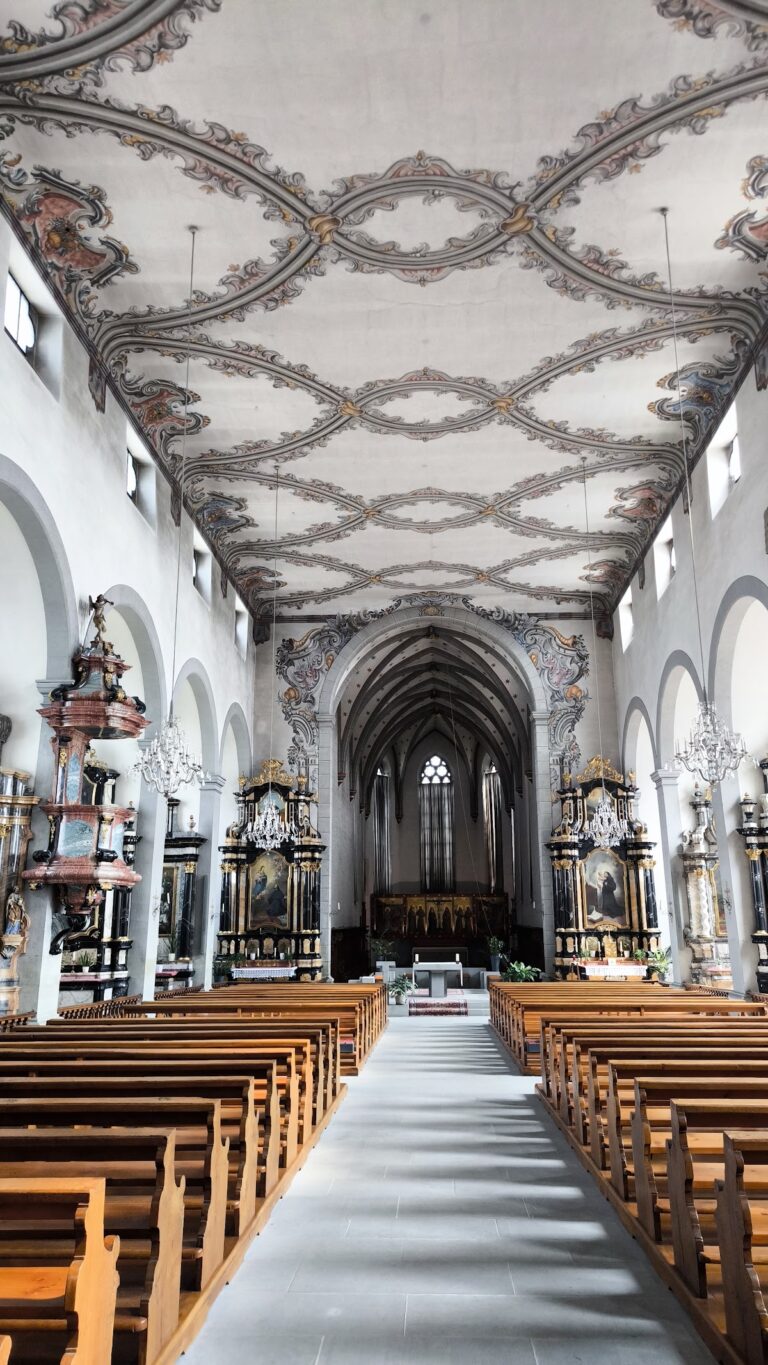
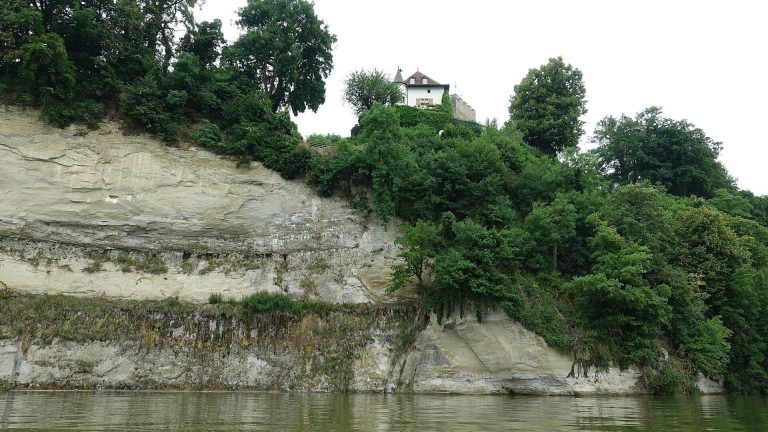
Fribourg Cathedral stands on a rocky spur about 50 metres above the Sarine and occupies a dominant position within the medieval center. It is a three-aisled Gothic building without a transept, constructed chiefly from local grey-green molasse, a relatively soft sandstone formed from consolidated sediment. Its fabric records a long sequence of building campaigns, from the flat-ended choir walls and lower parts of the final two side-aisle bays in 1283–1300 to the upper storeys of the entrance tower in 1470–1490.
Exterior and principal entrances
Entrance tower
The entrance tower was built from about 1370 and completed in 1490 after an interruption in the work. Approximately 74 metres high, it has no spire and changes from a square plan to an octagonal one in its third and fourth storeys. Its design reflects influences from Freiburg im Breisgau, Strasbourg, and Prague. A spiral stair of roughly 365–368 steps rises through the tower.
The ground floor contains a narthex, or entrance hall, with blind arcades. The external entrance portal was installed from about 1380, and its sculpture was completed over almost a century. The second storey has an exterior porch, a large rose window, and the former Saint Michael Chapel, now used for the treasury. The upper storeys contain the first and second bell chambers.
South and north portals
The south, or Sunday, Portal was probably begun around 1340 and is mentioned by 1343. It was once the principal entrance. Eleven statues stand around the doorway on consoles beneath gables and an archivolt, a sculpted band following an arch. The program includes the crowned Virgin and Child, the Magi, Saints Catherine, Barbara, and Nicholas, the three girls saved in the legend of Saint Nicholas, and Mary Magdalene. The archivolt contains God the Father, apostles, John the Baptist, and prophets. The figures were formerly polychrome and are now unpainted, while the interpretation of the complete program remains uncertain.
The main portal in the entrance tower was begun around 1380. Its tympanum, the decorated field above a doorway, presents the Last Judgment in two registers. Christ appears as judge above, with interceding figures and angels, while the lower register shows resurrection, the weighing of souls, paradise, and hell. A seventeenth-century inscription invokes Saint Nicholas’s protection over the city. The archivolts contain ten angels, twelve prophets, and fourteen patriarchal or female figures. The jambs and porch arcades contain the Annunciation and the twelve apostles with their attributes. The present statues are copies. The portal was altered in 1787–1789, during the nineteenth-century Neo-Gothic restoration, and again in 1944–1945.
The north portal dates from 1761–1765. It has a monumental staircase, an iron ramp, and a glory in its archivolt made by Dominique Martinetti.
Choir and sacristies
The former choir tower stood over the first choir bay and was reached by a spiral stair that remains visible externally on the northeast side. After its dismantling, the choir was rebuilt with two new bays and a three-sided polygonal apse, the terminal recess of a church, capped by a small spire. Tracery windows and a ribbed vault preserve its Gothic character, while the seventeenth-century reconstruction introduced a striking net-vault. Its ribs are attributed to Peter Winter of the Valsesia. Central bosses display the arms of the State of Fribourg, the Virgin Mary, Saint Nicholas, Saint Catherine, Saint Barbara, and Saint Charles Borromeo. Other stucco bosses carry the arms of the thirty-two members of the contemporary patrician government and are attributed to Joseph Plepp.
The two sacristies are vaulted. The first, south of the first choir bay, was rebuilt in 1632 as a two-storey structure linked by a spiral stair; the second dates from 1674. Their façades were remodeled in Neo-Gothic style in the mid-nineteenth century. Earlier entrances through the choir stalls and from the nave were closed in the sixteenth and nineteenth centuries, leaving access through the choir.
Chapels and devotional furnishings
Saint-Sépulcre Chapel
The Saint-Sépulcre, or Mossu Chapel, was probably inserted between the southern buttresses of the entrance tower around 1430 at the initiative of Jean Mossu, a Fribourg burgher and rector of the church fabric. It was roofed in 1457. Its irregular plan contains two windows, including one with elaborate tracery, the stone framework dividing a Gothic window into decorative sections. Cracks in the tower led to its division into two storeys in 1646. The vault and Baroque upper storey were removed in 1942, when the present arrangement was created.
The chapel contains thirteen life-sized, polychrome molasse statues depicting Christ’s entombment, perhaps more specifically a medieval raising of the body. The sarcophagus bears the date 1433, though that date may not mark completion. Joseph of Arimathea and Nicodemus hold the shroud supporting Christ. The mourning Virgin is supported by John the Apostle and accompanied by the two other Marys, while Mary Magdalene carries an embalming vessel. Two angels bear instruments of the Passion, and three sleeping soldiers occupy the foreground.
Paintings on the vault date from the 1450s. They show angels with instruments of the Passion, musicians playing portable organ, harp, lute, triangle, psaltery, viol, and drums, and the arms of Jean Mossu and the Chenaux lordship. Four phrases associated with the angel’s announcement at Christ’s tomb also appear: “Whom do you seek,” “He is not here,” “He has risen,” and “Peace be with you.” Antoine Claraz restored the paintings in 1942 and repainted the vault with these four phrases.
Side chapels and altars
The nave’s original side walls were aligned with the interior pillars rather than the outer buttresses, leaving space for only the Saint-Sépulcre Chapel beside the south side of the entrance tower. Eight side chapels were nevertheless added between 1515 and 1759 through the patronage of the state, families, and confraternities. Peter Falk established the first in 1515 beside the south side of the fifth nave bay. The state funded a second, dedicated to the Virgin Mary, in the preceding bay in 1663, and six more were built in the mid-eighteenth century.
The high altar was replaced several times. A late Renaissance altar made by the Dargent brothers of Besançon in 1584–1585 showed Saint Nicholas on its central panel. Joseph Anton Feuchtmayer replaced it in 1740 with a large Rococo altar dominated by the Immaculate Conception. The Müller workshop of Wil produced a Neo-Gothic altar in 1876. Its original crowning of the Virgin by the Trinity was removed in 1926 to make room for stained glass by Józef Mehoffer.
The church contained about seventeen side altars in 1453, eighteen in 1552, and twenty-one in 1599, 1687, and the mid-eighteenth century. A reorganization in the mid-eighteenth century removed the altars attached to the nave pillars and created thirteen principal altars. Twelve remain after the removal of the Saint Martin altar. The surviving eighteenth- and nineteenth-century examples are dedicated to the Virgin and the Nativity, Saint Barbara, Saint Josse, the Magi, Saint Sebastian, the Holy Sacrament, the Sacred Heart, Our Lady of Victories, Saint Anne, and Saint Anthony or Saint Sylvester. They were made or decorated by the Moosbrugger brothers, Anton Pfister, Jean-François Doret, Joseph Sauter, Paul Deschwanden, and other artists between 1750 and 1875.
Choir furnishings and baptismal font
Antoine de Peney and his nephew Claude made the choir stalls in 1462–1465. They provide fifty seats, with fifteen high and ten low stalls on each side, and are among the oldest figured choir stalls in Switzerland. Thirty high-stall backs depict the Creation, Adam and Eve, the twelve apostles, and the twelve prophets. The high ends include the Virgin and Child, the Visitation, Saint John the Baptist, Joseph and Potiphar, and the Resurrection of the three children by Saint Nicholas, among other scenes. Later additions, dark varnish, and brown paint altered their appearance.
Ulrich Wagner of Munich made the great iron choir screen in 1464–1466. Its installation required the arrangement of the stalls to be changed from one doorway to two. The Calvary group on the rood beam, showing Christ on the cross with the Virgin Mary and Saint John, dates from about 1430. Its polychromy was renewed in 1631, when the oak beam was painted blue and inscribed with a biblical quotation.
The octagonal baptismal font was made in 1498–1499 and rests on a star-shaped base. Its eight sides carry half-length reliefs of Christ, an angel holding his tunic, John the Baptist, the four Evangelists, and Saint Nicholas. Beside the second northern nave pillar stands a stone pulpit made in 1513–1516 in a southern German style by collaborators of Hans Felder the Younger. Its openwork octagonal bowl originally carried statues of Saint John the Evangelist, the four Doctors of the Latin Church, and Saint Nicholas. Those statues were removed for safety. A Neo-Gothic sounding board added in 1828 bears a statue of Faith, while a seated lion holding Fribourg’s shield marks the balustrade.
Paintings and stained glass
Wall and ceiling decoration
Thirty-four paintings made in 1651 by Burgundian painters who had taken refuge in Fribourg decorate the central nave. Eighteen full-length prophets flank the upper windows, while sixteen busts of apostles and Doctors of the Latin Church occupy the spandrels and are accompanied by contemporary family arms. Two large paintings in the choir by Nicolas de Hoey depict the risen Christ appearing to Saint Peter and Christ victorious over death.
Restoration work in 2011 revealed a wall painting from the first half of the fourteenth century behind and beside the present Nativity altar. It shows Abraham with the saved, Saints Michael, Christopher, and Maurice, and Saint Nicholas with the three girls from his legend. The same work revealed or restored starry skies, striped pillars, and polychrome capitals in several parts of the building. The narthex also retains two wrought-iron holy-water stoups from the late seventeenth century, while four oak confessionals were made in 1759–1760 in the Baroque style.
Medieval and modern windows
The earliest stained glass was installed during the fifteenth century, including glazing recorded in 1423 and the rose window glazing of 1461–1462. Much medieval glazing was lost between the sixteenth and seventeenth centuries, including damage caused by an explosion in a powder store in the Lorette fortifications. Some older windows were later transferred from Hauterive Abbey and Carignan Church.
Józef Mehoffer designed eight nave windows and five choir windows, which were executed by the Fribourg workshop of Kirsch and Fleckner between 1895 and 1936. The ensemble comprises approximately 120 square metres of nave glazing and 124 square metres in the choir. Its subjects include the Apostles, Our Lady of Victories, the Martyrs, the Eucharist, the Three Kings, Saints George, Michael, Anne, and Mary Magdalene, the Bishops and Deacons, and Saint Nicholas of Flüe.
Mehoffer combined Art Nouveau, an international style of flowing lines and organic ornament, with historicism, symbolism, popular art, and cloisonné-like construction, in which outlined sections of glass emphasize individual shapes and colors. The windows include scenes of apostles and martyrs, Eucharistic sacrifice, the Adoration of the Magi, the Swiss Confederates’ victory over Charles the Bold at Murten in 1476, the lives of saints, and the family and hermit life of Saint Nicholas of Flüe. The Martyrs window received a gold medal at the 1900 Paris World’s Fair.
The five choir windows were installed in stages from 1926 to 1936. They depict the Trinity, the history of the Church, and the history of the State of Fribourg. Their imagery includes God the Father and Creation, Christ’s Resurrection and Eucharistic presence, and the Holy Spirit as a dove with the seven gifts. The cycle also includes the apostles, the Annunciation, and references to the Fall and Noah’s Ark. Alfred Manessier created the remaining modern windows: those of the Saint-Sépulcre Chapel in 1974–1976, ten high nave windows in 1980–1983, and the tower rose window in 1988. The chapel windows evoke the medieval burial group, the nave windows represent Pentecost, and the rose window represents the Magnificat.
Organs and bells
Historic organs
The choir organ was made by Sebald Manderscheidt in 1655–1657, modeled on his instrument for the Franciscan church in Lucerne. It has two manuals, the hand-operated keyboards, and a pedalboard played with the feet. Its reconstructed 1657 disposition includes ten stops on the Great Organ, six on the Positive, and three pedal stops. The five-part Italianate case was probably made in Jean-François Reyff’s workshop. The instrument has three wedge bellows, accordion-like bellows that supply air, and a meantone temperament, a historical tuning system designed to improve the purity of selected intervals, at a pitch of 423 Hz at 17 degrees Celsius.
Aloys Mooser built the principal organ between 1824 and 1834 after lightning struck the tower in 1822. Its Neo-Gothic case has five towers and a balustrade by Niklaus Kessler. After several alterations, the organ was restored and reconstructed between 1974 and 1982 to approximate its 1834 state. It has four manuals, divided large and small pedal sections, mechanical action that transmits movement from keys and pedals to the pipe valves, and a range extending from a 32-foot stop to a 1-foot stop.
Bell ensemble
The historic bell ensemble contains thirteen bells distributed between the entrance tower and the small spire above the choir. They include the Sion, or Saint Mary, bell of 1505, weighing approximately 6,950 kilograms; the Saint Catherine bell of the same year, weighing about 3,550 kilograms; and the Saint Barbara bell of 1367, which weighs 2,080 kilograms and measures 146 centimetres in diameter. Other bells include the 1416 hours or confraternity bell, the 1437 Prime bell, the 1562 Gambach bell, two sacristan bells from 1569 and the fourteenth century, the 1734 Agony bell, two choralist bells from 1554 and 1567, the 1737 Mass bell, and the 1656 Holy Sacrament bell.
Walter Reber cast the Saint Barbara bell at Aarau for Romont Church. It reached Fribourg as war booty after the Burgundian conflict of 1476 and first sounded there at Pentecost in 1477. The Sion or Saint Mary bell carries images of a Calvary, the Virgin and Child, Saint Michael, three representations of Saint Nicholas, Saints Catherine and Barbara, and Fribourg’s arms. The bells historically announced Prime, the Angelus, Mass, funerals, the administration of extreme unction, and the death agony of townspeople. Electric ringing was introduced in 1953. Metal yokes and new clappers were fitted in 1967, while the 2013 restoration returned the bells to oak yokes and resized clappers.
Ecclesiastical treasury
The ecclesiastical treasury grew through gifts from Fribourg’s authorities and patrons. Its contents included liturgical vessels, vestments, books, relics, and other precious objects, with inventories beginning in the second half of the fifteenth century. Revolutionary contributions forced the melting of slightly less than one hundred kilograms of silver, resulting in the loss of most large silver objects. The surviving treasury is distributed between Saint Michael Chapel, the Museum of Art and History, and the provost’s residence.
The relic collection included objects associated with Christ, the Virgin Mary, martyrs, and other saints. Among the most valuable surviving pieces is an arm of Saint Nicholas, transferred from Rome to Hauterive Abbey in the early fifteenth century and delivered to Fribourg by papal order in 1506. A silver arm reliquary, a container shaped like an arm for preserving and displaying a saint’s arm bone, was made around 1514 for the saint’s humerus. Its base bears the arms of the donor Hans Furno and was renewed in 1758.
The treasury also contains nearly thirty chalices, ciboria, monstrances, cruets, basins, ewers, crosses, candlesticks, censers, incense boats, and liturgical vestments. Its largest Baroque monstrance, a vessel used to display the consecrated Eucharistic host, is more than one metre high.