Geras Abbey: A Premonstratensian Monastery in Austria


Site at a Glance
- Rating
- 4.5
- Popularity
- Low
- Country
- Austria
- Primary era
- Early Modern
- External website
- Open
- Eras represented
- Medieval, Early Modern
- Civilizations
- Duchy of Austria, Holy Roman Empire
- Site type
- Religious
- Remains
- Monastery
On this page18 sections
History
Geras Abbey is a Premonstratensian monastery in Geras, Austria, founded in 1153 as a daughter house of Seelau Abbey. Ekbert and Ulrich of Pernegg established the monastery, which was settled by canons from Seelau. It formed a double monastery, a foundation with associated communities of men and women, with the Premonstratensian nunnery at Pernegg about 10 kilometres away. The complex was built partly over an older Slavic burial ground, and the name Geras probably has Slavic origins, possibly deriving from “Jerus.”
Foundation and medieval development
Geras belongs to the Premonstratensian succession that ran from Prémontré through Steinfeld and Seelau. After the Counts of Pernegg became extinct, the monastery became a proprietary foundation of Passau. It remained in the Diocese of Passau until Emperor Joseph II established the Diocese of St. Pölten, and for most of its history it belonged to the Bohemian circary of the Premonstratensian Order.
Medieval donations connected Geras with noble families and parishes in and beyond Lower Austria. The Ranožír family supported the monastery from its beginnings. A second foundation charter issued by Duke Frederick II recorded the family’s gift of eight hides at Jeruša. Members of the family later granted or defended Geras’s patronage rights, the legal rights to nominate priests, at Kostelní Myslová and Rančířov. A Geras canon held the Rančířov parish by 1315.
Other benefactors included Vikart of Trnava, who granted the patronage of the church at Vratěnín in 1251. Members of the same family later confirmed or transferred related possessions. In the fourteenth century, Bohuslava, daughter of Sudka, may have donated a court near Vratěnín. In 1372, Siefried of Hafnerluden and his wife Bohuslava endowed a chapel and an altar at Lubnice and Vratěnín with land and annuities for specified masses.
War repeatedly damaged the monastery. Geras was plundered and destroyed during the conflict between King Ottokar II Přemysl of Bohemia and Rudolf I of Habsburg in 1278, leaving it impoverished. Hussite forces, supporters of the reform movement associated with Jan Hus, passed through the area repeatedly between 1419 and 1436. Hungarian forces occupied Geras and Pernegg in November 1486.
Reformation, war, and reconstruction
King Ferdinand I granted Geras a coat of arms on 22 June 1542, showing a green-and-red chequered shield. During the Reformation, the monastery became only nominally Catholic and entered a period of crisis. Geras was repeatedly plundered during the Thirty Years’ War, the seventeenth-century conflict that involved religious and political powers across central Europe. Troops commanded by Ernst von Mansfeld set the monastery on fire in 1620.
A small group of canons returned from Strahov Abbey in Prague to the ruins in 1625. Under Abbot Benedict Lachen, also recorded as Lacken or Laachen, rebuilding began. The reconstruction continued under Abbot Peter II Herkart and especially under Abbot Johannes Westhaus, who is regarded as the monastery’s second founder. The surrounding area had been depopulated during the war, and resettlement formed part of the broader recovery.
Geras also maintained fish farming in nearby waters from the Middle Ages and created fishponds partly during the medieval period. The monastery retains one of the oldest fish keeps still in use, a water installation designed to hold live fish while fresh water flows through it.
Baroque rebuilding and Josephine reforms
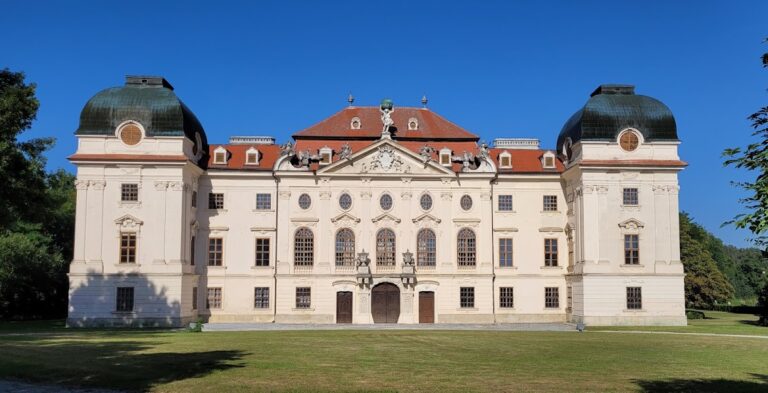
A fire badly damaged the abbey church at the beginning of the eighteenth century. Under Abbot Nikolaus Zandt, who served from 1730 to 1746, artists including the architect Josef Munggenast and the fresco painter Paul Troger were brought to the Waldviertel. The damaged buildings were repaired, and the monastery and church were enlarged and redesigned in the Baroque period, giving the complex much of its present appearance. The War of the Austrian Succession reached Geras in 1742.
During the second half of the eighteenth century, the abbey had more than fifty canons. Emperor Joseph II later imposed a fixed maximum on the number of canons at Geras, transferred Pernegg’s parishes to the monastery, and ordered the creation of several new parishes. Geras survived the Josephine reforms and the monastery closures of 1783.
Pernegg had begun as a Premonstratensian nunnery founded by Ekbert and Ulrich of Pernegg under Seelau’s authority. It became a community of canons in 1584, received abbey status in 1700, and was dissolved in 1783. Geras acquired its buildings in the mid-nineteenth century. Since 1995, the former Pernegg complex has operated as a fasting and seminar centre.
Modern pressures and continuing religious life
Geras’s manorial rule, meaning jurisdiction and rights over dependent land and inhabitants, ended in 1848. The Austro-Prussian War affected the monastery in 1866. National Socialist confiscation, the Second World War, and the subsequent Russian occupation placed further burdens on the institution, which nevertheless continued as an active monastery.
The church received the title of minor basilica in 1953. This is an honorific designation granted by the Catholic Church to a church of particular historical, devotional, or pastoral significance. The abbey buildings and gardens underwent fundamental renewal from 1990 to 1994. Geras has also hosted influential art courses and classical music recitals for many years.
The abbey currently serves 23 parishes, including several associated with it since its foundation. In November 2020, the community comprised 17 Premonstratensian canons and 13 lay familiars, and Norbert Mario Lesovský was identified as its abbot. Geras established a daughter monastery at Fritzlar Cathedral in Germany in 1989, but the foundation was dissolved by the abbot in 2010 after abuse by a member was discovered. The São Norberto foundation at Itinga-Bahia in Brazil became independent in 2009.
Remains
Geras Abbey combines a Romanesque pillar basilica with later Gothic and Baroque phases. Romanesque and Gothic window openings remain visible above the Baroque vaulting, while the choir ends in a Gothic three-eighths polygon, a termination formed from three sides of an octagon. The surviving complex includes the church, richly decorated monastic interiors, the former grain store on the hill above the monastery, the Meierhof, and the associated buildings of former Pernegg Abbey.
Abbey church and chapels
Baroque church interior
The church began as a Romanesque pillar basilica and was later Gothicized before its extensive eighteenth-century Baroque remodelling. Josef Munggenast directed the Baroque transformation, with frescoes by Franz Zoller and Paul Troger. The vault carries a representation of the Litany of Loreto. Paintings of the Twelve Apostles occupy the nave, while six Premonstratensian saints appear in the choir.
The high altar stands free of the surrounding wall, as required by Premonstratensian practice, and the side-aisle altars follow the same arrangement. Its principal painting shows Saint Norbert receiving the scapular from the Virgin Mary above Saint Augustine, whose rule was adopted by the order. The rear nave altars depict Augustine and Norbert. Their paintings have been associated with Bartolomeo Altomonte, although that attribution remains unproven.
Side altars and devotional images
The front side altars depict the Baptism of Jesus and Saint Nicholas of Myra rescuing a boy from robbers. The latter painting has more recently been attributed to Maulbertsch. The northern side aisle contains a Barbara altar, while the southern side aisle contains the Cross Altar. Josef Hauzinger painted the Cross Altar in 1756. A fourteenth-century heraldic stone of the Lords of Kottaun, possibly Kattau, is set into the wall beside it.
The church also preserves the fifteenth-century devotional image known as the Geras Madonna. Its present appearance derives from a painted finish applied in 1914 that closely resembles the original version of 1731. A Baroque sacristy lies beneath the Byzantine chapel. The upper storey of the southern side aisle contains the Byzantine, or Greek-Catholic, chapel installed under Abbot Michael Proházka. Gregorios III Laham, the Melkite Greek-Catholic patriarch from Damascus, consecrated it on 25 January 2010.
Organ, pulpit, and artistic furnishings
Ignaz Jakob Florian Casparides made the church organ in 1731. Franz Ullmann rebuilt it in 1842, and the firm Blank of Herwijnen restored it during the church renovation of 1993 to 1995. The instrument has 19 stops and retains some original pipes. The church also contains a stucco-marble pulpit by Johann Ignaz Hennevogel. Stucco marble is a polished plaster finish made to resemble stone.
Monastic interiors
Marble Hall and ceremonial staircase
The Marble Hall above the main portal was constructed under Abbot Nikolaus Zandt. Its walls are faced with high-quality stucco marble, and its ceiling carries Paul Troger’s signed 1738 fresco of the miraculous multiplication of the loaves. The fresco has never been cleaned or restored and retains the brightness of its colours. Troger’s oil paintings hang above the two fireplaces, which also contain small reliefs by Jakob Christoph Schletterer.
Schletterer created the sculptural decoration of the entrance facade and ceremonial staircase. Around the portal, a group represents the divine virtues of faith, love, and hope. Five historical colour schemes from different periods were found on the staircase, whose original Baroque wall finish was restored. Troger’s staircase fresco, The Triumph of Wisdom and Temperance, was almost entirely lost when part of the staircase collapsed around 1870; fragments survive.
Library and abbots’ gallery
The library was frescoed by Josef Winterhalder the Younger at the beginning of the nineteenth century. Abbot Nikolaus Zandt commissioned the abbots’ gallery from Johann Jakob Pischl in 1731. Its portraits use canons of Geras as models, with an identifying detail included in each image. A cycle of 35 large-format paintings depicts the life of Norbert of Xanten, the twelfth-century founder of the Premonstratensian order.
Other furnishings include wrought-iron grilles, exposed frescoes such as those in the Rose Room, reused Gothic elements, and an over-life-size statue of Minerva in a niche at the foot of the ceremonial staircase. A design by Troger showing Minerva accompanied by the virtues was originally intended for the Geras staircase. Albrecht Steiner von Felsburg later used it as the basis for a new version of Troger’s dome painting in Brixen Cathedral.
New Building and agricultural complex
Former summer refectory
The former summer refectory belongs to the New Building erected between 1736 and 1740. It was renovated for the abbey’s 850th anniversary using historical views and comparisons with other buildings associated with Munggenast. The west facade of the abbey church and the ceremonial staircase were restored during the same broader programme of work.
Schüttkasten grain store
The Schüttkasten was built between 1668 and 1670 under Abbot Johannes Westhaus as the abbey’s grain store. It stands on a hill above the monastery and has three storeys, broad framed windows along its long sides, cartouche windows in the gable walls, and a gabled roof with dormers. Figures of Saint John the Baptist and Saint John the Evangelist once stood at the gable peaks; the original figures are now kept at Geras.
Above the south entrance, facing the town, is the Schüttkasten Madonna, a polychrome high relief of the Madonna and Child carried by two angels. Thomas Steinböckh of Eggenburg has been proposed as its possible sculptor. The arms of Geras Abbey and Abbot Johannes Westhaus appear below the relief. The cellar has two aisles, square piers, and groin vaults, formed by the intersection of two barrel vaults. Narrower stone piers supported the ground floor, while the upper floors used timber posts, tie members, and wooden beam ceilings.
The Schüttkasten was converted into a 70-room hotel between 1978 and 1980 and now houses the Geras Academy.
Meierhof
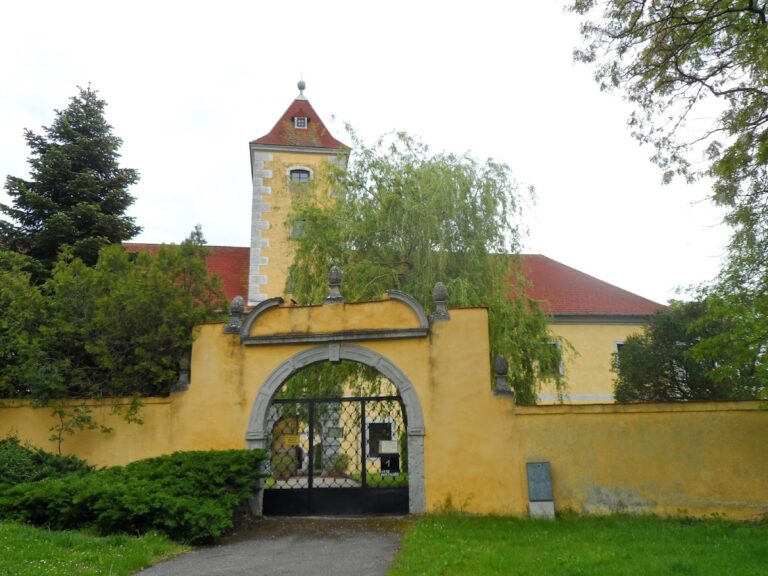
The abbey’s Meierhof lies about 350 metres north of the monastery on ground rising towards the east. After a fire in 1643, it was rebuilt as a four-winged complex. Its western gate tower contains a barrel-vaulted entrance and bears the date 1666. Beside the approach stands a statue of Mater Dolorosa on a composite column dating from the second half of the seventeenth century.
Former Pernegg Abbey
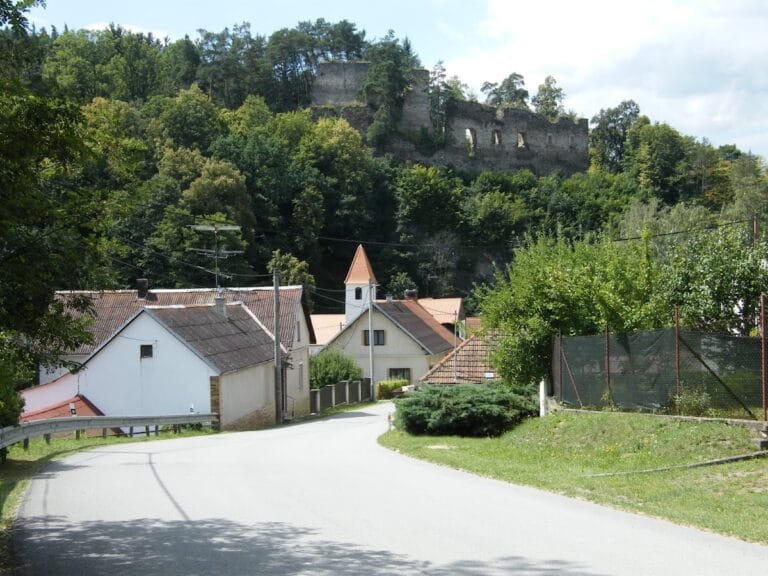
The former Pernegg Abbey complex lies about 10 kilometres from Geras. Its buildings became part of Geras’s holdings in the nineteenth century and continue in use as a retreat and seminar centre, preserving the physical connection between the two Premonstratensian foundations that began as a double monastery.