Schloss Ruegers: A Baroque Castle in Lower Austria


Site at a Glance
- Rating
- 4.1
- Popularity
- Low
- Country
- Austria
- Primary era
- Early Modern
- Eras represented
- Early Modern
- Civilizations
- Habsburg, Holy Roman Empire
- Site type
- Domestic
- Remains
- Castle
On this page6 sections
History
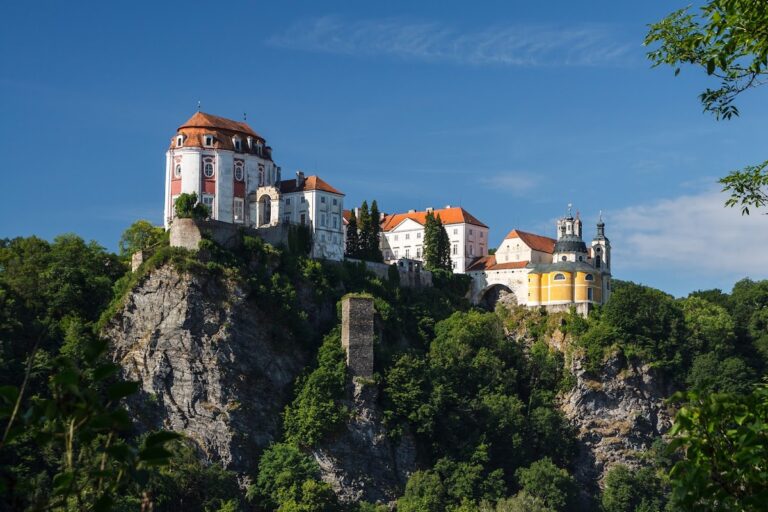
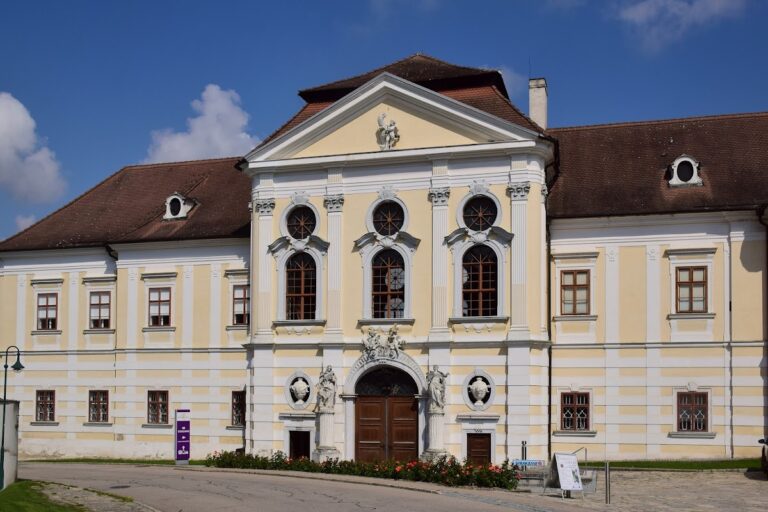
Schloss Ruegers is a Baroque castle in Riegersburg, Austria, near Hardegg in Lower Austria. Built in its present form between 1730 and 1780, it replaced a dilapidated medieval fortress and became a residence and administrative headquarters for the County of Hardegg.
Medieval origins
The site’s earliest history is uncertain. References have been placed in 1212, 1390, and 1427. The earliest proposed date associates it with the Counts of Hardegg or their followers, while the 1390 reference names a castle called Ruegers. The 1427 tradition again links the site with the Counts of Hardegg. The name Riegersburg probably derives from a person named Rueger, although a possible connection with Neudegg near Pulkau remains unresolved.
The Hardegg residence
The Eyczinger family held the castle from 1441 until Sigmund, Count of Hardegg, acquired it in 1568. He replaced the deteriorating medieval castle with a moated castle, a fortified residence surrounded by a water-filled ditch, and established the administrative headquarters of the County of Hardegg there. The rebuilt property also served as his residence.
Sigmund’s son, Johann Wilhelm von Hardegg, inherited heavily indebted estates and faced a severe financial crisis. After his death in 1635, the estate was declared bankrupt. His heir, Julius von Hardegg, assumed the debts and sold the Counties of Riegersburg and Hardegg in 1656 to repay them.
The Khevenhüller rebuilding
The Counts of Saint Julien-Wallsee later owned the property. On 1 August 1730, they sold the County of Hardegg and the lordships of Riegersburg, Prutzendorf, Obermixnitz, and Untermixnitz, together with their associated possessions, to Sigmund Friedrich von Khevenhüller. He had been elevated to Imperial Count in 1725, a high-ranking countly status within the Holy Roman Empire.
Sigmund Friedrich von Khevenhüller and his son Johann Joseph von Khevenhüller-Metsch visited the property soon after the purchase and found it dilapidated and probably uninhabitable. The castle was rebuilt in several phases from 1730 to 1780 according to plans by Franz Anton Pilgram, an eighteenth-century Austrian architect associated with late Baroque architecture and influenced by Johann Lucas von Hildebrandt. The chapel in the north wing was consecrated in 1755.
War, restoration, and renaming
In 1945, the castle first housed displaced people from neighboring South Moravia. Soviet occupying forces then used it as quarters until their departure in 1955. Little of the original furnishing remained afterward. The castle was partially renovated for the 1993 Lower Austrian State Exhibition, “Family – Ideal and Reality.”
The castle and its associated property, including Hardegg Castle, later passed by inheritance to the Counts Pilati von Thassul zu Daxberg. In 2017, castle lord Octavian Pilati changed its name from Riegersburg Castle to Schloss Ruegers. The property was acquired in 2021 by the artist Gottfried Helnwein and real-estate entrepreneur Klemens Hallmann.
Remains
Schloss Ruegers is a two-storey Baroque castle whose present structure was created through rebuilding between 1730 and 1780. Its arrangement incorporates the moated-castle plan established after 1568, when the earlier medieval fortress was replaced as Sigmund, Count of Hardegg, made the property both his residence and the administrative center of the county.
A chapel occupies the north wing. Known as the Chapel of Saint Sigismund, it was consecrated in 1755 and forms part of the castle’s eighteenth-century rebuilding. The manor kitchen retains a stove installed in connection with the Soviet occupation, and the stove remains functional. Much of the earlier interior furnishing was lost after 1955.