Burgruine Kollmitz: A Medieval Castle Ruin in Austria


Site at a Glance
- Rating
- 4.8
- Popularity
- Low
- Country
- Austria
- Primary era
- Medieval
- External website
- Open
- Eras represented
- Medieval
- Civilizations
- Habsburg, Holy Roman Empire
- Site type
- Military
- Remains
- Castle
On this page12 sections
History
Burgruine Kollmitz is the ruin of a medieval noble stronghold in Austria, near Raabs an der Thaya. First appearing in records in the thirteenth century, it developed into an extensive castle complex whose keep was completed in 1319, according to tree-ring dating. The site stands in the cadastral district of Kollmitzdörfl, within the municipality of Raabs an der Thaya in Lower Austria.
Medieval lordship and court
During the fourteenth century, Kollmitz housed a territorial court, a higher local court that administered justice within a lordship or territory. The castle and its surrounding authority changed hands several times among the Wallseer, Winkel, Kratzer, and Thyrna families. In 1411, Kollmitz became the seat of the Hofkirchen lordship, which remained in the family’s control for roughly two centuries.
The castle’s military importance continued into the fifteenth century. Around 1450, the Bohemian Wall was constructed in response to the threat posed by George of Poděbrady, a Bohemian nobleman who ruled as king of Bohemia from 1458 to 1471. The wall formed an additional defensive position in front of the main fortress.
The Hofkirchen era and religious conflict
Wolfgang von Hofkirchen was the last member of the family associated with Kollmitz. Because of his Protestant faith, he was driven into exile in Prague, where he died in 1611. During the Counter-Reformation, the Catholic Habsburgs’ effort to restore Catholic religious and political control in their lands, they regarded him as a leader of the Protestant nobility.
Kollmitz was closely connected with Drösiedl for about 300 years. From 1570, Drösiedl was rebuilt as a Renaissance castle, and the older fortress at Kollmitz may then have ceased to serve its original purpose. Later owners nevertheless continued to occupy the castle, so its history was not ended immediately by the rebuilding at Drösiedl.
Decline and preservation
From 1616, Kollmitz passed successively to the Schütter and Schubhardt families. Pernegg Abbey acquired it in 1693, and in 1708 it came into the possession of Franz Anton von Quarient and Raal, lord of Raabs. Under his ownership, the castle declined because its buildings no longer had a practical use and parts of the complex were exploited as a stone quarry.
A tradition claims that the castle was abandoned because of a tax on roofs. Its decline is instead connected with the loss of practical use after 1708. Since 1974, the Association for the Preservation of the Kollmitz Castle Ruins has cared for the site. The association was founded that year by the composer and local historian Herbert Loskott.
The earlier castle at Hauenstein
A predecessor castle stood on the opposite side of the valley, west of Kollmitzgraben, approximately 400 metres west of the later Kollmitz fortress. It was probably known as Hauenstein and was occupied for only about 150 years. The site was abandoned when the new fortress was built farther east. Earlier references to names such as Chalmunze before 1250 concern Kollmitzberg near Amstetten rather than this castle.
Remains
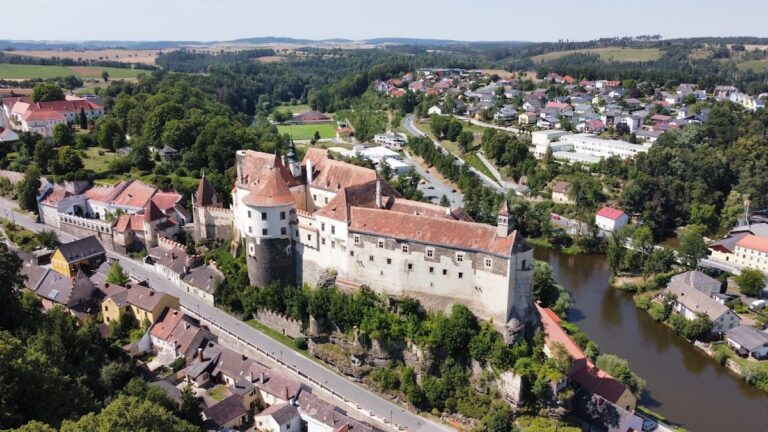
Kollmitz Castle Ruins occupy a steep rocky spur east of Raabs an der Thaya. The Thaya River curves around the spur on three sides, while the surviving fortress combines very large, roughly fitted stones, known as cyclopean masonry, with towers and other defensive structures. The complex was formerly among the largest and most extensive medieval castle sites in Lower Austria. Its remains include the main fortress, the Bohemian Wall set northwest of it, and the fragmentary site of the earlier castle across the valley.
Outer defenses
The Bohemian Wall rises northwest of the main castle, about 300 metres in front of it. Built around 1450 as a defense against George of Poděbrady, it extends for approximately 110 metres. Its position formed a separate forward defensive work beyond the principal fortress.
Buildings of the main fortress
Gate tower
A surviving semicircular gate tower marks the entrance to the castle complex. Its pointed-arch entrance remains among the identifiable features of the ruined fortress.
Hunger Tower
The so-called Hunger Tower is another surviving component of the castle. It stands within the ruined complex alongside the gate tower, keep, residential remains, and other structures.
Keep
The keep, the principal fortified tower of a medieval castle and a possible defensive refuge, forms one of the central surviving elements at Kollmitz. Tree-ring dating places its completion in 1319. It survives as part of the elevated ruin above the river valley.
Residential building
Remains of a two-storey residential building survive within the fortress. Together with various other structures, they preserve evidence of the castle’s former internal complex and its use as a noble residence as well as a fortified site.
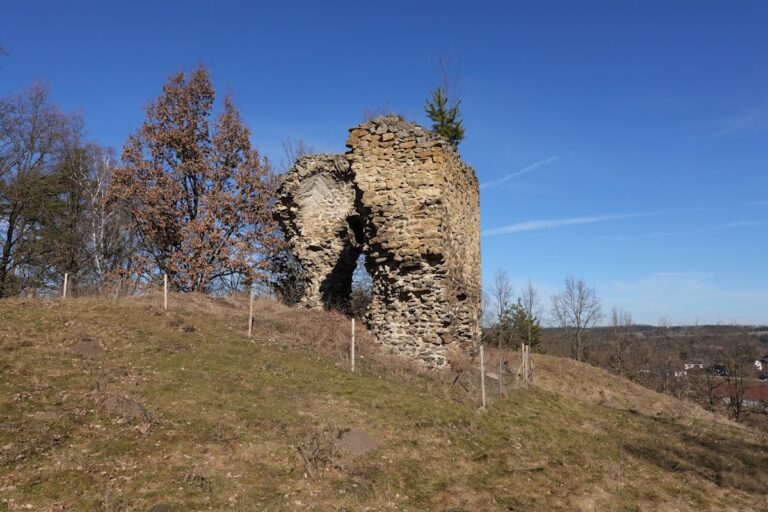
The predecessor castle probably called Hauenstein occupied the opposing side of the valley, west of Kollmitzgraben. Its location is now difficult to discern. A museum is associated with the castle ruins.