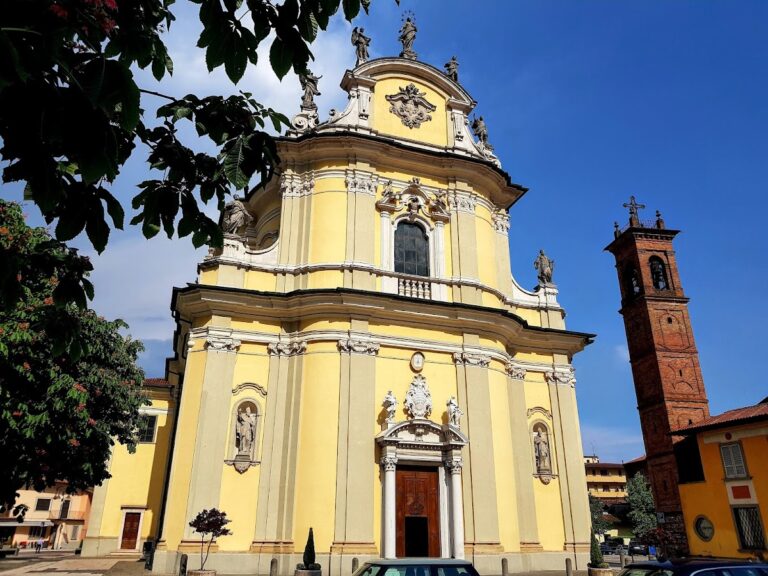
Saint Firmus and Rusticus Church: Caravaggio’s Parish Church in Italy


Site at a Glance
- Rating
- 4.6
- Popularity
- Low
- Country
- Italy
- Primary era
- Medieval
- External website
- Open
- Eras represented
- Medieval, Early Modern, Modern
- Civilizations
- Duchy of Milan, Habsburg, Italian, Venetian
- Site type
- Religious
- Remains
- Church
On this page23 sections
History
Saint Firmus and Rusticus Church is a Roman Catholic parish church in Caravaggio, Italy, dedicated to the Christian martyrs Saints Firmus and Rusticus. Conceived during the Romanesque period, it took its basic form in the thirteenth century and later acquired its characteristic Lombard Gothic appearance. The church is one of Caravaggio’s oldest buildings and has remained under the ecclesiastical authority of the Diocese of Cremona, although the surrounding territory was assigned to Bergamo during the Napoleonic period.
Early origins and medieval development
A local tradition says that Firmus and Rusticus passed through Caravaggio in 306 and brought a dead person back to life. The tradition links the saints directly with the town, while the beginnings of the church itself belong to an earlier and less certain phase. The first explicit documentary references date from 1196 and 1218. Its origins are considered older, and a first sacred building may have been erected when the settlement was founded, before the year 1000.
The church’s present basic structure developed in the thirteenth century, probably replacing or incorporating an earlier place of worship. Its later medieval transformation gave the building the vertical character associated with Lombard Gothic architecture. In 1429, side aisles were added and the central elevation was raised, changing the original gabled form. Side chapels were created during the same intervention. The third chapel on the left still preserves medieval wall paintings, while long tomb slabs commemorating prominent local families remained in the chapels until the beginning of the twentieth century.
Chapels, patronage, and early modern changes
The church’s chapels changed their dedications and decoration over time. One was originally dedicated to Saint Gothard, while another began under the patronage of Saint John the Evangelist and became the Chapel of the Madonna of the Rosary around 1650. A further chapel was first dedicated only to Saint Bernardino of Siena, the fifteenth-century Franciscan preacher. His figure on the portal establishes that the portal is later than 1450, the year of his canonization.
The Chapel of the Apparition was built in 1841 for devotion to the Madonna of Caravaggio. Before its construction, this devotion was associated with the Chapel of Saints Peter and Andrew. The Saint Anthony chapel also underwent a change in the seventeenth century. Its altar painting of Saint Anthony of Padua was replaced in 1674 by a niche containing a statue. The decoration of the Saint Bernardino chapel was administered by the Monte dei Morti, an organization based at the entrance to Porta Folcero that collected offerings for the cult of the dead.
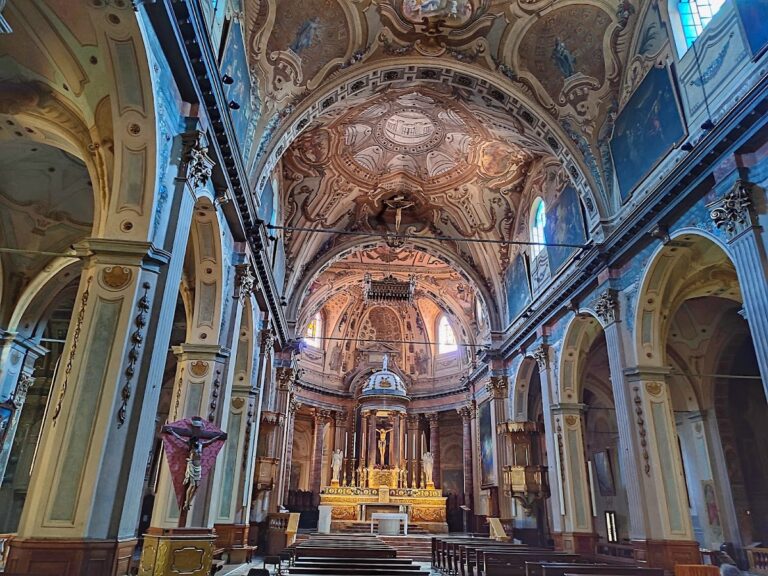
Between 1777 and 1798, the interior was extensively remodelled in a strongly Baroque manner despite opposition from local residents. Fabrizio Galliari, a Piedmontese theatrical painter and designer, directed the work and reorganized the presbytery and choir. The intervention enclosed the pillars with Corinthian pilasters and covered the vaults with large painted-medallion fields. These alterations remain an essential part of the church’s interior appearance.
The bell tower and nineteenth-century completion
The bell tower was begun on 29 June 1500 at the order of Giovanni Dandolo, the Venetian governor. It replaced a lower tower near the roof of the left aisle, between the Chapel of Saint Ambrose and the sacristy, although another tradition places the earlier tower on the same site. Construction stopped at 48 metres, resumed in 1515, and was interrupted several times before reaching the level of the bell-chamber parapet in 1710.
The tower’s early architecture developed distinct Bramantesque characteristics, a language associated with Donato Bramante. In the nineteenth century, Lewis Gruner proposed a four-pitched roof at a height of 54 metres. Angelo Bedolini later designed a classical cornice, balustrade, octagonal dome, finial, and cross in 1894. The project was partly carried out in 1912 and completed in 1932, when the tower reached 71 metres. A related design from 1592 by Lorenzo Gallonzello was found in the State Archive of Rome during the second half of the twentieth century, although its influence on Bedolini’s project remains uncertain.
The large bell bears the date 1614, together with an image of the Madonna of Caravaggio, the town coat of arms, a crucifix, and the arms of the Sforza family. In 1616, Muzio Sforza held the title of fourth marquis of Caravaggio. The Sforza presence was also commemorated by a round marble monument that once stood in the central nave before the high altar. It was later moved outside, to the cemetery entrance south of the church and behind the bell tower.
Restoration and musical history
A major restoration took place in 1932, and the facade was cleaned again in 1990. The murals belonging to the Saint Roch cycle were partly restored near the end of the twentieth century. Earlier conservation also affected the vault paintings: Luigi Pastro cleaned the large medallions in 1931 after they had suffered from neglect, humidity, and dust. In 1923, the earlier stuccoes in the Chapel of Saint Anthony were removed when Mario Albertella repainted its vault.
The pipe organ was built by the Serassi brothers in 1841 as opus 555. It later underwent repairs and modifications, including a major reform by Giuseppe Franceschini, recorded in 1838 in the restrained Cecilian style promoted by a nineteenth-century Catholic church-music reform movement. Several stops were removed, including bells, timpani, snare drum, and cornet, but almost all of the original Serassi material remains.
Remains
Exterior and principal spaces
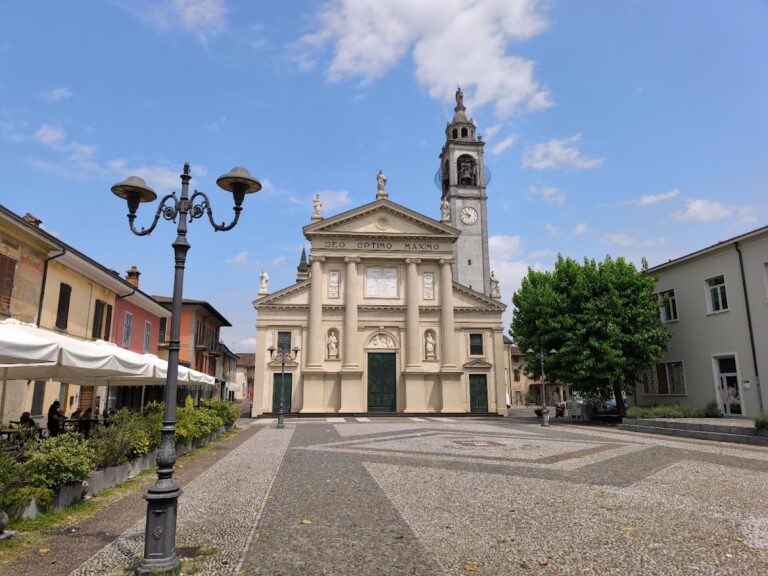
The church is a Lombard Gothic building with an exposed-brick facade divided into three sections. Two square end piers and two inner semicircular columns define the composition; the columns become square as they rise towards the tall gable. Five octagonal pinnacles strengthen the facade’s vertical emphasis. Several changes in brick colour and windows that were never opened reveal modifications made during construction.
Portal and gable
The central entrance has a marble portal with reliefs of prophets and saints, including Saint Francis and Saint Bernardino of Siena. A large rose window with ten rays rises above it. Three niches in the gable contain statues of the Virgin Mary and the titular saints Firmus and Rusticus. In the portal lunette, Giovanni Moriggia painted the Virgin and Child with Saints Firmus and Rusticus. The lantern at the top of the facade was added in the 1830s to a design by Carlo Bedolini.
Interior arrangement
The interior is organized around a central nave, side aisles, side chapels, a presbytery, and a choir. The eighteenth-century vault lining carries sixteen painted medallions commissioned after the vault work, allowing the existing scaffolding to be reused. Federico Ferrario and his son Carlo, painters from Milan, executed the scenes near the end of the eighteenth century. Their subjects include Elijah fed by ravens, Daniel and the idol Bel, David and Abigail, the sacrifice of Isaac, Melchizedek offering bread, Abraham and the three angels, Moses receiving the tablets, and Jacob’s meeting with Esau. Other medallions depict the Book of the Seven Seals, David’s offering of water, the preparation of the Tabernacle, Hagar and Ishmael in the desert, Elijah and the angel, Aaron’s rod, and Moses at the burning bush.
Side chapels and devotional paintings
Chapel of Saint Gothard
The chapel originally dedicated to Saint Gothard contains Madonna and Child with Saints Francis, Roch, and Sebastian, attributed to Fermo Ghisoni and influenced by Mantuan painting. The work may represent the donor through Saint Francis and the painter through Saint Roch. It is set within a late-sixteenth-century wooden altarpiece, while the altar frontal originally came from the Chapel of the Blessed Sacrament.
Two small arched canvases from the early seventeenth century depict Saint Stephen and Saint Lawrence and may be by Giovanni Battista Secco, known as il Caravaggino. Five scenes from the life of Saint Roch cover the walls and vault: Saint Roch among plague victims, before Pope Urban V, in prison, with the angel, and accompanied by three putti carrying the palm and crown. The three vault scenes were restored near the end of the twentieth century.
Chapel of Saint Anthony
Mario Albertella painted the chapel’s 1923 vault frescoes, including Ezzelino da Romano before Saint Anthony, Saint Anthony Blessing with the Monstrance, and Glory of Saint Anthony. He also painted Saint Anthony among African Indigenous People in the lunette. Two seventeenth-century paintings on the side walls represent the Miracle of the Reattached Foot and Saint Anthony Resurrecting a Dead Person.
Chapel of the Madonna of the Rosary
The Chapel of the Madonna of the Rosary retains stuccoes and paintings associated with its dedication around 1650. Its seventeenth-century stuccoes were dismantled in stages from near the end of the eighteenth century until 1923. Moroder, a sculptor from Gardena, replaced the wooden statue of the Virgin in the central niche in 1937.
Mario Albertella painted a band across the entrance pilaster and the arch beneath the vault. The paintings are attributed to Andrea Asper and include fifteen seventeenth-century panels of the Mysteries of the Rosary, a Catholic devotion based on repeated prayers and meditation on episodes from the lives of Jesus and Mary. The same decoration includes Saint Jerome and Saint Dominic with the Madonna. The latter two panels are dated 1655 and signed by Asper.
Chapel of Saint Bernardino
The Chapel of Saint Bernardino was described as entirely painted. Its works include Crucifix between Saint Bernardino and the Guardian Angel, a 1709 altar frontal by Pietro Solari made with scagliola, a polished composite material imitating marble, and a central image of Saint Bernardino. A later altarpiece, altar painting, and balustrade complete the altar arrangement.
Above the altar is Francesco Bradella’s Saint Bernardino and Our Lady of Suffrage, painted in the first half of the eighteenth century and surrounded by a gilded frame. Two seventeenth-century canvases depict Saint Peter Martyr and Saint Catherine of Siena, while two others represent Saint Teresa of Avila and Saint Maurus. The last pair was retouched in 1931.
Chapel of the Apparition
The Chapel of the Apparition stands at the end of the side transept leading towards the Chapel of the Blessed Sacrament. It contains Giovanni Moriggia’s 1844 painting The Apparition of the Madonna to Giannetta, set within a white altarpiece. Its Neoclassical dome has four angels painted at the corners, each carrying an invocation from the Salve Regina, a major Latin prayer to the Virgin Mary.
Renaissance chapels and family monuments
Secco sarcophagus
The sarcophagus of Fermo Secco, who died in 1401, is partly embedded in the transept wall opposite the Chapel of the Blessed Sacrament. It was moved there from the Chapel of Saint Ambrose, founded by the Secco family. Its relief shows the Virgin and Child between Saint Anthony the Abbot and Saint Mark, who symbolically entrust the Secco family to the Virgin. Fermo Secco and his sons Gianluigi, Marco, and Emanuele appear on one side, while their mother, Florida of the Counts of Arco, and their daughter Antonia appear on the other. The family coats of arms occupy the ends.
An inscription in Latin elegiac couplets praises Secco’s achievements in Gothic lettering that matches the sarcophagus. It identifies him as lord of Calcio, castellan of Angera, Dertona, and Novara, and a commander on the borders of Trento.
Octagonal chapel
The irregularly octagonal chapel incorporated into the church was built between the late fifteenth and early sixteenth centuries. It originally faced the adjacent town cemetery and was integrated into the church later. Its Amadeo-inspired design, associated with the Lombard Renaissance style of Giovanni Antonio Amadeo, has been attributed to Giovanni Battagio.
The chapel has a semicircular domed cupola. Against a blue sky, Francesco Prata painted angelic hosts, seven apostles, and musical angels leaning over a balustrade during the first half of the sixteenth century. Bernardino Campi painted Saint Luke, Saint John the Evangelist, Saint Matthew, and Saint Mark in the pendentives, the curved triangular sections supporting the dome. He also painted scenes of the Last Supper, the Annunciation, the Washing of the Feet, the Deposition, and Jesus with the Samaritan Woman. The central image of the Redeemer, made in the same period, was incorrectly attributed to Giovan Battista Secco.
Other Renaissance and early modern works
One chapel contains Madonna and Child with Saints Ambrose, an unidentified saint, and Gothard, a seventeenth-century painting. Another holds Christ Deposed, an early-sixteenth-century crowded composition by Francesco Prata, a local Mannerist painter and pupil of Romanino. A recently restored chapel contains Madonna and Child between Saints Peter and Andrew, signed by Cristoforo Ferrari de’ Giuchis and dated 1504.
The Chapel of Saint Joseph contains Nicola Moietta’s 1529 Renaissance triptych of the Nativity, Saint Christopher, and Saint Catherine of Alexandria. Its style reflects influences associated with Leonardo da Vinci and Bernardino Luini. The church also preserves Coriolano Malagavazzo’s Baptism of Jesus, dated 1571, as well as Mario Albertella’s 1923 Apparition of Jesus to Margaret Mary Alacoque, a seventeenth-century high-backed bench from the Carminati workshop, and the eighteenth-century high altar.
Choir, bell tower, and organ
Choir decoration
The choir contains Giulio Cesare Procaccini’s large Baroque altarpiece Madonna and Child with Saints Firmus and Rusticus. Its refined handling of light reflects Procaccini’s association with the Emilian school, the regional painting tradition of Emilia in northern Italy. Giovanni Moriggia’s 1834 fresco Martyrdom of Saints Firmus and Rusticus is also in the choir, together with a seventeenth- or eighteenth-century scene showing the saints passing through Caravaggio and resurrecting a dead person.
Bell tower
The bell tower stands beside the church on the viewer’s right and is described as between 71 and 76 metres high, although the completed 1932 project brought it to 71 metres. Its early construction gave it Bramantesque characteristics. The later upper structure consists of a cornice, balustrade, octagonal dome, finial, and cross. The large 1614 bell carries the Madonna of Caravaggio, a crucifix, the town arms, and the Sforza arms.
Serassi organ
The organ occupies the cornu epistolae position, conventionally the viewer’s right when facing the altar. Its refined late-eighteenth-century wooden case is Neoclassical. The facade has 25 tin pipes from the Principale 16-foot, Principale 8-foot, and Principale II 8-foot stops, arranged in three cusps with aligned mouths.
An independent wind chest, which distributes air to the pipes, stands in front of the facade and carries the Oboe 8-foot treble stop. It originally held an unusual brass Trombe forzate 8-foot treble stop, later removed. The window console has two 58-key manuals extending from C1 to A5. The upper manual controls the Grand Organ and the lower one the Echo Organ. Both have a chromatic first octave, with the bass and treble divided between B2 and C3.
The non-original straight pedalboard was made by Giuseppe Franceschini. It has 25 pedals from C1 to C3, with the first twelve notes forming the real notes of the extended first octave and the following notes repeating the first. Lombard-style stop controls, combination and full-organ pedals, an Echo Organ full-organ pedal, and seven accessory pedals complete the instrument.
Nearby sites