Fort of Stabroek: An Armoured Fort in Antwerp’s National Redoubt


Site at a Glance
- Rating
- 4.3
- Popularity
- Low
- Country
- Belgium
- Primary era
- Modern
- External website
- Open
- Eras represented
- Modern
- Civilizations
- Belgian
- Site type
- Military
- Remains
- Fort
On this page7 sections
History
Fort of Stabroek is a Belgian armoured fort built between 1902 and 1908 as part of the early twentieth-century defensive ring around Antwerp. It formed part of Belgium’s National Redoubt, a fortified zone centered on Antwerp that was intended to serve as the country’s final stronghold during an invasion. The fort also compensated for a breach in Antwerp’s defensive line created by the expansion of the city’s port.
Construction and local impact
Construction was ordered in 1900, began after delays in 1902, and reached completion in 1908. Along with the Fort of Sint-Katelijne-Waver, Fort of Stabroek was among Antwerp’s first armoured forts, concrete defensive works equipped, or intended to be equipped, with guns in armoured turrets. Its design was intended to resist artillery shells of up to 22 centimetres.
The project required nine people to surrender land for the fort. It also brought Walloon guest workers from the Geldenaken area, whose spending supported local caterers and other small businesses. Excavation uncovered three former river channels. Georges Hasse discussed these discoveries in a series of articles on the history of the rivers of northern Antwerp.
War and changing military use
Germany invaded Belgium during the First World War and began the siege of Antwerp. The surrounding fortifications delayed the German advance, but King Albert I ordered the evacuation of Fort of Stabroek on 7 October 1914, ten days after the siege began. The fort’s intended resistance to shells of up to 22 centimetres was overtaken by German artillery, which included 30.5-centimetre guns and the 42-centimetre weapons known as Big Bertha guns.
Belgium built an antitank canal around Antwerp between 1937 and 1939 in preparation for the Second World War, and the fort’s moat became part of that defensive system. The canal did not stop the German advance. Fort of Stabroek was subsequently affected by the German occupation of Belgium, which lasted approximately four years from 1940.
After military service
Fort of Stabroek ceased to be classified as a defensive work on 2 April 1947. Albert Callens, a dentist from Beveren, purchased it in 1955. He first used it as a country retreat and later, for a short period, for mushroom cultivation. The fort and its surrounding moat were subsequently used for recreation, including swimming and fishing.
The fort is part of Antwerp’s historic fort belts, which form a Natura 2000 protected area and bat habitat. Natura 2000 is the European Union network of protected areas created under environmental directives, including the Habitats Directive. The protected area associated with the fort is given as 3.585 square kilometres and carries the European site code BE2100045.
Remains
Fort and moat
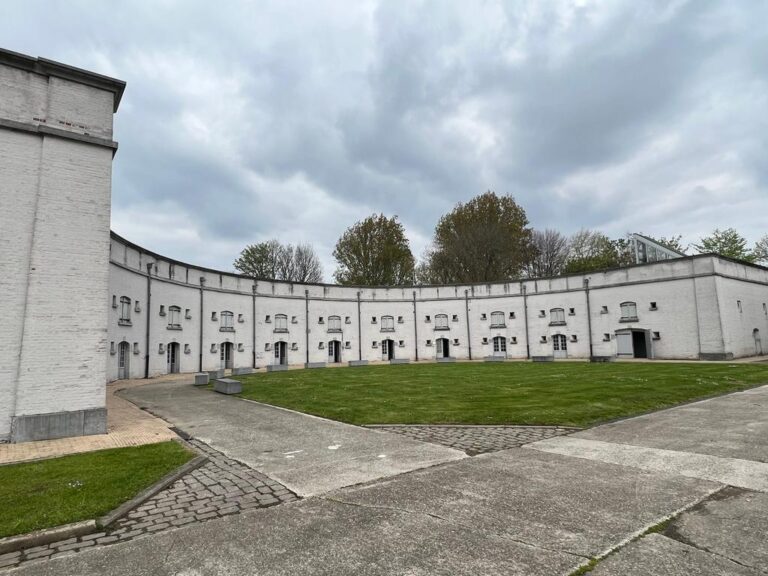
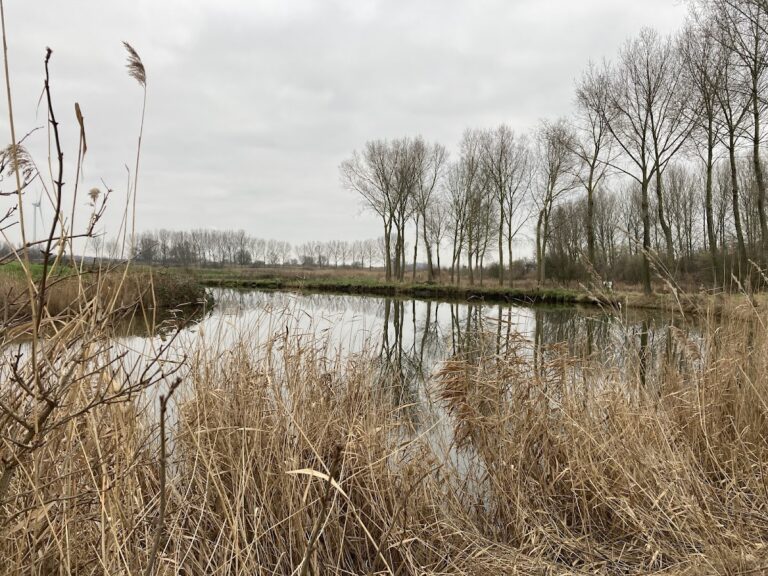
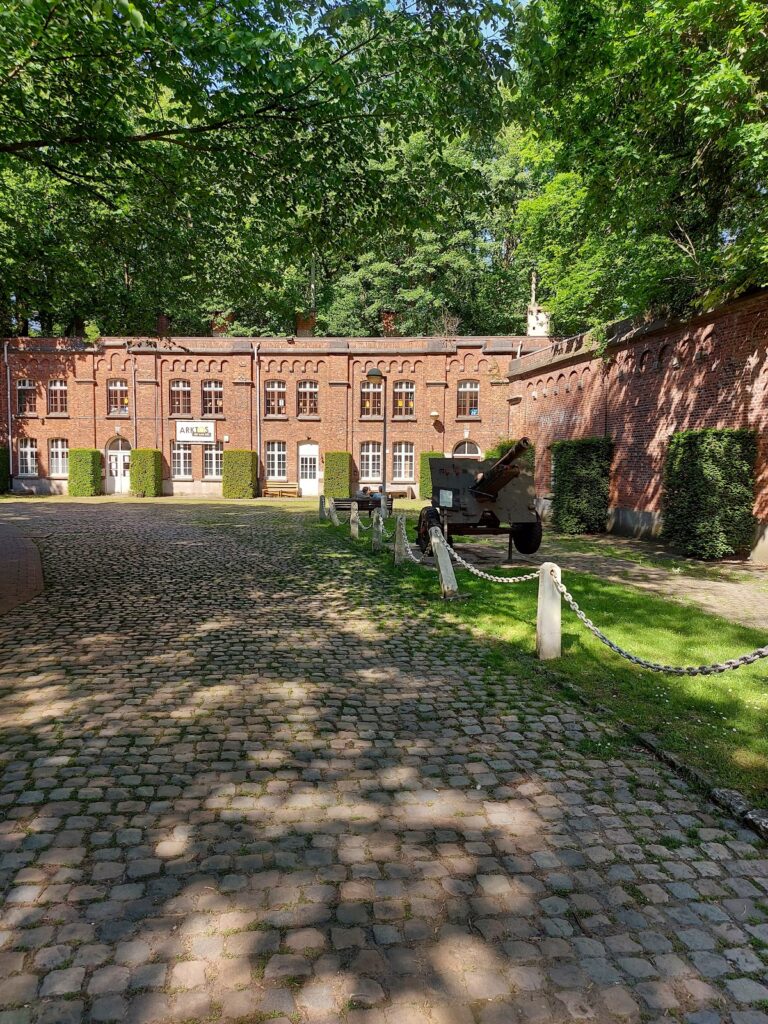
The fort has a trapezoidal plan and is constructed from reinforced concrete. A moat surrounds the position, and this water-filled defensive feature now forms part of the Antwerp antitank canal. The basic fabric remains sound following later upgrades, preserving the principal form of the early twentieth-century fortification.
Detached caponiers and gun turrets
Fort of Stabroek is a second-order fort, a formal category within Antwerp’s fortification system that was distinct from the larger first-order forts. Two detached reverse caponiers project separately from the main fort. A caponier is a fortified structure beside or projecting into a moat, designed to fire along the ditch. Because these caponiers stand apart from the main fort, two small turrets mounting 5.7-centimetre guns protected the connecting trenches between them.
The planned armament consisted of one turret for two 15-centimetre guns, two turrets for 12-centimetre howitzers, and four turrets for 7.5-centimetre guns. The 15-centimetre turret was a recovered type. The heavy artillery intended for the fort was never installed, leaving the completed concrete structure without its planned main armament.
Nearby sites