Noordkasteel: A Citadel of Antwerp’s Northern Fortifications


Site at a Glance
- Rating
- 4.3
- Popularity
- Low
- Country
- Belgium
- Primary era
- Modern
- External website
- Open
- Eras represented
- Modern
- Civilizations
- Belgian
- Site type
- Military
- Remains
- Citadel
On this page11 sections
History
Noordkasteel is a citadel in Belgium, built in 1862 to defend the Oosterweel bend of the Scheldt at Antwerp. A citadel is a fortified stronghold designed to protect a settlement or strategic position. The fort stood on the territory of Oosterweel, a polder village whose low-lying land had been reclaimed and protected by dikes and drainage works.
From Fort Ferdinand to Noordkasteel
Noordkasteel replaced Fort Ferdinand, a smaller fort established in 1812 by Napoleon Bonaparte, the French military ruler and emperor whose regime controlled much of Europe in the early nineteenth century. It became the northernmost fort in Antwerp’s defensive system and closed the line of fortifications surrounding the city.
Harbour expansion and military abandonment
Antwerp’s harbour expansion brought a major change to the site. Plans for the Amerikadok and Afrikadok existed from 1872, and construction began in 1882. Most of Noordkasteel was demolished in 1881 to make way for the docks. The fort was formally removed from the military domain in 1910, while other parts of Antwerp’s wider fortification system were dismantled during the twentieth century for the construction of the Antwerp Ring, also known as the R1.
Recreation area and renewed infrastructure
In 1934, on the initiative of Antwerp mayor Camille Huysmans, the 61-hectare Noordkasteel domain became a recreation area. It included a highly popular public outdoor swimming pool. In 1957, much of the recreation area was taken for the western expansion of the Amerikadok. The remaining recreational area closed in 1969 to make way for the never-realized Boerinnensluis.
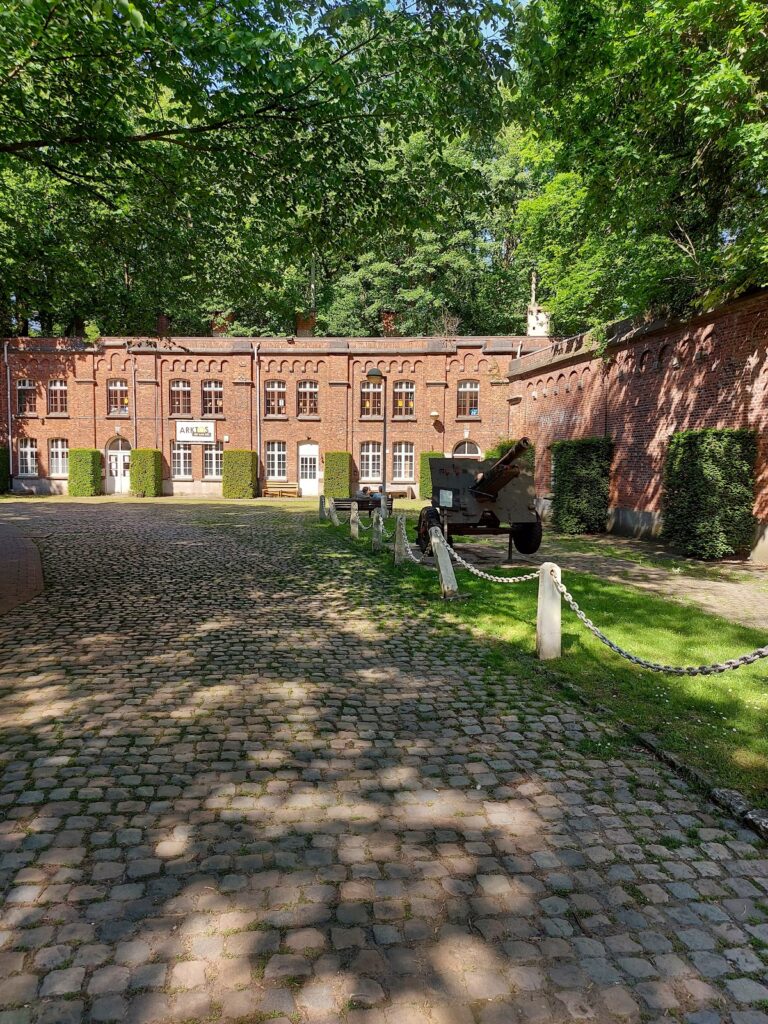
The surviving half-caponnière, a defensive structure projecting into a fortification ditch, was reused as a municipal storehouse. Its underground passages continued to be used for storing explosives until 1995. Noordkasteel is now recognized as built heritage, with ownership divided between the City of Antwerp and the Flemish Region.
The 2005 Antwerp master plan proposed an Oosterweel interchange on part of the remaining Noordkasteel land as part of the Oosterweel connection. Works near the site began in October 2021 and have partly restricted the area. The planned interchange is to be sunken and partly covered, with Ringpark Noordkasteel above it. The pond is planned to remain intact, while the green area is intended to extend toward Oosterweel Church.
Remains
Noordkasteel survives mainly as a green area, a section of rampart, the former defensive ditch now occupied by a rowing pond, and part of a defensive structure. The fort was built from earth and brick. The remaining rampart lies between numbered sections 1–2 and 2–3, beside the rowing pond and near the Higher Nautical School, now called Antwerp Maritime Academy.
Fortifications
Rampart and defensive ditch
The surviving rampart preserves part of the fort’s earth-and-brick defensive system. It stands beside the rowing pond, which occupies the former main defensive ditch. This fragment remains close to Antwerp Maritime Academy and forms part of the green area that survives from the former fort domain.
Half-caponnière
Only half of the caponnière remains beside the present Oosterweelsteenweg. A caponnière is a covered defensive structure or passage projecting into a ditch, allowing defenders to protect the ditch from inside the fort. The surviving section was converted into a municipal storehouse, and its associated underground passages were used for explosive storage until 1995.
Archaeological and later features
Underground drainage sluice
Archaeological investigations carried out during the recent infrastructure works uncovered an underground drainage sluice measuring 30 by 20 metres. It was built after 1883 and is intended for demolition as part of the works.
Buulmolen windmill
The Buulmolen windmill was brought from Olen and installed in the opening of the fort’s dome. It remained at Noordkasteel from 1936 until 1974, when it was moved about 400 metres away. The windmill was dismantled in 1986 and permanently returned to Olen in 1991.
Nearby sites