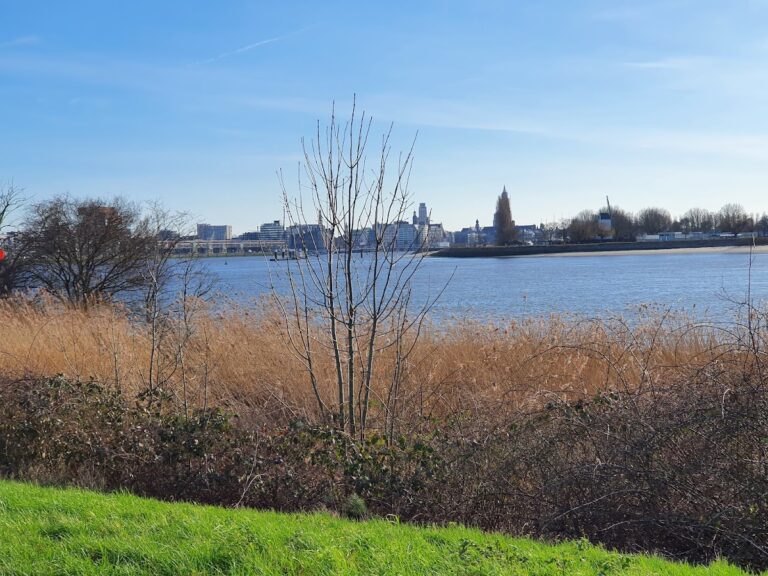
Fort Sint-Marie: A Scheldt Defensive Fortification in Belgium


Site at a Glance
- Rating
- 4.1
- Popularity
- Very Low
- Country
- Belgium
- Primary era
- Modern
- External website
- Open
- Eras represented
- Early Modern, Modern
- Civilizations
- Belgian, Spanish
- Site type
- Military
- Remains
- Fort
On this page17 sections
History
Fort Sint-Marie is a military fortification in Belgium, first established by Spanish forces in 1584 during the Eighty Years’ War to control movement on the Scheldt and support the siege of Antwerp. The present fort was built from 1850 on the same site and formed part of Antwerp’s wider defensive system. Its changing role reflects the military importance of the river, from blocking shipping and defending a pontoon bridge to monitoring naval traffic during the Cold War.
The Spanish bridgehead and the Siege of Antwerp
Fort Sint-Marie I was constructed in 1584, when Alexander Farnese, the Italian-born commander and governor-general of the Spanish Netherlands, sought to establish a bridgehead on the left bank of the Scheldt. From there, Spanish forces could build and defend a pontoon bridge across the river during the Siege of Antwerp. The work was carried out by Robert de Melun, Marquis of Roubaix and commander-in-chief of the Spanish forces. In April 1585, he was killed when an Antwerp powder ship exploded near the bridge.
The pontoon bridge was known as “El Puente” and connected the Sint-Marie and Sint-Filips redoubts. Its purpose was to obstruct Scheldt shipping and prevent the Dutch Watergeuzen, maritime insurgents and privateers supporting the Dutch revolt, from supplying Antwerp. The people of Antwerp attacked the bridge with burning ships and vessels loaded with powder, but these attempts failed. Antwerp capitulated on 17 August 1585.
The name Sint-Marie is traditionally linked to Farnese’s devotion to Mary and to his deceased wife, who was also named Maria. The first fort was originally called Sint-Marieschans. On the opposite bank, Farnese ordered the construction of the Sint-Filips redoubt, named after his uncle, King Philip II of Spain.
Wars and eighteenth-century changes
Fort Sint-Marie I later played a role in the Battle of Kallo in 1638. During the Nine Years’ War, the European conflict fought from 1688 to 1697, the fort formed part of the Line-Dike defence. The Dutch States Army sought to recapture Antwerp from the Spanish, and Maurits-Frederik, the only son of William of Nassau and a nephew of William of Orange, was killed in the battle.
The 1785 Treaty of Fontainebleau transferred the forts of Liefkenshoek and Lillo to the Southern Netherlands. Emperor Joseph II subsequently ordered most of the Scheldt forts to be demolished. Their locations nevertheless continued to serve wartime artillery purposes. Fort Sint-Marie saw little activity during the French period in Belgium, from 1794 to 1815.
The nineteenth-century fort
Alterations from 1832 onward repeatedly changed the site. The Netherlands retained Liefkenshoek and Lillo until 1839, while the state border between the Netherlands and Belgium was definitively established in 1843. Fort Sint-Marie II was then built from 1850, partly over the remains of the earlier fort. The design was by Henri Alexis Brialmont, the Belgian military engineer whose work shaped Antwerp’s ring of forts.
Unlike most forts in the Brialmont belt, which were chiefly intended to resist attacks by ground forces, Fort Sint-Marie II was designed primarily to control the Scheldt. It protected Antwerp and its harbour from gunboat raids and naval landing forces. The fort became part of the Fortified Position of Antwerp, also known as the National Redoubt, Belgium’s principal defensive system centred on Antwerp. Its unified command was intended to enable the army to hold the city and harbour while retaining a secure national base.
After the Franco-Prussian War and the development of longer-range, heavier artillery, the left-bank Scheldt defences were judged inadequate in 1870. The government established a Fortified Camp on the Left Bank. In 1877, five casemates, fortified chambers used for artillery or military storage, were demolished and replaced by an armour battery fitted with 24-centimetre Krupp guns.
A Defensive Dike was built between Fort Sint-Marie II and the new Fort Zwijndrecht to contain the inundation area of the Melsele polder. This was an inundation defence, a deliberate flooding system intended to hinder advancing land forces. The dike and its moat survive as part of the former defensive landscape, although they are separated from the fort’s present perimeter.
Fort Sint-Marie in the world wars
In 1881, two external heavy-torpedo launching installations were added. They could fire both upstream and downstream along the Scheldt. Their operators were known as torpilleurs. The installations used five-metre-long Whitehead torpedoes, self-propelled naval weapons carrying 45 kilograms of explosive with a range of 1,600 metres.
During the First World War, Antwerp was attacked by land. The armed neutrality of the Netherlands prevented enemy ships from entering the Scheldt, so Fort Sint-Marie did not fire. On 8 October 1914, General Victor Deguise, commander of the Fortress of Antwerp, ordered the river closed from his headquarters at the fort. The German passenger ship Gneisenau was partly sunk to prevent the Imperial German fleet from using the harbour as a base for operations against England. Belgian military engineers destroyed the torpedo installations, and Antwerp fell to German forces on 10 October 1914.
Between the two world wars, the fort served as a depot. Its oldest artillery was replaced by light and heavy machine guns, while parts of the armour were strengthened with reinforced concrete. Ventilation was installed and gas-proof rooms were added.
At the beginning of the Second World War in May 1940, the Scheldt itself was not the scene of fighting. A land-force defensive line ran along the left bank between Fort Sint-Marie and Fort Kruibeke, with the 15th and 17th Infantry Divisions and the 4th Lancers Regiment. Fort Sint-Marie functioned as a military support point and storage facility. It passed undamaged into German hands and became a depot for recovered Belgian equipment. In 1944, the German Wehrmacht blew up the Krupp armour battery.
Naval base and later use
After the Second World War, Fort Sint-Marie continued as a military depot and was modified during the 1950s Cold War. From 1961, it became Antwerp Naval Base, popularly known as Kallo Naval Base even though it lies in Zwijndrecht. Buildings for naval personnel, administration, and logistics were added within the fort.
In 1970 and 1971, a concrete upper storey was built over the old brick casemates for the naval staff. Designed by the Antwerp Military Buildings Service, 2 KDR, with Guy Kussé as draughtsman, it became known as the Operations Block. During the Cold War, the building served as a military control and listening centre that monitored shipping on the Scheldt and in Antwerp’s harbour. It was also used during Reforger NATO exercises, which practised the rapid reinforcement of Europe by allied forces. Electronic equipment monitored shipping, particularly vessels from Eastern Bloc countries, Cuba, China, and North Korea.
Until the late 1970s, several river minesweepers and fast river boats were based at the fort. A tidal harbour was created by demolishing two points of the fort. It included an ebb gate and a flood gate connecting the harbour with the Scheldt. The naval harbour was abolished in 1989 after the fall of the Berlin Wall and the end of the Cold War. Naval cadets continued to use the site for a time, and the newer buildings and harbour later served the Cenflumarin maritime school, which left the domain in November 2015.
The 37-hectare domain belongs to the Belgian federal Ministry of Defence and is listed in the inventory of architectural heritage in Flanders. It has been designated as a nature area on the regional plan since 1979. A memorial to sailors killed in both world wars stands on the grounds, listing the affected ships and their victims. An annual commemorative ceremony continues to be held there. A photographic and explanatory presentation about the fort is maintained at Fort Liefkenshoek, approximately eight kilometres away by road.
Remains
Layout and defensive structure
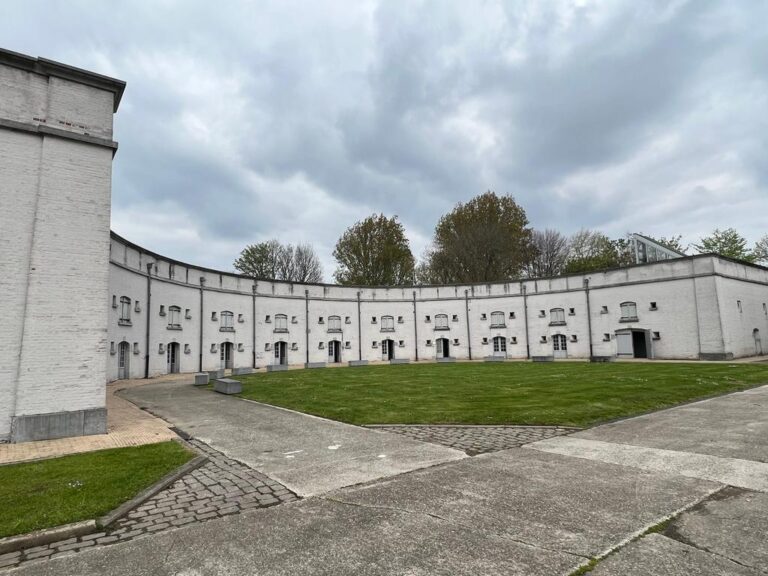
Fort Sint-Marie II occupies the site of the first square earth-and-timber fortification, which measured approximately 100 by 100 metres. The earlier fort lay beneath the remains of Bastion II, between the central pond and the Scheldt. The later fort retained the location while creating a much larger defensive complex with six bastions, projecting sections designed to provide defensive fire along the faces and adjoining walls. Its river-facing side was covered with earth and stone.
The basic structure included a double moat, a central pond, a torpedo-launching installation, and a fortified heavy-gun building. Earth excavated from the middle of the fort was used to form the ramparts. The excavation left an island in the pond, which is now covered by trees and shrubs. Two small harbours were created, one within the fort and another to the southeast. The roof of the main artillery building is now positioned behind high Scheldt dikes, which were later raised as part of the Sigma Plan.
Artillery and torpedo defences
Casemated coastal battery
The principal artillery installation is a large coastal battery built in brick masonry. It was designed to fire on ships attacking along the Scheldt and protected the position against both ground and naval forces. The ground floor contained accommodation for artillerymen and military storage, including two powder magazines. The first floor held 27 bombproof casemates, fortified chambers designed to withstand explosive bombardment, for heavy guns. Approximately ten additional heavy guns could be placed on the roof.
Krupp armour battery
The 1877 replacement battery was made of cast iron and carried 24-centimetre Krupp guns. These weapons were intended to penetrate armoured cruiser ships. The German Wehrmacht destroyed the battery in 1944, leaving its destruction as part of the fort’s wartime physical history.
Torpedo installations
The two external torpedo-launching installations added in 1881 formed part of the river defence system. Their five-metre Whitehead torpedoes carried 45 kilograms of explosive and could travel 1,600 metres. A brick ruin below the Scheldt dike survives from this system.
Water barriers and later naval works
Defensive Dike
The Defensive Dike between Fort Sint-Marie II and Fort Zwijndrecht survives with its moat. It was built as a water barrier for the Melsele-polder inundation area, allowing low-lying ground to be flooded as a defensive measure. The dike remains part of the former military landscape, although its moat no longer has a direct connection to the fort.
Operations Block
The Operations Block is a concrete upper storey constructed in 1970 and 1971 over the older brick casemates. It housed the naval staff’s control and listening centre and provided a broad view over the Scheldt. Its construction preserved the relationship between the nineteenth-century artillery building below and the Cold War naval functions introduced above it.
Tidal harbour
The tidal harbour was created for naval use and connects with the Scheldt through an ebb gate and a flood gate. The harbour and the newer buildings later accommodated the Cenflumarin maritime school. Together, these works represent the site’s transformation from a coastal artillery fort into a naval support and training complex.
Landscape and surviving domain
The former military grounds cover 37 hectares, or 370,000 square metres, and are designated as a nature area. Trees and shrubs cover the island in the central pond, while the surviving dike, moat, brick structures, artillery buildings, later naval works, and memorial form the physical remains of the fort’s successive military uses.