Wettingen Abbey: A Former Cistercian Monastery in Switzerland
Site at a Glance
- Rating
- 4.6
- Popularity
- Low
- Country
- Switzerland
- Primary era
- Medieval
- External website
- Open
- Eras represented
- Medieval, Early Modern, Modern
- Civilizations
- Holy Roman Empire, Swiss
- Site type
- Religious
- Remains
- Monastery
On this page20 sections
History
Wettingen Abbey is a former Cistercian monastery in Switzerland, founded by the Catholic Cistercian order in 1227 on the Limmat peninsula. Named Stella Maris, or “Star of the Sea,” it developed through the medieval period as a religious, agricultural, judicial, and educational center. Its motto, Non mergor, meaning “I do not sink,” recalled the traditional rescue of Heinrich II of Rapperswil from shipwreck during the Crusades.
Foundation and medieval development
After 1220, Heinrich II of Rapperswil acquired land at Wettingen and the legal right to nominate the priest of the village church. He donated his possessions at Wettingen to Salem Abbey, while the nunnery at Schänis supplied land for the new foundation. On 14 October 1227, Salem’s abbot Eberhard of Rohrdorf sent twelve monks and several lay brothers under Konrad, his former deputy and the monastery’s designated first abbot. Construction then began.
Wettingen was a daughter house of Salem Abbey, meaning that it was founded from an established mother monastery, and belonged to the Cistercian line of Morimond. Its church was dedicated in 1256 to the Virgin Mary assumed into Heaven, whose patronal feast was celebrated on 15 August. In 1231, Pope Innocent IV granted the abbey temporal exemption, freeing it from certain external secular controls. The Habsburgs protected the monastery until 1415, when that role passed to the Old Swiss Confederacy, the loose alliance of Swiss cantons that preceded the modern Swiss state.
The abbey steadily enlarged its landed possessions in Uri, Zurich, Riehen, and especially the Limmat valley around Wettingen. It administered farms and scattered estates, exercised low justice, meaning jurisdiction over lesser offenses and civil matters, in the Limmat valley, and maintained an extensive economic base. The monastery belonged to the Upper German Cistercian Congregation until 1806 and thereafter to the Swiss Cistercian Congregation.
Fire, religious change, and renewal
Financial difficulties weakened the abbey in the early sixteenth century. On 11 April 1507, a fire destroyed large parts of the monastery and its economic buildings. The church, organ, tower, altarpieces, choir stalls, books, church furnishings, cloister, refectory, cellar and wine stores, press house, cooperage, barns, kitchen, rooms, vessels, and other equipment were damaged. The loss was assessed at about 16,000 guilders, while assistance from Baden and neighboring communities prevented the fire from consuming the entire monastery.
The community may have reconstructed and rededicated the monastery in 1517. In 1529, Abbot Georg Müller and most of the monks adopted the Reformed faith during the Reformation, the sixteenth-century religious movement that challenged Catholic institutions and produced Protestant churches. After the Second War of Kappel in 1531, a conflict between Catholic and Reformed Swiss cantons, Catholic cantons imposed the monastery’s recatholicization, or restoration to Catholic control, and appointed its abbots until 1564.
Under Abbot Christoph Silberysen, who led the abbey from 1563 to 1594, Wettingen produced richly illustrated chronicles and received colored stained-glass windows and heraldic panes. Abbot Peter Schmid, in office from 1594 to 1633, oversaw a renewed phase of activity. The buildings were restored and enlarged, a school of philosophy and theology opened in 1604, and a printing press was established in 1671.
War, refuge, and dissolution
During the Toggenburg War of 1712, also called the Second War of Villmergen, the monks temporarily fled to central Switzerland. This conflict was fought between the broader Catholic and Reformed alliances in Switzerland. After the French Revolution, Wettingen sheltered thousands of religious and political refugees from France.
In 1803, the newly established Canton of Aargau acquired the monastery but initially permitted it to continue on the condition that it operate a school. From 1830, the canton imposed increasing financial demands. In 1834, it placed the abbey’s assets under state administration, prohibited the admission of novices, and closed the monastic school. On 13 January 1841, the cantonal parliament dissolved Wettingen and the other monasteries in the canton. The decision led to the Aargau Monastic Conflict, a political and religious dispute over the canton’s suppression of its monasteries.
The monks, including Alberich Zwyssig, were forced to leave soon afterward. After several years of movement, the community settled on 8 June 1854 in the secularized Benedictine monastery of Mehrerau at Bregenz, Austria. The new institution became the territorial abbey of Wettingen-Mehrerau, an ecclesiastical jurisdiction governed by an abbot whose authority is defined by territory, directly subject to the Holy See, the central governing authority of the Catholic Church. Its abbot retained the title Abbot of Wettingen and Prior of Mehrerau.
Later institutional use
The former monastery buildings were made available to the Wettingen teachers’ training college in 1843. Since 1976, they have housed Wettingen Canton School. The former abbey church remains a Catholic place of worship, with weekly services and weddings. The monastery library was transferred in 1845 and 1846, together with the library of Muri, to the Aargau Cantonal Library. Manuscripts and incunabula, books printed before 1501, were moved first, followed by the remaining works. Examination of the late medieval manuscripts showed that only a few originated at Wettingen or in its immediate circle, while many had been acquired from secularized religious houses during or after the Reformation.
Wettingen Abbey is listed as a cultural property of national importance, and the surviving monastery complex is identified as a nationally significant heritage site.
Remains
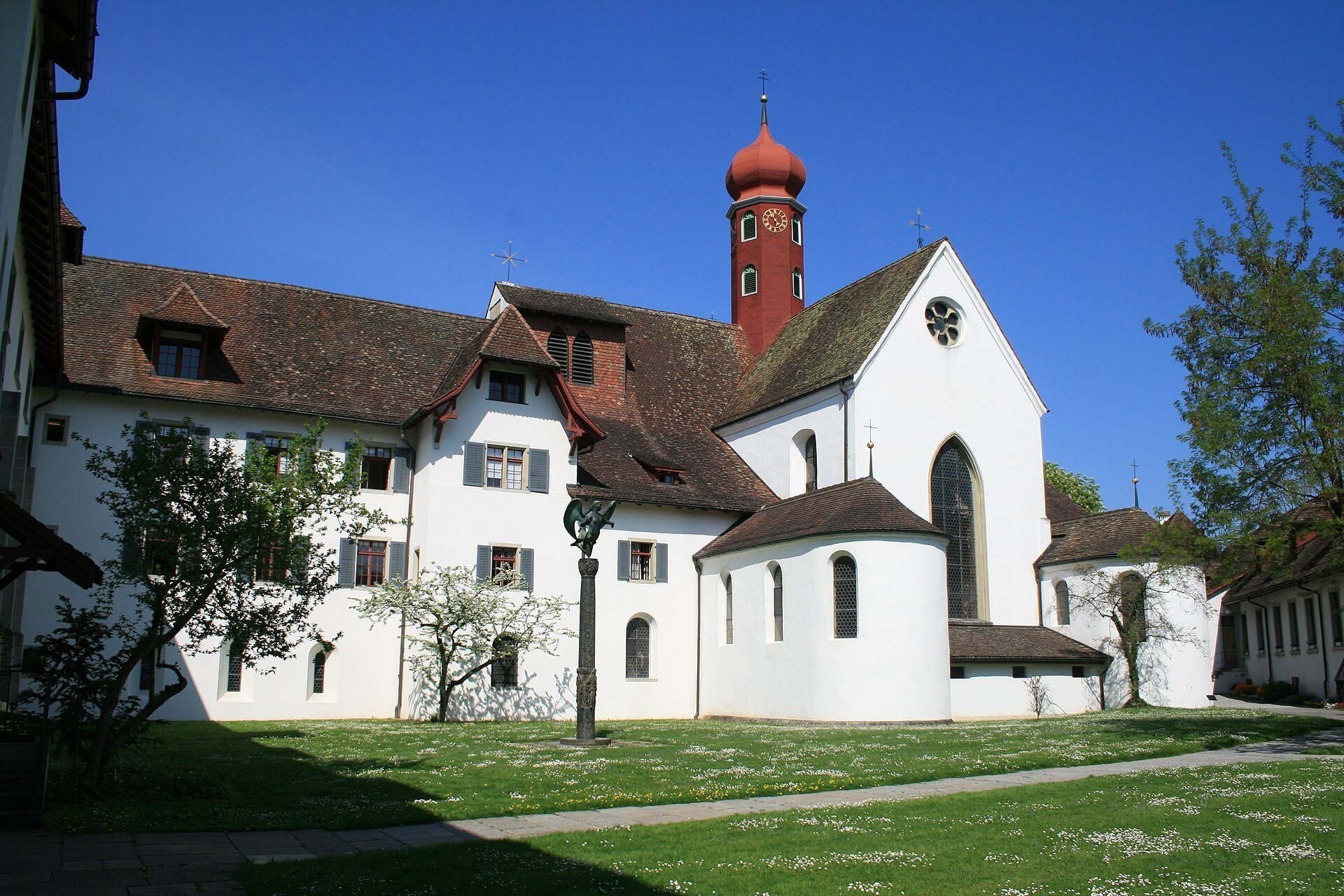
The monastery occupies the Limmat peninsula and is arranged around an inner monastic district, an outer district, and buildings beyond the former protective enclosure. The inner district contained the church, cloister, and the residential and communal spaces of the monks. The outer district held supply buildings and accommodation for guests. A protective wall separated the peninsula from the Wettingen fields, while other monastery-owned buildings nearby were subject to secular authority.
Inner monastic district
Abbey church
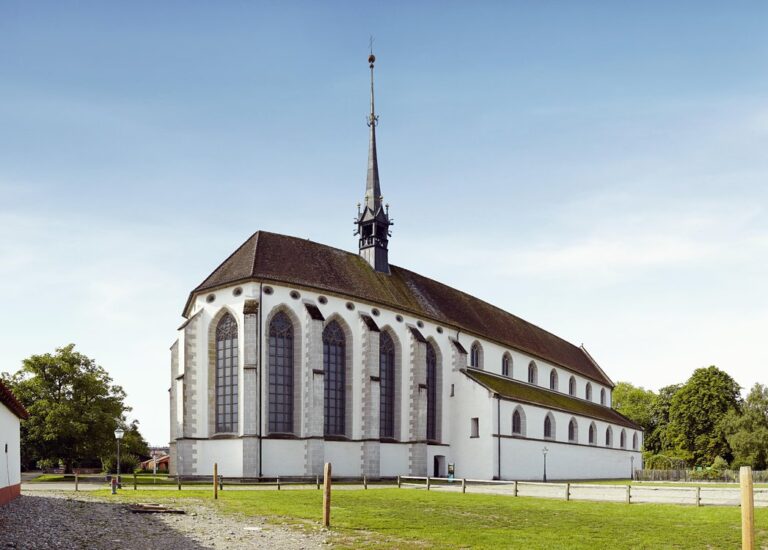
The church originated in the thirteenth century and was altered and enlarged repeatedly. Its nave is divided into a rear section, formerly accessible to the public and known as the lay-brothers’ church, and a front section separated by a portal and formerly reserved for monks and clergy, known as the monks’ church. Large medieval sarcophagi remain inside, including the sarcophagus of Rudolf of Habsburg-Laufenburg. The church also contains burial places associated with regional noble families, including Arnold of Wart and Ita of Tegerfelden, the wife of Ulrich II of Klingen.
Cloister
The cloister, a covered walkway around an enclosed garden, was completed around 1520 under Abbot Johann Müller. Its large windows contain Gothic tracery, the stone framework that divides and supports pointed-arch openings. The windows hold cabinet panes, small individually composed stained-glass panels, including a series of painted scenes. The cloister walks are enclosed by outer walls and entered through doors on all four sides. Cupola windows pierce the wall beside the former chapter house. Sculptures of the Virgin Mary and former abbots, with their coats of arms, are attached to the walls, while small grave slabs of monks are set into the tiled floor.
Cloister chapel
The cloister chapel stands on the ground floor of the east wing near the entrance to the abbey church. Built around 1285, it was restored in 1954, when late medieval frescoes were brought back into view. The paintings depict the Baptism of Jesus and Saints Benedict of Nursia and Anthony the Hermit. The chapel also contains the fifteenth-century wooden image known as the Wettingen Infant Jesus. Numerous burn marks on the image are traditionally associated with its survival in the monastery fire of 11 April 1507.
Former chapter house
The former chapter house, where the monastic community met for official business, occupies the ground floor of the east wing. Its original appearance was restored during the 1954 renovation, and the room is now used as a music auditorium.
Outer district and former enclosure
Former sisters’ house
The former sisters’ house, also called the women’s house, stands in the area of the monastery gate. Two gatehouses formerly stood northwest of it, and the space between them marked the meeting point of the monastery’s religious and secular spheres. After the monastery was dissolved, the building was converted into the Sternen inn.
Former ropeworks
The former ropeworks, also known as the long building, has a wine cellar in its basement. Together with the sisters’ house, its 70-metre length forms an architectural barrier between the former monastery and the municipality of Wettingen. It was extensively altered after the dissolution and now contains biology and chemistry rooms, preparation rooms, and practical-training rooms belonging to Wettingen Canton School.
Former bakery
The former bakery stands southeast of the long building on the same axis. Karl Rothpletz converted it into a dwelling in 1884.
Zwyssig Court
The open-sided Zwyssig Court occupies the site of the former servants’ and farmhands’ house. It contains a monument to Alberich Zwyssig, the Cistercian monk and composer associated with the Swiss Psalm, made in 1954 by the sculptor Eduard Spörri. The monument is a bronze angel.
Grounds and riverside structures
Mill and gardens
The monastery grounds included gardens extending southward to the Limmat. The former monastery mill stood on the river and was replaced during the nineteenth century by the Wettingen spinning mill.
Wooden bridge
In 1764, the abbot commissioned the Swiss bridge builder Hans Ulrich Grubenmann to construct a wooden bridge across the river. French troops destroyed the crossing in 1799. A replacement was built in 1819, and the larger of its two spans survives as the Wettingen–Neuenhof wooden bridge.
Surviving decoration and present use
Colored stained-glass works and heraldic panes survive throughout the former monastery complex, including the cabinet panes of the cloister. The present buildings are used by Wettingen Canton School, while the former abbey church continues to function as a religious space.