Brunegg Castle with tenant’s house: A Habsburg Border Castle in Switzerland


Site at a Glance
- Rating
- 3.9
- Popularity
- Very Low
- Country
- Switzerland
- Primary era
- Medieval
- Eras represented
- Medieval, Modern
- Civilizations
- Habsburg, Holy Roman Empire
- Site type
- Domestic
- Remains
- Castle
On this page10 sections
History
Brunegg Castle with tenant’s house is a preserved medieval castle complex in Switzerland, built by the Habsburgs in the thirteenth century on a defensible rocky slope above Brunegg. It formed part of the Habsburgs’ defenses on the southern side of their core territory, the Eigenamt, and probably worked with nearby Wildegg Castle to protect this frontier.
Habsburg foundation and feudal ownership
The Habsburgs granted Brunegg Castle as a fief, meaning property held from a superior lord in return for service and loyalty. Wernher von Brunegg, who died in 1270, is the earliest known owner. The knights of Hedingen, the lords of Trostburg, the Gessler von Meienberg, and the lords of Friedingen later held the castle.
The settlement that grew around the castle took its name from it. It initially belonged to the Habsburgs’ personal lands. During the fourteenth century, the Habsburgs transferred authority over lesser legal cases to the castle owners, while Bern later placed the area under the court of Othmarsingen in the Lenzburg district.
Bernese conquest and later administration
In 1415, during Bern’s conquest of western Aargau, Bernese forces besieged Brunegg. The defenders resisted, and a counterattack forced the besiegers to lift the siege. Brunegg was one of the few castles in the region to offer such resistance.
Bern withdrew the fief in 1470 and granted it in 1472 or 1473 to the Segesser family of Mellingen. The Segessers were Catholic, and after the Reformation reached the Bernese Aargau in 1528, they sold the castle back to Bern. From 1538 until 1798, Brunegg was subordinate to the governor of Lenzburg. The surrounding area later belonged to the Brugg district for part of the nineteenth century and has been in the Lenzburg district since 1840.
Damage, conversion, and private ownership
Centuries of poor maintenance left the castle vulnerable, and natural forces badly damaged it in 1626 and 1664. The new Canton of Aargau acquired Brunegg in 1804 as Bern’s legal successor. In 1805 and 1806, the keep and outbuildings were repaired, the roof was rebuilt, and the complex was converted into a castle residence. It served as a care institution for several years.
Since 1815, Brunegg has been privately owned. It first belonged to the Lenzburg patrician Hünerwadel family and later passed by inheritance to the von Salis family, which has owned it since 1945. The current owner is the physician Thomas von Salis, son of the Swiss historian Jean Rudolf von Salis.
The castle also became associated with twentieth-century literary and journalistic life. The Swiss journalist and feuilletonist Manuel Gasser lived in the gatekeeper’s house during the final decade of his life, from 1969 to 1979. The writer Hermann Burger later lived there and died by suicide in 1989. His novel Brenner, published in 1989, commemorated the castle in literature under the fictional name “Brunsleben.”
Remains
Main castle complex
Residential wing and keep
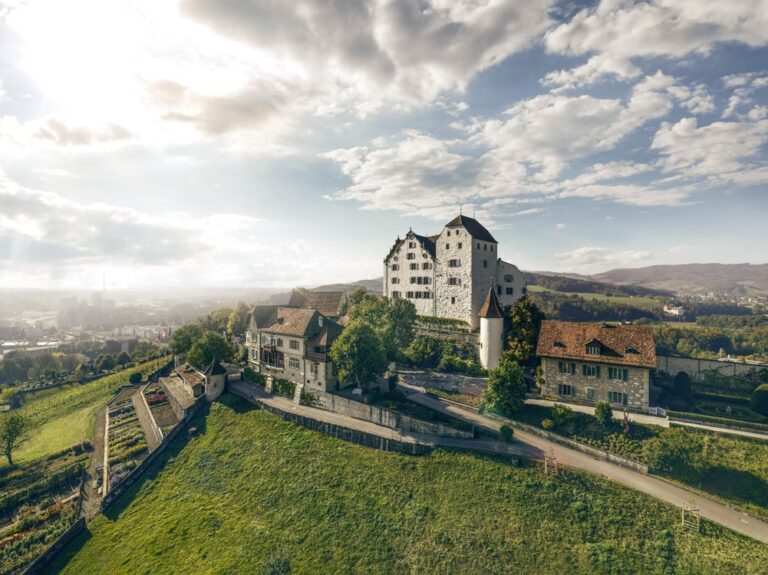
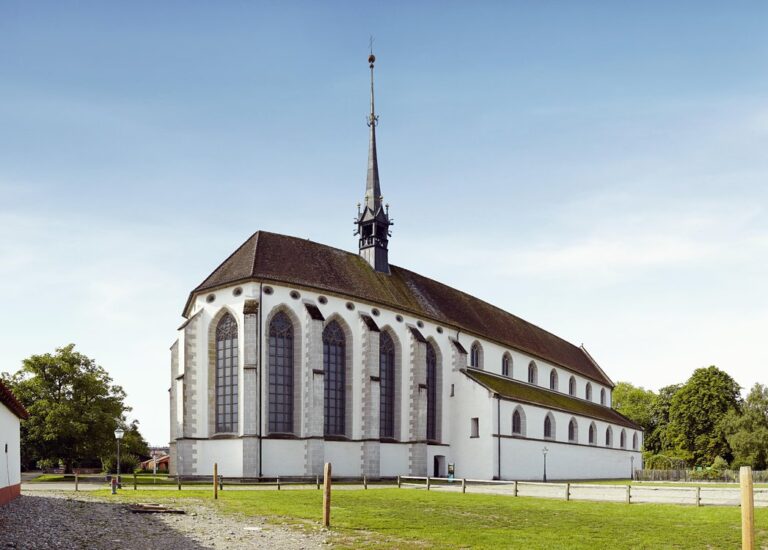
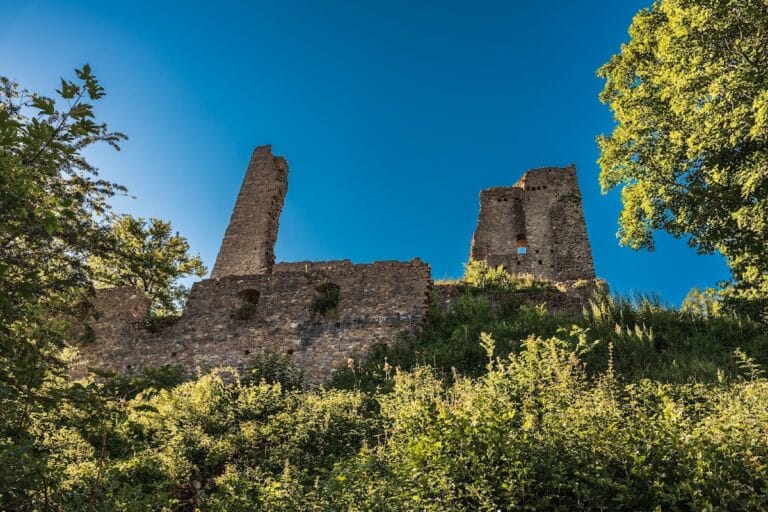
Brunegg is a small castle-like complex on a rocky spur at the end of the Chestenberg, approximately 120 metres above the village and 543 metres above sea level. The ridge falls steeply eastward toward the Birrfeld plain, and the castle stands on a hill at the edge of the Jura Mountains. Its principal residential wing dates from the thirteenth century.
The castle tower, or keep, was reduced in height in the early nineteenth century. A connecting wing was then built between the tower and the palas, the main residential and representational building of a medieval castle. This work joined the principal elements into a unified building and formed part of the conversion into a castle residence.
Outbuildings and grounds
Agricultural buildings and garden
The complex includes two agricultural outbuildings and a nineteenth-century garden. Together with the main residential wing, these elements preserve the arrangement of the castle as a residence and working estate after its early nineteenth-century reconstruction.
Gatekeeper’s house
A gatekeeper’s house forms part of the complex. In the twentieth century it served as a residence for Manuel Gasser and Hermann Burger, linking this surviving building to the castle’s later literary and cultural history.
Nearby sites