Baden Catholic Town Church and Sebastian’s Chapel: Parish Church, Ossuary, and Church Treasure


Site at a Glance
- Rating
- 4.7
- Popularity
- Very Low
- Country
- Switzerland
- Primary era
- Medieval
- External website
- Open
- Eras represented
- Medieval, Early Modern, Modern
- Civilizations
- Habsburg, Swiss
- Site type
- Religious
- Remains
- Church
On this page11 sections
History
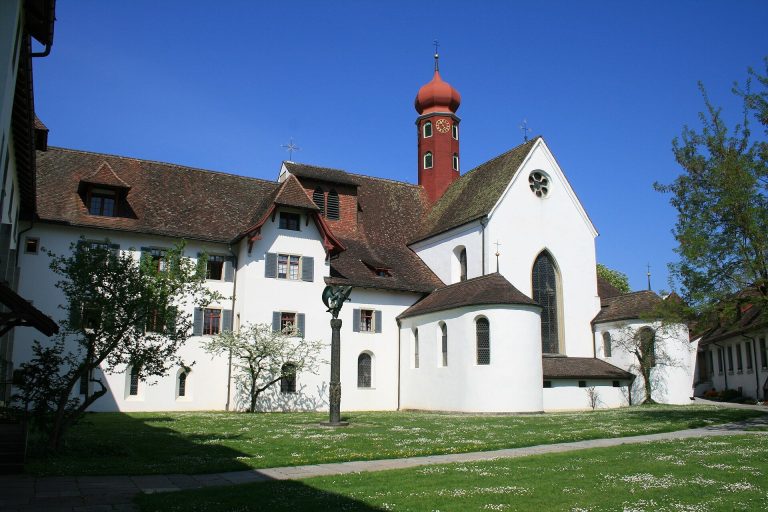
The Catholic Town Church and Sebastian’s Chapel in Baden, Switzerland, form a historic Roman Catholic complex whose main church developed from a Carolingian-period predecessor into a fifteenth-century Gothic building. The parish serves Baden and Ennetbaden within the Aargau Limmat Valley pastoral area of the Diocese of Basel, a Roman Catholic diocese in Switzerland. The church remains a place of worship and also hosts cultural events and concerts.
From the Early Middle Ages to the Habsburg Transfer
The parish’s origins reach back to the early Middle Ages. A first predecessor church was built in the second half of the ninth century, during the Carolingian period, the era of the Frankish Empire associated with the Carolingian dynasty and Charlemagne. Archaeological investigations examined this early church in 1967 and 1968. A Romanesque church followed on the same site in the twelfth century.
A parish at Baden is recorded from 1241, more than fifty years before the formal foundation of the town. By the fourteenth century, Mary was the church’s patron. In 1406, Duke Friedrich of Habsburg transferred the church to Wettingen Abbey, a Cistercian monastery in Aargau, as compensation for losses connected with the Gugler War of 1375 and the Sempach War of 1386. The change of patronage produced repeated disputes between the town and the abbey, especially over vacant priestly offices.
The Baden Disputation and Catholic Continuity
From 19 May to 8 June 1526, the church hosted the Baden Disputation between Johannes Eck, a German Catholic theologian who opposed the Protestant Reformation, and Johannes Oecolampad, a Swiss-German reformer associated with Basel. It was the first disputation connected with the Zwinglian Reformation held outside Zurich. This branch of the sixteenth-century Protestant Reformation was associated with Huldrych Zwingli and initially centred on Zurich.
The disputation took place during a period when four of the thirteen Old Swiss Cantons accepted the new faith, ending the Confederation’s confessional unity. Baden remained Catholic, partly because the town wished to protect its position as a meeting place of the Swiss Diet and as a spa town.
Collegiate Foundation and Later Renovation
In 1624, Baden established a collegiate chapter at the church. A collegiate chapter was a community of secular clergy formed to conduct worship and administer a church, rather than a monastic community. The church’s second patron became Saint Damian in 1650, when Pope Innocent X gave it the relics of Damian, a catacomb saint whose remains had been taken from the Roman catacombs and venerated as those of a Christian martyr.
Wettingen Abbey was suppressed in 1841. Its assets first passed to the Canton of Aargau and, four years later, to the town. The collegiate chapter was dissolved in 1875 during the Kulturkampf, the nineteenth-century political and religious conflict between secular governments and the Roman Catholic Church in several European countries, including Switzerland.
The surrounding ground served as a cemetery until 1820. The church underwent a comprehensive renovation in 1967 and 1968. Another major renovation began in May 2021, addressing exterior repairs and cleaning, interior cleaning and refurbishment, fire safety, and the complete renewal of the electrical installations. The church is designated cultural property of national importance.
Remains
The complex stands in the centre of Baden’s old town on the edge of a terrace descending toward the Limmat. The present church is based on a fifteenth-century Gothic structure, while Sebastian’s Chapel occupies the slope immediately to its south. Together, the buildings retain evidence of successive religious, funerary, and defensive uses.
Town Church
Gothic Church Building
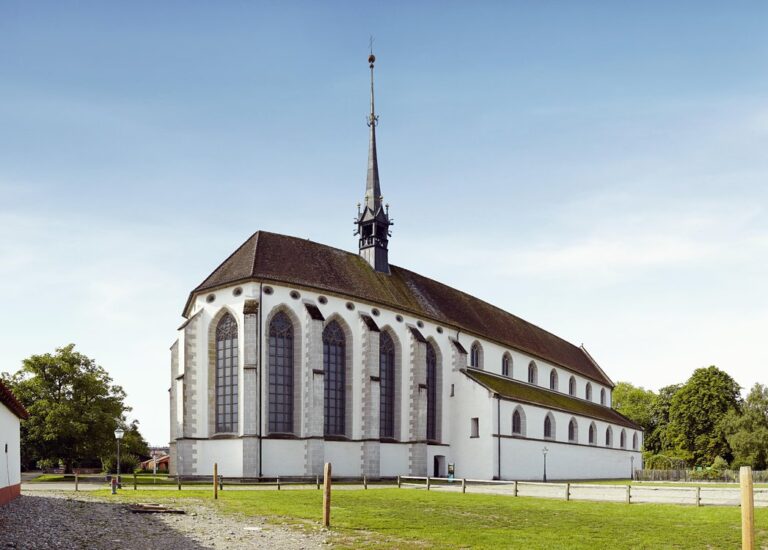
The present church was built in 1457–60 as a three-aisled Gothic structure under the direction of Hans Murer and Cunrat Zobrist. The central nave kept the width of the earlier church, while two side aisles were added and the west end was extended by 4.5 metres. The choir and the lowest three stories of the tower belong to the fourteenth century. An earlier Mauritius Chapel later lost its independent sacred function and became the sacristy.
The west entrance was redesigned in 1937 with a lean-to roof and a mosaic of the Assumption of Mary. Since the 1930s, tomb slabs from the former ossuary have been set into the outer wall of the south side aisle. A relief of Saint Christopher by the Baden artist Walter Squarise decorates the choir’s end wall, while his image of Jesus teaching was added to the north side aisle in 1951.
Tower and Bells
The tower was completed in 1489–93 by Martin Grülich during the final construction phase around 1490. It rises 52 metres and is the second-highest building in the old town after the town tower, which is approximately four metres taller. A pointed spire covered with coloured tiles crowns the structure. Six bells hang in the tower, all cast in 1926 by the H. Rüetschi company of Aarau.
Interior and Organ
The interior has changed repeatedly. Baroque high-altar panels and Passion paintings were added between 1612 and 1617, followed by stucco work and paintings of prophets in 1696–98. At the beginning of the nineteenth century, the stucco ceiling, altars, and pulpit were remodelled in the Classical style.
Clear-glazed windows in the side aisles and white walls give the interior a bright appearance. The side-aisle ceilings are lower than the central nave’s ceiling, which rests on octagonal pillars. An organ gallery occupies the western end of the nave. The organ itself was built in 1968 by the Metzler company of Dietikon and has 41 stops distributed across three manuals and a pedal division.
Church Treasure Museum
Two rooms above the sacristy contain the church treasure museum. Its holdings include liturgical vessels, complete sets of vestments, other liturgical textiles, and examples of goldsmiths’ and silversmiths’ work dating from the late Middle Ages to the modern period. The collection is regarded as one of the most important church treasuries in the Canton of Aargau.
Sebastian’s Chapel
Sebastian’s Chapel is a simple Gothic building with a gabled roof and a roof turret, a small tower rising from the roof. The town built an ossuary on the slope south of the church in 1481. An ossuary is a chamber or building used to store human bones after burial space has been cleared. A chapel was erected above it during the first decade of the sixteenth century and completed in 1509. The project was financed by the town clerk Ulrich Dösch, directed by Hans Murer, and consecrated by Balthasar Brennwald, auxiliary bishop of the Diocese of Constance.
The chapel’s partly underground ossuary has a massive wall on its downhill side. Its wall-walk, a passage along the top of a fortification wall, formed part of Baden’s former town defences. This construction preserves the chapel’s connection not only with burial practice but also with the medieval fortified town.