Daigo-ji Temple: A Historic Shingon Buddhist Temple in Kyoto


Site at a Glance
- Rating
- 4.4
- Popularity
- Medium
- Country
- Japan
- Primary era
- Medieval
- External website
- Open
- Eras represented
- Medieval, Early Modern, Modern
- Civilizations
- Japanese, Toyotomi regime
- Site type
- Religious
- Remains
- Monastery
On this page21 sections
History
Daigo-ji Temple is a historic Japanese Buddhist temple in Kyoto, Japan, founded in 874 during the early Heian period by Shobo, a second-generation disciple in the lineage of Kukai. It is the head temple of the Daigo-ha branch of Shingon Buddhism, an esoteric school centered on initiation, mantra, mandala, and specialized rituals. Its principal deity is Yakushi Nyorai, the Buddha of healing and medicine, and the temple has traditionally been associated with the Minamoto clan as its family temple.
Foundation and Imperial Expansion
Shobo established the temple at Kami-Daigo on Mount Daigo, where he enshrined images of Juntei Kannon and Nyōirin Kannon that he had carved himself. Kannon is a bodhisattva associated with compassion, while these two forms belong to esoteric Buddhist worship. At the request of Emperor Daigo, a Yakushi-do was built in 907 for a Yakushi Triad. A Godai-do followed as a hall for the protection of the state, dedicated to the Five Great Wisdom Kings, esoteric Buddhist guardian deities.
A Shaka-do was built at Shimo-Daigo in 926 and later became known as the Kondo, or main hall. Plans then developed to transform the whole of Mount Kasatoriyama into a temple complex. Work continued under Emperors Suzaku and Murakami after Emperor Daigo’s death, including the construction of a Hokke Sammai Hall. The Five-Story Pagoda was completed in 951 during Emperor Murakami’s reign under the direction of Empress Dowager Onshi.
Imperial support also supplied Daigo-ji with estates in Ise, Owari, and Kawachi. These tax-privileged estates provided economic resources for the institution. Expansion slowed after the death of Fujiwara no Onshi and the political decline of the Minamoto clan, but Daigo-ji remained closely connected to the court.
Imperial Abbots and Medieval Influence
As the imperial court developed cloistered rule, a system in which retired emperors exercised authority from behind the throne, Daigo-ji moved still closer to the imperial family. The temple adopted the practice of appointing imperial princes as abbots and later became a monzeki temple, a major Buddhist institution whose abbot traditionally belonged to the imperial family or imperial aristocracy. This arrangement helped produce prominent monks and encouraged the development of the Ono school within Daigo-ji’s esoteric lineage.
After Fujiwara no Kenshi, the empress of Emperor Shirakawa, died in 1084, Emperor Shirakawa built Enko-in on the mountain and placed her remains there. He also dedicated a gilt-bronze Mandala of the Two Realms, a Shingon diagram representing the complementary Diamond and Womb Realms of Buddhist cosmology and practice. Daigo-ji possessed extensive temple and shrine lands, and those holdings continued to influence its economy for centuries.
During the Nanboku-cho period, a time of rival imperial courts and civil conflict, Daigo-ji produced religious and political figures with influence beyond the temple. The abbot Kenshun received the support of Ashikaga Takauji, while Manzai played an influential role at the Muromachi shogunate from the time of Ashikaga Yoshimitsu to Ashikaga Yoshinori.
Destruction in the Onin War and Revival
The Onin War, a civil war that devastated Kyoto in the late fifteenth century, brought fire and major destruction to Daigo-ji. Shimo-Daigo was left in ruins, while the Five-Story Pagoda survived. In October 1469, villagers in the surrounding area rioted while demanding that their annual tax payments to the temple be reduced by half. Armed warrior monks suppressed the revolt, and a large goma rite, a consecrated fire ritual in which offerings are burned before Buddhist deities, was held soon afterward to curse the rebel leaders.
Daigo-ji began to recover during the Azuchi-Momoyama period, when Toyotomi Hideyoshi became a patron of the abbot Gien. Hideyoshi rebuilt Sanbo-in in preparation for a large cherry-blossom viewing held at Daigo-ji in 1598. The event later became part of the temple’s continuing cultural identity. Toyotomi Hideyori continued the restoration of the complex, overseeing the relocation of the Kondo, completed in 1600, the rebuilding of the West Gate in 1605, and the rebuilding of Nyōirin-do, Kaisan-do, and Godai-do in 1606.
Early-Modern and Modern Developments
During the Edo period, the abbot Takaen made two ascents of Mount Omine with 3,000 mountain ascetics to encourage the development of Shugendo. This Japanese mountain-based religious tradition combines ascetic practice, pilgrimage, ritual, Buddhism, and mountain worship.
The anti-Buddhist movement of the Meiji period led to the abolition of many temples and the dispersal of their treasures. Daigo-ji nevertheless preserved much of its temple treasure and survived that period comparatively intact. In 1930, the businessman Yamaguchi Gendo sponsored buildings belonging to the Daidenbo-in complex, centered on Kannon-do. The Reihokan Museum opened in 1935.
A forest fire struck Kami-Daigo in August 1939 and destroyed the sutra repository and Juntei-do. Juntei-do was rebuilt in May 1968, but lightning caused another fire on August 24, 2008, and destroyed the building again. Its pilgrimage image was subsequently kept temporarily at Kannon-do in Shimo-Daigo. The original Hokke Sammai Hall, built in 949 and later destroyed by fire, was replaced by Shinnyo Sanmaya-do in 1997. The hall commemorates the esoteric lineage established by Shinjo Ito, founder of Shinnyo-en, who completed major initiation rites at Daigo-ji and received the rank of great archbishop from the temple in 1966.
After the Second World War, Daigo-ji retained close institutional relationships with the Shingon-derived new religious movements Shinnyo-en and Gedatsu-kai. Gedatsu-kai’s founder, Okano Seiken, was ordained at Sanbo-in, and Daigo-ji later conferred on him the posthumous title Gedatsu Kongo.
Heritage and Continuing Religious Life
Daigo-ji was inscribed in 1994 as one of the 17 component sites of the UNESCO World Heritage property Historic Monuments of Ancient Kyoto. Its grounds are also designated as a National Historic Site, and the temple holds numerous National Treasure and Important Cultural Property designations. The grounds cover more than 6.6 million square metres and contain approximately 150,000 temple treasures.
The temple remains the eleventh station of the Saigoku Kannon Pilgrimage. Kami-Daigo’s Juntei-do historically served as the pilgrimage station, and Daigo-ji is also associated with several other Buddhist pilgrimage networks. Religious practices include outdoor Shiba-goma fire rites traditionally attributed to Shobo. The Five Great Power Nio-e, held on February 23 in honour of the Five Great Wisdom Kings, includes a ritual strength contest involving a 150-kilogram rice cake for men and a 90-kilogram rice cake for women. A cherry-blossom procession connected with Hideyoshi’s 1598 viewing and an August lantern festival incorporating a memorial service for hungry spirits also continue at the temple.
Remains
Three Principal Areas
Daigo-ji is arranged in three principal areas: Sanbo-in, Shimo-Daigo, and Kami-Daigo. Sanbo-in and Shimo-Daigo occupy the foot of Mount Daigo, while Kami-Daigo lies higher on the mountain and is separated from the lower precincts by a steep route that takes about an hour on foot. The forest behind the temple covers 118 hectares. It belonged to Daigo-ji until the Edo period, became government land under the early Meiji transfer of temple and shrine lands, and was later surrounded by temple property after approximately 160 hectares of former precinct land were transferred to Daigo-ji under postwar legislation. The entire national forest lies within the temple’s National Historic Site area.
Sanbo-in
Garden and Buildings
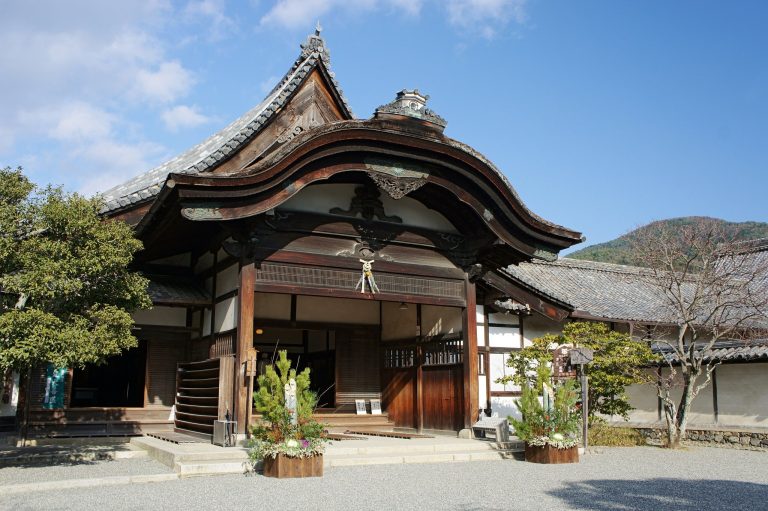
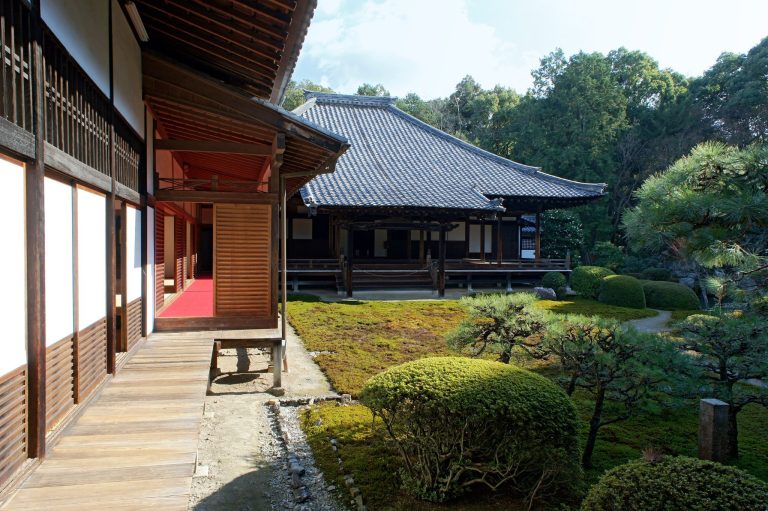
Sanbo-in consists of walled compounds joined by streets lined with cherry trees. Its buildings include sub-temples, a tea garden, a museum, and the Sanbo-in garden. The compound also contains the Karamon, Omote-shoin, Ura-shoin, reception and waiting rooms, a kitchen, a main residential hall, a Pure View Hall, a goma hall, and a Hokkyo-in pagoda.
Sanbo-in Garden
The Sanbo-in garden is a Momoyama-period strolling pond garden laid out under Toyotomi Hideyoshi in 1598 and further developed in the early Edo period. Designed for viewing from the Omote-shoin, it combines a pond-and-path arrangement with dry landscape elements. A central pond, islands, bridges, and a multi-stage waterfall form the garden’s principal composition. The garden is designated by the Japanese government as both a Special Historic Site and a Special Place of Scenic Beauty.
Shimo-Daigo
Shimo-Daigo is a large enclosed precinct centered on the Kondo and the Five-Story Pagoda. Detached halls and open spaces connect the principal buildings, including Kiyotaki-gu Main Hall, Kiyotaki-gu Worship Hall, the West Gate, Kannon-do, Sanbo-in’s halls and gate, and the former Godai-do.
Kondo
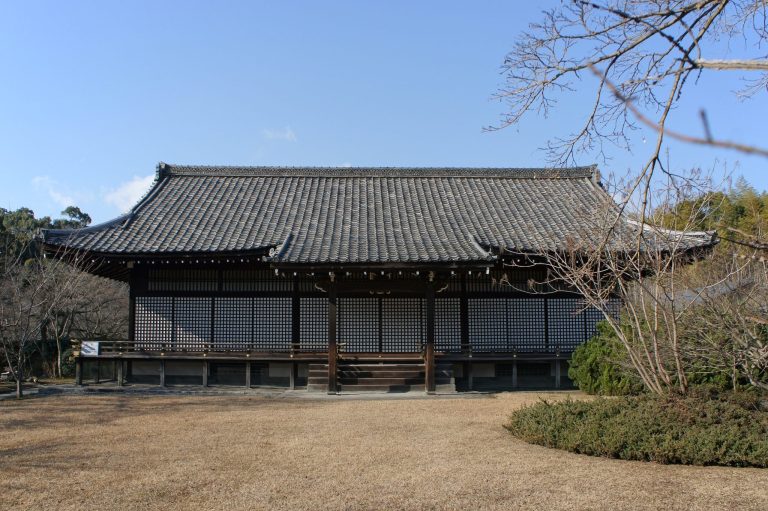
The present Kondo is a seven-by-five-bay hall, using the structural intervals between adjacent columns, and dates principally from the late Heian period, although some components are earlier. It originally served as the main hall of Mangan-ji in Yuasa, in Kii Province. After renovation during the Kamakura period, the building was relocated to Daigo-ji in a project begun under Toyotomi Hideyoshi and completed in 1600.
Inside the Kondo, the principal image is a seated statue of Yakushi Nyorai, accompanied by statues of Nikko Bosatsu, Gakko Bosatsu, and the Four Heavenly Kings. The Four Heavenly Kings are protective Buddhist figures associated with the four directions. The hall’s inner and outer sanctuaries are not divided by barriers or partitions, creating a single unified interior space. The Kondo is designated a National Treasure.
Five-Story Pagoda
Completed in 951, the Five-Story Pagoda rises 38 metres, including its 12.8-metre spire. Its roofs become sharply smaller toward the top, giving the tower a low, compact profile. It is the oldest surviving wooden structure in Kyoto Prefecture and one of the few surviving Heian-period buildings in Kyoto.
The pagoda survived the destruction of Shimo-Daigo during the Onin War but required repeated repairs. Extensive work followed the 1586 Tensho earthquake, and repairs supported by Toyotomi Hideyoshi were completed in March 1598. Damage from Typhoon Jane in 1950 led to further repairs completed in 1960.
Eighteen Heian-period mural panels survive inside the first story. They depict the Two Realms Mandala and the Eight Shingon Patriarchs. The image of Kukai is the oldest surviving portrait of him. The murals are separately designated as National Treasure paintings.
Gates and Shrine Buildings
Kiyotaki-gu Main Hall is an Important Cultural Property. The West Gate, also called Niomon, was rebuilt by Toyotomi Hideyori in 1605. Its Nio statues had originally been installed at the Great South Gate and were erected in 1134; they are Important Cultural Properties.
The original Godai-do at Shimo-Daigo no longer survives. The former Godai-do on the upper mountain, once designated a National Treasure building, burned on April 3, 1932, after a goma fire spread to its roof. It was rebuilt in 1940.
Kami-Daigo
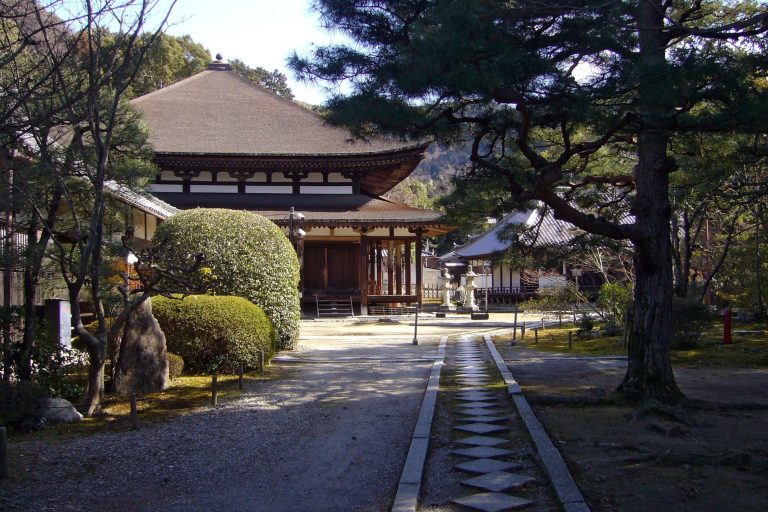
Kami-Daigo occupies the upper mountain around Kaisan-do and Nyōirin-do at an elevation of approximately 450 metres. The area includes Yakushi-do, the former Juntei-do site, the spring known as Daigo-sui, Oku-no-in, and a network of mountain paths and steps.
Nyōirin-do and Kaisan-do
Nyōirin-do was rebuilt by Toyotomi Hideyori in 1606 as a suspended structure, meaning that part of the building projects beyond or hangs from its supporting framework. Kaisan-do was founded in 911 by Kanken, Daigo-ji’s first abbot, rebuilt during the Kamakura period, and rebuilt again by Hideyori in 1606. Its inner sanctuary contains a seated portrait statue of Shobo and other objects. Nyōirin-do and Kaisan-do are Important Cultural Properties.
Yakushi-do
Yakushi-do was founded by Shobo at Emperor Daigo’s request as a hall for imperial prayer. The present building was rebuilt in 1121. It has a gabled roof covered with cypress bark, five bays across the front, and four bays along each side. The side arrangement, with narrow central bays and wider end bays, is unusual.
The hall formerly housed the National Treasure statues of the Yakushi Triad, together with Important Cultural Property statues of Enma, Taishaku-ten, and Senju Kannon. These images have been moved to the Reihokan Museum in Shimo-Daigo. Yakushi-do itself is designated a National Treasure.
Daigo-sui and Oku-no-in
Daigo-sui is a spring of holy water at the entrance to the upper-mountain complex. Beyond the principal complex, a further walk reaches the summit and Kaisan-do. A rough trail continues to Oku-no-in, a grotto containing several statues, with an outlook known as the East Lookout near the grotto.
Juntei-do Site
The former Juntei-do stood in Kami-Daigo and served as the eleventh station of the Saigoku Kannon Pilgrimage. It burned in 1939, was rebuilt in 1968, and was destroyed again by a lightning-caused fire in 2008. Its pilgrimage image was later kept temporarily at Kannon-do in Shimo-Daigo.
Collections and Documentary Heritage
Daigo-ji’s holdings include 69,393 temple documents and religious texts dating from the Heian through Meiji periods. The collection also contains a Southern Song edition of the Buddhist canon, comprising 6,102 volumes in 604 boxes. Together, these materials record the institution’s administration and religious activity across many centuries.
Other holdings include a Heian-period wooden standing statue of Kokuzo Bosatsu and Heian-period wooden statues of Yakushi Nyorai and his attendants. The collections also contain Buddhist paintings, imperial calligraphy, ritual manuscripts, and other religious works. Cultural-property designations include the Kondo, Five-Story Pagoda, Yakushi-do, Kiyotaki-gu Worship Hall, Sanbo-in Karamon, and Sanbo-in Omote-shoin as National Treasures, while Nyōirin-do, Kaisan-do, and Kiyotaki-gu Main Hall are Important Cultural Properties.