Kajū-ji Temple: An Imperial Monzeki Head Temple in Kyoto


Site at a Glance
- Rating
- 4.1
- Popularity
- Low
- Country
- Japan
- Primary era
- Early Modern
- External website
- Open
- Eras represented
- Early Modern, Modern
- Civilizations
- Japanese, Tokugawa
- Site type
- Religious
- Remains
- Monastery
On this page13 sections
History
Kajū-ji Temple is a Buddhist temple in Japan, founded in 900 by Emperor Daigo as a memorial to his mother, Fujiwara no Tanesuko. Established by imperial order on the former residence of Tanesuko’s maternal grandfather, Miyamichi Iemasu, the temple incorporated Himuro Pond and became closely associated with both the Imperial family and the Fujiwara family.
Imperial foundation and early development
Fujiwara no Sadakata was ordered to oversee Kajū-ji’s foundation, while Shōshun, a monk of the Hossō school from Tōdai-ji, became its first abbot. The temple’s name came from the posthumous title of Tanesuko’s father, Fujiwara no Takafuji. The Fujiwara lineage descended from Takafuji later became known as the Kajū-ji line.
The traditional foundation date is 900, although an official document from 905 describes the temple as having been established by Tanesuko during her lifetime. If that statement is accepted, Kajū-ji’s foundation predates her death in 896. In 905, the temple received designation as a teigakuji, an officially recognized state-supported temple.
Kajū-ji’s chief monk held the office of Chōri. Kanchin, who became the seventh Chōri in 1110, was a descendant of Fujiwara no Takafuji. He also served as head of Tō-ji and administrator of Tōdai-ji, and is regarded as the founder of the Kajū-ji branch of the Ono school, a major lineage within Shingon esoteric Buddhism.
An imperial and aristocratic temple
Kajū-ji became a monzeki temple, a Buddhist institution traditionally led by monks of imperial or aristocratic lineage. Imperial princes are recorded as residing there as monks from 942. From the Nanboku-chō period onward, when Kan’in Hōshinnō became the fifteenth Chōri, imperial princes or princes who had entered religious life successively joined the temple.
During the medieval period, Kajū-ji was a major center of the Ono school and an important imperial temple. It controlled the surrounding area of present-day Kajū-ji in Yamashina as well as estates in other regions. A 1336 estate register lists holdings in eighteen estates, including one in Kaga Province and others in Mikawa and Bizen.
War, decline, and restoration
Kajū-ji was burned during the Ōnin War in 1470, a conflict that divided the warrior government and caused widespread destruction in Kyoto. The temple grounds were later reduced when Toyotomi Hideyoshi constructed the Fushimi Highway. The southern part of Himuro Pond was filled, contributing to the temple’s decline.
The temple was revived in 1682 when Saishin Hōshinnō, a son of Emperor Reigen, entered Kajū-ji as its twenty-ninth Chōri. His contribution to rebuilding the Great Buddha Hall of Tōdai-ji was associated with an increase in Kajū-ji’s holdings to 1,012 koku, a historical measure of agricultural production and territorial revenue. Much of the present complex derives from former palace buildings presented by Emperor Reigen, Emperor Meishō, and other members of the Imperial household.
The thirtieth Chōri, Sonkō Hōshinnō, came from the Fushimi-no-miya branch of the Imperial family. Through his aunt San-no-miya Masako, the wife of shogun Tokugawa Yoshimune, approximately one hundred temples in Kii Province became Kajū-ji branch temples. Kimiidera Gokoku-in, a pilgrimage temple formerly affiliated with Kajū-ji, later became independent from Shingon Buddhism.
The thirty-second Chōri, Saihan Nyūdō-shinnō, also came from the Fushimi-no-miya family. He later left the priesthood and became Yamashina-no-miya Akira-shinnō. After entering Kajū-ji’s priesthood under the title Saihan Hōshinnō, he was removed from office by the Tokugawa bakufu and confined at Tō-ji in 1842. Emperor Kōmei adopted him in 1858 and granted him the title Yamashina-no-miya, while the bakufu reinstated him in 1864.
Modern religious and educational history
Part of the temple was used as Kajū Elementary School from October 1872 until June 1881. In April 1951, Bukkō-in was established on the site of a former subtemple by Junkyō Ōishi.
As Shingon Buddhism was reorganized in the modern period, Kajū-ji became the head temple of the Yamashina branch in 1907. During the Second World War, the Religious Organizations Law forcibly unified Buddhist branches, but the Yamashina branch became independent again in 1952. Kajū-ji is now a major temple of that branch, with Kikkōzan as its mountain name, Senju Kannon, the thousand-armed form of the bodhisattva of compassion, as its principal image, and the status of a head temple. It is also known as the Yamashina Monzeki and is the tenth temple among the Eighteen Head Temples of Shingon Buddhism.
The temple and its associated cultural properties include nationally designated Important Cultural Properties, among them the Shoin and several ritual and documentary holdings. The garden, comprising the Shoin’s southern garden and the Himuro Garden, became a Kyoto City Place of Scenic Beauty in 1988. The Main Hall and Shinden are Kyoto City-designated tangible cultural properties. A tapestry depicting Shaka Nyorai, the historical founder of Buddhism, was transmitted at Kajū-ji for centuries before becoming state property after the Second World War. It was later designated a National Treasure and is held by the Nara National Museum.
Remains
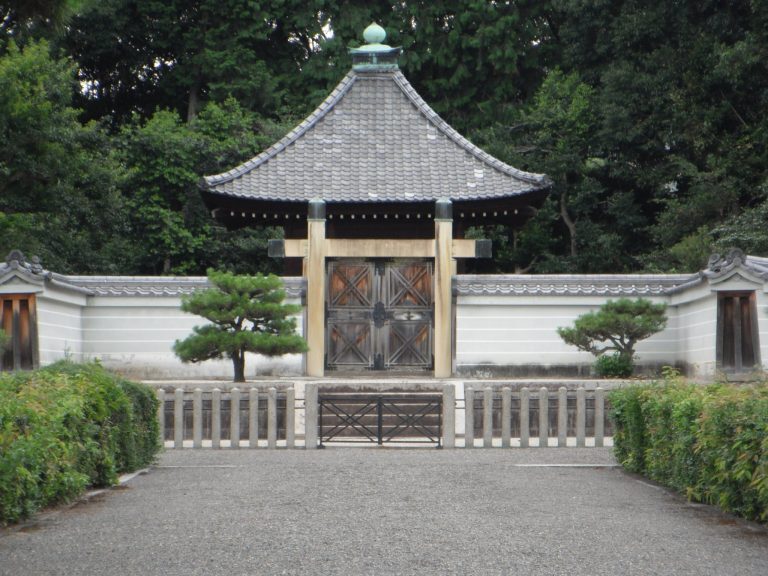
Kajū-ji’s grounds are organized around a formal approach to the Sanmon, an eastern sequence of principal buildings, and a western garden centered on Himuro Pond. White-plastered earthen walls line both sides of the approach, reinforcing the ceremonial character associated with the temple’s history as a monzeki institution.
Principal buildings and approach
Sanmon approach
The processional approach leads to the Sanmon between white-plastered earthen walls. Its enclosed, ordered form provides the entrance arrangement for the temple grounds and expresses the formal character of the former imperial and aristocratic temple.
Eastern building group
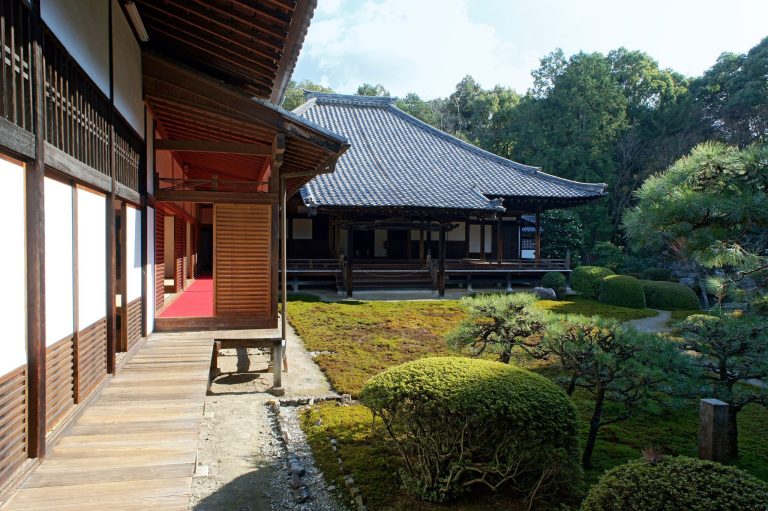
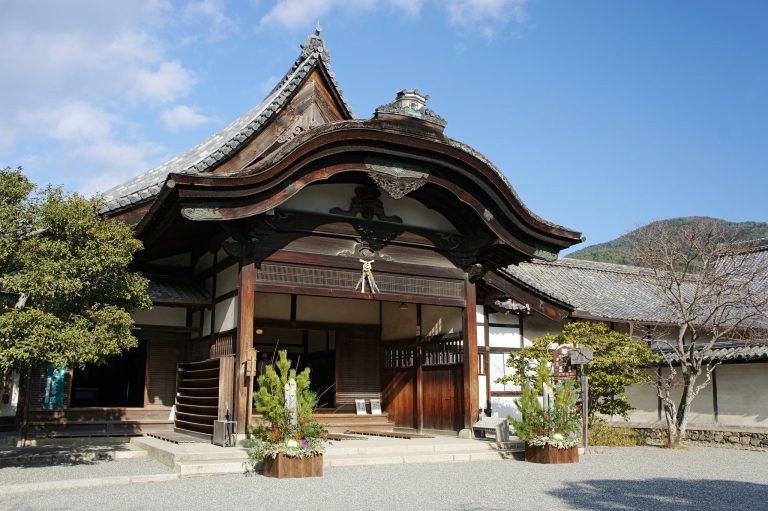
On the eastern side of the grounds, the Shinden, Shoin, Godaido, and Main Hall stand in sequence from the front. Much of the complex consists of former palace buildings presented by members of the Imperial household during Kajū-ji’s revival. The Shoin is among the temple’s nationally designated Important Cultural Properties, while the Main Hall and Shinden are Kyoto City-designated tangible cultural properties.
Himuro garden and pond
Pond garden
The western side of the grounds contains the southern garden of the Shoin and the Himuro Garden. Their principal water feature is the large pond also called Hamuro-no-ike. The pond was formerly larger and may once have formed the central element of a much more extensive pond-and-hill garden associated with Miyamichi Iemasu’s estate.
Lotus, water lilies, and irises grow in the pond garden. It was formerly used for boating and poetry gatherings and is now arranged as a strolling garden. A pavilion-style Kannon Hall, built in the early Shōwa period, stands beside the pond on the western side of the grounds.
Garden features
A stone lantern in front of the Shoin is traditionally attributed to Mito Mitsukuni, popularly known as Mito Kōmon, as a donation to Kajū-ji. An old plum tree transplanted from the Imperial Palace during the Edo period remains another notable feature of the garden and is traditionally considered especially attractive in February.
Ritual and documentary holdings
Kajū-ji’s Important Cultural Property holdings include a lotus-design makie sutra box. Makie is a Japanese lacquer technique in which designs are formed with sprinkled metallic powder. The box contains thirteen scrolls of the Dainichi Sutra.
The holdings also include three albums of Liangfen’s commentary on the Benevolent Kings Sutra, scrolls of the Vajraśekhara Yoga Tantra with a colophon dated 1050 and an associated third scroll, 935 Kajū-ji documents, and 2,435 Buddhist doctrinal and ritual texts preserved in twenty-six storage boxes.