Raigō-in Temple: A Tendai Buddhist Chanting Center in Kyoto

Site at a Glance
- Rating
- 4.2
- Popularity
- Low
- Country
- Japan
- Primary era
- Early Modern
- External website
- Open
- Eras represented
- Early Modern
- Civilizations
- Ashikaga shogunate
- Site type
- Religious
- Remains
- Temple
On this page9 sections
History
Raigō-in Temple is a Tendai Buddhist temple in Ohara, Kyoto, Japan, traditionally associated with a foundation during 851–854. Its mountain name is Uozan, it is a branch temple of Enryaku-ji, the head temple of the Tendai school, and its principal image is Yakushi Nyorai, the Buddha associated with healing.
Foundation and Buddhist chant
Temple tradition attributes Raigō-in’s foundation to Ennin, also known as Jikaku Daishi, during the Ninju era. According to this tradition, the temple was modeled on Tiantai Mountain in China and established as a center for Tendai Buddhist chant. No surviving historical evidence confirms this foundation account, but the association with formal Buddhist chanting helped shape the temple’s later identity.
After a period of decline, Raigō-in was revived in 1109 by Ryonin, the monk regarded as the founder of the Yuzu Nembutsu school. This movement taught that reciting the Buddha’s name could benefit all beings through mutual spiritual connection. Shorin-in served as the main hall of a lower temple, while Raigō-in served as the main hall of an upper temple. Together, the two temples became known as Uozan Ohara-dera.
The Ohara chant tradition
The chant tradition transmitted in Ohara became known as Ohara-style or Uozan-style Buddhist chant. Buddhist chant, or shōmyō, is the formal vocal performance of liturgical texts and melodies. The Ohara tradition later served as a prototype for the chant traditions of the Jōdo and Jōdo Shinshū schools, linking Raigō-in and its neighboring temple to the wider development of Japanese Buddhism.
Fire, affiliation, and protection
Raigō-in suffered fires on several occasions and was rebuilt after each loss. The temple later changed affiliation to the Yuzu Nembutsu school before returning to the Tendai school. During the Edo period, the Tokugawa shogunate granted it a vermilion-seal certificate, a formal authorization marked with a shogunal red seal.
The temple’s associated cultural properties include two National Treasures and several Important Cultural Properties. They include principal Buddhist sculptures, documentary holdings, and a stone three-story pagoda, preserving evidence of the temple’s religious, institutional, and literary history.
Remains
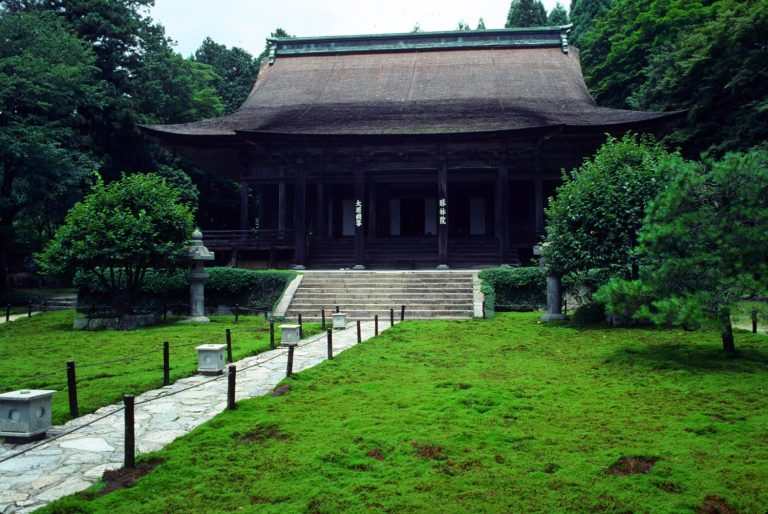
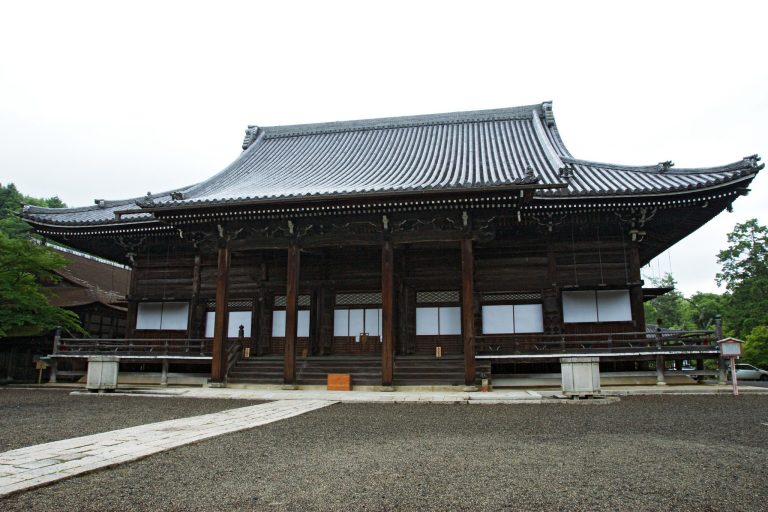
Raigō-in stands in Raigō-in-chō, in Ohara’s Sakyo Ward. Its surviving remains combine a rebuilt sixteenth-century main hall with a stone pagoda and collections of Buddhist scriptures and historical documents. Together, these features reflect the temple’s continuing connection with Tendai worship, the Yuzu Nembutsu tradition, and the preservation of Japanese religious texts.
Main hall and pagoda
The present main hall was rebuilt in 1533 after the temple’s repeated destruction by fire. Inside are wooden seated images of Yakushi Nyorai, Amida Nyorai, and Shaka Nyorai. Amida is the Buddha of the Pure Land tradition, while Shaka Nyorai is the historical Buddha, Shakyamuni. A stone three-story pagoda is traditionally regarded as the tomb of Ryonin, connecting this surviving monument with the monk who revived the temple in 1109.
Sutra repository
The Nyoraizo, the temple’s sutra repository, preserves a substantial collection of Buddhist scriptures and documents transmitted through Raigō-in. The holdings are arranged in three cases. The first contains 15 items of Ryonin’s handwritten works, 62 scripture texts, and 3 documents. The second contains 257 scripture texts and 5 documents, while the third contains 93 scripture texts and 112 documents. The collection includes handwritten works by Ryonin and reflects the temple’s role in transmitting Buddhist learning.
Documents concerning Saichō
One National Treasure consists of three documents mounted as a single scroll concerning Saichō’s ordination and clerical registration. Saichō, also known as Dengyō Daishi, was the monk who founded the Tendai school in Japan in the early ninth century. The scroll contains a draft provincial-government notification from 780, Saichō’s ordination-certificate draft from 783, and a notification from the Buddhist administrative office approving his ordination in 785. The documents record his secular name, birthplace, age, religious training, and physical marks. The third bears the original seal of the Buddhist administrative office. The scroll is entrusted to the Tokyo National Museum.
Nihon Ryōiki manuscript
Two fascicles containing the middle and lower sections of the Nihon Ryōiki survive in a manuscript from the late Heian period. The Nihon Ryōiki is an early collection of Buddhist miracle and moral-tale narratives. These fascicles are regarded as the oldest surviving copy of those sections and provide important evidence for the history of Japanese literature. They are entrusted to the Kyoto National Museum.