Zuishin-in Temple: A Major Shingon Buddhist Temple in Kyoto


Site at a Glance
- Rating
- 4.2
- Popularity
- Medium
- Country
- Japan
- Primary era
- Early Modern
- External website
- Open
- Eras represented
- Early Modern, Modern
- Civilizations
- Japanese, Tokugawa, Toyotomi regime
- Site type
- Religious
- Remains
- Monastery
On this page28 sections
History
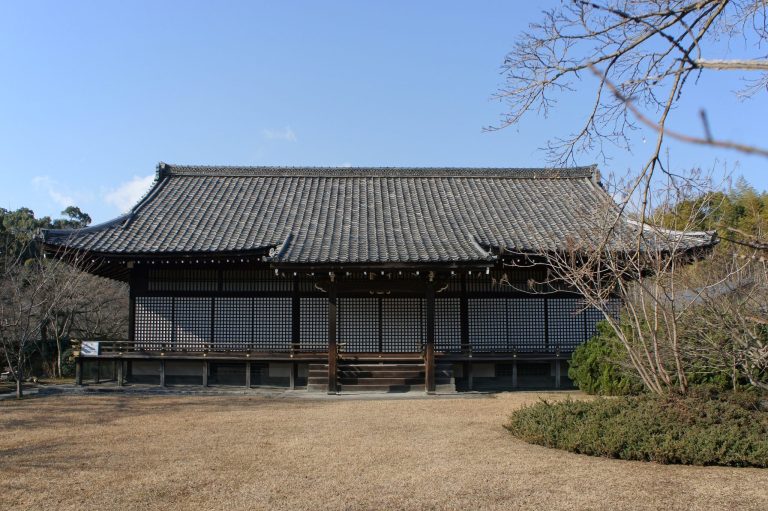
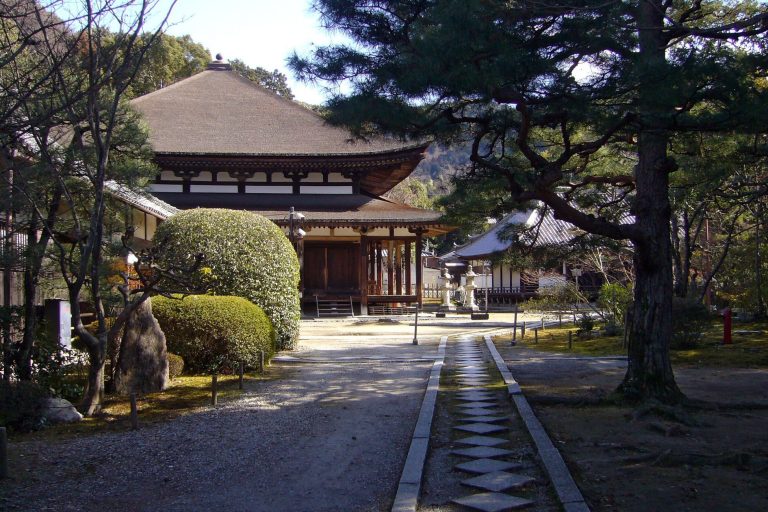
Zuishin-in Temple is a major Shingon Buddhist temple in Kyoto, Japan, whose present main hall was rebuilt in 1599 in the Momoyama-period shinden-zukuri style, a courtly architectural form associated with aristocratic residences. It belongs to the Zentsuji branch of Shingon, a Japanese school of esoteric Buddhism traditionally founded by Kukai, and its principal image is Nyoirin Kannon, a form of Kannon associated with compassionate assistance and the fulfilment of wishes.
Origins at Mandala-ji
The temple’s history began as a sub-temple of Gohizan Mandala-ji, which Ningai is said to have established in 991 after Emperor Ichijo granted him land beside the Ono family residence. The site stands in the Ono district, traditionally regarded as the base of the Ono clan, and Zuishin-in retains the Gohizan mountain-style prefix connected with Mandala-ji.
A tradition explains the name Gohizan Mandala-ji through a dream in which Ningai’s deceased mother had been reborn as a cow. After the animal died, he painted the Mandala of the Two Realms on its hide and made it the temple’s principal image. The Mandala of the Two Realms represents the complementary cosmological realms of esoteric Buddhism. A similar story in the Kojidan names Ningai’s father rather than his mother as the person reborn as the cow.
Zuishin-in itself arose during the tenure of Mandala-ji’s fifth abbot, Zoshun. Under the sixth abbot, Kengon, it became a prayer site for Emperor Juntoku, Emperor Go-Horikawa, and Emperor Shijo. During the tenure of the seventh abbot, Shigon (1151–1236), the temple acquired a more prominent institutional position. Shigon also served as head priest of To-ji and Todai-ji, and in 1229 Emperor Go-Horikawa’s imperial decree made Zuishin-in a monzeki temple. This status traditionally meant that abbots came from the imperial family or from families of regents. Members of the Ichijo, Nijo, and Kujo families later entered the temple as abbots.
War, relocation, and rebuilding
Mandala-ji held extensive temple lands in Yamashiro, Harima, and Kii Provinces. Its buildings and those of Zuishin-in suffered repeated destruction during the Jokyu War, a thirteenth-century conflict over political authority, and the Onin War, the fifteenth-century civil war that caused widespread damage in Kyoto. After the Onin War, Zuishin-in moved several times, including to the Kujō Karahashi area and to the vicinity of Shokoku-ji.
In 1599, during the tenure of its twenty-fourth abbot, a member of the Kujo family, the main hall was rebuilt on the former site of Mandala-ji. The restored temple inherited the Gohizan name and the historical traditions associated with the earlier complex, while continuing as Zuishin-in.
Aristocratic connections and institutional change
Zuishin-in’s connection with the Kujo family continued into the Edo period. Gyogon (1717–1787), a monzeki abbot and son of the regent Kujo Sukezane, attained the rank of Grand Priest. After Kujo Tanemoto died young, Gyogon returned to secular life in 1743, took the name Kujo Naozane, and eventually became regent and Grand Minister of State.
During the nineteenth-century reorganization of Shingon Buddhism, Zuishin-in remained within the institution then called Shingon. When that organization was dissolved in 1907, the Yamashina, Ono, To-ji, and Sennyu-ji branches became independent, and Zuishin-in became the head temple of the Ono branch. The branch adopted the name Zentsuji in 1931, and Zentsu-ji was elevated to head-temple status in 1941. Zentsu-ji is now the branch’s head temple, while Zuishin-in remains its major temple under an ecclesiastical director.
Ono no Komachi and modern recognition
The temple is traditionally associated with Ono no Komachi, the celebrated Heian-period waka poet. Tradition places her origins in the Ono area and says that she lived there after leaving the imperial court. Stories about her later life have shaped several memorial features within the precincts and remain part of the temple’s cultural identity.
Zuishin-in began the Hanezu Dance in 1973. In 2009, it added The Vividly Colored Plum-Scented Komachi Picture to the Noh room, linking a modern artistic commission with the longstanding Komachi traditions of the temple. The precincts were designated a National Historic Site in 1966. The temple also preserves numerous Important Cultural Properties, including Buddhist sculptures, a mandala painting, historical documents, and a large screen painting. Its pilgrimage affiliations include the eleventh position among the eighteen major Shingon temples and the eleventh position in the Kyoto Thirteen Buddhas pilgrimage.
Remains
The precincts combine a rebuilt Momoyama-period main hall with Edo-period reception buildings, performance spaces, gardens, gates, memorial structures, and religious objects. Their surviving interiors preserve fusuma, opaque sliding panels used to divide rooms, carrying paintings from the Kano school and other Edo-period artists. A pond-style garden centered on Shinji Pond forms part of the temple grounds, while the Ono Plum Garden and several Komachi-related features connect the physical setting with local tradition.
Main hall and garden
Main hall
Rebuilt in 1599, the main hall follows the courtly shinden-zukuri style associated with the Momoyama period. It houses the concealed principal image, a seated wooden Nyoirin Kannon from the Kamakura period, kept from ordinary view. The hall also contains a late-Heian-period seated Amida Nyorai and other Buddhist images. The Nyoirin Kannon became an Important Cultural Property in 2020, while the Amida Nyorai received that designation in 1917.
Shinji Pond garden
A pond-style garden is arranged around Shinji Pond. The garden forms one of the precincts’ principal landscape features and provides the setting for the temple’s wider collection of buildings and memorial sites.
Reception and performance buildings
Noh room
The Noh room was built during the Horeki era with a donation from the Kujo family and renovated in 1991. Its four fusuma carry The Vividly Colored Plum-Scented Komachi Picture, a brightly colored account of Ono no Komachi’s life created in predominantly pale pink tones by the artist unit Daruma Shoten in 2009.
Omote Shoin
The Omote Shoin was rebuilt during the Kan’ei era, between 1624 and 1631, through a donation by Tenshin-in. Its fusuma include Flowers, Birds, Mountains, and Water and The Four Loves, works dating from the period of Kano Einō.
Oku Shoin
The Oku Shoin was built in the early Edo period. Its fusuma preserve Kano-school paintings of court dances, court assemblies and banquets, virtuous sages, and tigers. Other paintings associated with the building include Bugaku, Court Figures, Sages on Sliding Panels, and Bamboo and Tiger.
Main entrance building
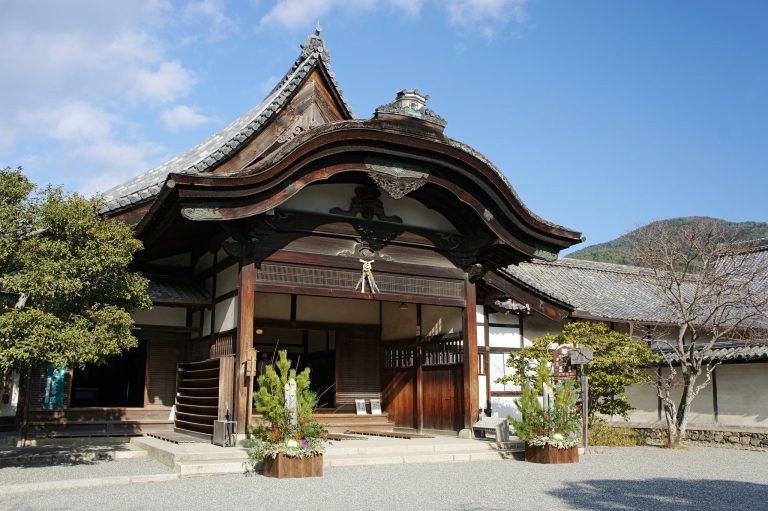
The main entrance building was rebuilt during the Kan’ei era through a donation associated with Tenshin-in of the Kujo family. It has smaller entrances on both sides and includes a messenger’s room. Its cedar panels carry Kano-school paintings of paired chickens beneath a tree and cranes among waves.
Kitchen and refectory
The kitchen and refectory were moved to Zuishin-in in 1753 from the Nijo family’s administrative residence, where the building had formed part of the palace complex. The main gate was also transferred from the Nijo family in the same year.
Gates, sub-temple, and sacred features
Gates and Komachi Hall
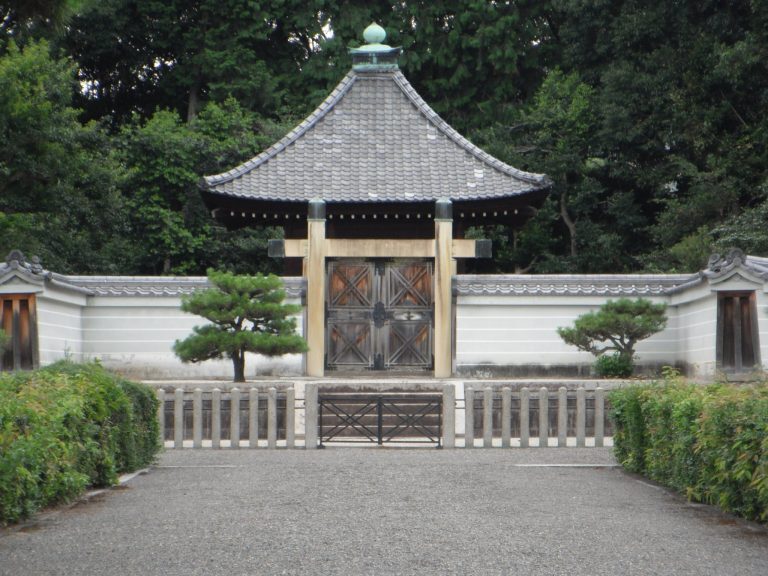
The precincts contain a Komachi Hall used as an ossuary, a longhouse gate, and a Yakui-style gate built during the Kan’ei era through Tenshin-in’s donation. A Yakui-style gate is a traditional Japanese gate form distinguished by its roof arrangement.
Daijo-in and Ningai’s memorial pagoda
Daijo-in, a sub-temple within the precincts, stands alongside Ningai’s memorial pagoda. These features preserve the connection between Zuishin-in and the monk whose foundation of Mandala-ji established the temple’s early institutional history.
Seiryu Gongen
The grounds also include Seiryu Gongen, a sacred site associated with a protective figure in Buddhist temple worship. Its presence forms part of the precincts’ continuing religious landscape.
Plum garden and Komachi traditions
Ono Plum Garden
The Ono Plum Garden contains approximately 230 plum trees, including red, white, and pale-pink varieties. The pale-pink blossoms gave the garden its traditional designation as the Hanezu Plum Garden, using the name of their distinctive color.
Komachi Garden and Komachi Kaya
The Komachi Garden and a Japanese nutmeg tree called Komachi Kaya are associated by tradition with Ono no Komachi. Together with other memorial features, they connect the poet’s traditional residence in the Ono area with the temple precincts.
Komachi’s well
A well is identified by tradition as the site of Komachi’s residence. It is said to have supplied the water she used for makeup, preserving a domestic detail within the larger body of stories about her life after the imperial court.
Komachi’s Letter Mound
Behind the main hall stands Komachi’s Letter Mound, traditionally said to contain a thousand letters sent to Komachi by noblemen, including Fukakusa no Shosho. Five round stones are arranged vertically on the mound, giving the memorial feature a defined physical form.
Sculpture, paintings, and ritual objects
Buddhist sculptures
The temple’s Buddhist sculpture collection includes a Kamakura-period seated wooden Kongōsatta attributed to the sculptor Kaikei. A vermilion inscription reading “Kōshō Hōgen Kaikei” is placed inside the statue. Other images include late-Heian-period statues of Yakushi Nyorai and Fudo Myoo, an Edo-period seated Kobo Daishi, an Edo-period seated Ningai, and figures from a Shaka triad: a Muromachi-period seated Shaka Nyorai, a late-Heian-period Fugen Bosatsu, and a Nanbokucho-period Monju Bosatsu.
Mandala and screen paintings
Among the temple’s Important Cultural Properties is a Kamakura-period silk painting of the Aizen Mandala. Another is the Edo-period ink-and-color painting The Orchid Pavilion Gathering, mounted as two pairs of eight-panel screens and attributed to Kano Sansetsu. The unsigned work depicts Wang Xizhi inviting forty-one eminent men to the Orchid Pavilion in AD 353, where cups floated along a winding stream as poems were composed. Its attribution rests on distinctive tree forms and the use of cunfa, a Chinese landscape-painting technique.
Other paintings include the Edo-period Four Poets screen by Tsuruzawa Tansaku, the Bugaku Screen by Kano Tanshin, a pair of crane-and-tortoise paintings by Ganku, and Flowers of the Four Seasons on the Omote Shoin fusuma. These works complement the paintings preserved on the sliding panels and entrance screens throughout the temple buildings.
Documents and ritual objects
Five volumes of Zuishin-in documents dating from the Heian period are among the temple’s Important Cultural Properties. Its ritual and religious objects include a late-Heian-period Fukuukenjaku Myoo attributed to Ningai, a single-pronged vajra and a three-pronged vajra said to have belonged to him, and a rosary incorporating a five-pronged vajra transmitted through the monzeki succession. A vajra is a ritual implement associated with indestructibility and spiritual power. The temple also preserves a late-Heian-period cowhide flower garland attributed to Ningai and associated with Fukusho-ji.