Compesières Commandry: Historic Headquarters of the Order of Malta in Switzerland
Visitor Information
Google Rating: 4.5
Popularity: Very Low
Country: Switzerland
Civilization: Crusader, Early Modern, Modern
Site type: Military
Remains: Castle
History
The Compesières Commandry is located in the small settlement of Compesières within Bardonnex, Switzerland. It served as the principal headquarters of the Order of Saint John, later known as the Order of Malta, in the Geneva region. The Commandry belonged to the Auvergne langue, a linguistic and administrative division of the Order.
The site first appears in records from 1270, when Aymon de Cruseilles, the Bishop of Geneva, donated a Romanesque church to the Order. This church, dedicated to Saint Sylvester, was built on earlier Roman foundations. The Order established a hospice there to care for travelers and the sick. Over the following century, the Order expanded its presence in the region, including operating a hospital and a two-story house with a tower at Hautevillette in the County of Geneva, active until 1576.
Between the late 1300s and early 1400s, the Order constructed a fortified house next to the church. This building became the administrative center for the Commandry in the Genevois area. During the Protestant Reformation, from 1536 to 1567, the castle was seized and used as the residence of the Bernese bailiff. Although the Order was dispossessed, it returned in 1564. However, the site remained under the control of Protestant Geneva and Bern until a treaty in 1598 restored full possession to the Order.
In the late 16th century, the Commandry was threatened during conflicts between the Duchy of Savoy, led by Charles Emmanuel I, and Geneva. King Henry IV of France intervened to protect the site from destruction. The knights’ hall from this period features a heraldic ceiling with 165 painted coffers displaying religious and heraldic symbols arranged in five sections.
From 1617 until the French Revolution, the Order expanded the fortified house and church, surrounding them with a defensive wall that included round towers. In 1792, French troops occupied the Commandry, converting it into national property. The towers and church bell tower were destroyed, all Order insignia removed, and the building repurposed as a saltpeter factory.
Following the French occupation, the Commandry passed into private hands before being acquired by the local municipality. Starting in 1822, it housed the town hall, school, and parish. The church underwent major reconstruction in 1834–1835. The defensive enclosure was demolished in the early 20th century to make way for a new school building. Renovations of the castle took place in the mid-20th century and again in 1971. Since 1955, a room within the castle has been dedicated to a museum honoring the Order of Malta, featuring a 15th-century painted cross from the Mouxy chapel. Today, the Commandry remains a protected cultural property of national importance in Switzerland and continues to serve as the municipal town hall and church parish.
Remains
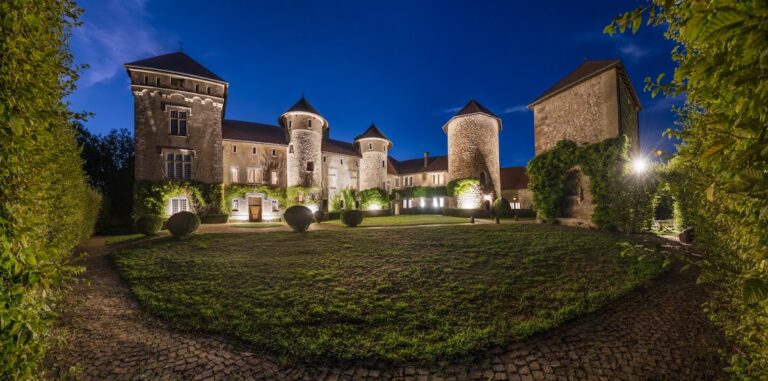
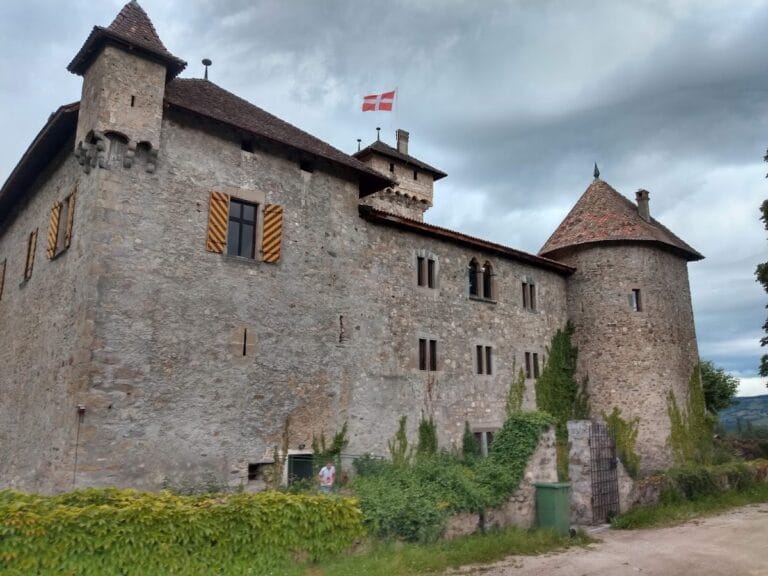
The Compesières Commandry consists of a fortified residence built alongside a Romanesque church originally dedicated to Saint Sylvester. The oldest parts of the site date back to the late 13th century, with the main castle structure constructed during the 15th century. The complex once included a defensive enclosure with round towers added in the 17th century.
A notable feature inside the Commandry is the knights’ hall, which has a heraldic ceiling composed of 165 painted wooden panels, known as coffers. These panels display religious and heraldic imagery arranged in five sections defined by the main beams of the nave. This ceiling dates from the late 16th century, reflecting the artistic style of that era.
The defensive wall and its round towers, built during the 17th-century expansions, were destroyed in 1792 during the French occupation. The church’s bell tower was also demolished at that time. The church itself was largely rebuilt in 1834–1835, altering much of its original medieval fabric. The enclosure surrounding the Commandry was removed in the early 20th century to allow construction of a school.
The castle has undergone several restorations, notably in 1954–1955 and 1971, which helped preserve its structure. Today, the building includes a museum room dedicated to the Order of Malta, housing artifacts such as a 15th-century painted cross from the Mouxy chapel. The Commandry remains well preserved and continues to function as a municipal and religious center.
Nearby sites