Church of the Presentation of Mary, Roztoka: A 17th-Century Wooden Church in Ukraine
Site at a Glance
- Popularity
- Very Low
- Country
- Ukraine
- Primary era
- Early Modern
- Eras represented
- Early Modern
- Civilizations
- Habsburg, Hungarian
- Site type
- Religious
- Remains
- Church
On this page14 sections
History
Foundation and traditions
The Church of the Presentation of Mary in Roztoka, Ukraine, is a wooden church founded in 1650 in the Boyko tradition, a regional building tradition associated with the Boykos, an East Slavic people of the Carpathians. It is first mentioned in 1759. The church was regarded as the oldest and most architecturally accomplished of the Mezhyhirya group, and its design probably influenced churches in Podobovets, Pylypets, Bukovets, Izky, Torun and Pryslip.
Local traditions offer different accounts of how the church arrived in Roztoka. One says villagers bought it in neighboring Studene, dismantled it and hauled it by oxen across the mountains between the valleys. Another places its purchase in a Galician Boyko village and says it was first brought to the lower village. Residents of the upper part then moved the dismantled building uphill by oxen at night.
Refashioning and parish use
The church began as a three-towered building, with its central tower tallest. An inscription beside the south door records work in 1759, when the church was refashioned into a single-towered Baroque form. Baroque was a European artistic and architectural style especially associated with the 17th and 18th centuries. The change formed part of modernization among Eastern-rite Christians in communion with Rome, although its extent is uncertain and may chiefly have involved a new crowning for the tower.
Inscriptions also preserve the names of people who contributed to the church’s furnishings. Vasyl Dovhanych bought an Annunciation icon in 1709, Roman Tyaskailo made an image of the Virgin Mary, and Ilko Holovchyn carved the royal doors. An inscription by the south entrance marks the death of a church patron in 1800.
Recent history and protection
A new wooden church was built between 1993 and 1996, followed by a bell tower beside it in 1998. In 2001, the parish sold the old church’s iconostasis and many icons for a small sum and used the proceeds to equip the new building. The large folk-painted Last Judgment icon was transferred there separately. The old church was left empty, and its roofs deteriorated severely. In summer 2005, craftspeople from Synevyrska Polyana, led by Ivan Rusnak, renewed the roof covering. The church is designated a national architectural monument, number 224.
Remains
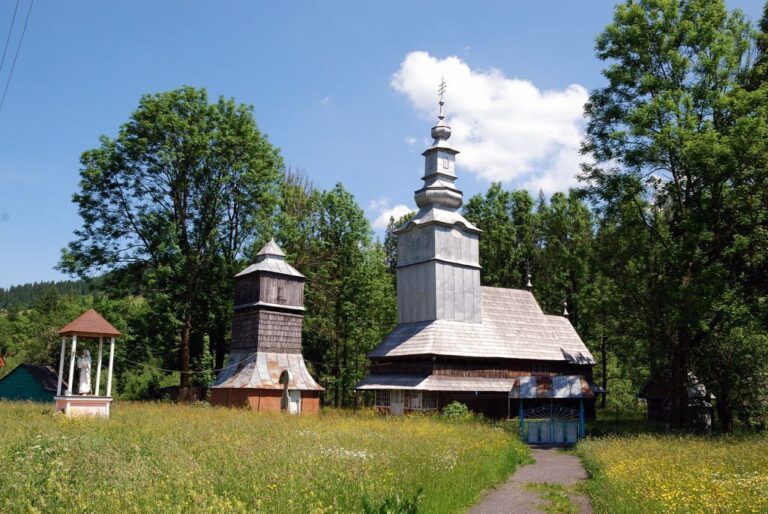
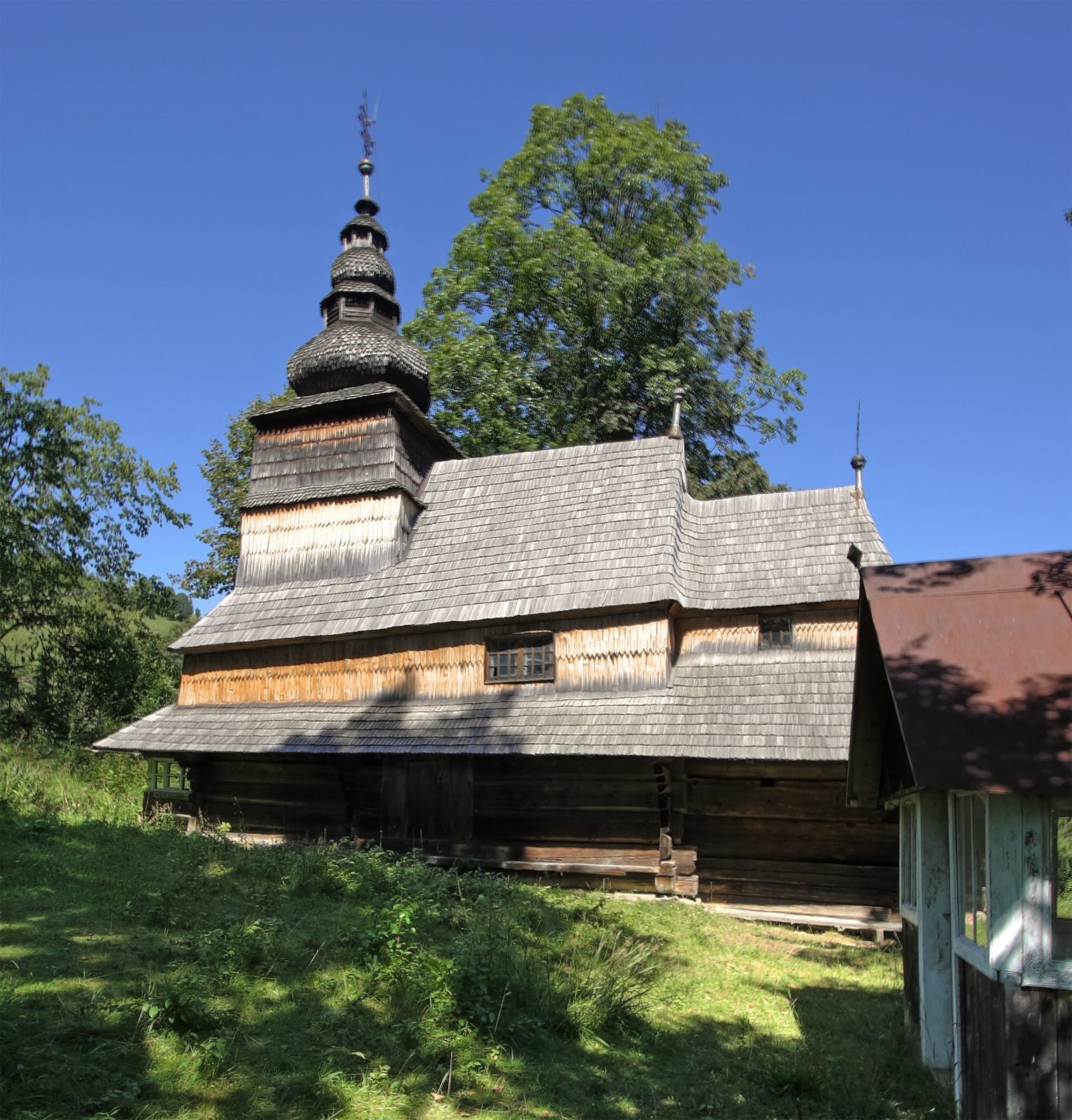
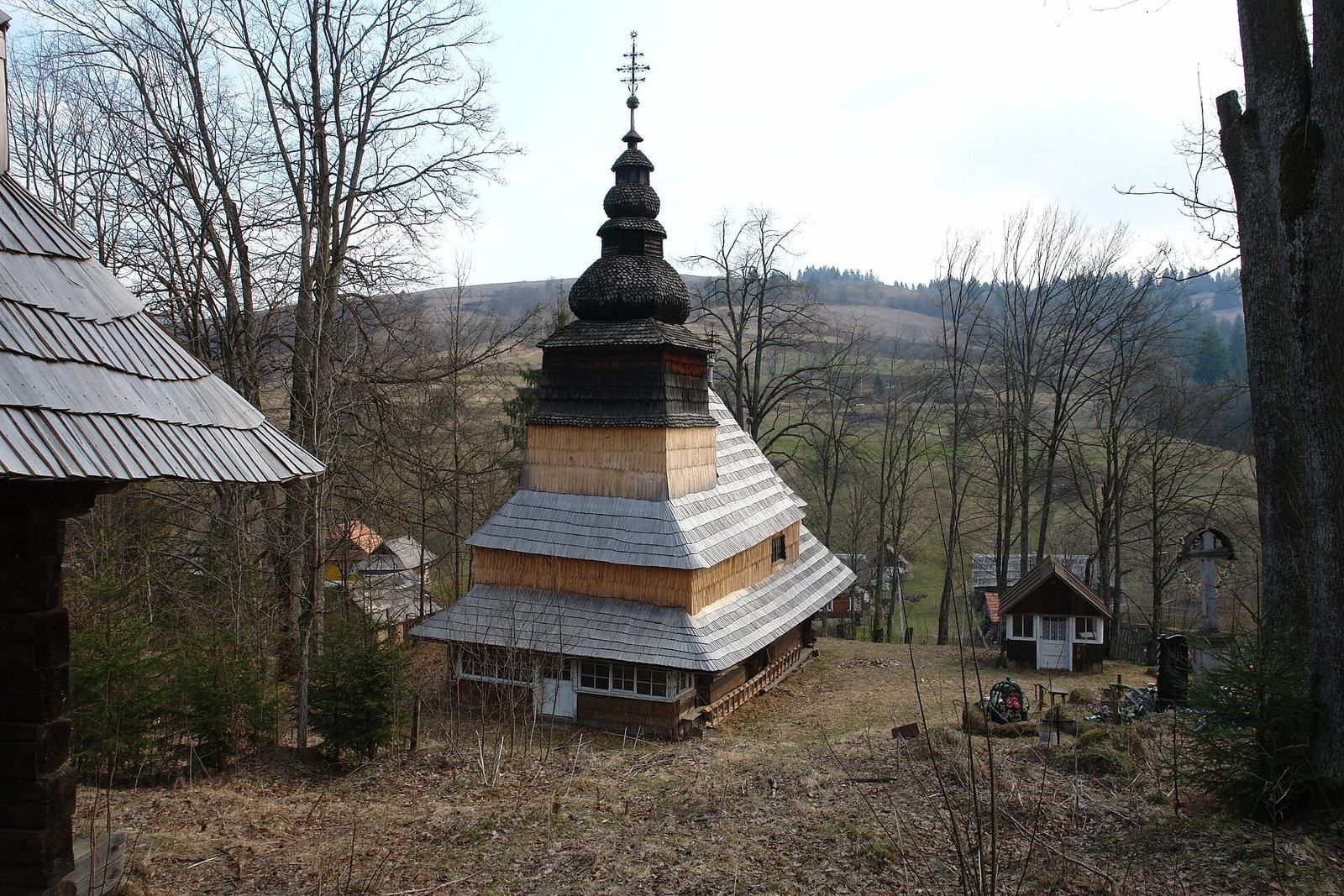
The old church stands on a steep, tree-covered hillside, with mountains behind it. Its timber structure has a three-part rectangular plan, a broad roof projecting around the walls, and a tower at the western end. A separate wooden bell tower stands higher up the slope.
Main church
Plan and timber structure
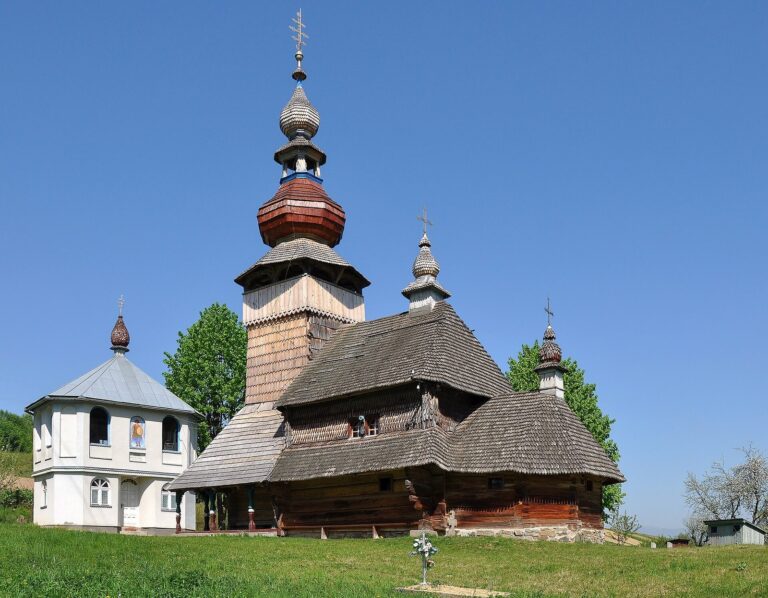
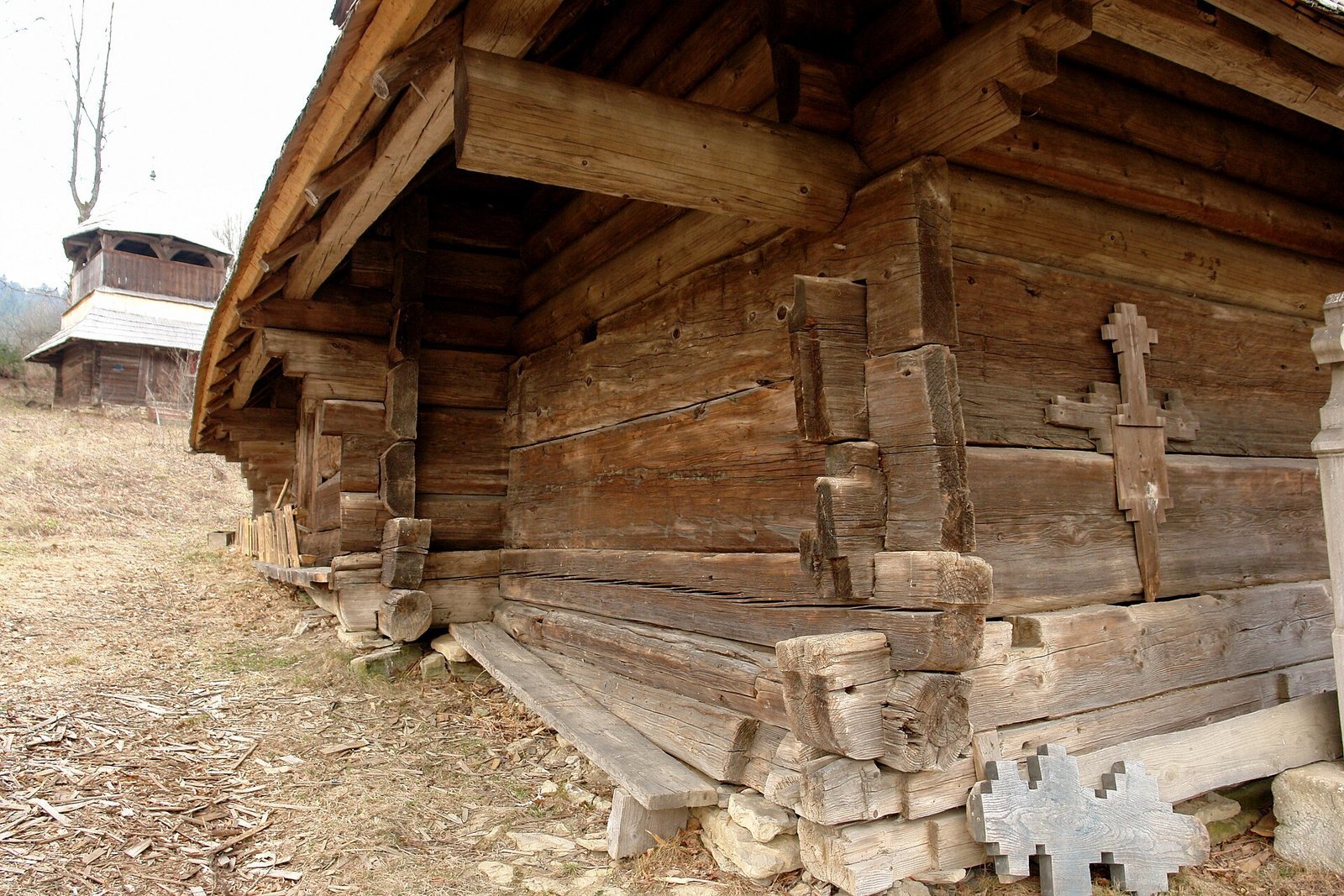
The church is 13.5 metres long. Its entrance compartment, or narthex, and main congregational space, or nave, are equal in width, while the square sanctuary, the area containing the altar, is narrower. Fir logs form the structure, and oak shingles cover the walls and roofs. A wide, bracket-supported roof overhangs the building. The west porch has four columns; formerly open, it was later enclosed as a glazed veranda. Shingles make the roofs over the nave and sanctuary appear continuous while concealing the junction between their timber structures. The nave and narthex have flat ceilings.
West tower and exterior form
The tower rises above the narthex to a height of 17 metres. It narrows in successive stages, with horizontal divisions and a two-tiered Baroque crown topped by an octagonal dome and lantern. The roof over the building’s broad overhang also wraps around the tower. From the east, the building’s outline is relatively even; from the west, the substantial nave and sanctuary contrast with the narrower tower. The church is in satisfactory condition.
Separate bell tower
The separate 18th-century wooden bell tower stands above the church, nearer the hilltop. It has a square plan and two levels. Its lower section, built from logs beneath a sloping roof that projects around it, encloses four supporting posts. These posts carry the taller, boarded upper section. The bell chamber has two open arched windows on each side and a low, octagonal pyramidal roof covered with shingles.
Interior and painted furnishings
Iconostasis and royal doors
The small interior formerly held an iconostasis, an icon-bearing screen separating the nave from the sanctuary, along with icons from different periods, embroidered cloths, carpets and old engravings. The original 17th-century screen had columns and cornices arranged in a rising, broken-line composition rather than a rectangular grid. Every tier above the lowest climbed more steeply toward the centre. Its painting may have come from the same workshop as work at Pryslip. The carved royal doors, the screen’s central doors, showed the Tree of Jesse, a representation of Christ’s genealogy. Twisting branches formed twelve openwork scrolls, each containing a biblical figure in low relief. The old iconostasis was sold in 2001.
Virgin Mary images
Roman Tyaskailo is credited with making an image of the Virgin Mary. A separate Hodegetria, a traditional image of the Virgin with the Christ Child, was painted by the iconostasis painter. It uses blue, red and ochre, with a carved, gold-toned frame. The painter favored a monumental, fresco-like treatment over fine detail and gave the saints features resembling those of ordinary Ukrainians.
Saints and feast-day icons
Two 17th-century icons, Saint Nicholas and Saint Paraskeva, were kept in cases on the north and south walls of the nave. They are attributed to an artist probably trained through prints, whose work has a strongly graphic, structured character. Icons from the feast-day and Deesis rows, the latter centered on Christ with intercessory figures, hung on the south wall. They probably came from an iconostasis made in the first quarter of the 17th century. Their fresco-like painting uses bold brushstrokes to outline folds in the garments rather than shading them, preserving traditions of 16th-century art.
Protection and Last Judgment icons
A likely local painter signed an icon of the Protection of the Mother of God, a subject showing the Virgin’s protective intercession. Although its composition follows traditional iconography, Romanos the Melodist, a Byzantine Christian hymnographer and saint who shared the painter’s name, dominates the scene and is larger than the other figures.
The large folk-painted Last Judgment icon, probably made around the turn of the 18th and 19th centuries, was once displayed on the nave’s north wall and is now in the new church. It depicts the judgment of peoples and the world, while satirizing contemporary vices through figures including customs officials, usurers, drunkards, fortune-tellers, slanderers, thieves and robbers.