Church of the Dormition of the Theotokos (Schapovo): An Orthodox Parish Church
Site at a Glance
- Popularity
- Low
- Country
- Russia
- Primary era
- Early Modern
- Eras represented
- Early Modern, Modern
- Civilizations
- Russian
- Site type
- Religious
- Remains
- Church
On this page14 sections
History
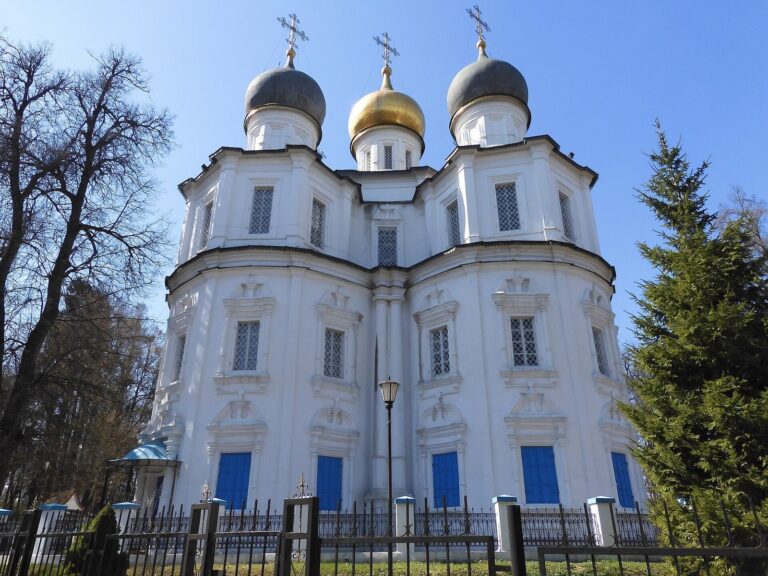
The Church of the Dormition of the Theotokos (Schapovo) is an Orthodox parish church in Schapovo, Russia. Its present brick building was completed and consecrated in 1779 in the Classical style, which draws on ancient Greek and Roman forms. The Dormition is the Eastern Orthodox commemoration of Mary’s death and assumption into heaven, while Theotokos means “God-bearer.”
The wooden church and Alexandrov estate
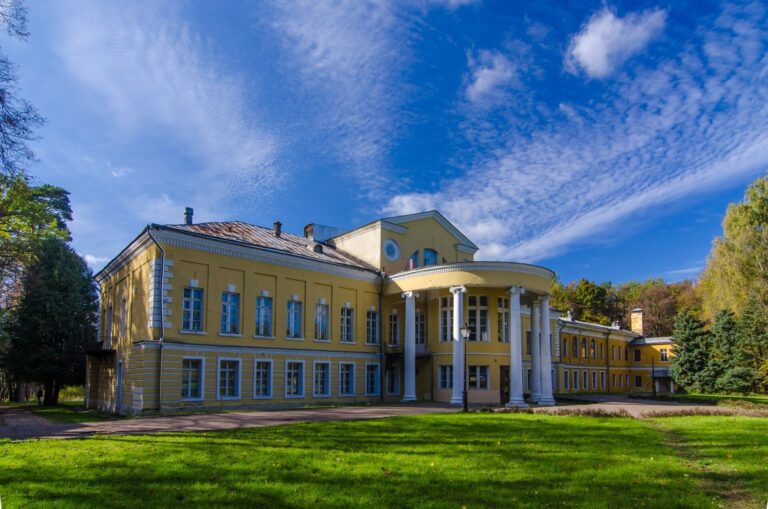
In 1612, the boyar Vasily Morozov, a high-ranking Russian noble, erected a wooden church on his estate at Alexandrov, above the Lubenka River. In 1681, Tsar Fyodor Alexeyevich granted the village to Mikhail and Vasily Grushetsky, cousins of his late wife, Tsarina Agafya Grushetskaya. The two men served as chamber stewards, officials who attended to the tsar’s private chambers.
The brick church and nineteenth-century owners
After the village passed through several owners, Senator Vasily Grushetsky, an official of Russia’s governing Senate, financed a brick church beside the wooden one. A 1779 decree of the Synod, the governing body of the Russian Orthodox Church, required the new Church of the Dormition to be built alongside its predecessor and directed that the older church’s icons and sacred furnishings be moved into it. The brick church was completed and consecrated that year.
French forces camped near Alexandrov in 1812 as they prepared to advance on Moscow, and raided villages in the area. At the church, they took silver covers from two Gospel books. In April 1815, the estate was sold to Brigadier Ivan Arsenyev, a military officer with the rank of brigadier. He devoted substantial resources to the church. The property later passed as a dowry to his daughter Evdokia, who added a chapel in 1819 for John the Warrior, a Christian saint venerated as a martyr.
Shchapov, schools, and community work
Moscow manufacturer Ilya Shchapov bought the estate in March 1889. The church had deteriorated badly, about four decades after Arsenyeva’s death. Shchapov arranged repairs and added a wooden wing for a charitable home for elderly women without homes. He also built two clergy houses and paid for a stone building for pupils’ after-school activities.
In 1892, the Cyril and Methodius Brotherhood, an Orthodox educational association, opened a boys’ parish school in Alexandrov. It served as many as 200 pupils, and Shchapov provided its stone school building. In 1912, a local self-government body, the provincial zemstvo, established a lace-making school for girls. The pupils learned both lacework and literacy.
Peter Vorona served at the church as a reader from December 1915 for ten years. A reader leads scripture and prayer readings during services. Venerated as a priest-martyr, Vorona was shot on 11 December 1937 at the Butovo firing range near Moscow.
Closure, changing uses, and return to worship
The church closed in 1929, and its interior decoration was burned. Maria, an altar attendant, later recalled that a vehicle became stuck during the removal of church property. Workers placed an icon of the Holy Trinity beneath its wheels; it survived with tire marks. For decades, the building served as a blacksmith’s shop, workshops, and a fertilizer store. Fumes from the fertilizer damaged the wall paintings.
Restoration began in the mid-1980s under the patronage of M. M. Boynovich, director of the agricultural firm Shchapovo, with plans to turn the church into a concert and organ hall. An organ made by Rieger-Kloss in Krnov, Czechoslovakia, in 1988 was acquired in 1989 at Boynovich’s initiative. Its first concert took place on 23 May that year. The Orthodox community regained the church in 1990, and the organ was later moved to a new hall at the municipal museum of the history of the Shchapovo estate.
Restoration continued after the community’s return. Benefactors and parishioners improved the church grounds, restored the enclosure, and erected a bell tower. On 19 May 1996, Metropolitan Juvenaly (Poyarkov), a senior Orthodox bishop, consecrated a new altar table, the table used to prepare bread and wine for the Eucharist, along with a recreated carved icon screen. The active church belongs to the Nikolsky Deanery, a group of parishes, in the Moscow City Diocese, a bishop’s administrative district.
Remains
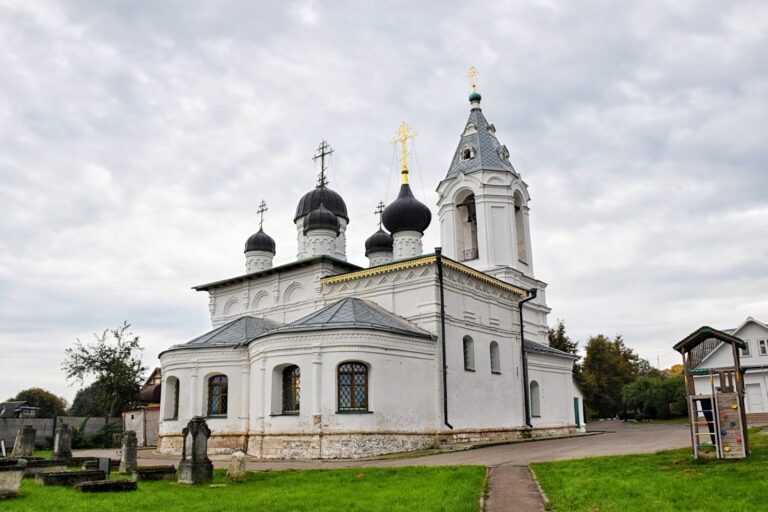
The complex centers on the brick church, built in the Classical style, within an elongated enclosure. The grounds also include surviving school buildings and other structures associated with the estate’s charitable and educational work.
Church and enclosure
Main building and access
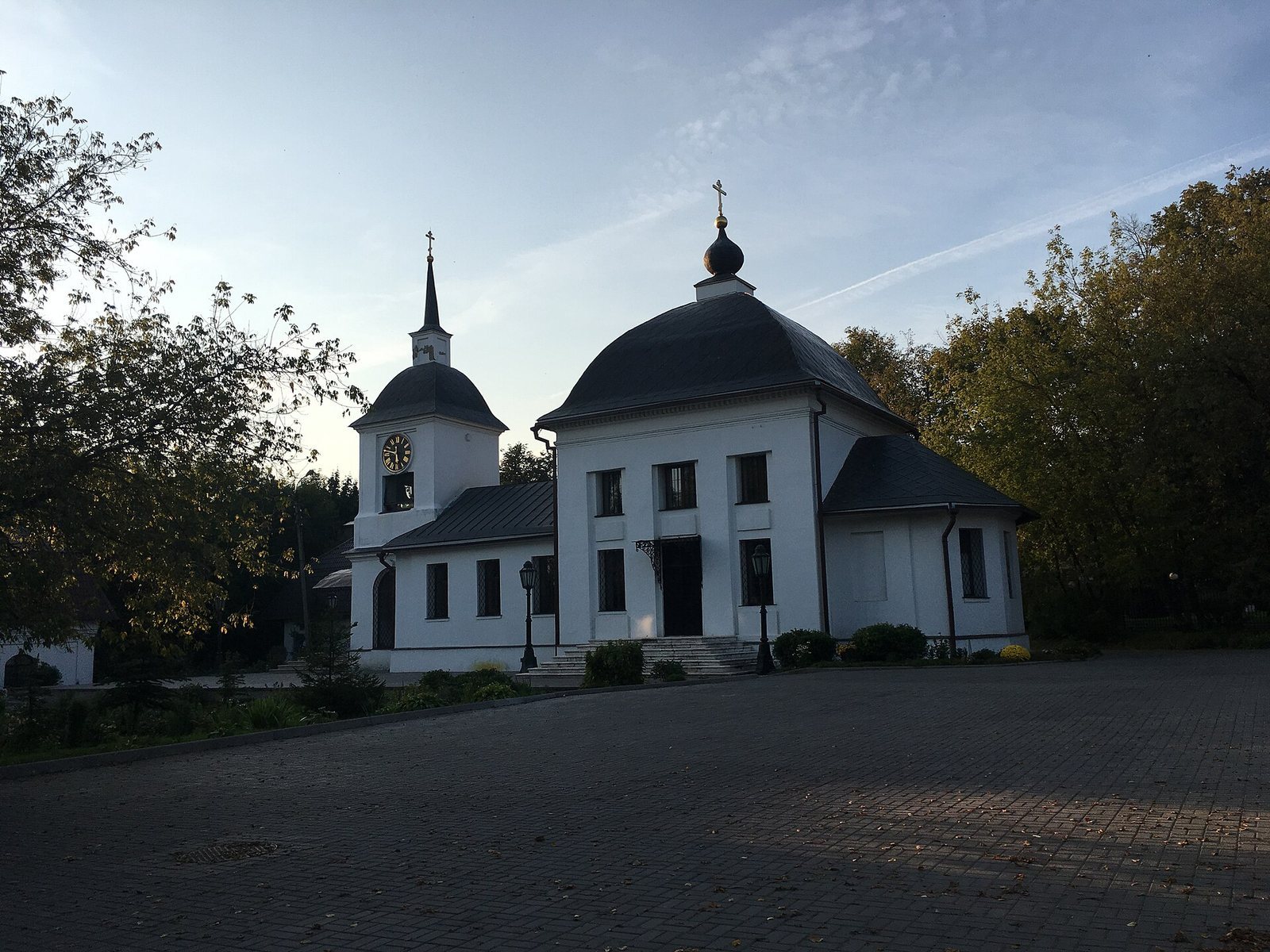
The church’s tall worship space extends through two storeys. A lower gathering hall with three windows links it to the two-tier bell tower. The roof has a square base beneath an onion-shaped cupola, and the brick building adopts the hipped-roof form of its wooden predecessor. A fence encloses the church in an elongated octagon, with a gate on the south side. Broad staircases, with flights on three sides, lead to the church and bell-tower entrances. A side chapel is dedicated to John the Warrior.
Interior and sacred objects
The iconostasis, a screen of icons separating the sanctuary from the main worship space, was painted and gilded. Images of the apostles and Gospel accounts of Jesus’ miracles were painted on the church vault. Frescoes, wall paintings made on wet plaster, survive beneath the dome from the original interior decoration. Fertilizer fumes caused other frescoes to crumble.
Sacred objects associated with the church include a crucifix containing relics, physical objects linked to holy people or places, including fragments associated with the Oak of Mamre and the Upper Room on Mount Zion. A reliquary, a container for relics, holds fragments linked to monastic saints of the Kyiv Pechersk Lavra and to Maximus the Greek, an Orthodox monk and scholar. Other icons contain relics associated with John the Baptist, the preacher who baptized Jesus; the Apostle Andrew, known in Orthodox tradition as the First-Called; and Aristocles of Athos, an Orthodox monk and elder. Icons above the chapel entrance carry fragments associated with Isaac of Optina, Agapit of Kyiv Pechersk, an unmercenary physician, and the 14,000 infants remembered in Christian tradition as victims of Herod’s order.
Bell tower
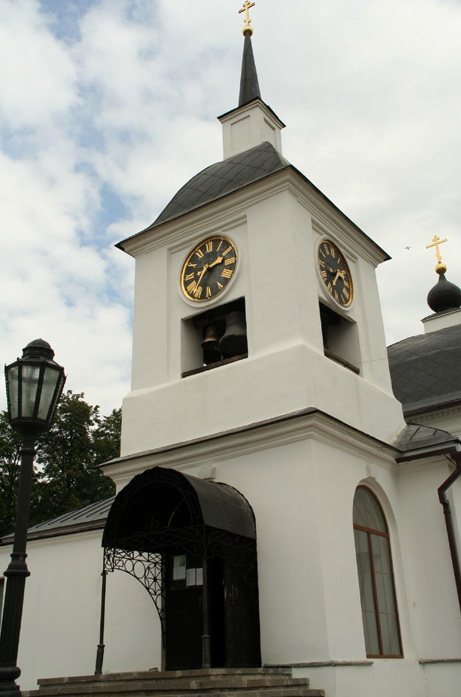
A chiming clock ordered from England was installed in the bell tower. Its mechanism still works.
Estate buildings
Charitable home and clergy houses
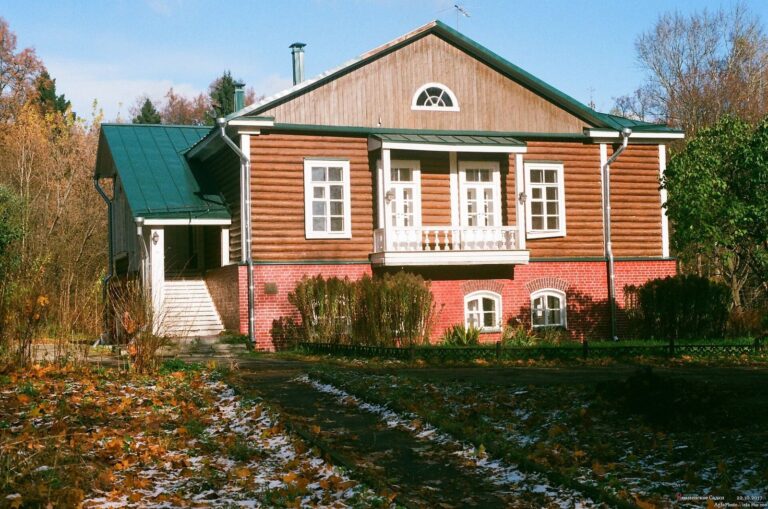
A wooden wing added to the church accommodated the charitable home for elderly women without homes. Two wooden clergy houses were built on stone foundations.
Boys’ school buildings
The boys’ parish school occupied a stone building erected by Shchapov. The school continues in Sunday-school use, and its surviving building now serves as the parish house. A separate stone structure was built for pupils’ after-school activities.
Girls’ lace-making school
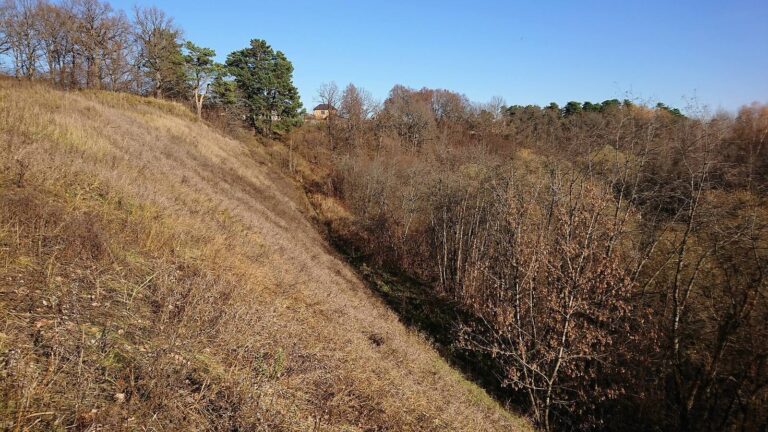
The lace-making school building survives near a ravine in a low, damp part of the estate, a setting considered suitable for the craft taught there.