Château Mouton Rothschild: A Premier Cru Wine Estate in Pauillac


Site at a Glance
- Rating
- 4.5
- Popularity
- Low
- Country
- France
- Primary era
- Modern
- External website
- Open
- Eras represented
- Modern
- Civilizations
- French
- Site type
- Economic
- Remains
- Production Complex
On this page14 sections
History
Château Mouton Rothschild is a historic wine estate in Pauillac, France, within the Médoc and the broader Haut-Médoc appellation of Bordeaux. Its landholding can be traced to 1311, while its viticultural development began in the seventeenth century and its modern identity was shaped by the Rothschild family.
Medieval landholding and early vineyards
In 1311, the land belonged to the feudal lord Pons de Castillon. It later passed through the family of Foix to the notary Jacques de Ségur. During the fifteenth century, part of the estate was associated with Humphrey, Duke of Gloucester, the younger brother of Henry V. After the English defeat in the Hundred Years’ War, the former English possession passed into French hands.
Jacques de Ségur began planting vines in 1670 on part of the wider holding, in an area now associated with Château Lafite Rothschild. His son Alexandre married the heiress of Château Latour, linking the family to another major Pauillac estate. Their son Nicolas-Alexandre de Ségur expanded Mouton in 1717, then sold it in 1720 to Joseph de Brane. This transaction separated Mouton from Lafite, while an existing estate building passed to Dominique Armailhac, the owner of Château d’Armailhac.
The Brane and Thuret periods
Joseph de Brane gave the property the name Château Brane-Mouton. Under the Brane family, the estate prospered. Its wines were sold at lower prices than those of Lafite and Latour, yet generated revenues comparable to those of the Pichon estates.
In 1830, Joseph de Brane’s grandson Hector sold Brane-Mouton for 1.2 million francs to Isaac Thuret, a Parisian banker. Management then deteriorated, the vineyards declined, and wine quality fell. On 11 May 1853, Thuret sold the 35-hectare estate for 1.124 million francs to Nathaniel de Rothschild, a banker from the English-origin branch of the Rothschild family.
Rothschild ownership and the 1855 classification
Nathaniel de Rothschild appointed Théodore Galos as estate manager, invested in improving the wine, enlarged the holding, and renamed it Château Mouton Rothschild. In 1855, the Bordeaux Wine Official Classification ranked the estate as a Deuxième Cru Classé, or second growth. The classification primarily reflected the market prices of leading estates’ wines, so this rank placed Mouton below the Premier Cru Classé, or first-growth estates. The decision also reflected the property’s recent decline and may have been influenced by its ownership by an English-origin banker.
In 1868, Nathaniel’s uncle and father-in-law James Mayer Rothschild acquired the neighbouring first-growth estate Lafite and renamed it Château Lafite Rothschild. James-Edouard de Rothschild later commissioned an administrative and residential building at Mouton. His death in 1881 led his widow, Thérèse, to complete the work. Their son Henri James de Rothschild subsequently managed the estate, but his main interests lay in the arts and theatre, and mismanagement again affected the property.
Philippe de Rothschild and estate bottling
Philippe de Rothschild developed an interest in viticulture while spending time at Pauillac during the First World War. After reporting the estate’s mismanagement to his father, he received its management on 22 October 1922. He made bottling the entire harvest at the estate the foundation of a new production policy. Château Mouton Rothschild became an early pioneer of estate bottling, rather than selling wine in barrels to merchants for bottling elsewhere.
Philippe de Rothschild pursued the estate’s elevation within the 1855 classification for decades. In 1973, Château Mouton Rothschild became a Premier Cru Classé. This was the only substantive change to the original classification apart from the addition of Château Cantemerle in 1856. The estate’s motto changed accordingly from “Premier ne puis, second ne daigne, Mouton suis” to “Premier je suis, Second je fus, Mouton ne change.”
Wine production and international partnerships
The estate introduced its second wine, Le Petit Mouton, in 1993. It also produces Aile d’Argent, a dry white Bordeaux wine. Philippe de Rothschild SA expanded beyond Pauillac through international partnerships. In 1978, it announced a joint venture with Robert Mondavi that created Opus One Winery in Oakville, California. During the 1990s, the company expanded in North and South America, and in the late 1990s it partnered with Concha y Toro to establish a winery in Chile’s Maipo Valley. The Chilean wines Almaviva and Escudo Rojo followed.
The 1976 Judgment of Paris was a blind tasting in which French and Californian wines were compared by judges in Paris. The 1970 Château Mouton Rothschild placed second and was the highest-ranked French wine. The 1945 vintage, produced under cellar master Raoul Blondin, carried a “V” design by Philippe Jullian commemorating victory over Nazi Germany. It became one of the estate’s most celebrated wines, while surviving bottles grew scarce and counterfeits became numerous.
Art, ownership, and interpretation
Since the 1945–1946 vintages, the estate has generally commissioned a different artist to design each year’s label. Contributors have included Jean Hugo, Jean Cocteau, Georges Braque, Salvador Dalí, Henry Moore, Joan Miró, Marc Chagall, Wassily Kandinsky, Pablo Picasso, Andy Warhol, Francis Bacon, Keith Haring, Anish Kapoor, Jeff Koons, David Hockney, Lee Ufan, Gerhard Richter, William Kentridge, Olafur Eliasson, Peter Doig, Chiharu Shiota, and Gérard Garouste.
Several labels commemorate particular events or associations. The 1953 design marked the centenary of Nathaniel de Rothschild’s acquisition. The 1973 label was dedicated to Pablo Picasso, while the 1977 design commemorated a visit associated with Queen Elizabeth II and the Queen Mother. Two Jean-Paul Riopelle designs were used for the 1978 production. The 2003 label marked 150 years of Rothschild ownership with a photograph of Nathaniel de Rothschild and part of the deed of sale.
The 1993 Balthus label was altered for the United States market after the Bureau of Alcohol, Tobacco, Firearms and Explosives rejected its nude figure. The American version left that area blank, and both versions became sought-after by collectors. The 2000 vintage replaced the conventional paper label with artwork applied directly to the bottle. The estate also operates a museum and maintains winery interpretation facilities. In 2003, it hosted La Fête de la Fleur at the end of Vinexpo, coinciding with the 150th anniversary of Rothschild ownership.
Philippine de Rothschild and her son Philippe are members of Primum Familiae Vini, an international association of longstanding family-owned wine businesses. The estate is also an honorary member of the Union des Grands Crus de Bordeaux.
Remains
Gravel rise and vineyards
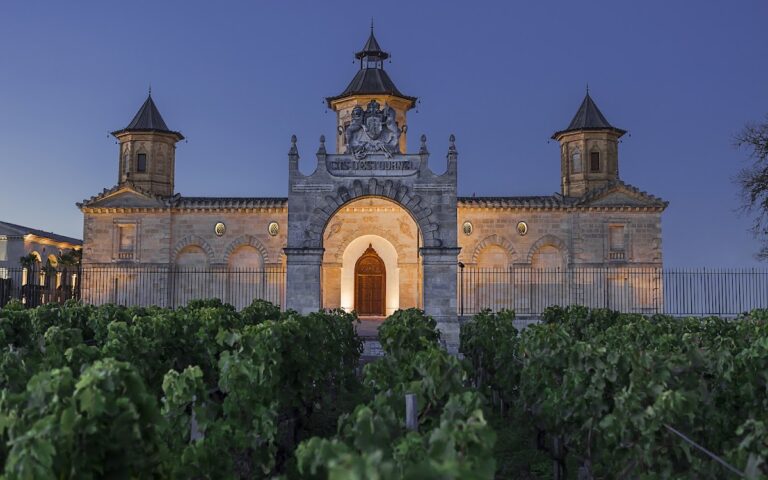
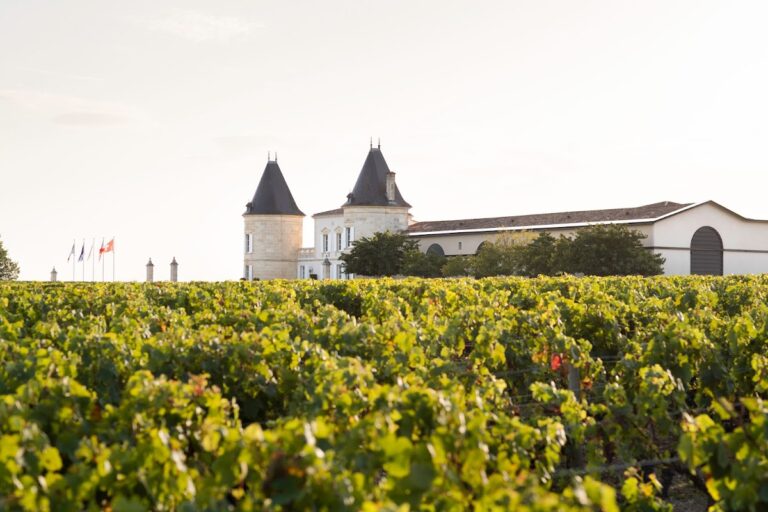
Château Mouton Rothschild lies in northern Pauillac, where its vineyards descend toward the Gironde Estuary. The estate and neighbouring Château Lafite Rothschild occupy a gravel-capped rise reaching about 30 metres in height. More than eight metres of gravel cover a limestone base. The Gironde deposited these gravels from Pyrenean sediments carried by glacial meltwater at the end of the Günz glacial period.
The poor, heat-retaining gravel soil limits yields, encourages earlier ripening of Cabernet Sauvignon, and drives vine roots deep into the ground. Drainage runs toward the Vallon du Poujalet. The vineyards cover approximately 82 hectares, planted with 77 percent Cabernet Sauvignon, 12 percent Merlot, 9 percent Cabernet Franc, and 2 percent Petit Verdot. The detailed 2007 description gives an average density of about 8,500 vines per hectare and an average vine age of 48 years.
Winery and cellars
Cuvier
The winery retains traditional oak vats for fermentation. Grapes are harvested by hand, destemmed, and sorted repeatedly on tables before fermentation. Maceration lasts between 15 and 25 days according to the vintage, after which the wine moves into 225-litre barriques, normally new oak barrels, for 19 to 22 months of maturation. The expanded and remodelled cuvier, the winery room containing fermentation vats, entered service in 2012 according to plans by architect Richard Peduzzi.
Underground cellars
The château includes underground cellars with several distinct uses. One section holds wines from around the world in the private cellar associated with Baroness Philippine. Another preserves estate products from roughly the previous 150 years as reference samples for laboratory comparison. A third stores exchange wines from about 60 leading Bordeaux estates. These reference areas are only rarely shown, while the museum and winery installations form part of the estate’s interpretation facilities.
Production buildings and wine stocks
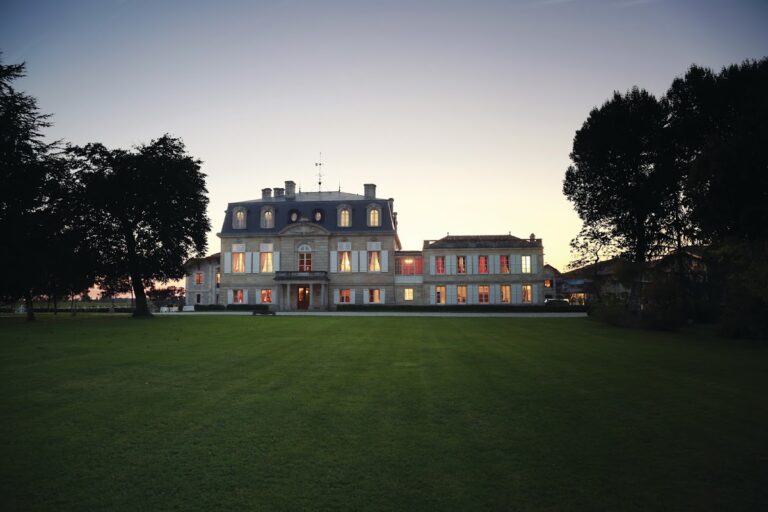
The estate’s administrative and residential building was commissioned by James-Edouard de Rothschild and completed by his widow Thérèse after his death. The vineyards supply approximately 300,000 bottles of the grand vin, the estate’s principal wine, each year, together with a variable quantity of Le Petit Mouton. A separate parcel of nearly four hectares supplies Aile d’Argent, made principally from Sémillon and Sauvignon Blanc with some Muscadelle. Typical yield is around 40 hectolitres per hectare.
Labels and material artworks
The bottle labels form a recurring artistic feature of the estate. The 2000 vintage used gold-enamel artwork applied directly to the bottle instead of a conventional paper label. Its design shows the Augsburg Ram, a late-sixteenth-century goldsmith’s work and a motif also present on the estate’s coat of arms. The changing label commissions give the wines a continuing material connection with twentieth- and twenty-first-century art.
Nearby sites