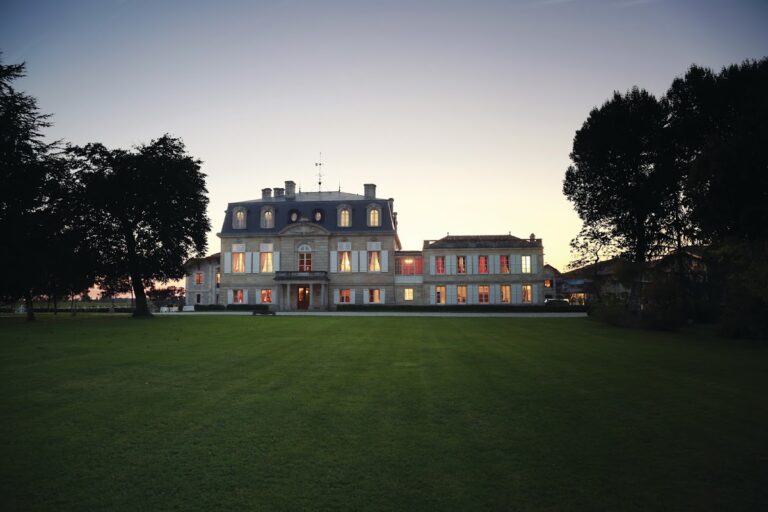
Château Lafite Rothschild: A Premier Grand Cru Classé Wine Estate in France


Site at a Glance
- Rating
- 4.4
- Popularity
- Low
- Country
- France
- Primary era
- Modern
- External website
- Open
- Eras represented
- Modern
- Civilizations
- French
- Site type
- Economic
- Remains
- Production Complex
On this page11 sections
History
Château Lafite Rothschild is a French wine estate in Pauillac, France, in the Médoc district of Bordeaux. Its vineyards were developed under the French seigneurial system from the seventeenth century, and its red wines gained exceptional recognition in the eighteenth century. The estate became a Premier Grand Cru Classé, or first growth, in the 1855 Bordeaux classification, the highest rank in a system based largely on established wine prices and reputations.
Origins and the Ségur family
The name Lafite appears in a record from 1234, when Gombaud de Lafite, abbot of Vertheuil monastery north of Pauillac, referred to the estate. It probably derives from the Gascon expression la hite, meaning “hillside” or “hill.” The seigneurial estate of La Fitte can be traced to the fourteenth century.
During the seventeenth century, part of the property belonged to Joseph Saubat de Pommiers. After his death around 1670, it passed to his wife, Jeanne de Gasq, who married Jacques de Ségur. Under Jacques de Ségur, agricultural land was converted into vineyards, with the first vines planted in the late 1670s or early 1680s.
Alexandre de Ségur’s marriage to Marie-Thérèse de Clauzel, heiress of Château Latour, in 1695 linked Lafite to another prominent Bordeaux estate. Their son Nicolas-Alexandre de Ségur joined the family enterprise in 1716 and expanded Lafite’s reputation in France and abroad. He became known as the “Prince of the Vineyards,” while Lafite’s wine acquired the courtly title “the King’s Wine.”
Royal fashion and changing ownership
Lafite wines became fashionable at Versailles. Marshal Louis François Armand de Vignerot du Plessis, duc de Richelieu, helped promote them at court. In 1755, after Richelieu became governor of Guyenne, a Bordeaux physician advised him to drink Lafite wine. A later story about his conversation with Louis XV, king of France from 1715 to 1774, reinforced the wine’s association with health and refinement. Madame de Pompadour served it at her receptions, and the comtesse du Barry reportedly considered it the only wine suitable for her.
After Nicolas-Alexandre de Ségur died, Lafite and Château Latour were divided among his four daughters, though the two properties continued to be jointly managed for several decades. Lafite later passed to his grandson Nicolas-Marie-Alexandre de Ségur, who sold it in 1784 because of heavy debts. After a brief intervening ownership, Nicolas Pierre de Pichard, president of the Parliament of Bordeaux, acquired the estate.
The French Revolution brought another decisive change. Pichard was executed on 30 June 1794, and the estate was confiscated as state property. It was auctioned publicly on 12 September 1794 and purchased by the Dutchman Jean de Witt. Ownership changed several times before Lafite passed to the Vanlerberghe family in the early nineteenth century.
The Rothschild acquisition
The Vanlerberghe family concealed its ownership through a nominal transfer to the British banker Samuel Scott. Scott and later his son administered the estate, while Joseph Goudal and, from 1834, his son Monplaisir Goudal managed its daily operations. The arrangement became public during the succession of Aimé-Eugène Vanlerberghe, after which the property was eventually offered at public auction.
James Mayer Rothschild purchased Château Lafite on 8 August 1868 for 4.4 million francs. He died three months later, and ownership passed to his sons Alphonse, Gustave, and Edmond. The estate then held 74 hectares of vineyards. Its 1868 vintage reached 6,250 francs per 900-litre barrel, a price record that remained unbroken for more than a century.
Before the Rothschild purchase, Lafite had already acquired a strong commercial reputation. Its inclusion in the highest category of the 1855 Bordeaux classification confirmed its position as a Premier Grand Cru Classé. It was grouped with Château Latour, Château Margaux, Château Haut-Brion, and Château Mouton Rothschild among Bordeaux’s foremost red-wine estates. Mouton received Premier Cru status later, in 1973.
Crises, war, and recovery
Phylloxera, a destructive vine pest, together with gray rot and mildew, damaged the vineyards during the nineteenth and early twentieth centuries. The First World War and the Great Depression further affected prices, production, and vineyard area. For quality reasons, Lafite did not release several vintages between 1882 and 1886, and it also withheld the 1910 and 1915 vintages. Vintages from the difficult period that received particular recognition included 1899, 1900, 1906, 1926, and 1929.
Counterfeiting encouraged Lafite to become one of the first Bordeaux estates to bottle its wine on the property instead of selling it entirely in barrels through wine merchants. During the First World War, the estate also imposed stricter limits on the supply of its wines.
The German Wehrmacht occupied the estate from June 1940 during the Second World War. Rothschild family property was confiscated, and Château Lafite was converted into an agricultural school in 1942. The estate was partly damaged, but it was recovered after the war by Baron Élie de Rothschild. He began extensive repairs to the buildings and vineyards, encouraged by the excellent vintages of 1945, 1947, and 1949.
Modern direction and wines
New markets, especially in the United States, expanded sales in the early 1960s. The estate produced excessively tannic wines in the early 1970s, but from 1974 Éric de Rothschild assisted Élie, increased investment, and changed the technical staff. Since the 1980s, Lafite has again been described as consistently producing top-quality wines.
The estate belongs to Domaines Barons de Rothschild, the wine-holding organization associated with the French branch of the Rothschild family. The group later acquired or managed several other French wine estates, including Château Duhart-Milon, Château Rieussec, Château L’Évangile, Château Paradis Casseuil, Château d’Aussières, and Château Peyre-Lebade. In 2003, Château Lafite Rothschild lost a legal case against Château Lafitte over the similarity of their names and the risk of consumer confusion. Since March 2018, the estate has been directed by Saskia de Rothschild, Éric de Rothschild’s daughter.
Château Lafite Rothschild produces two red wines from its vineyards. The principal wine, Château Lafite-Rothschild, is generally made from 80–95 percent Cabernet Sauvignon, 5–20 percent Merlot, and up to 3 percent Cabernet Franc and Petit Verdot. It is aged for 18–20 months exclusively in new oak barrels and produces approximately 15,000–25,000 cases, or about 150,000 bottles, annually. Carruades de Lafite, the second wine, uses grapes from the Carruades vineyards acquired in 1845. Its blend generally contains 50–70 percent Cabernet Sauvignon, 30–50 percent Merlot, and up to 5 percent Cabernet Franc and Petit Verdot. It is aged for 18 months in new and two-year-old barrels and produces approximately 20,000–30,000 cases, or about 180,000 bottles, each year.
Remains
Estate landscape and vineyards
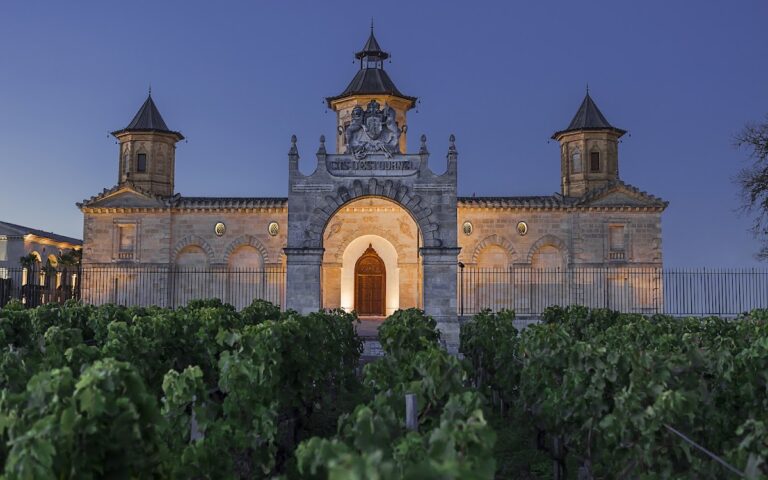
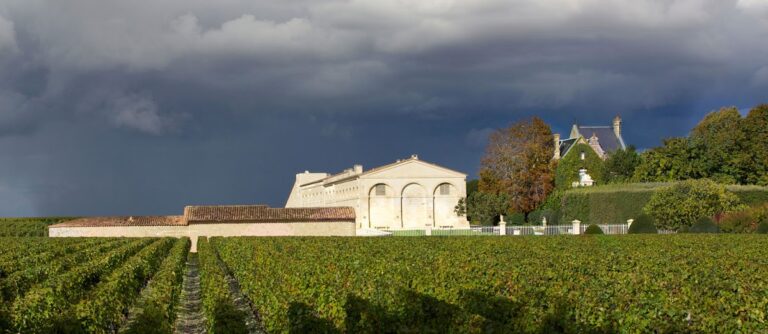
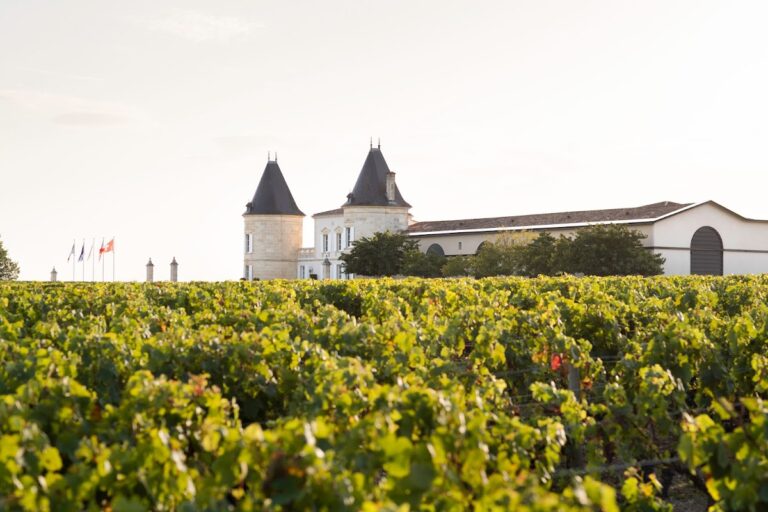
Château Lafite Rothschild occupies 178 hectares, including 103 hectares of vineyards, in northern Pauillac beside the Saint-Estèphe boundary and near the former neighboring estate Château Mouton-Rothschild. The vineyard land is arranged in three principal areas: the slopes around the château, the Carruades plateau immediately to the west, and 4.5 hectares adjoining the commune of Saint-Estèphe.
The vineyards lie on a rise reaching approximately 30 metres in height. More than 8 metres of gravel rest on a limestone base; the gravel came through the Gironde system from Pyrenean material carried by glacial meltwater. Fine sandstone and gravel over limestone form the soil, which drains toward the Jalle du Breuil, an artificial channel created by the Dutch during the medieval drainage of the formerly marshy Médoc. Sun exposure and heat retained by the gravel favor earlier ripening of Cabernet Sauvignon, while the poor soil limits yields and encourages deep root growth.
The vineyard composition is 71 percent Cabernet Sauvignon, 25 percent Merlot, 3 percent Cabernet Franc, and 1 percent Petit Verdot. The average vine age is about 30 years, while vines used for the principal wine average about 40 years. Approximately 20 hectares of vines younger than ten years are excluded from that wine. The estate also includes about 18 hectares of vines more than 50 years old and two sectors with vines over 80 years old. The La Gravière parcel, planted in 1886, was still producing fruit in 2001, and the estate contains vines described as more than a century old.
Wine production
Barrel cellar
A circular barrel cellar added in 1987 holds 2,200 barriques, traditional Bordeaux barrels used to age wine. The Catalan architect Ricardo Bofill designed the building. Its capacity forms part of the estate’s modern production facilities, alongside technical management by Charles Chevallier and advice from the oenologists Jacques Boissenot and his son Éric. An oenologist specializes in the production, maturation, and analysis of wine.
Principal and second wines
Grapes for Château Lafite-Rothschild are selected from older, lower-yielding vines. The resulting wine is full-bodied and highly tannic, with complex aromas and flavors that may include almond and violet. Its maturation uses only new oak. Carruades de Lafite is made from the Carruades vineyard area and is aged in both new and two-year-old oak barrels, with new barrels comprising about 10–15 percent of the total. The label was called Moulin des Carruades until the end of the 1980s and became an officially separate second wine during the twentieth century.
Nearby sites