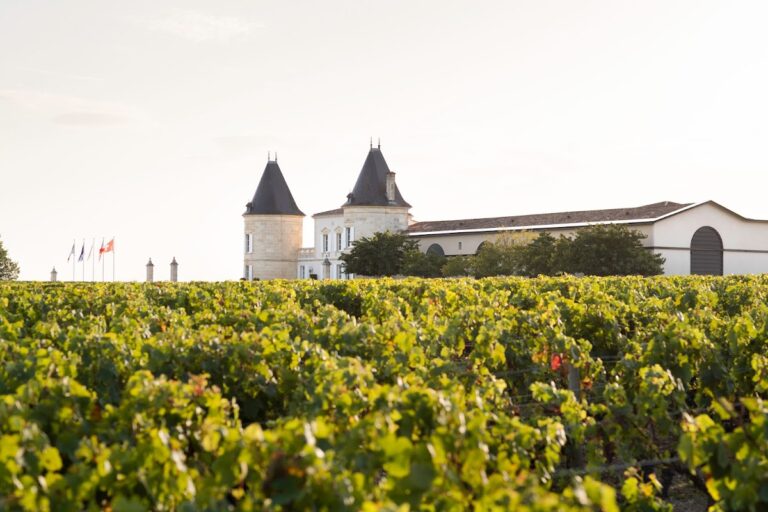
Château Pontet-Canet: A Classified Wine Estate in Pauillac, France


Site at a Glance
- Rating
- 4.5
- Popularity
- Very Low
- Country
- France
- Primary era
- Early Modern
- External website
- Open
- Eras represented
- Early Modern, Modern
- Civilizations
- French
- Site type
- Economic
- Remains
- Production Complex
On this page10 sections
History
Château Pontet-Canet is a wine estate in Pauillac, France, conventionally founded in the early eighteenth century and associated with the Neoclassical château buildings constructed during the following decades. Its wine was designated a Fifth Growth in the official 1855 Classification of Bordeaux wines, a system based on the historical reputation and market value of leading Bordeaux estates.
Early landholding and estate formation
The agricultural land associated with Pontet-Canet can be traced to 1311, when it belonged to the feudal lord Pons de Castillon. The property remained within his family before passing in the fifteenth century to Humphrey, Duke of Gloucester, the younger brother of Henry V. Following the English defeat in the Hundred Years’ War, the land formerly held by the English passed into French hands.
Through the Foix family, part of the property came to the notary Jacques de Ségur. From 1670, he established some of the earliest vineyards on land now occupied by Château Lafite-Rothschild. His son Alexandre married the heiress of Château Latour in 1695, and their son, Nicolas-Alexandre de Ségur, expanded Mouton in 1717 and acquired Château Calon-Ségur. He sold Mouton in 1720, or possibly 1725, to Joseph de Brane, beginning the separation of the Mouton and Lafite properties. An existing estate building and the central part of the land later passed to Dominique Armailhac and formed the beginning of Château d’Armailhac.
François de Pontet, governor of the Médoc, acquired the southernmost part of the property, several hundred metres above the Gironde. His descendants added the plot known as Canet in 1757. A house stood on that plot, and the wine produced by the estate was thereafter traded under the name Pontet-Canet.
Cruse ownership and twentieth-century decline
The de Pontet family retained the estate until 1865, when Hermann Cruse, a Bordeaux wine merchant from Schleswig-Holstein, purchased it. The Cruse family modernized the vineyard layout, grape-harvesting methods, and winemaking installations. In 1895, it added service buildings with an advanced grape-sorting installation for the period.
After the Second World War, the Cruse trading house failed to maintain investment, and the quality of Pontet-Canet’s wines declined. In 1960, Cruse transferred some vineyard land from Château Haut-Bages-Libéral to the more profitable Pontet-Canet. Once this became known, the company was forced to sell Pontet-Canet and later Haut-Bages-Libéral.
Renewal under the Tesserons
Guy Tesseron, a cognac merchant, bought the estate in 1975. Investment and quality-focused winemaking under his younger son Alfred Tesseron, assisted by the oenologist Émile Peynaud, helped Pontet-Canet recover its standing as a Fifth Growth from the beginning of the 1990s. Gerald and Alfred Tesseron are identified as the estate’s managers. Jean-Michel Comme has been responsible for cultivation and blending since 1988, and the estate has also received advice from the oenologist Michel Rolland.
Pontet-Canet has worked according to biodynamic principles for several years. Biodynamic viticulture treats the farm as an integrated ecological unit and uses preparations and cultivation practices linked to natural cycles. The estate received official Agence Bio certification in 2010, along with Biodyvin certification from 2010 and Demeter certification from 2014. It was described as the first classified Médoc growth to receive certification for both organic and biodynamic agriculture. The estate produces a principal wine and a second wine called Les Hauts de Pontet, with annual production of approximately 300,000 bottles and 60,000 bottles respectively.
Remains
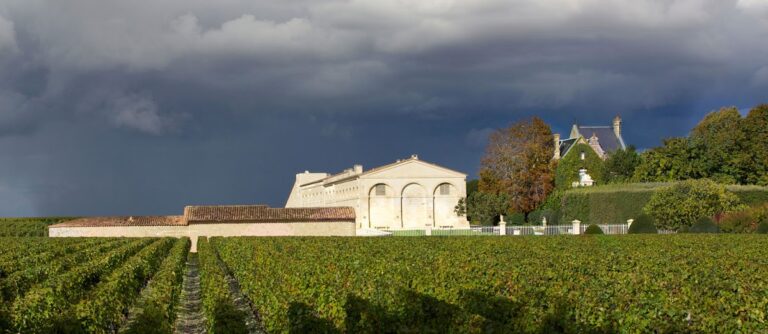
The surviving estate consists of Neoclassical château buildings, service structures, and a vineyard extending across approximately 120 hectares. About 81 hectares are planted with vines, divided into three parcels that include a principal continuous block of roughly 50 hectares. The buildings and working areas express the estate’s development from an eighteenth-century residence to a modern wine-production complex.
Built features
Château buildings
The château was built in the Neoclassical style during the mid-eighteenth century. Its right-hand section dates to 1755, while the principal section was completed in 1781. The entrance colonnade resembles the columns of Bordeaux’s Grand Théâtre, which was inaugurated in 1780.
Service buildings
Service buildings added in 1895 contain a gravity-fed processing arrangement. Grapes arrive on the first floor, are sorted there, and then descend into the fermentation vats. Gravity-fed winemaking uses elevation instead of pumps to move grapes or must between successive stages.
Vineyard landscape and cultivation
The largest vineyard parcel occupies a gravelly rise formed during the Günz glaciation, an early Pleistocene glacial period, near Château Mouton-Rothschild. The gravelly rises reach approximately 30 metres in height, and the subsoil consists of clay, gravel, and limestone. Planting density is approximately 9,000 vines per hectare. The average vine age is about four decades, with the oldest vines approximately 75 to 80 years old and the youngest about five years old. The plantings comprise approximately 62 percent Cabernet Sauvignon, 32 percent Merlot, 4 percent Cabernet Franc, and 2 percent Petit Verdot.
Horses are used extensively in the vineyards to reduce soil compaction caused by tractors. The grapes are harvested by hand and sorted again after collection.
Fermentation and maturation
Fermentation lasts approximately four weeks in concrete and stainless-steel tanks. Since the 2012 vintage, about one-third of the harvest has also been matured in amphora-like ceramic tanks specially developed for the estate. The wine then matures for approximately 16 to 20 months in barrels, with about 60 percent of the barrels renewed each year. It is bottled without filtration.