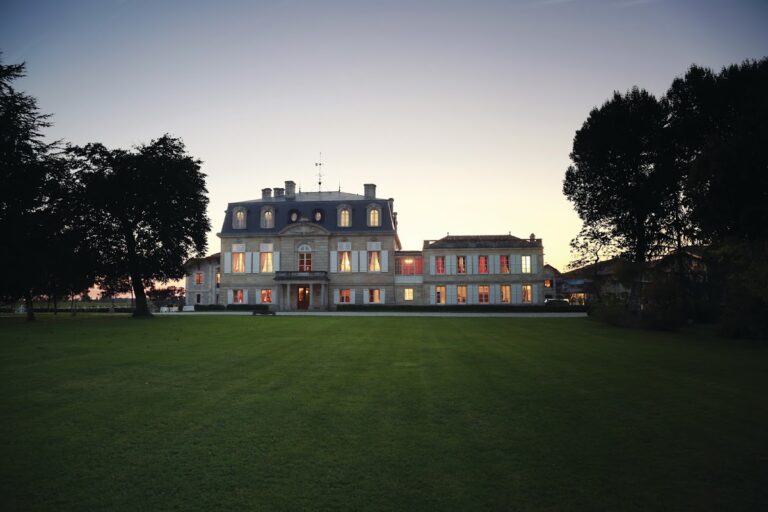
Château Cos d’Estournel: A Classified Second-Growth Wine Estate in Saint-Estèphe


Site at a Glance
- Rating
- 4.6
- Popularity
- Low
- Country
- France
- Primary era
- Modern
- External website
- Open
- Eras represented
- Modern
- Civilizations
- French
- Site type
- Economic
- Remains
- Production Complex
On this page9 sections
History
Château Cos d’Estournel is a wine estate in France, in Saint-Estèphe’s Médoc wine region, founded in 1811 and known for its Chinese-influenced pagoda-style winery buildings. It produces wines under the Saint-Estèphe appellation, a legally defined wine-producing area whose name identifies a wine’s geographical origin and production identity. The estate takes its name from cos, a Gascon word meaning “hill of stones” or “gravel hill,” and from Louis-Gaspard d’Estournel, its first owner.
Foundation and overseas trade
Wine production at the site is first mentioned in 1810. The estate’s foundation followed in 1811, when Louis-Gaspard d’Estournel inherited vineyards near the village of Cos and began enlarging both the holdings and the winemaking facilities.
D’Estournel traded Arabian horses and exported wine to Arabia, India, and the Indies. He noticed that wine returning unsold from overseas voyages had improved during the journey. He therefore began sending wine by ship before its sale, marking bottles treated in this way with an “R” for Retour des Indes, meaning “Return from the Indies.” The expense of the building programme and maritime transport eventually brought about his financial ruin.
The pagoda buildings and nineteenth-century ownership
In 1830, d’Estournel constructed the estate’s Chinese-influenced pagoda buildings to celebrate the success of his wines and their distant export markets. Their unusual appearance helped give him the nickname “Maharajah.” He sold the estate in 1852 to his London banker, Martyns, while burdened by debt, and died unmarried and without children in 1853. The property received international recognition shortly afterward through the 1855 Bordeaux classification.
The 1855 classification placed Château Cos d’Estournel among the Deuxièmes Grands Crus Classés, or second growths. This hierarchy ranks leading Bordeaux estates in several growth categories, with a second growth below the five first-growth estates but still among the highest-ranked properties. Cos d’Estournel is described as the leading classified growth of Saint-Estèphe and is sometimes called a “super-second.”
Ownership changed several times during the rest of the nineteenth century. The Martyns sold the property to the Errazu family in 1869. In 1889, the Errazus sold it to the brothers Jean-Justin and Jean-Jules Hostein, who also owned Château Montrose until 1896.
Twentieth-century ownership and changing production
The Bordeaux wine merchant Fernand Ginestet acquired Cos d’Estournel in 1917. His family later acquired Château Margaux, and his grandchildren Yves, Jean-Marie, and Bruno Prats inherited Cos d’Estournel in 1970. Bruno Prats remained its managing partner until 1998.
During the Second World War, anti-aircraft installations were placed on the estate, affecting its buildings and later reconstruction needs. Until 1994, wine that did not meet the standards of Château Cos d’Estournel was sold under the Château Marbuzet label, which belonged to the neighbouring Prats family estate. From 1995, Château Marbuzet used grapes only from its own harvest, while Cos d’Estournel introduced its own second wine, Les Pagodes de Cos. A museum at the winery also opened that year. A second wine is a separate estate bottling made from younger vines or lots not selected for the principal wine.
In 1998, the Prats family sold the estate to the Taillan trading group and Argentine investors. After a brief period under Taillan ownership, the property was sold in 2000 to the industrialist Michel Reybier, who later took personal responsibility for its direction. Jean-Guillaume Prats succeeded his father as salaried general manager after the 1998 sale and held the position until January 2013. Aymeric de Gironde directed the estate until 2017, after which Reybier directed it personally. Jacques Boissenot and his son Eric also advised the estate as oenologists, while around the 2008 vintage day-to-day operations involved Bo Barrett, Greg Ralston, cellar master Dominique Arangoits, and Jean-Guillaume Prats.
Restoration and wine production
By 1990, roughly two-thirds of the estate’s stonework required restoration, and the copper roofing was repaired. Restoration in 2006 brought the pagoda buildings closer to their original appearance, and the winery was reconstructed again in 2008.
The principal red wine is made from Cabernet Sauvignon and Merlot, with one stated formulation using 65 percent Cabernet Sauvignon and 35 percent Merlot. It matures for 18 to 22 months in oak barrels, 80 percent of them new, with racking every three months. Only vines more than twenty years old are selected for this wine. Les Pagodes de Cos comes from younger vines and is made from approximately 55 percent Cabernet Sauvignon, 36 percent Merlot, 5 percent Cabernet Franc, and 4 percent Petit Verdot.
The estate also produces Cos d’Estournel Blanc, made from approximately 65 percent Sauvignon Blanc and 35 percent Sémillon, and Goulée by Cos d’Estournel, a red blend of approximately 86 percent Merlot, 13 percent Cabernet Sauvignon, and 1 percent Cabernet Franc. Annual production varies from about 200,000 to 380,000 bottles. In normal years it is approximately 370,000 bottles, or around 28,000 cases, including about 20,000 cases of the principal wine. The 2009 vintage received 100 Parker points, while the 2003 and 2005 vintages each received 98 points.
Remains
The pagoda winery complex
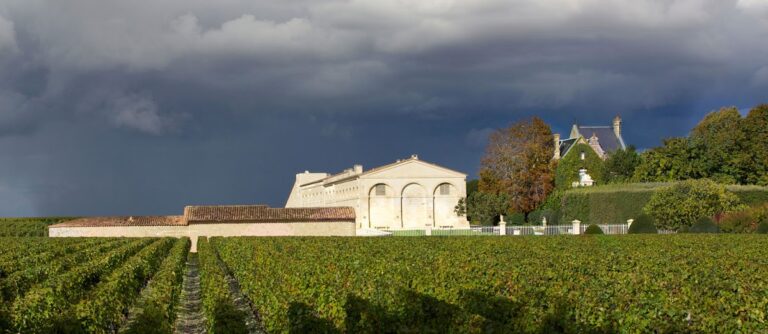
Château Cos d’Estournel’s buildings stand on a gravel hill rather than around a conventional château. The main winery is an exotic stone structure crowned by Chinese-style pagodas, an architectural identity also reproduced on the estate’s wine labels. The large barrel cellar takes the form of a Chinese pagoda with several curved roofs, while the complex includes other Asian decorative elements and an Asian sculpture.
A dark, carved double door occupies the gable end of the barrel cellar. It was reportedly brought from Zanzibar and said to have come from the seventeenth-century harem area of the Sultan’s palace. D’Estournel acquired it in exchange for wine. Wartime military use affected the main buildings, and later campaigns restored about two-thirds of the stone masonry, repaired the copper roof, restored the pagodas in 2006, and reconstructed the winery in 2008.
Vineyard setting and soils
The estate lies on the first rise of Saint-Estèphe near the boundary with Pauillac, opposite Château Cos Labory and near Château Lafite-Rothschild across the small Jalle de Breuil. Its land extends over about 91 hectares, with approximately 64 to 65 hectares planted as vineyards divided among roughly thirty parcels.
The vineyards occupy slopes at markedly different elevations. The upper sections reach about 25 metres, while the lower parts lie at approximately 4 metres. The highest vineyards are near the Gironde, where temperatures are reported to be 2 to 3 degrees lower. The soils combine gravel with calcareous clay. Gravel retains moisture during summer, while the sloping ground and deep Eocene subsoil allow winter water to drain without stagnating. The gravel also encourages the vines to send their roots deeper into the soil.
Plantings consist mainly of Cabernet Sauvignon and Merlot. The commonly stated division is 60 percent Cabernet Sauvignon and 40 percent Merlot, while another breakdown gives 60 percent Cabernet Sauvignon, 38 percent Merlot, and 2 percent Cabernet Franc. Planting density is approximately 9,000 to 9,500 vines per hectare, and the vines average about 35 years of age. Harvesting is carried out by hand. Younger vines supply Les Pagodes de Cos, while vines over twenty years old are selected for the principal wine.
Labels and surviving identity
The estate’s bottles have carried a two-part label since 1891. The lower section bears the motto “Semper fidelis,” together with the alcohol content and bottle capacity. The surviving pagoda complex, restored stonework, distinctive roof forms, and vineyard landscape preserve the physical identity established during Louis-Gaspard d’Estournel’s ownership and maintained through later rebuilding.
Nearby sites