Château Lafon-Rochet: A Saint-Estèphe Wine Estate in France


Site at a Glance
- Rating
- 4.8
- Popularity
- Low
- Country
- France
- Primary era
- Early Modern
- External website
- Open
- Eras represented
- Early Modern
- Civilizations
- French
- Site type
- Domestic
- Remains
- Manor House
On this page10 sections
History
Château Lafon-Rochet is a wine estate in Saint-Estèphe, France, with a viticultural history traditionally traced to the seventeenth century and a property history reaching back to 30 April 1557. On that date, Janot Bernard acquired the Fief de la Vallée Roussillon from Jeanne Bernard. The estate later became part of the Saint-Estèphe appellation, a legally defined French wine-growing designation that regulates the geographical origin and production of wine.
From the sixteenth century to the Lafon family
Janot Bernard was a prosperous merchant who enlarged his holding by buying adjoining parcels. In 1563, he enclosed his house with a wall. After his death, his daughter Françoise inherited the estate and managed it until 1619. During this period, disputes connected with her marriage to Hellies de Lahaye were mediated by Guillaume de Lafite, a member of the neighbouring Lafite estate.
In 1619, the portion called Rochette passed to Adrianne de Lahaye. Her daughter Antoinette later inherited it and married Étienne de Lafon, an influential member of the Parlement of Bordeaux, the regional high court and administrative institution of the French monarchy. When Antoinette died in 1700, Étienne challenged her testament after remarrying. The legal disputes left him with only a reduced part of the former property, corresponding approximately to the modern Lafon-Rochet.
Expansion of viticulture
Étienne de Lafon seldom lived at the largely agricultural estate and placed its management in the hands of Pierre Delage. Delage expanded the landholding and greatly increased viticulture by planting vines. After Étienne’s death, his son Pierre acquired the estate and continued to purchase land. Pierre’s widow, Marguerite, and their son Jean managed the property until 1788.
The French Revolution had comparatively little effect on the estate. The Lafon family was not considered influential enough to become a principal target, while Jean supported the revolutionary cause through service on the local revolutionary council. The property was subsequently divided among members of the family. Jean adopted the name Jean de Lafon Rochet, and his brothers took the names Arnaud Lafon Barrail, Joseph Lafon de Camarsac, and Raymond Lafon Du Hayet. The central portion containing the estate buildings eventually passed to Joseph after Arnaud transferred his share to him.
Nineteenth-century setbacks and recognition
Joseph married Anne Paignon in 1793. Revolutionary turmoil, together with probably ineffective management, brought about the loss of much of their wealth. After Joseph’s death, Anne continued to manage the property until 1824, when its severe financial problems forced her to surrender it to their son, Louis Arnaud Blaise Lafon de Carmasac.
Louis Arnaud began restoring the estate’s finances and gradually enlarged its remaining 15 hectares. A destructive hailstorm in 1839 dealt the property a serious blow. After his death, two-thirds of the estate passed to his widow, Marie-Chevalier Pages, while one-third went to his son Pierre.
Pierre earned a living by producing photographs set in enamel and left the management of the vineyards to his daughter Lucie, who worked alongside Marie-Chevalier. Their efforts coincided with the estate’s inclusion among the Fourth Growths in the Bordeaux Wine Official Classification of 1855. This classification arranged selected estates according to their established reputation and market standing, with a Quatrième Cru Classé, or Fourth Growth, occupying its fourth level.
Crisis, sale, and decline
The nineteenth-century phylloxera crisis, caused by a vine pest that devastated European vineyards, was followed by a mildew epidemic. These disasters placed Pierre and Lucie under intense financial pressure, and on 30 June 1895 they sold Lafon-Rochet to Frédéric Audon of Cannes. Audon also owned neighbouring Château Ladouys and rebuilt the property until 1924. Following his divorce from Marie Madeleine Lucie Buttura, however, he was compelled to sell much of his estate.
Marcel Ricard and his wife, Catherine Marguerite Eyssand, bought Lafon-Rochet at auction on 4 June 1924. Catherine died later that year, and disagreements between Marcel and their two children prevented an agreed division of the property. They sold it on 8 September 1938 to Élie and Berthe Nafrechoux, who transferred it less than two years later to Charles Louis Duquenoy-Legry.
Duquenoy-Legry lived in northern France and entrusted daily operations to Fernand Revon. During this period, both production and wine quality declined sharply. Nine years after the purchase, output was about half the quantity made at the beginning of the twentieth century. When Guy and Nicole Tesseron acquired the estate on 6 May 1960, Lafon-Rochet had only 15 hectares and was producing almost no wine.
The Tesseron period and later ownership
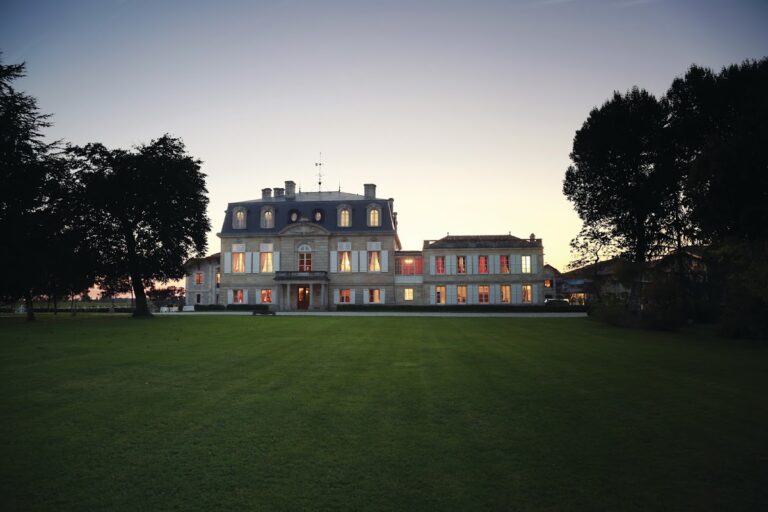
Guy Tesseron came from a family whose fortune was made through Cognac distillation, the production of grape brandy in the Cognac region. Lafon-Rochet was his first Bordeaux estate. During the 1960s, the château was completely demolished and rebuilt from plans based on an eighteenth-century chartreuse, a French country residence usually formed by a long, relatively low central building with flanking wings. Tesseron later acquired Château Pontet-Canet in 1975 and Château Malescasse.
In 1999, Michel Tesseron and his sister Caroline Poniatowski assumed responsibility for Lafon-Rochet, while Alfred and Gérard Tesseron managed Pontet-Canet. Improvements during the 1990s were associated with later harvesting, a greater proportion of new oak, increased use of Merlot, and the introduction of a second wine made from weaker lots. Beginning with the 2000 vintage, the château’s canary-yellow colour was reproduced on its bottle labels. The estate had long been associated with firm, highly tannic wines, while the greater role of Merlot later softened that character. The 1996 and 2000 vintages each received 90 Parker points.
Jacky Lorenzetti and his family bought Château Lafon-Rochet in 2021. They already owned Château Pédesclaux in Pauillac and Château Lilian Ladouys in Saint-Estèphe. Emmanuel Cruse was given management of the three estates, and Vincent Bache-Gabrielsen became director of Lafon-Rochet at the end of 2024. About 40 percent of the estate’s production is made into Les Pèlerins de Lafon-Rochet, the second wine. In 2018, analyses commissioned by an anti-pesticide association found pesticide residues in the 2013, 2014, and 2015 vintages after Basile Tesseron had announced that organic management would end. The regional organic-farming federation stated that the estate had never held organic certification.
Remains
Vineyard setting and soils
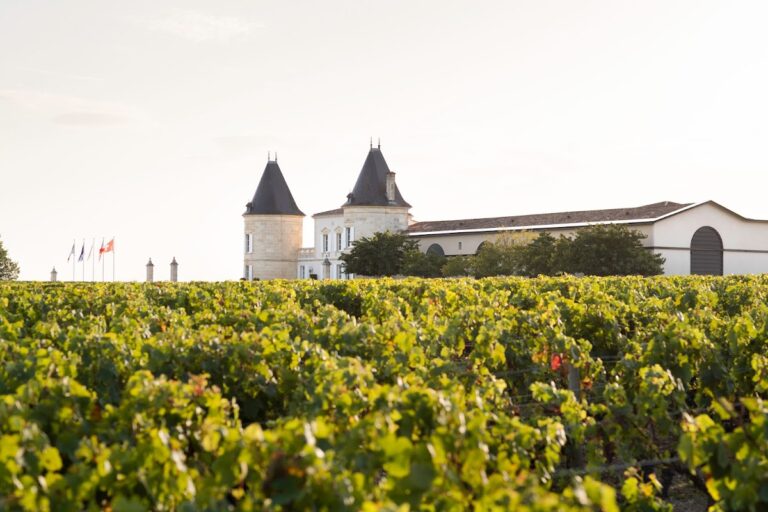
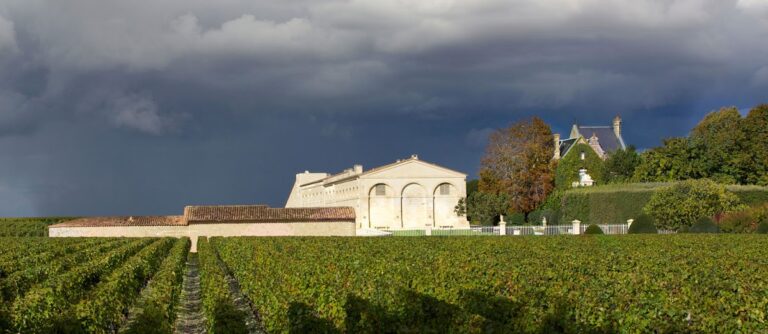
Château Lafon-Rochet occupies a single contiguous vineyard in the southern part of the Saint-Estèphe appellation. A jalle, meaning a local drainage channel or small watercourse in the Médoc landscape, marks the estate boundary. The property lies opposite Château Lafite Rothschild. Its approximately 45 hectares include 41 hectares planted with vines, which average 37 years of age. Planting density is about 8,800 to 9,200 vines per hectare, with yields of approximately 40 to 50 hectolitres per hectare.
The vineyard soils are arranged in three relatively uniform groups. Clay-rich gravelly ground forms one part of the estate, while dry gravel produces the classified grand vin, the château’s principal wine. Colluvial soils, made from material carried downslope, are used for Les Pèlerins de Lafon-Rochet. These soil divisions therefore correspond to the estate’s two principal wine categories.
Planting and cultivation
The present vineyard comprises approximately 55 percent Cabernet Sauvignon, 40 percent Merlot, 3 percent Cabernet Franc, and 2 percent Petit Verdot. When the property was reconstituted after the Tesseron acquisition, Cabernet Sauvignon initially made up 80 percent of the plantings. This composition produced about twenty vintages of particularly hard wine before the proportion of Merlot was increased.
Harvesting is carried out entirely by hand. Fermentation lasts between 18 and 21 days, followed by malolactic fermentation in oak barrels. This secondary fermentation converts sharper malic acid into softer lactic acid. The wine then matures for 15 to 20 months in oak barriques, small barrels traditionally holding about 225 litres. Depending on the year, 35 to 45 percent of these barrels are new.
Château building and production
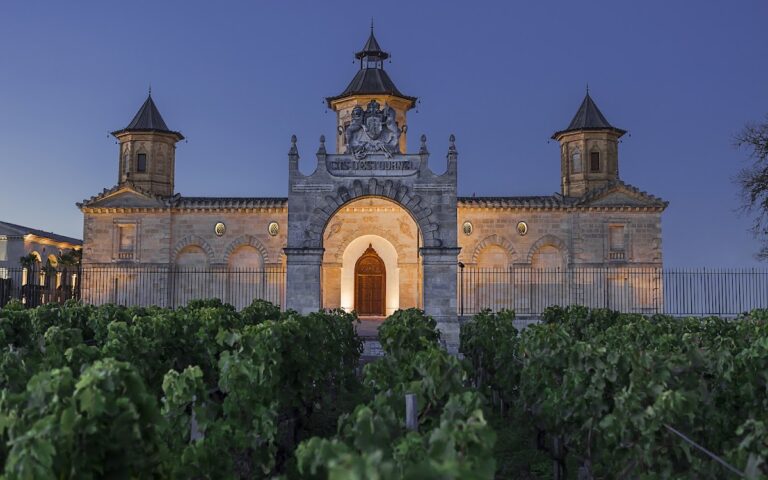
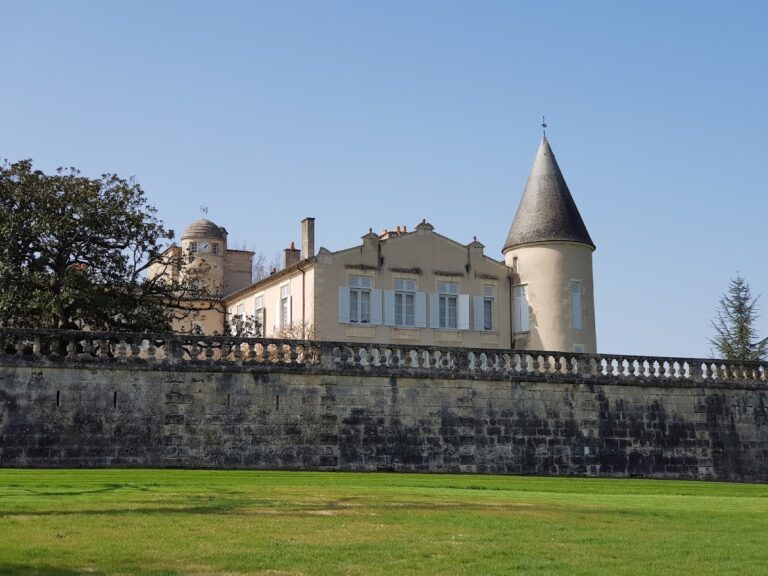
The château that stood before the Tesseron period was demolished during the twentieth century. It was replaced by a wholly reconstructed building based on eighteenth-century chartreuse plans. The rebuilt residence forms part of the modern estate complex alongside the contiguous vineyard and its production facilities.
Château Lafon-Rochet produces its classified Saint-Estèphe wine and the second wine, Les Pèlerins de Lafon-Rochet. In an average year, total production is approximately 120,000 bottles. The division of grapes between the grand vin and the second wine follows the estate’s separate soil groups and its selection of lots for each product.
Nearby sites