Marly Palace: A Memorial Pavilion-Palace in Peterhof


Site at a Glance
- Rating
- 4.8
- Popularity
- Low
- Country
- Russia
- Primary era
- Early Modern
- External website
- Open
- Eras represented
- Early Modern
- Civilizations
- Russian
- Site type
- Domestic
- Remains
- Palace
On this page8 sections
History
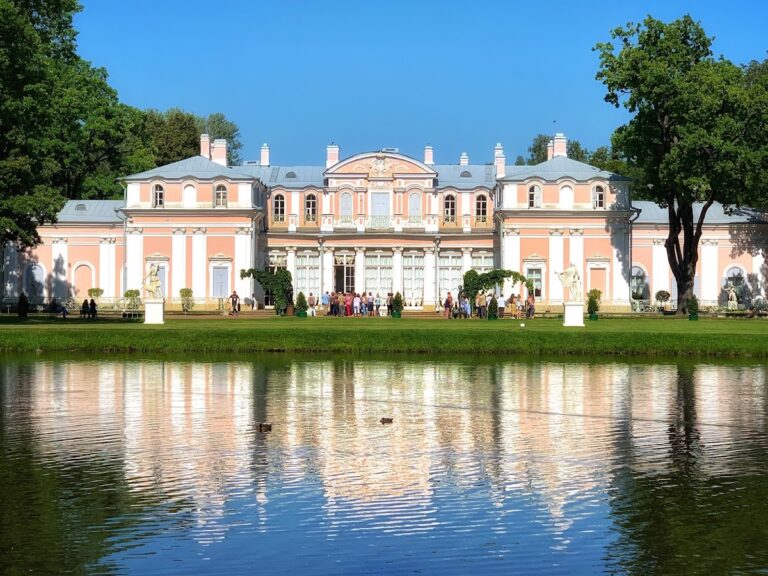
Marly Palace is a miniature pavilion-palace in Russia, located in the western part of the Lower Park at Peterhof. Founded by Peter I, also known as Peter the Great, it was constructed from 1720 to 1723 to designs by Johann Braunstein. The palace formed part of a wider landscape project that combined court architecture, formal gardens, ponds, and practical facilities.
Foundation and early purpose
The palace took its name from Peter I’s visit in 1717 to Marly-le-Roi, the French royal residence near Paris. Peterhof did not reproduce the French building, but adopted its broad compositional ideas, including the integration of decorative scenery with useful park functions. Marly Palace was built at the same time as the Marly Ponds, which helped establish the character of this part of the Lower Park.
Johann Braunstein’s original proposal called for a one-storey building. During construction, Peter I ordered a second floor to be added, producing the balanced two-storey form that survives today. The sculptor Nicolas Pineau and the stoneworkers Yakov Neupokoyev and Antoine Cardassier contributed to the palace’s construction and decoration.
At first, Marly Palace accommodated distinguished guests staying at Peterhof. By the middle of the eighteenth century, it had acquired a memorial character connected with Peter I, and that function continued thereafter.
Reconstruction and wartime damage
In 1899, cracks in the walls led to the complete dismantling of the palace. It was rebuilt on a new foundation under the direction of architect A. Semyonov. The original decorative elements were preserved, allowing the building to be reconstructed with close accuracy.
Marly Palace suffered severe damage during the Second World War when a delayed-action mine exploded in the building. Its collections had been evacuated in 1941. The facades were restored after 1955, and the palace reopened as a museum in 1982. It is protected in Russia as a cultural-heritage property of federal significance.
The Marly Garden and ponds
The Marly Garden occupies the westernmost part of the Lower Park. Its regular plan, meaning a geometric arrangement of ordered divisions and controlled planting, joined formal scenery with productive purposes. The Great Pond divided the garden into the Garden of Bacchus to the south and the Garden of Venus to the north, nearer the sea.
The Garden of Venus supplied fruit for court meals. During Peter I’s reign, attempts were also made to grow grapes in the Garden of Bacchus. An earthwork bank raised when the ponds were created protected the northern garden from Baltic winds. The Marly Ponds lie east of the palace, while the Sectoral Ponds lie to the west. These waters served decorative purposes and supplied fish for the royal table. Fish brought from different parts of Russia was kept there, and breeding began in 1724. Fish breeding has since been revived.
Remains
Palace building
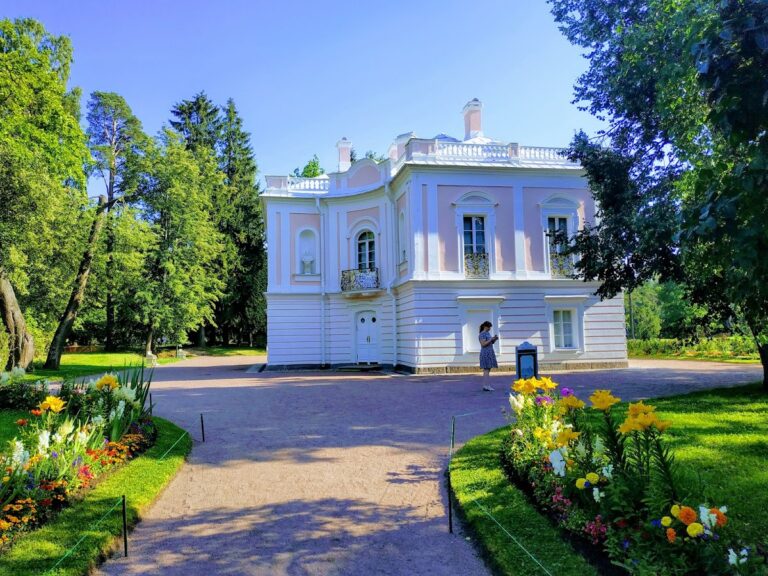
Marly Palace is a compact, clearly defined cube with two storeys. It contains 12 rooms, apart from the staircase and two corridors. The building has no traditional grand hall. Instead, the vestibule known as the Front Hall served as the principal ceremonial space.
The restrained facades combine rusticated lesenes, or strongly jointed masonry features, with Doric capitals, the plainest form of the classical Greek orders. Balconies have wrought-iron railings, and the windows contain small square panes. The present structure also preserves decorative elements retained during the reconstruction on the new foundation in 1899.
Interior collections
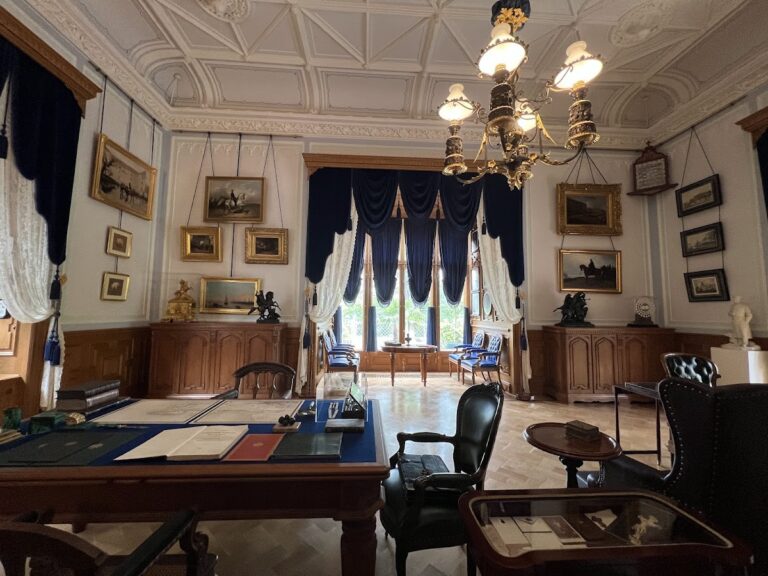
The museum presents personal possessions associated with Peter I, including a naval greatcoat, a caftan embroidered with the Order of Saint Andrew, books from his library, and personal tableware. It also contains a table made by the emperor with a slate board.
Paintings collected by Peter I form the basis of the palace’s painting exhibition. The collection includes works by relatively little-known Dutch, Flemish, and Italian artists of the seventeenth and eighteenth centuries, including A. Silo, A. Storck, P. Bellotti, and A. Celesti. Some furnishings are authentic, while others were selected by comparison with the originals using surviving documentary evidence.
Gardens and water system
The palace stands within a coordinated complex of ponds and gardens in the western Lower Park. The Garden of Bacchus lies south of the Great Pond, and the Garden of Venus lies north of it, closer to the sea. Their regular plan combines formal composition with fruit cultivation, attempted grape growing, wind protection, and fish ponds.
Nearby sites