Château du Helfenstein: A Medieval Rock Castle in France


Site at a Glance
- Rating
- 3.6
- Popularity
- Very Low
- Country
- France
- Primary era
- Medieval
- Eras represented
- Medieval
- Civilizations
- Duchy of Lorraine, Holy Roman Empire
- Site type
- Military
- Remains
- Castle
On this page9 sections
History
Château du Helfenstein is a medieval rock castle near Philippsbourg in Moselle, France, built on a ridge within the former Duchy of Lorraine. Its exact origin is uncertain, but the castle is securely documented from the thirteenth century onward. Adolphe Malye considered that it might predate the neighboring Falkenstein and did not rule out a foundation in the ninth or tenth century.
Medieval origins and Lorraine lordship
A record from 1225 mentions a man named Ruodegerus de Helphenstein, although it does not establish that he was connected with this castle. By the beginning of the fourteenth century, Helfenstein certainly belonged to the dukes of Lorraine, who granted it as a fief to the Wasselonne family. In 1315, a serious fire badly damaged the castle. By 1410, the fortress and its dependencies at Butten, Kirspach, and Birsbach formed a fief of the Duchy of Lorraine.
Destruction and abandonment
Around 1435, Guillaume de Falkenstein besieged and destroyed Helfenstein, apparently opposing any attempt to rebuild it. In 1437, the Bishop of Strasbourg settled a dispute between Guillaume de Falkenstein and Frédéric de Thann concerning the demolished fortress. Helfenstein was never reconstructed. Its stone was probably reused for building work at neighboring Falkenstein, while the remains gradually came to resemble a natural rock formation.
By about 1470, written references named Helfenstein Mountain rather than the castle. The site then passed from local memory. Before its rediscovery, people in the area called it Wachtfels or Wachtfelse, a name meaning “guard rock.” Explanations proposed for Helfenstein include an association with an elephant, perhaps inspired by the massive rock, and another involving elves. Malye rejected an interpretation based on the German verb meaning “to help.”
Rediscovery and later history
Adolphe Malye, a local historian, rediscovered the forgotten castle after finding references to it in historical works and investigating the ground near Falkenstein. The rediscovery is dated to 1927, although some descriptions give 1928, and excavation and further investigation followed. In 1938, French artillerymen used the ruins of Helfenstein and Falkenstein. The ruins are now state property.
Helfenstein stands about 100 metres from Falkenstein, with a ditch cut through the rock between them. Their close position created tensions with the lords of Falkenstein. Malye’s analysis indicated that the two fortresses were oriented away from each other. Helfenstein faces the Sturzelbronn valley and lies near the boundary with Bas-Rhin and Rhineland-Palatinate.
Remains
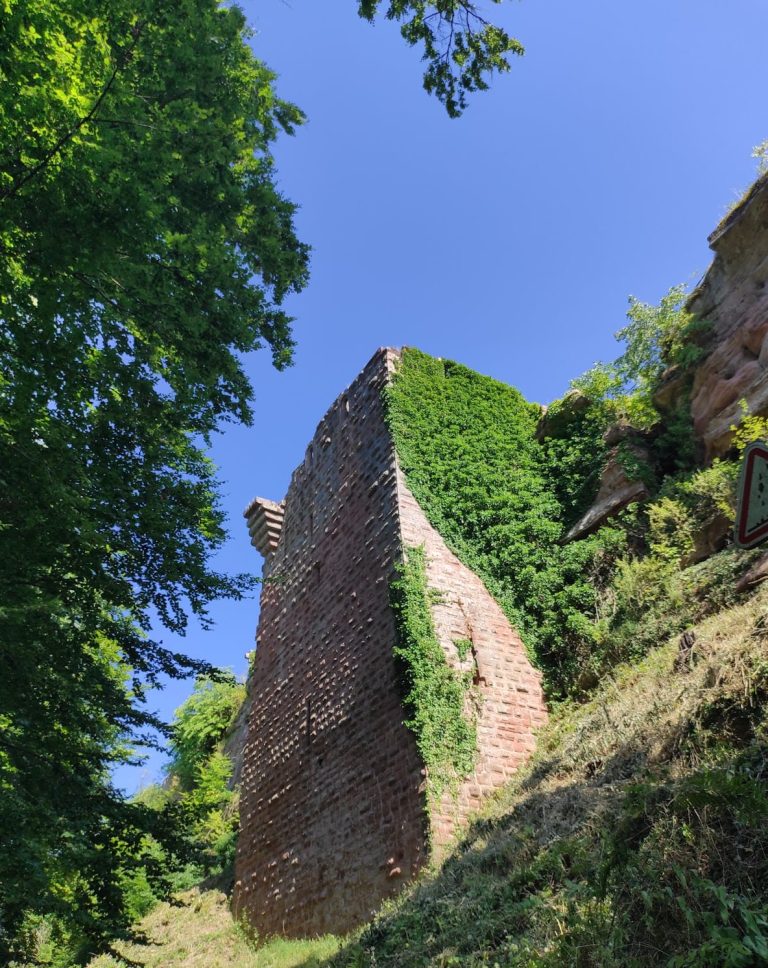
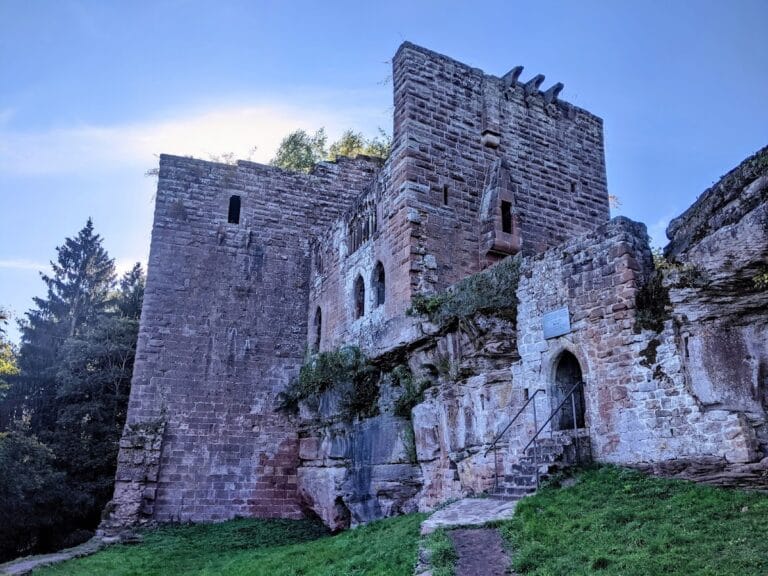
The ruined castle occupies the eastern end of a ridge at approximately 350 metres above sea level, while Falkenstein stands at the western end. Helfenstein is arranged in distinguishable lower and upper sections. The surviving remains combine dressed sandstone, enclosing walls, courtyards, stairways, wells, and rock-cut defenses with the natural formation on which the castle was built.
Lower castle and courtyards
The lower section was entered through a northwestern gate that has disappeared, although various dressed stones survive in the area. The broad courtyard remains only sparsely, with fragments of its enclosing wall. On the southern side, a rock face approximately 3 to 5 metres high forms the boundary. The outline of the northern courtyard enclosure can still be followed, and buildings together with a corner tower once stood along its southern side.
Upper rock and stairways
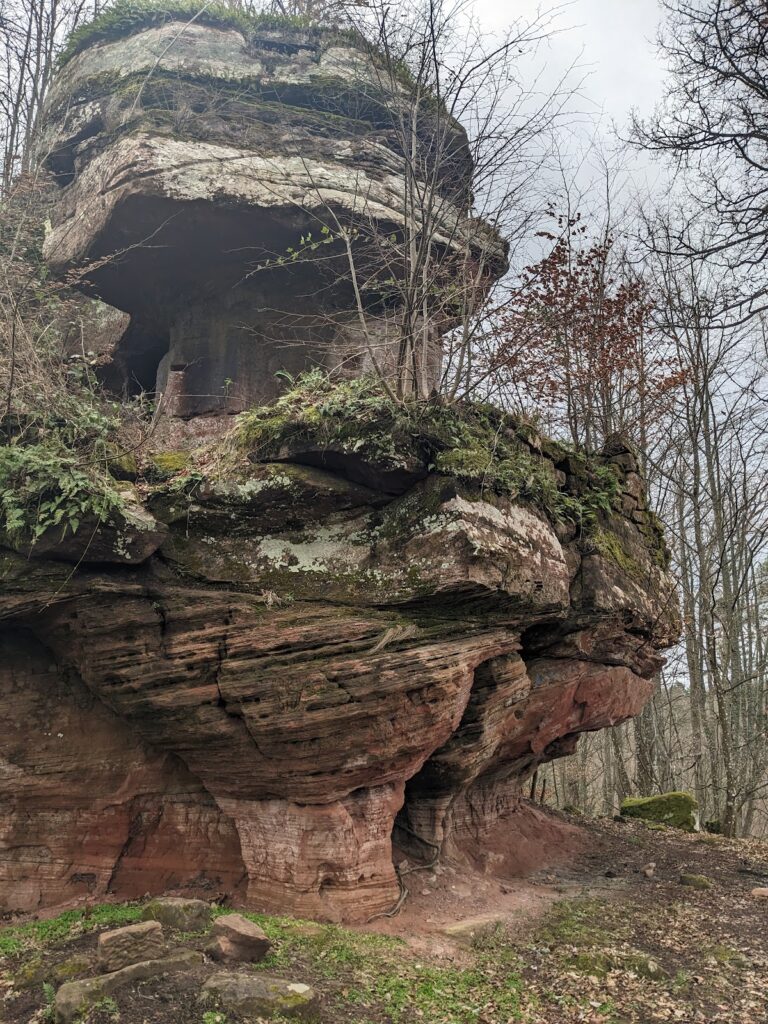
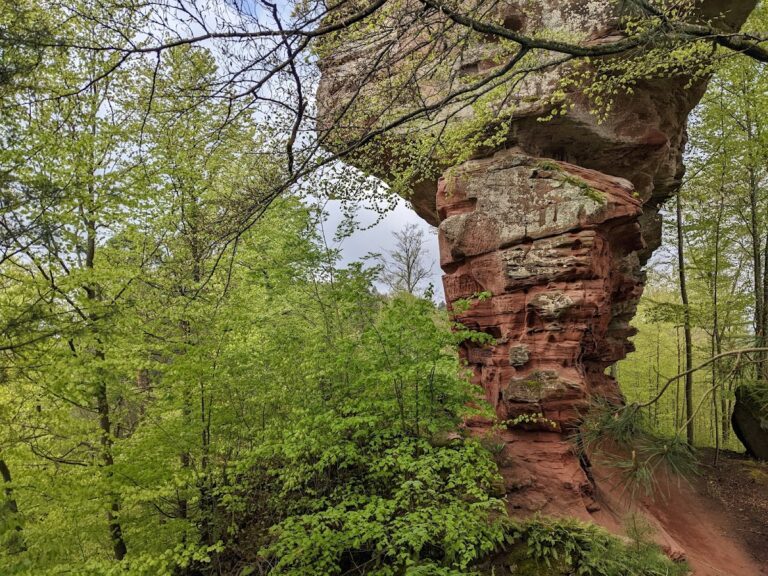
An imposing cubical sandstone monolith, about 15 metres high, forms part of the upper castle on the eastern side of the courtyard. Its northern and southern faces have been hollowed out, while the western face preserves the beginnings of work intended to cut the rock into blocks. The eastern approach included a staircase whose access is now impossible. Malye also described a second staircase, and the two broad stairways led to the upper platform.
Water installations and timber structures
The upper platform contains a filter cistern, a water-storage installation designed to clarify collected water before it was drawn out, measuring approximately 3.50 by 4 metres. At its center is a withdrawal shaft 5.37 metres deep, and the platform also contains a very deep well. Beam sockets cover the rock, showing where the timbers of a structure built against it were formerly held. Access to the upper rock is currently hazardous.
Rock-cut defenses and movable remains
A defensive ditch cut across the narrow connecting part of the ridge protects the castle on the west. This neck ditch is approximately 6 metres wide and 5 metres deep, with vertical sides. A bronze culverin from Helfenstein survives at the Maison de l’archéologie in Niederbronn-les-Bains. The culverin was a relatively long-barrelled early firearm used chiefly as an artillery weapon.