Abbey Sturzelbronn: A Former Cistercian Monastery in France
Site at a Glance
- Rating
- 4.7
- Popularity
- Very Low
- Country
- France
- Primary era
- Medieval
- Eras represented
- Medieval, Early Modern
- Civilizations
- Duchy of Lorraine, Holy Roman Empire
- Site type
- Religious
- Remains
- Monastery
On this page15 sections
History
Abbey Sturzelbronn was a former Cistercian monastery dedicated to Saint Mary in France, founded in 1135 in the Sturzel Valley of the Northern Vosges. The Cistercians were a reform branch of Western monasticism that emphasized strict observance, communal labor, and a comparatively austere way of life. The abbey belonged to the Diocese of Metz and was a daughter house of Maizières, itself part of the line of La Ferté. Its first community arrived from Maizières in Burgundy under Abbot Ortlibius, with twelve monks establishing the monastery known as the Valley of Saint Mary.
Foundation and Lorraine protection
Simon I, Duke of Lorraine, founded and richly endowed the abbey. The dukes of Lorraine remained its protectors, and Simon I was buried there in 1139. Simon II followed in 1205, Thiébaud in 1220, and Gertrude of Dabo in 1225, together with other regional nobles. Simon I’s successor, Matthew I, greatly expanded the monastery’s landed possessions.
Tradition associates the new foundation with Saint Bernard of Clairvaux, a leading Cistercian abbot and preacher. He probably passed through Sturzelbronn on 27 December 1146 while travelling along the former Roman road from Bitche to Wissembourg to preach the Second Crusade, a Western Christian expedition launched after the loss of the County of Edessa.
Estates and political change
From 1297, the abbey came under the protection of the Counts of Zweibrücken-Bitsch. Its estates included numerous farm settlements and rights to collect all or part of the tithe, a customary levy that supported religious institutions, in villages east and southeast of the Bitche region. The surviving estate records show an institution whose resources came from agricultural production, rents, fisheries, tithes, and rights over dependent holdings.
The German Peasants’ War in 1525 brought severe damage. Insurgents plundered the abbey and burned its library books, donation charters, archives, and registers of dues and taxes. After the Counts of Zweibrücken-Bitsch died out, the Protestant County of Hanau-Lichtenberg attempted to seize the abbey and its possessions in 1570. Duke Charles III of Lorraine occupied the Bitche region in 1572, keeping the abbey outside the Reformation territories.
War, rebuilding, and renewed monastic life
Mercenaries serving Ernst von Mansfeld plundered Sturzelbronn in 1622 during the Thirty Years’ War, the prolonged European conflict that devastated much of central Europe between 1618 and 1648. In 1633, amid the destruction of Lorraine, the abbey was burned completely except for the porter’s cottage. Famine and plague also affected the surrounding region.
Cistercian monks returned in 1687, and monastic life gradually resumed. Under Abbots Fournier and Jean-François de Mahuet, the abbey church was rebuilt, with new construction beginning in 1711. The monks also reasserted their territorial rights by placing boundary stones along their lands. In 1749, an agreement with Landgrave Louis IX of Hesse-Darmstadt formally regulated the boundary between ecclesiastical and secular property in the Pirmasens area. Tithe-paying lands were marked separately with stones bearing the year, heraldic symbols, and the initials GSZ.
Revolutionary dissolution
On the eve of the French Revolution, the abbey’s income was estimated at 9,000 livres. In 1790 its domain included fourteen fish-stocked ponds, the Zinsel and Sturzelbronn streams, about sixty tenant farms, and twenty-one agricultural granges. Nine monks remained at Sturzelbronn, supported by an organist, two cooks, a baker, a refectory steward, and a servant for the prior. The abbey had had no abbot since Abbot Colin de Contrisson died on 7 December 1789.
The revolutionary government confiscated the abbey’s ecclesiastical properties on 2 November 1789 and declared them national property on 17 March 1790. The monastery was not among the religious houses allowed to continue, and monks who wished to preserve communal life were sent to Justemont. Hesse-Darmstadt separately sequestrated the properties within its territory.
The district of Bitche began liquidating the abbey in 1791. Its movable possessions were auctioned at Bitche between 10 April and 12 November 1792, while the buildings were sold in stages from 1796. The convent and church were auctioned in lots on 13 July 1798, and the convent was secularized in 1799. The abbey is generally dated as dissolved in 1790, although liquidation continued through the 1790s. The abbey church, sold as national property, was largely demolished in 1807.
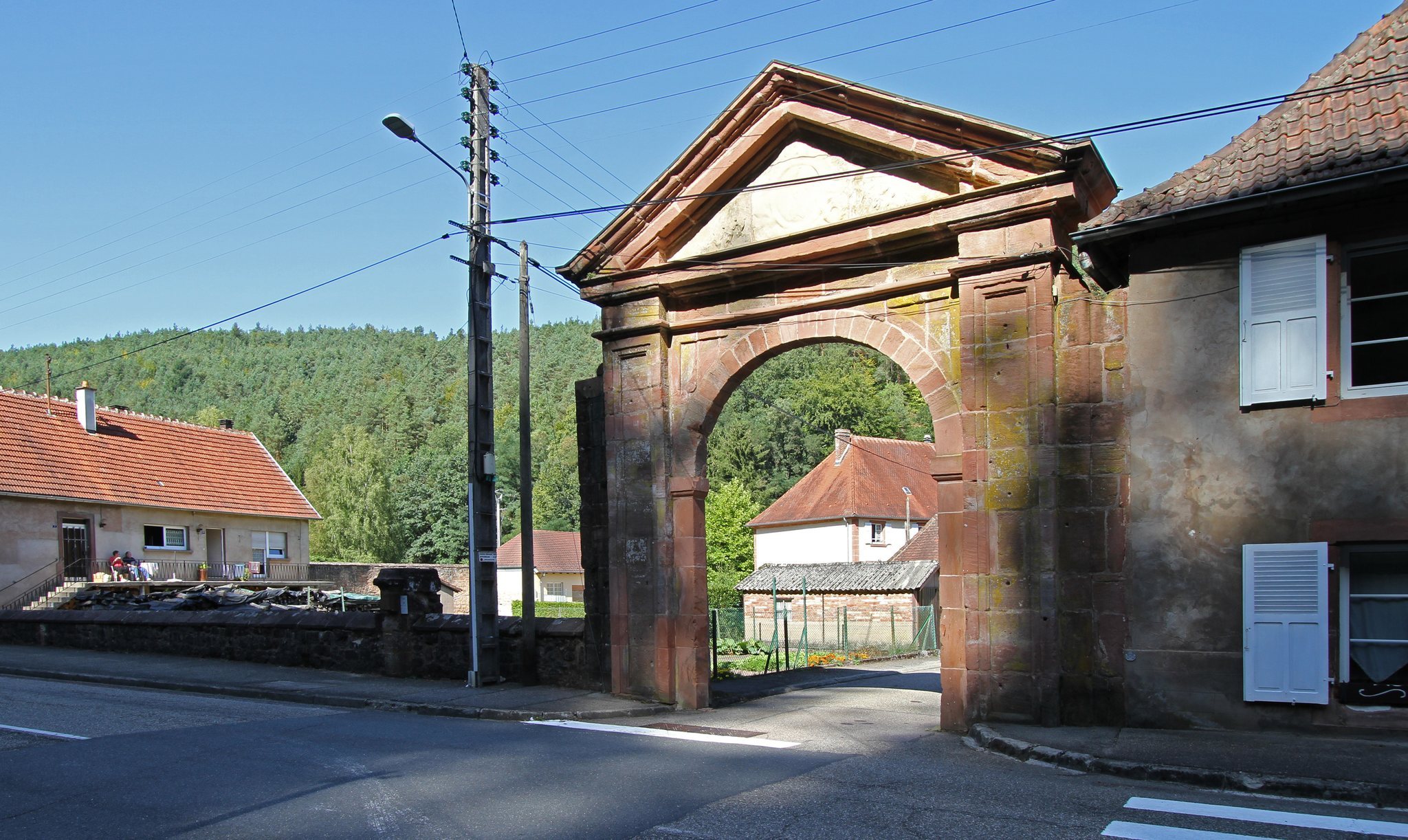
The surviving portal received protection as a French historic monument on 18 November 1987. A reconstruction of the abbey complex was attempted in a 1994 publication. A memorial plaque was installed opposite the parish church in 1895, and a statue of Saint Bernard was erected in the village in 1935.
Remains
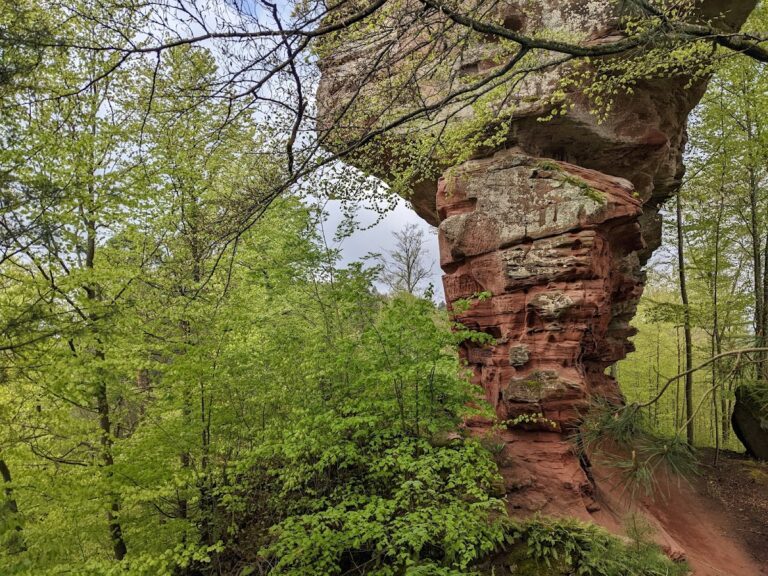
The surviving remains stand in the Sturzel Valley, a narrow wooded valley in the Northern Vosges east of Bitche and near the former Roman road to Wissembourg. They include a round-arched portal, two former abbey buildings converted in the nineteenth century into the town hall, school, and presbytery, and stone elements preserved in or around the parish church. Boundary stones from the abbey estate also survive across parts of the former territory.
Church and surviving buildings
Church portal and transept
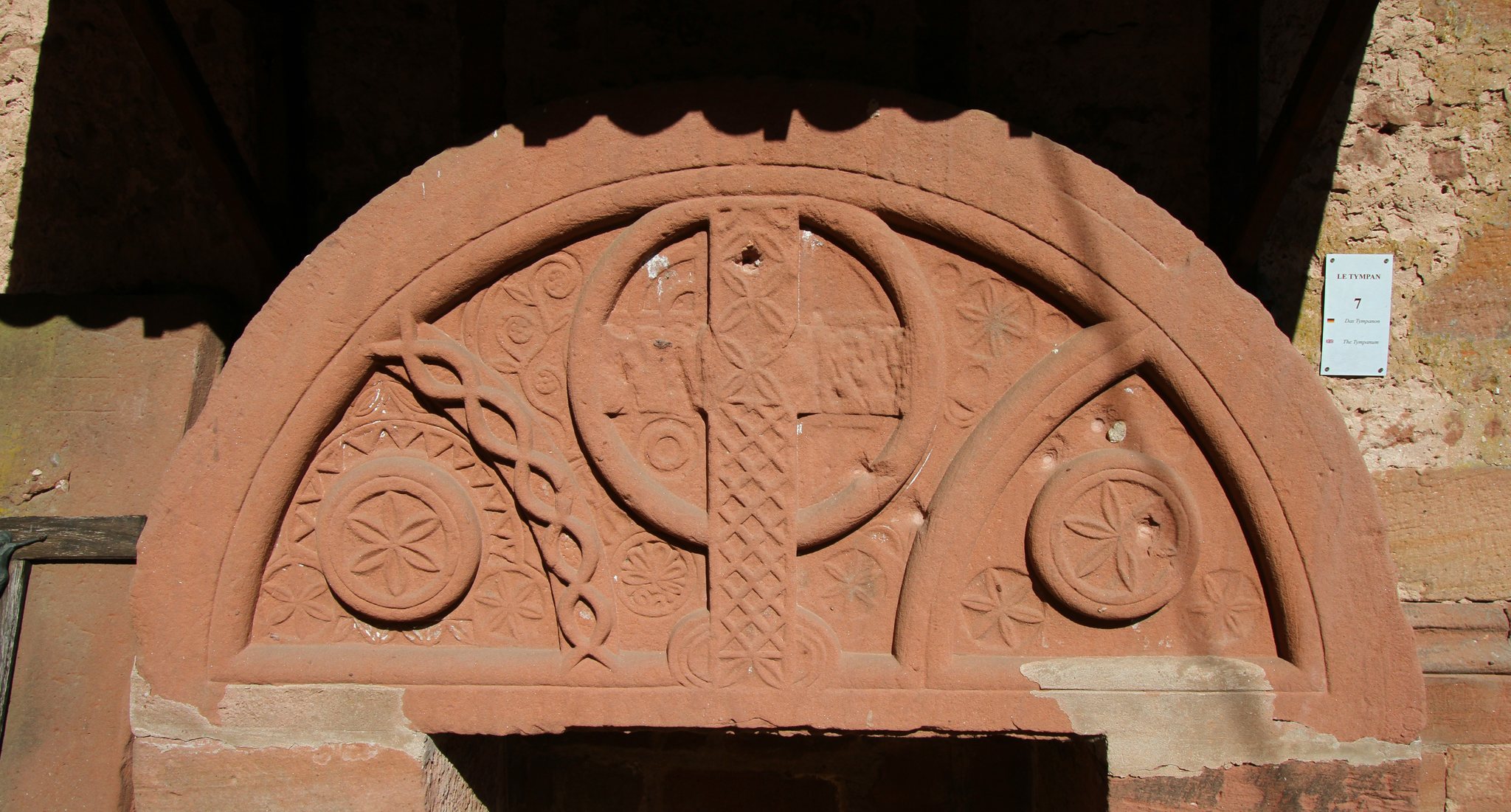
The former abbey church had a transept and a straight-ended choir. Its north transept facade remained incorporated into a house until 1961, with a round-arched portal at ground level providing access to the church. The principal church portal had a twelfth-century tympanum, the usually semicircular or triangular field above a doorway. This tympanum was later placed in the surviving left arm of the transept. It carries a cross of the Redeemer surrounded by the sun, moon, stars, flowers, and symbols of infinity, described as esoteric ornaments.
Former abbey buildings
Two buildings from the former abbey complex survive after nineteenth-century conversion for civic and religious uses. They became the town hall, school, and presbytery, preserving parts of the former monastic complex within the modern village fabric.
Parish church elements
The parish church preserves additional stonework from the abbey. An undated perpetual calendar for calculating the date of Easter is embedded in the entrance area, while a stone sarcophagus stands outside.
Estate boundaries
Boundary stones
Boundary stones installed by the monks to mark abbey lands survive in parts of the former estate. They are found in areas around Vinningen, Obersimten, Eppenbrunn, Trulben, Schweix, Hilst, and Kröppen. Some stones marking tithe-paying lands carried a year, heraldic symbols, and the initials GSZ.
Dispersed furnishings
Clock, organ, and fittings
The abbey clock was purchased by the town of Bitche. It measured six feet long, four feet wide, and three feet high. The organ went to Sarrelouis, the pulpit to Roppeviller, a confessional to Breidenbach, a large bell to Haspelschiedt, and the Baroque altar to Loutzviller.
Choir woodwork and ironwork
The choir woodwork was transferred to the former abbey church at Neuwiller-lès-Saverne, where the Louis-Seize-style choir stalls have remained since 1804. Other furnishings were distributed among churches in the surrounding area. The church’s iron grille and other iron fittings were removed in 1793 for use in the manufacture of weapons at Metz.