Maiden Tower (Gadabay): A Medieval Defensive Fortress in Azerbaijan


Site at a Glance
- Rating
- 4.6
- Popularity
- Very Low
- Country
- Azerbaijan
- Primary era
- Medieval
- Eras represented
- Medieval
- Civilizations
- Armenian
- Site type
- Military
- Remains
- Castle
On this page7 sections
History
Maiden Tower (Gadabay) is a medieval defensive fortress in Azerbaijan near Soyudlu village, identified as an Armenian fortress in the historical region of Gardman, a medieval region of the eastern South Caucasus. Its construction is placed between the ninth and twelfth centuries, although its exact date and original purpose remain uncertain. The fortress is also known as Charek Fortress and Namerdgala. Charek is the name used in scientific literature, while Maiden Tower and Namerdgala are common in local usage.
Uncertain origins and medieval rule
One tradition connects the fortress with Saak Sevadi, a prince of Gardman, during the ninth or tenth century. Architectural and material analysis has instead associated it with the twelfth-century Eldiguzid period. The Eldiguzids, also called the Ildegizids, were a Turkic dynasty that ruled much of Azerbaijan and neighboring parts of the South Caucasus and Iran during the twelfth and early thirteenth centuries. An official dating places the fortress between the ninth and eleventh centuries, preserving the uncertainty surrounding its beginnings.
After 1206, the fortress was liberated by Ivane Zakarian, one of the leading military and political figures of the Zakaryan ruling family. A further reference to Charek dates to 1224. The Mongols later captured the fortress. Following that conquest, Charek probably lost its military importance, and later records mention it only rarely.
Heritage recognition
Maiden Tower (Gadabay) is recognized as part of the Khojaly-Gadabay cultural heritage and as a locally important architectural monument in Azerbaijan. Its surviving structure preserves evidence of a fortified settlement shaped by the political and military changes of medieval Gardman.
Remains
Fortress layout and setting
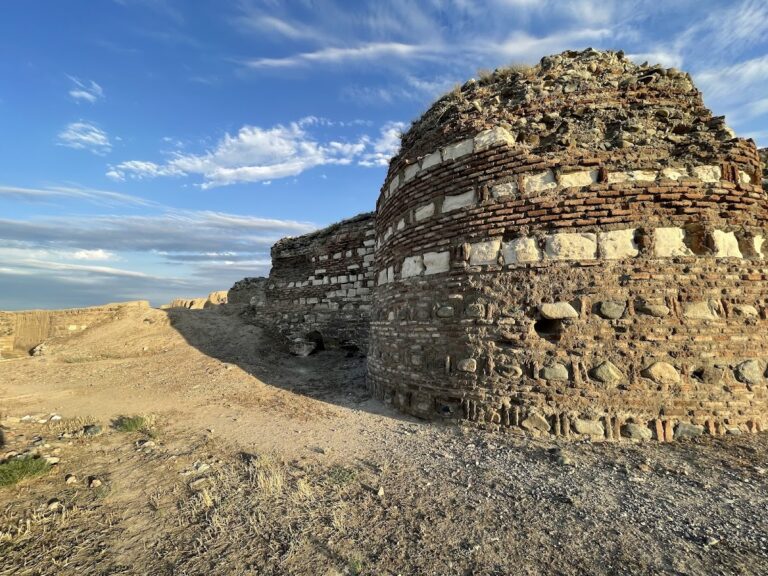
The ruins occupy the rocky end of a mountain spur in a mountainous, densely wooded landscape near Soyudlu. The position is associated with the confluence of the Shamkir, also called Charek, and Gadabay rivers, and the fortress is described as standing on rocky ground about 7 to 10 kilometers from Soyudlu. It lies at approximately 1,110 meters above sea level and rises about 100 meters above the riverbank. Its elevated position provided a view over, and helped control, a large surrounding territory.
Levels and towers
Charek has a polygonal plan adapted to uneven rocky relief. It forms a two-level fortress, with the upper level occupying the highest point of the mountain and its southern side connecting with the lower level. Rounded or semicircular towers stand at the principal corners. The fortress is also described as having five circular tower-like columns that differ in height and diameter. Within the upper level is a five-sided inner tower. The complete perimeter measures approximately 250 meters.
Walls and defensive works
Unlike many mountain fortresses built from nearby rock or stones gathered from riverbeds, Maiden Tower was constructed from baked brick. The bricks measure approximately 23 centimeters in length and 6 centimeters in width, and some descriptions state that the walls were faced with polished bricks. The defenses included two layers of machicolations, projecting openings through which defenders could observe or attack people below. A belt-like structural element passed through the walls and towers and completed the upper crown, adding further strength to the defenses.
Hidden exits formed part of the fortress’s defensive arrangements, while an underground tunnel led toward the Shamkir River. The fortress now survives in ruins, with its towers, polygonal enclosure, elevated position, and defensive features preserving the main elements of its medieval military design.
Nearby sites