Castello dell’Abbadia: A Medieval Fortress and Archaeological Museum in Italy


Site at a Glance
- Rating
- 4.5
- Popularity
- Low
- Country
- Italy
- Primary era
- Medieval
- External website
- Open
- Eras represented
- Classical, Medieval, Early Modern
- Civilizations
- Etruscan, Papal States, Roman
- Site type
- Military
- Remains
- Castle
On this page9 sections
History
Castello dell’Abbadia is a historic castle in Italy, at the crossing of the Fiora River near the ancient Etruscan city of Vulci. Its earliest fortifications protected the Etruscan-Roman bridge known as the Rainbow Bridge or Devil’s Bridge, which dates to the third century BC. The crossing controlled an important route and gave the site lasting strategic value.
Abbey and medieval fortress
During the Early Middle Ages, the site was occupied by a Benedictine abbey dedicated to Saint Mamilian of Palermo. Its position between the Papal States, territories governed by the pope, and Tuscan territories made the abbey and bridge strategically important. Control of the crossing also connected the religious foundation to wider political and military rivalries.
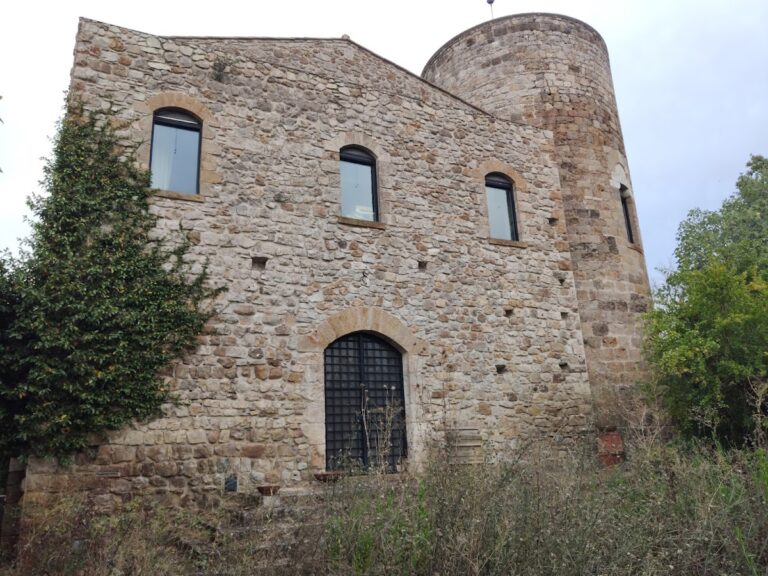
From the twelfth century, the former abbey was contested by the Aldobrandeschi, the commune of Orvieto, and the Prefects of Vico. It was gradually transformed into a fortified castle, with successive owners reinforcing its defenses. By the end of the fourteenth century, the castle had assumed its principal medieval form, including heavy stone walls and a tall watchtower.
Farnese rule and the Duchy of Castro
In 1430, the condottiero, a professional military commander in medieval and Renaissance Italy, Ranuccio Farnese the Elder received the castle as a fief. The Farnese family retained control until the early sixteenth century. In 1513, Cardinal Alessandro Farnese, who later became Pope Paul III, received the castle for his lifetime and used it regularly as a residence.
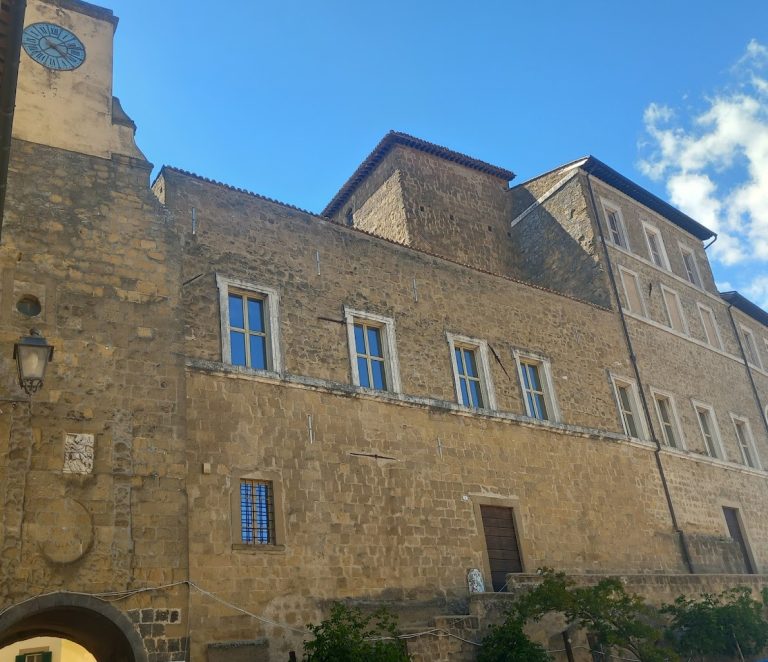
Alessandro Farnese rebuilt and altered both the exterior and interior, creating much of the form that survives today. In 1537, Castello dell’Abbadia became part of the Duchy of Castro, a Farnese-ruled state established within the papal sphere by Pope Paul III for his son, Pier Luigi Farnese. The castle returned to the Papal States in 1649, after the army of Pope Innocent X captured and destroyed major cities of the duchy, including Ischia di Castro and Acquapendente.
Decline, reuse, and museum conversion
At the end of the seventeenth century, the castle lost its former strategic importance. It continued as a secondary Papal State fortress until the end of the eighteenth century. During the Napoleonic period, French forces seized it and assigned it to Lucien Bonaparte, Napoleon Bonaparte’s younger brother, who had been made Prince of Canino.
The complex later passed to the Torlonia family and served as a pontifical customs post on the northern frontier of the Papal States. The unification of Italy in 1870 ended its administrative and strategic role. After decades of neglect, the castle was effectively abandoned and was used by local farmers as a rural farm building.
The Italian state later confiscated and repaired the complex, making it state property. Since 1975, the castle has housed the National Archaeological Museum of Vulci, whose collections include finds from excavations at Vulci, an important ancient Etruscan city. Castello dell’Abbadia is also one of three museum “gates” to the Vulci Archaeological and Natural Park, established under a convention signed in 1999. The property is state-owned, administered by Italy’s Ministry of Culture, and recognized as Italian national heritage.
Remains
River crossing and setting
The castle stands on a high rocky bank above the Fiora River. Its trapezoidal plan overlooks the river valley and the ancient bridge, whose crossing helps explain the site’s defensive position and historical development.
Rainbow Bridge
The Etruscan-Roman bridge protected by the earliest fortifications is known as the Rainbow Bridge or Devil’s Bridge, names associated with its arched form. It is a substantial stone structure rising about 30 metres above the water and is built from porous reddish-brown tuff blocks. The bridge and castle both use tuff, although the castle blocks were more carefully squared.
Fortified complex
The main castle building occupies the western side of the complex and has a tiled roof. A tall bergfried, or defensive tower used mainly as a strongpoint and lookout, adjoins it on the north. A continuous ring wall encloses the site, while four projecting semicircular towers strengthen the perimeter. Outside the walls lies a deep moat filled with water.
A small inner courtyard forms part of the fortress. In earlier periods, it contained storage buildings, workshops, a forge, and other service structures. The castle could be entered from the west across the ancient bridge or from the east by a drawbridge.
The complex suffered from prolonged neglect before its repair and conversion to museum use. In 1927, David Herbert Lawrence described the castle as blackened and partly ruined, with grass growing from its walls and tower. His description also compared its appearance to that of a rural house.
Archaeological museum
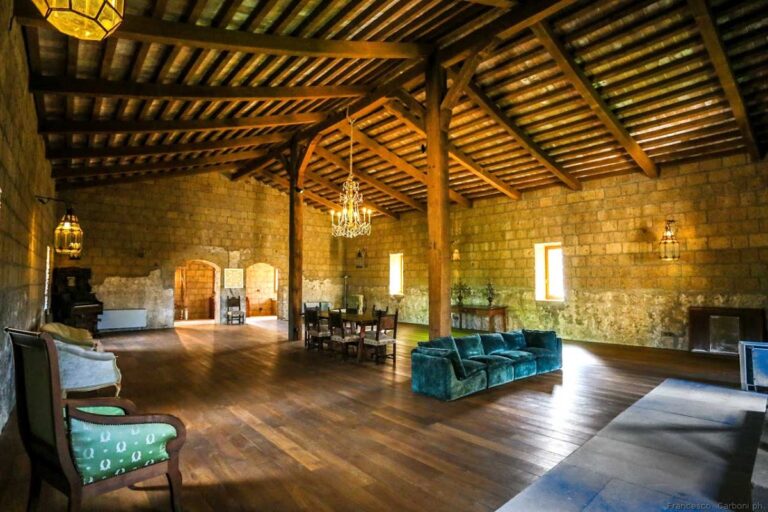
The National Archaeological Museum of Vulci occupies the castle’s historic spaces. It contains archaeological finds recovered from excavations at Vulci, including material from the ancient city’s remains and cemeteries. The museum therefore gives the fortified complex a continuing role in presenting the history of the landscape around the Fiora River.