Château de Nointel: A Seventeenth-Century French Château


Site at a Glance
- Rating
- 4.6
- Popularity
- Low
- Country
- France
- Primary era
- Early Modern
- External website
- Open
- Eras represented
- Early Modern
- Civilizations
- French
- Site type
- Domestic
- Remains
- Castle
On this page9 sections
History
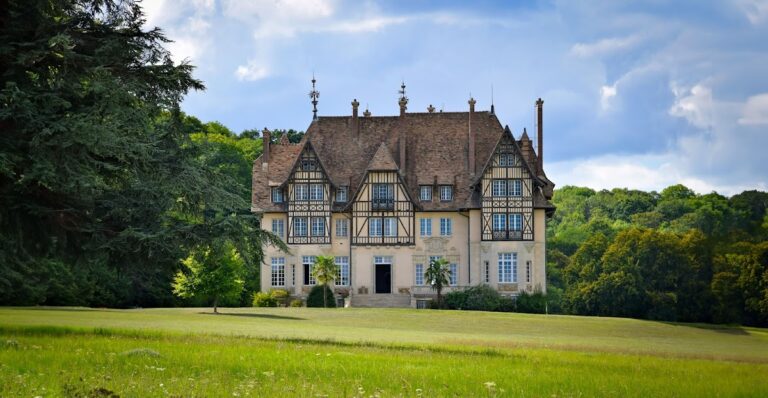
Château de Nointel is a seventeenth-century French château in France, created during the period of Louis XIV as the centre of the Nointel seigneurie, a territorial lordship whose holder controlled an estate and its dependent lands. Until the second half of the seventeenth century, the estate comprised land, houses, vineyards, and woodland.
Creation of the château
In 1679, Jean I de Turmenyes purchased the entire seigneurie of Nointel. A knight of the King’s Order during the reign of Louis XIV and keeper of the Royal Treasury, he commissioned an architect who had studied under Jules Hardouin-Mansart, a leading architect associated with major royal projects, together with a landscape designer. Their work established the château and its formal French garden during the last quarter of the seventeenth century.
The estate’s hydraulic installations entered service in 1720. They used the park’s 65-metre difference in elevation to feed its fountains, which contemporary authors considered comparable only to those of royal residences.
Ownership and changing landscapes
In 1748, Prince Louis François de Bourbon-Conti bought the lands of Nointel, Presles, Courcelles, and Pérolles from the two heirs of Jean de Turmenyes. He sought to enlarge his hunting domain around the Forest of Carnelle. In exchange for land and houses at L’Isle-Adam, he transferred the château to Pierre-François Bergeret, a wealthy fermier général, or private financier who collected certain taxes for the French monarchy.
Bergeret spent lavishly on the estate and regularly hosted sumptuous festivities. From 1787, his son Pierre-Jacques-Onésyme Bergeret succeeded him. He already owned Château de Cassan at L’Isle-Adam and was known as a friend of the painter Jean-Honoré Fragonard.
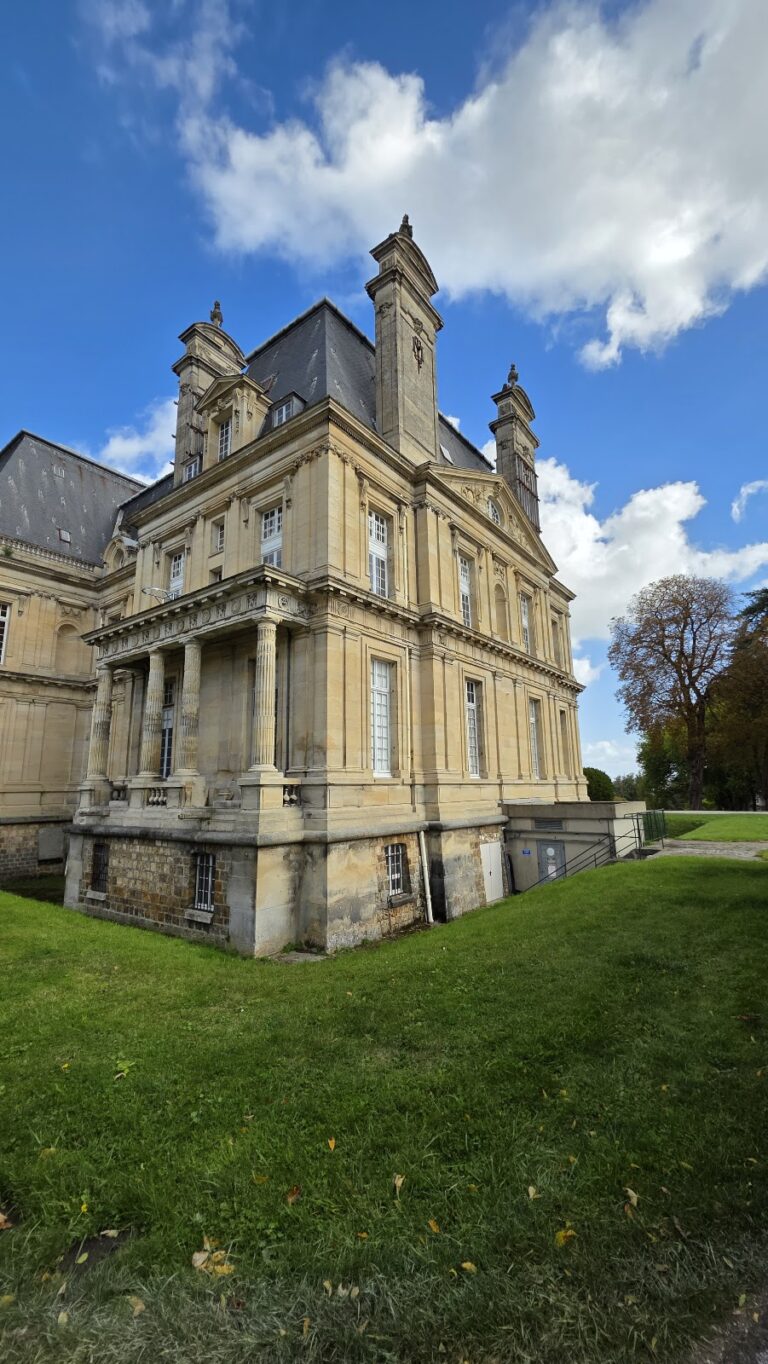
At the end of the eighteenth century, a new owner named Ribault made major changes. He added a storey to the château, moved the balustrades that had concealed its shallow-pitched roof into the main courtyard, and converted the park into an English-style landscape garden.
Later owners and protection
Château de Nointel remained for 172 years with the Béjot family and their descendants, the Fauchier-Magnan family, who played an important part in village life. It later belonged briefly to the German publisher Jürgen Mahnert-Lueg before Prince Joachim Murat acquired it.
Murat transformed the château into a highly eclectic centre for contemporary art. The project attracted considerable regional attention but soon failed because it lacked sufficient financial resources. The château received protection under France’s historic-monument legislation in 1987, followed by an order dated 3 November 1997.
Remains
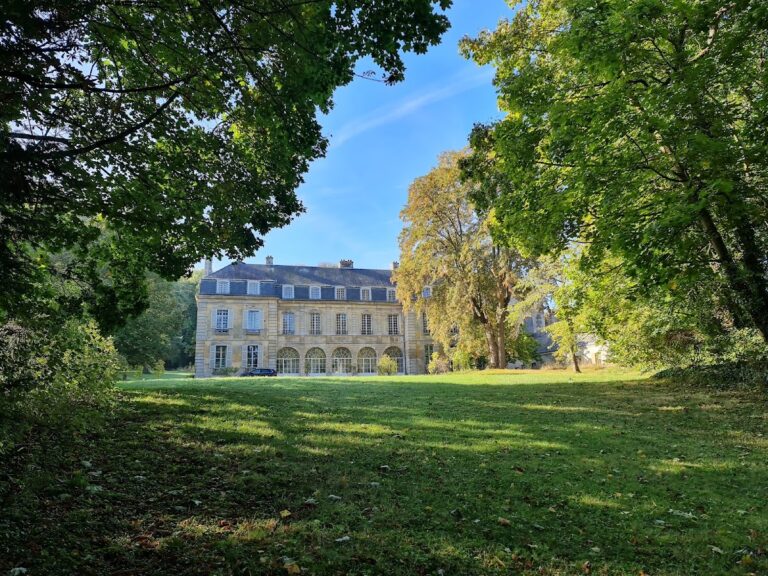
Château de Nointel stands beside the centre of Nointel on Rue Notre-Dame and Avenue de Verdun. Its park extends northward to the neighbouring commune of Beaumont-sur-Oise. The site combines the château with the remains of a formal garden, later reshaped as an English-style landscape, and a large system of water installations arranged across the park’s sloping ground.
Château and garden layout
The château
The original château was a single-storey building begun during the last quarter of the seventeenth century. It measured 48 metres in length and 9 metres in width. Inside, rooms followed one another in sequence, with daylight entering from two sides. Ribault’s alterations added a storey and transferred the balustrades formerly used to screen the shallow-pitched roof into the main courtyard.
The hydraulic installations
The principal feature of the formal garden’s water system was the Mississippi Basin, a large reservoir placed at the top of a hill. It held 4,000 cubic metres of water and supplied twenty fountains distributed through the park. An axis from the château led toward the basin by a monumental staircase of 87 steps. A statue representing Comedy stood above the staircase.
Sculpture and planted grounds
The statue of Comedy, along with other statues including Athena, was long attributed to Antoine Coysevox, a prominent French Baroque sculptor. Without proof for that attribution, the Comedy statue is more probably the work of one of Coysevox’s pupils.
During the Bergeret family’s ownership, the park contained avenues, groves, formal parterres, ornamental beds arranged in symmetrical patterns, bodies of water, and a kitchen garden. Its later conversion into an English-style landscape garden changed the character of this earlier formal arrangement.
Nearby sites