Château de Camy: A Former Quercy Farmstead and Noble Residence


Site at a Glance
- Rating
- 4.6
- Popularity
- Very Low
- Country
- France
- Primary era
- Early Modern
- Eras represented
- Medieval, Early Modern
- Civilizations
- French
- Site type
- Domestic
- Remains
- Castle
On this page8 sections
History
Château de Camy is a former Quercy farmstead in Luzech, France, that became a secondary residence of the Chapt de Rastignac family during their stays in the region. The building stands within the historical region of Quercy, in the Lot department of Occitanie, and its surviving fabric combines a fourteenth-century element with later remodelling.
The Chapt de Rastignac inheritance
The Chapt de Rastignac family came from Limousin and acquired the Quercy possessions of the barons of Luzech in 1600. This inheritance followed the marriage of Jacquette de Ricard de Gourdon, widow of Jean II de Luzech, to Jean Chapt de Rastignac. The family used Camy because the ancestral castle of the barons of Luzech had long been completely ruined.
Jean Chapt de Rastignac served Louis XIII and Louis XIV, the kings of France, in royal military and political roles. His efforts helped Luzech avoid the upheavals of the Fronde, a series of rebellions against royal government during Louis XIV’s minority from 1648 to 1653. In 1617, the land of Rastignac became a marquisate, a territorial lordship whose holder ranked as a marquis, and Jean Chapt de Rastignac became a field marshal.
The Chapt de Rastignacs retained Luzech until the middle of the eighteenth century. Alfred de La Rochefoucauld, whose mother was born Zénaïde de Rastignac, later sold the family’s possessions and transferred the remaining ruins of the barons’ castle to the municipality.
Later ownership and division
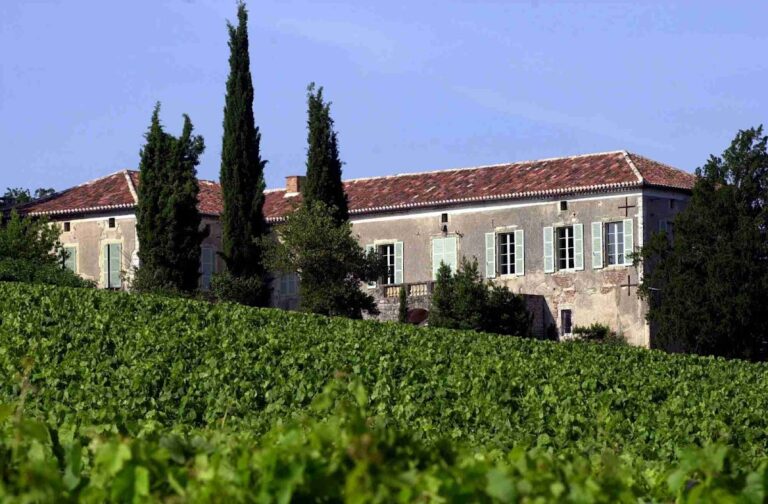
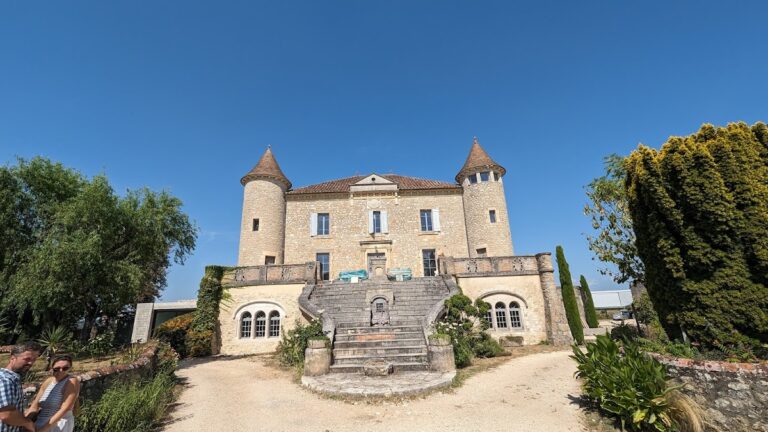
Afterward, Château de Camy passed through several owners and was divided into two residences, known as the left wing and the right wing. The right-hand residence, which continues to be called Château de Camy, includes the outbuildings, woodland, and a large orchard along the Lot. Its current hosts purchased it in 2021.
Remains
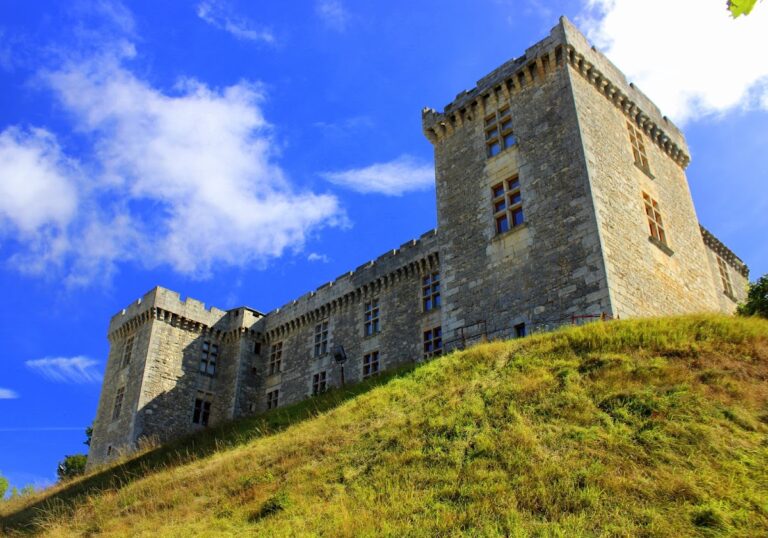
Château de Camy is arranged at a right angle and is partly buried in the road embankment. Its roofs are covered with black slate, a regional peculiarity that makes the building recognizable for several kilometres from the air. A square tower is attached to the eastern angle, forming a distinct element within the surviving complex.
Residential wings
The right residential body
The small residential body on the right is topped by a Mansard roof, which has two slopes on each side, with the lower slope steeper than the upper one. It retains an ornate twin window, a pair of adjoining openings divided by a central vertical support. The window has a capital decorated with a palmette, a stylized palm-leaf ornament. It was unblocked and brought back into view at the end of the twentieth century.
The other residential body
The other residential body preserves the remains of a trefoil window, an opening with three lobes. This feature indicates a building dating from the fourteenth century. The body was completely remodelled in the eighteenth century, leaving the medieval element within a later architectural form.
Family arms and motto
The Chapt de Rastignac arms are described as Azure, a lion argent armed, langued, and crowned or. Their motto was In Domino Confido, meaning “I trust in the Lord”; the phrase Laissez dire, meaning “Let them say,” is also associated with the family.
Nearby sites