Château de La Coste: A Historic Château in Grézels, France


Site at a Glance
- Rating
- 4.2
- Popularity
- Very Low
- Country
- France
- Primary era
- Early Modern
- Eras represented
- Medieval, Early Modern
- Civilizations
- French
- Site type
- Military
- Remains
- Castle
On this page8 sections
History
Château de La Coste is a medieval château in Grézels, France, built and developed by the Guiscard family from an earlier fortified refuge. Its history reaches back to the period of the Albigensian Crusade and continued through the Hundred Years’ War, the Wars of Religion, the French Revolution, and successive restorations.
Medieval Origins and the Hundred Years’ War
The first proprietors of La Coste were members of the Guiscard family. Bernard I Guiscard took part in the Albigensian Crusade, a thirteenth-century campaign against Catharism in southern France, in the army of Simon de Montfort. Guillaume de Cardaillac, bishop of Cahors, granted Bernard the château and other lands as a fief, meaning property held from a superior in return for obligations. An act of 1267 states that Bernard had already held these lands for more than forty years.
The character of the residence changed in medieval records. Finelle’s testament of 10 July 1286 called the site an hôtel, or lordly residence. In Bernard II Guiscard’s homage to Raymond de Pauchel, bishop of Cahors, on 12 November 1301, it was described as a repaire, a fortified residence or refuge. In 1348, King Philippe VI stationed troops there for its defense, and the site was then described as a château for the first recorded time. Bernard III Guiscard served as its captain.
La Coste was attacked during the opening phase of the Hundred Years’ War, the prolonged conflict between the English and French crowns from the fourteenth to the fifteenth century. Forces associated with Raymond de Durfort took part in attacks in the region. The surviving structure was probably rebuilt at the beginning of the war to strengthen its defenses. After the Treaty of Brétigny transferred Quercy to English suzerainty in 1360, La Coste remained under English allegiance from 1362 to 1372, with the Guiscards acting as vassals of the English king.
The Guiscard Line
Succession and homage continued to define the château’s medieval history. Bernard IV Guiscard was named heir in Bernard III’s testament of 11 April 1353, while his younger son Guillaume-Bertrand was to govern La Coste. On 17 April 1368, Bernard IV rendered homage for La Coste, Grézels, and part of Bélaye to the bishop of Cahors. A Guillaume-Bertrand rendered homage in 1391, although his relationship to the earlier Guillaume-Bertrand is uncertain.
In 1393, Guillaume-Bertrand I seized the contribution paid by the inhabitants of Cahors to the English in exchange for peace. He made his testament on 9 February 1416, after which his son, Guillaume-Bertrand II, succeeded him. Armed bands remained active in the Bélaye region until 1460, but La Coste does not appear to have been destroyed during that period. By the end of the fifteenth century, the Guiscard family’s position was firmly established.
Sixteenth-Century Conflict
The family faced serious legal and political difficulties in the sixteenth century. In 1526, three sons of Antoine de Guiscard were permanently banished and had their property confiscated by the Parlement, the sovereign judicial court of the French monarchy, for crimes committed in the Cahors diocese. Their brother Jean I de Guiscard inherited the succession, but the bishop’s men attacked him and forced him to pay legal costs. He later distinguished himself in François I’s wars against Charles V.
Jean II de Guiscard married Souveraine Ricard de Genouillac in 1528 and became one of the hundred gentlemen of the King’s Household, a court and household service position. The expense of this office led him to sell his fief of Montcuq. Their son, Jean III de Guiscard, later supported the Catholic League, a Catholic political and military movement active during the French Wars of Religion.
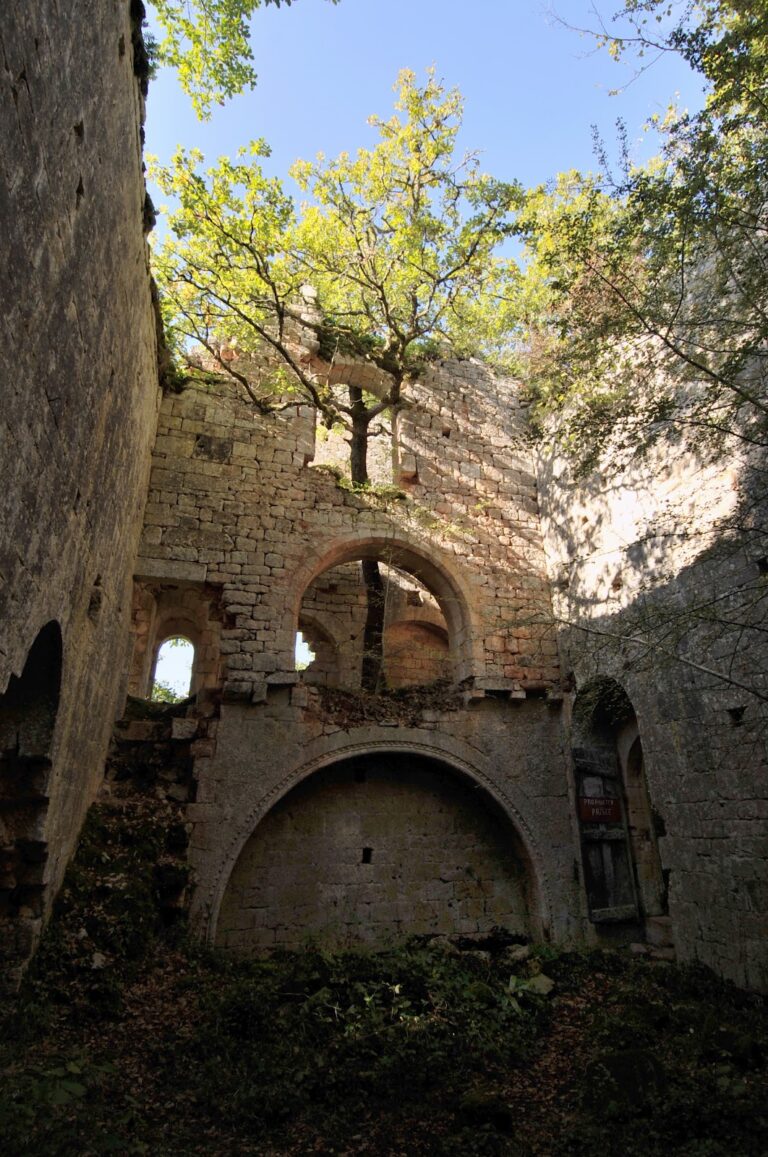
The Guiscards remained Catholic during the conflicts between Catholics and Protestants in sixteenth-century France. In 1567, Jean II received fiefs confiscated from Protestants from Blaise de Montluc. During Jean III’s support for the League, Protestant troops captured, looted, and partly destroyed La Coste, probably during the night of 14–15 April 1580. A guardianship account dated 17 February 1593 states that the château was then uninhabitable and abandoned. Reconstruction had not begun in 1595, but probably started soon afterward and continued into the early seventeenth century.
From the Eighteenth Century to Modern Ownership
During the seventeenth and eighteenth centuries, members of the Guiscard family served in the royal armies. In 1750, Marie-Anne-Foy de Cadrieu married Arnaud-Jean-Louis de Guiscard, Count of Guiscard and lord of Puycalvary, Lacoste-Grézels, and Lalaurie. The marriage required the name Cadrieu to be added to Guiscard. Because there was no male heir, the château passed through the marriage of Marie-Josèphe-Charlotte de Guiscard-Cadrieu to Alphonse-Sarrasin, Marquis of Durfort-Boissières, on 22 November 1773. A document from 1786 records Alphonse as possessing it on behalf of his son Armand.
Alphonse de Durfort acted as a messenger between Louis XVI, Marie Antoinette of Austria, the Count of Artois, and the Austrian emperor. He fought with the Army of the Princes during the campaigns of 1792–1794, served under Lord Moira in 1795, and later served Louis XVIII in England before returning to France with him. He died in 1822 at Château de Montgraham near Nogent-le-Rotrou.
During the French Revolution, La Coste was seized as national property. Perrouteau-Lanauze acquired it and sold its mills, farmsteads, and tileworks in 1815 and 1817. He sold the château in 1825 to Clément, an industrialist from Longwy who lived there until 1846. It was later purchased by Prady, a wine merchant from Grézels, who demolished one wing to enlarge his house. The Prady family retained the property until 1942, when it was acquired by the owner of the neighboring Château du Cayrou.
Mr. and Mrs. Bacquié later owned the château and restored it between 1960 and 1965. After their deaths in 1975, they left it to the Curie Foundation. The foundation sold it in 1976 to Mr. Dienet, who sold the furnishings in 1980. Mr. and Mrs. Gervais Coppé purchased La Coste in 1983, repaired the château, and organized exhibitions there. The building entered the register of historic monuments on 8 December 1961. Its façades, roofs, and courtyard ground received classified protection on 25 April 1997.
Remains
Fortified Plan and Surviving Buildings
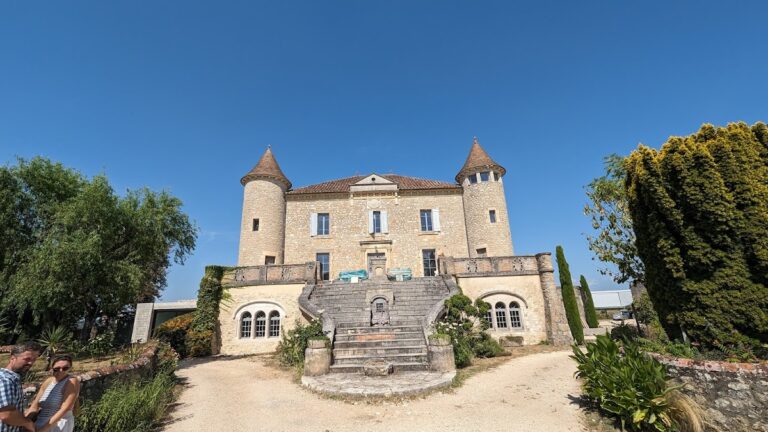
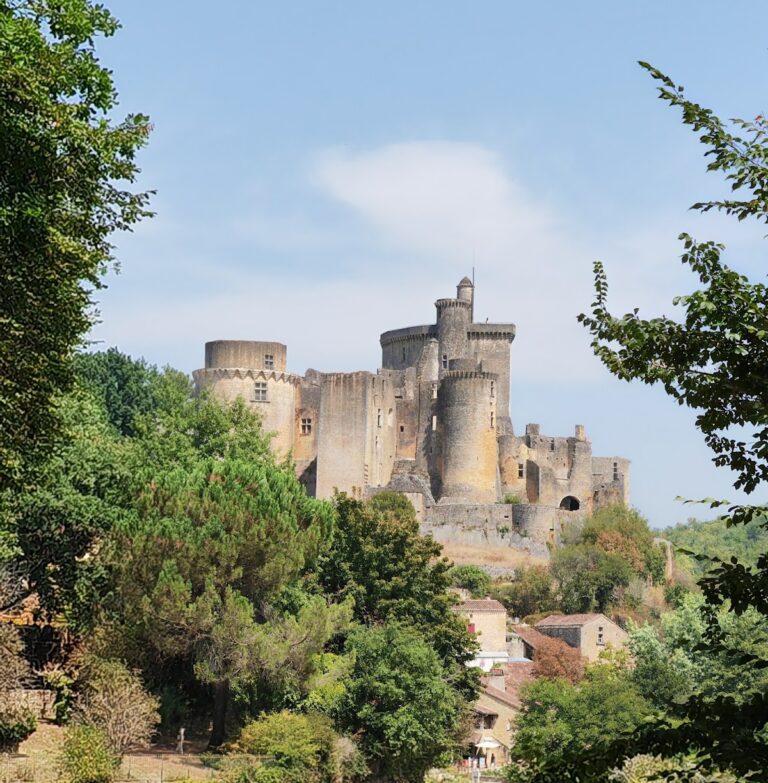
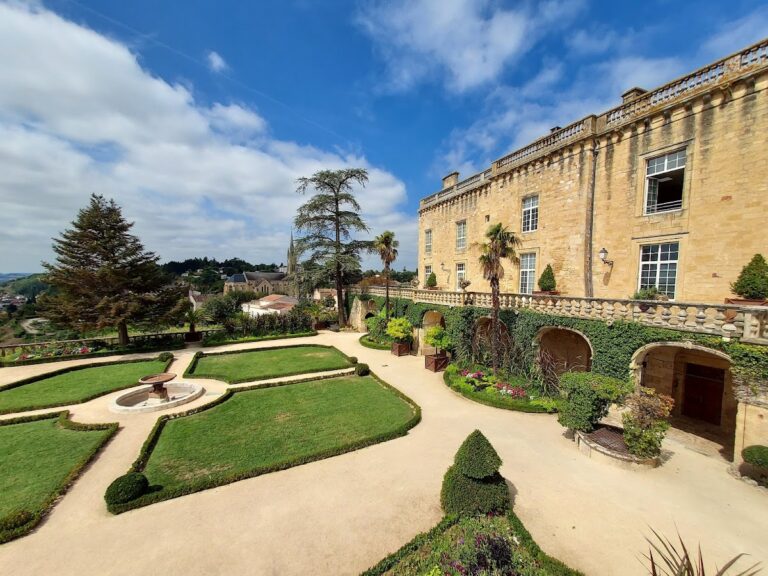
Château de La Coste began as a simple watchtower or fortified refuge and survives as a ruined example of fourteenth- and fifteenth-century military architecture, with later rebuilding from the late sixteenth into the early seventeenth century. The complex follows a square plan. Four towers mark its corners, with two massive rectangular towers on the west adjoining the main residential block and two round towers on the east.
The rectangular corps de logis, the principal residential block, was extended by two perpendicular return wings between the western rectangular towers and the eastern round towers. A southern curtain wall, the defensive wall connecting the towers, runs between the two round towers and encloses the courtyard. The southern return wing was demolished in the nineteenth century. The northern wing, once used as stables, was partly quarried for stone for a former owner’s house and included an open gallery designed to provide protection from the weather.
Medieval and Later Construction
The western façade and the two rectangular western towers appear to date from the fourteenth century. Most of the other surviving buildings belong to the reconstruction undertaken from the end of the sixteenth century into the beginning of the seventeenth century, after the château was partly destroyed during the Wars of Religion. The main residential block has four levels and contains a staircase with a straight central newel, the central upright around which the steps are arranged.
The two rectangular towers retain latrines, or built toilet facilities, in the angles where they meet the main residential block. These surviving elements, together with the towers, walls, courtyard, and later reconstructed buildings, preserve the successive defensive and residential phases of La Coste.