Château de la Touche: A Renaissance-Style Pleasure Residence in France
Site at a Glance
- Rating
- 4.6
- Popularity
- Very Low
- Country
- France
- Primary era
- Modern
- Eras represented
- Modern
- Civilizations
- French
- Site type
- Domestic
- Remains
- Elite Residence
On this page13 sections
History
Château de la Touche is a historic estate in France, a few hundred metres northeast of Nozay’s centre, whose present Renaissance-style pleasure residence was commissioned in 1827 after the medieval manor was demolished. Its history is connected with the lords of La Touche and Nozay, including members of the Montmorency family, and with the formation of a substantial feudal domain in Brittany.
Medieval origins and early transfers
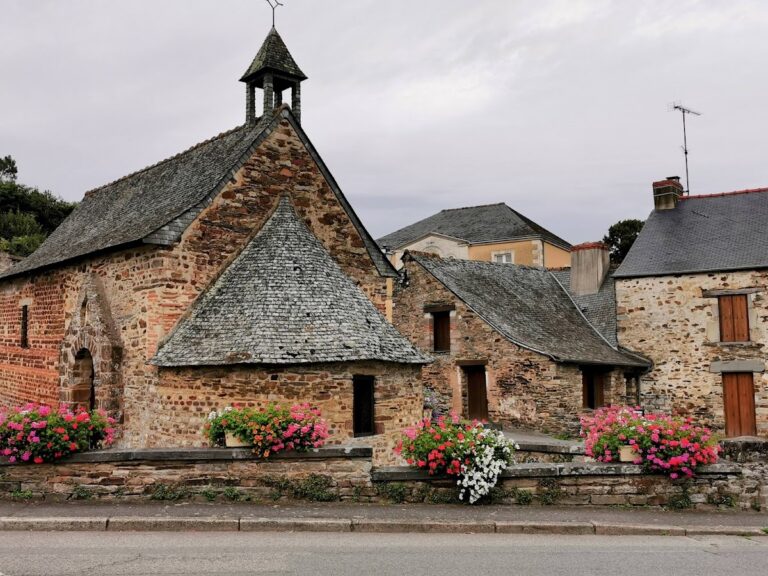
The medieval estate was associated with Jeanne du Moulin, lady of La Touche. In 1437, she founded a chaplaincy dedicated to Saint Michael in the north transept of the parish church. A chaplaincy was an endowed religious foundation that supported a priest and specified worship. In 1680, this foundation was transferred to the private chapel of La Touche, where Masses continued until the French Revolution.
Jeanne’s heir, Jean Sorin, and Robert Sorin sold the lordship to Bernard de Frosy in 1498. Bernard’s heirs transferred it to Jean Trégouët in 1504, and the Trégouët family sold it to Pierre Pirault in 1534. Pirault served as a royal councillor and secretary to Jean de Laval, governor of Brittany, baron of Châteaubriant, and lord of Nozay. While at Chantilly in 1538, Jean de Laval had Pirault ennobled and obtained permission for him to hold noble lands in Brittany producing up to 400 livres in annual revenue. Pirault died in 1541.
The Cornulier family and the châtellenie
Before 1553, Toussaint de Comaille became lord of La Touche through his marriage to Pirault’s widow, Perrine Vivien. Their daughter Claude de Comaille brought the estate to her husband, Pierre de Cornulier, in 1563. This marriage began the long association between La Touche and the Cornulier family.
On 26 September 1605, Henri de Montmorency, lord of Nozay, granted Claude de Cornulier, lord of La Touche and marquis of Château-Fromont, the right to a reserved bench in the choir of the parish church. A burial vault for the lords of La Touche-Cornulier was dug below it. The family also sometimes used the chapel of Saint Clair in Nantes Cathedral.
In 1611, King Louis XIII raised La Touche to the status of a châtellenie, a feudal jurisdiction centred on a lord’s castle or manor and extending over associated lands. The new jurisdiction united the lordships of Toulan, La Rivière, and La Croix-Mérhan in the parish of Nozay. The lords of La Touche later added Beaujouet, Bois-Guillaume, Haie-Poil-de-Grue, La Naulière, Grande Villatte, and Petite Villatte. An arbitration sentence of 17 May 1634, involving Henri II de Bourbon-Condé, lord of Nozay, confirmed Claude II de Cornulier in the rights of the La Touche châtellenie and authorized him to exercise them.
Eighteenth-century ownership
In 1718, La Touche became the dowry property of Élisabeth de Cornulier, the wife of Jean-Paul Hay des Nétumières. The couple sold the estate on 24 May to Joachim Darquistade, a merchant from Nantes. François de Montmorency and his wife, Émilie-Félicité de Cornulier, then sought to recover it through a feudal withdrawal procedure. In August, the superior lords Louis IV Henri de Bourbon-Condé and Jean-Baptiste de Cornulier were each awarded the relevant feudal rights and immediately transferred them to François de Montmorency and Émilie-Félicité de Cornulier.
François de Montmorency died at La Touche in 1748. His daughter Marie-Anne de Montmorency, wife of Louis Alexandre Xavier de Carcado, sold the estate to Françoise Bouteiller, widow of François-Bertrand des Coeuvre, on 8 May 1766. Toussaint de Cornulier secured a lineage withdrawal and related rights in 1767 on behalf of his son, Jean-Toussaint de Cornulier. In 1772, the property passed among Jean-Toussaint and his brothers Toussaint-Charles and Joseph de Cornulier. Most of the estate was then allotted to their niece Marie-Anne de Lanloup, wife of Jean Marie Louis de Bellingant, who remained associated with it until its sale in 1821.
Revolution, occupation, and rebuilding
Patriots invaded the château and set it on fire on 17 February 1790 during the French Revolution. The National Guard of the canton of Nozay was quartered at La Touche, and the estate entered a prolonged period of decline. In 1794, Captain Sigisbert Hugo commanded the La Touche cantonment. He later became a general of the Empire and was the father of the writer Victor Hugo. During the First Empire, the estate served as a hunting rendezvous.
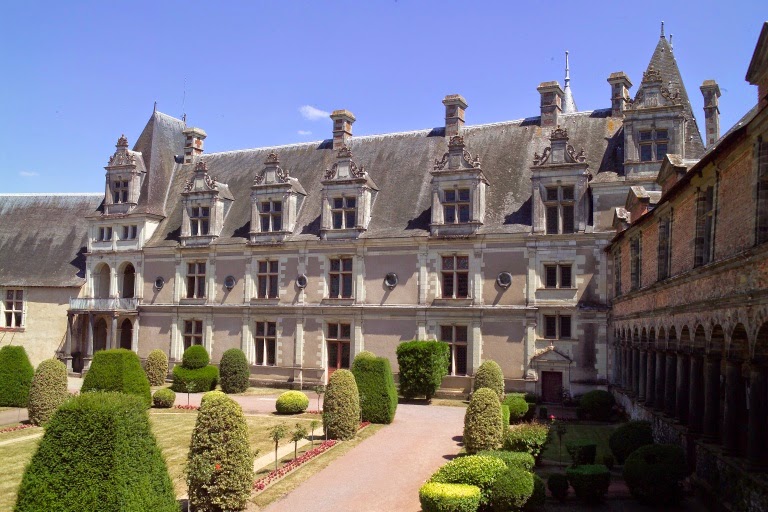
Prussian troops occupied the château in 1815 and left it uninhabitable. The old building then contained four large principal rooms on the ground floor, numerous bedrooms above, a corner turret, and a perpendicular wing of comparable importance. François de Monti de Rezé and his wife, Olympe Le Roux de Commequiers, acquired La Touche on 29 January 1821. Because the medieval manor was severely dilapidated, François de Monti had it demolished and commissioned the present château in 1827 for 25,000 gold francs.
Later inheritance and conservation
The rebuilt estate passed to the couple’s daughter, Euphrasie de Monti de Rezé, and her husband, Constant-Antoine du Bois de Maquillé, who had served as a page to King Charles X. Their son Henri inherited La Touche, followed by his sister Clémentine, their nephew Constant, Constant’s son Daniel, and Daniel’s son Yannick du Bois de Maquillé. The property remains privately owned by Yannick and Christine du Bois de Maquillé.
A fire devastated the château on 6 April 1987. Restoration of the main residence began in 1990, while work on the outbuildings began in 1991 in cooperation with regional and departmental heritage authorities. The outbuildings had been registered as Historic Monuments in 1988, and a later renovation and reconstruction programme addressed both the château and its associated buildings.
Remains
The estate combines a nineteenth-century Renaissance-style pleasure residence with surviving outbuildings and religious features connected with the former seigneurial domain. Its present form reflects the replacement of the medieval manor after the building’s destruction, occupation, and severe deterioration.
The rebuilt estate
Present château
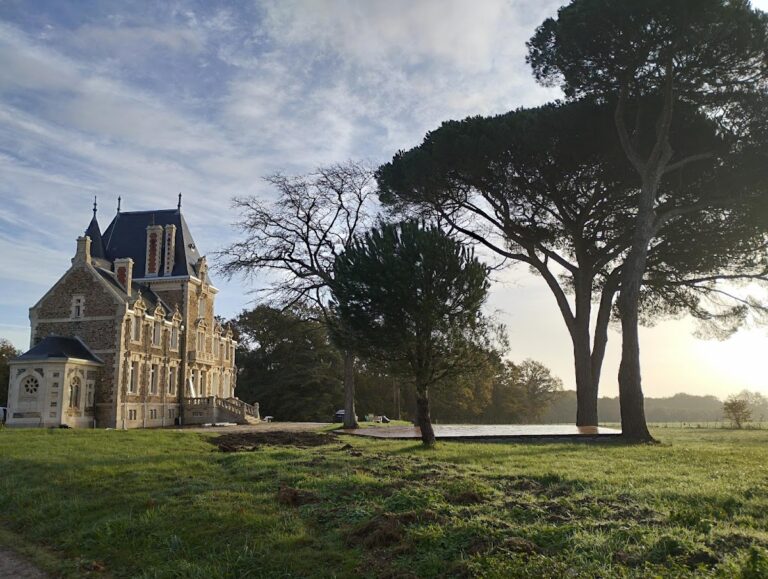
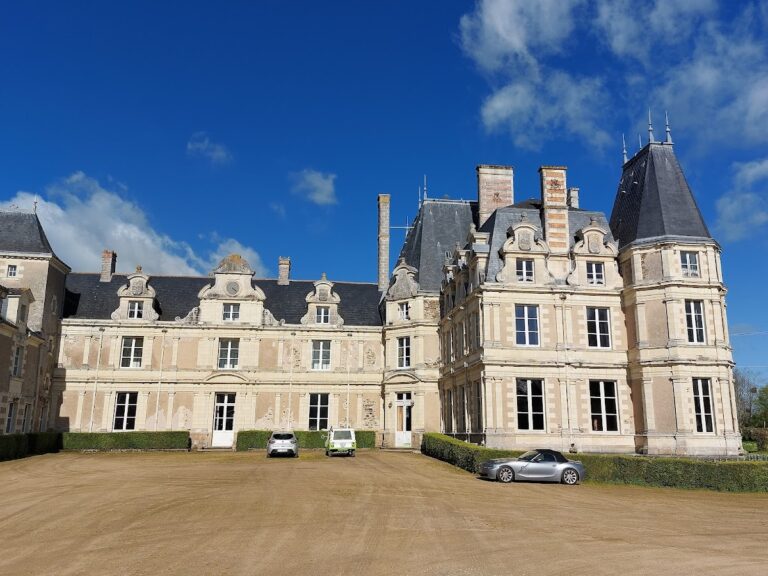
The present château was built in 1827 as a Renaissance-style pleasure residence after the earlier manor was demolished. It was damaged by the fire of 6 April 1987 and subsequently became the subject of restoration and reconstruction beginning in 1990. The building forms the principal residence of the private estate.
Outbuildings
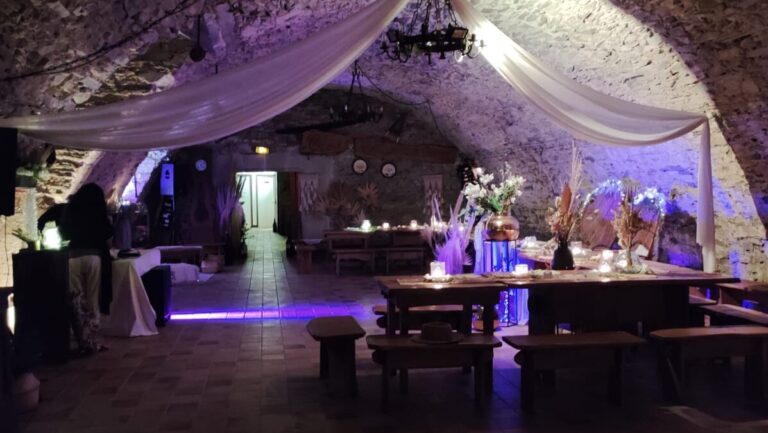
The estate’s outbuildings, known as the communs, were registered as Historic Monuments in 1988. Their restoration began in 1991 as part of work involving the château and the wider estate. These buildings preserve the physical extent of the former domain alongside the rebuilt residence.
Earlier manor and religious features
Medieval manor
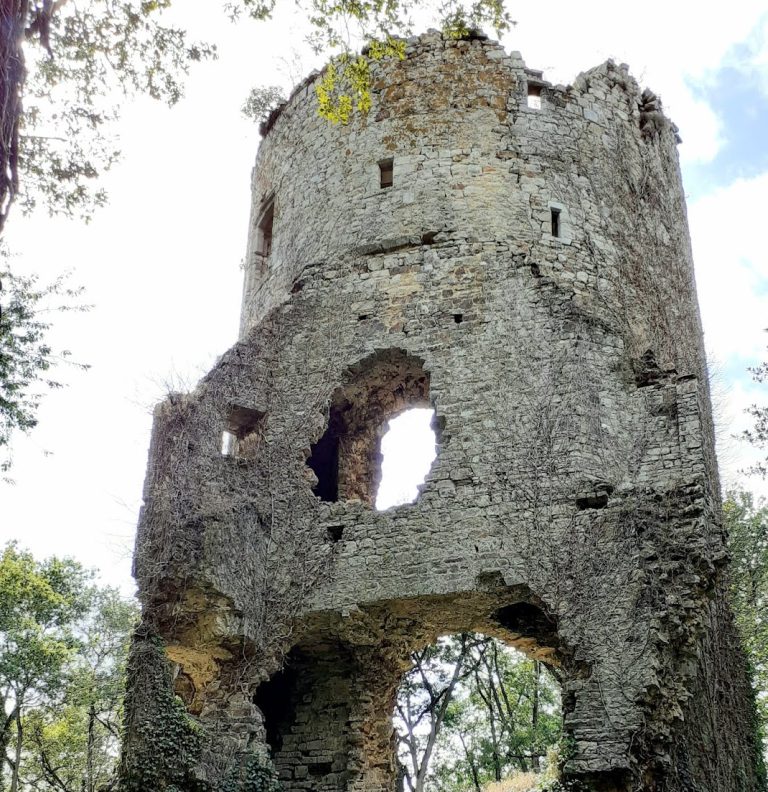
Before its demolition, the old château consisted of four large principal rooms on the ground floor and numerous bedrooms on the upper floor. A corner turret and a perpendicular wing of comparable importance formed part of the building. The 1815 occupation left this manor uninhabitable, and its poor condition led to its demolition after the estate changed hands in 1821.
Private chapel and parish church arrangement
A private chapel belonged to the La Touche domain by 1680, when the Saint Michael chaplaincy was transferred there from the parish church. The earlier parish-church arrangement included a reserved choir bench near the chapel of Saint Anne and a burial vault beneath it for the lords of La Touche-Cornulier. The family also used the Saint Clair chapel in Nantes Cathedral.
Nearby sites