Castelpagano: A Historic Hilltop Fortress in Apricena, Italy
Visitor Information
Google Rating: 4.7
Popularity: Very Low
Country: Italy
Civilization: Medieval European
Site type: Military
Remains: Castle
History
Castelpagano is a ruined hilltop fortress located in the territory of Apricena, Italy. Its origins likely date back to the second half of the 9th century, built before the nearby town of Apricena itself emerged. Although the exact founders are unknown, the fortress developed through a series of important historical phases linked to the surrounding region.
In the 11th century, Castelpagano rose to prominence under the rule of the Norman Count Henry of Monte Sant’Angelo. Control of the fortress later shifted after a prolonged conflict to Rainulf, Count of Aversa, followed by Roger, Lord of Rignano. Despite its strong natural defensive position on a high spur of the Gargano massif, the fortress was seized in 1137 by Emperor Lothar III during his Italian campaign, supported by Pope Innocent II to displace local princes.
By 1177, the nearby monastery of San Giovanni de Lama was granted to Queen Joanna I, wife of King William II of Sicily and daughter of Henry II of England, marking the close ties between the fortress’s surroundings and royal authority. The fortress itself appears in a 1231 document recounting a local legend about a blind beggar named Leonardo di Falco and the Virgin Mary, which is connected to the foundation of the Santa Maria di Stignano sanctuary nearby.
Emperor Frederick II later restored Castelpagano, stationing a loyal Saracen garrison in the fortress for his hunting retreats. The settlement’s name, “Pagano,” derives from the Italian word for non-Christians, referring to these Saracen soldiers. The fortress eventually became a fief of Frederick’s son Manfred of Sicily, who founded the new town of Manfredonia, before it returned to royal control.
In the late 15th century, King Ferdinand II of Aragon granted Castelpagano to Ettore Pappacoda of Naples. Pappacoda revitalized the area and constructed the Santa Maria di Stignano monastery in 1515. After the Pappacoda family’s extinction, the fortress reverted to royal ownership. In 1580, Antonio Brancia purchased the castle from King Philip II of Spain. Ownership subsequently changed hands several times, passing to the Mormile family in 1732, then to Don Garzia of Toledo, and later in 1768 to Prince Cattaneo di Sannicandro.
Gradually abandoned in the early 17th century, likely due to severe water shortages, residents moved to the nearby town of Apricena. The fortress sustained damage in several earthquakes, notably in 1627, and later was plundered by local shepherds who used its stones to build shelters in the surrounding Sant’Anna valley. Archaeological discoveries around Castelpagano, including wells and cisterns, human remains implying a cemetery, and artifacts predating the medieval period, confirm the site’s long history as a substantial settlement. Nearby caves, such as the 200-meter-deep Lia cave, were known refuges for bandits during the 14th century.
Remains
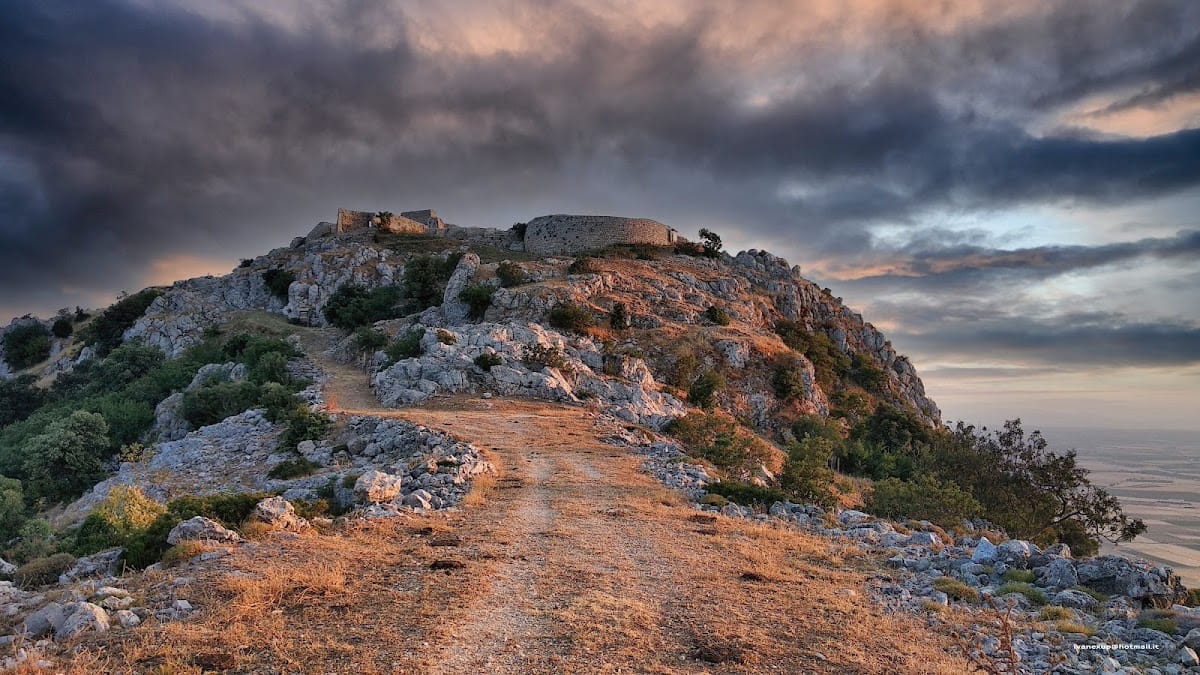
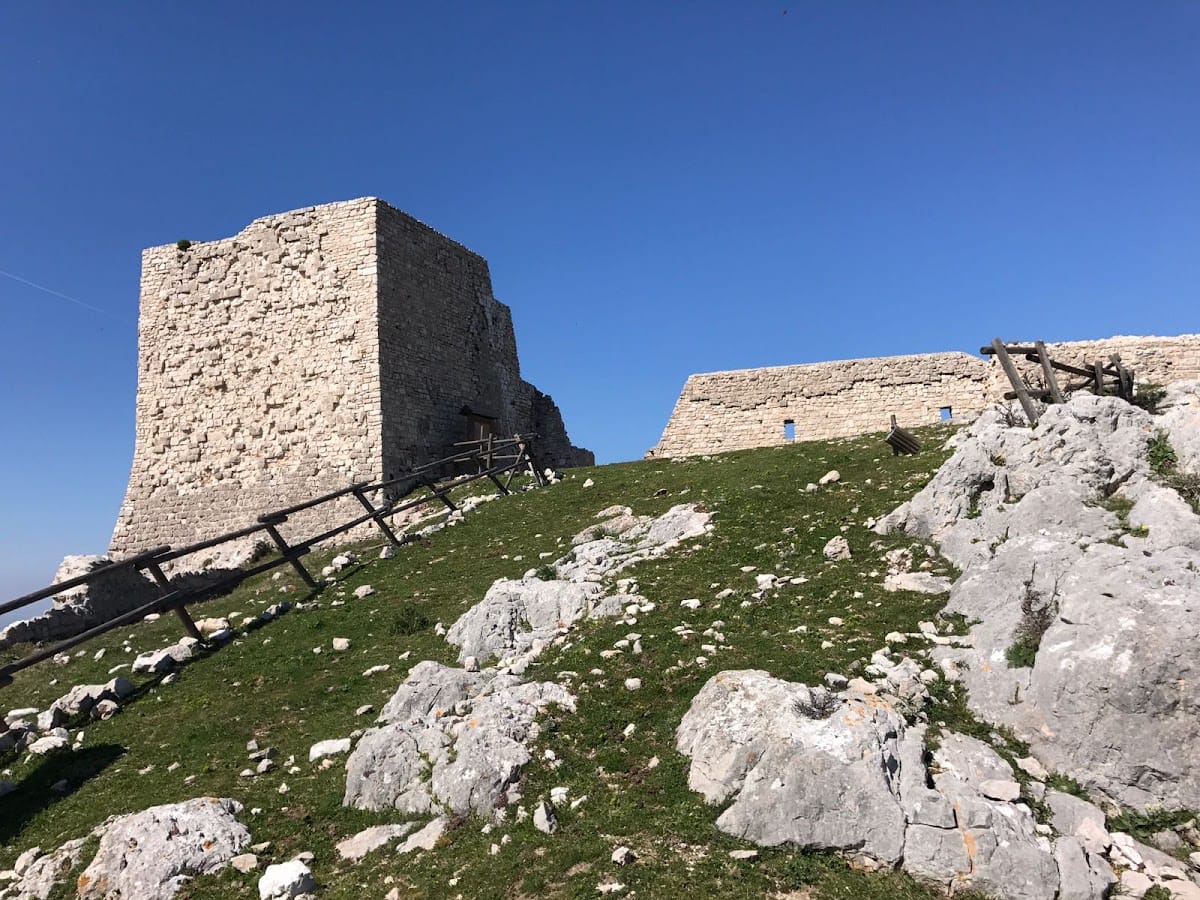
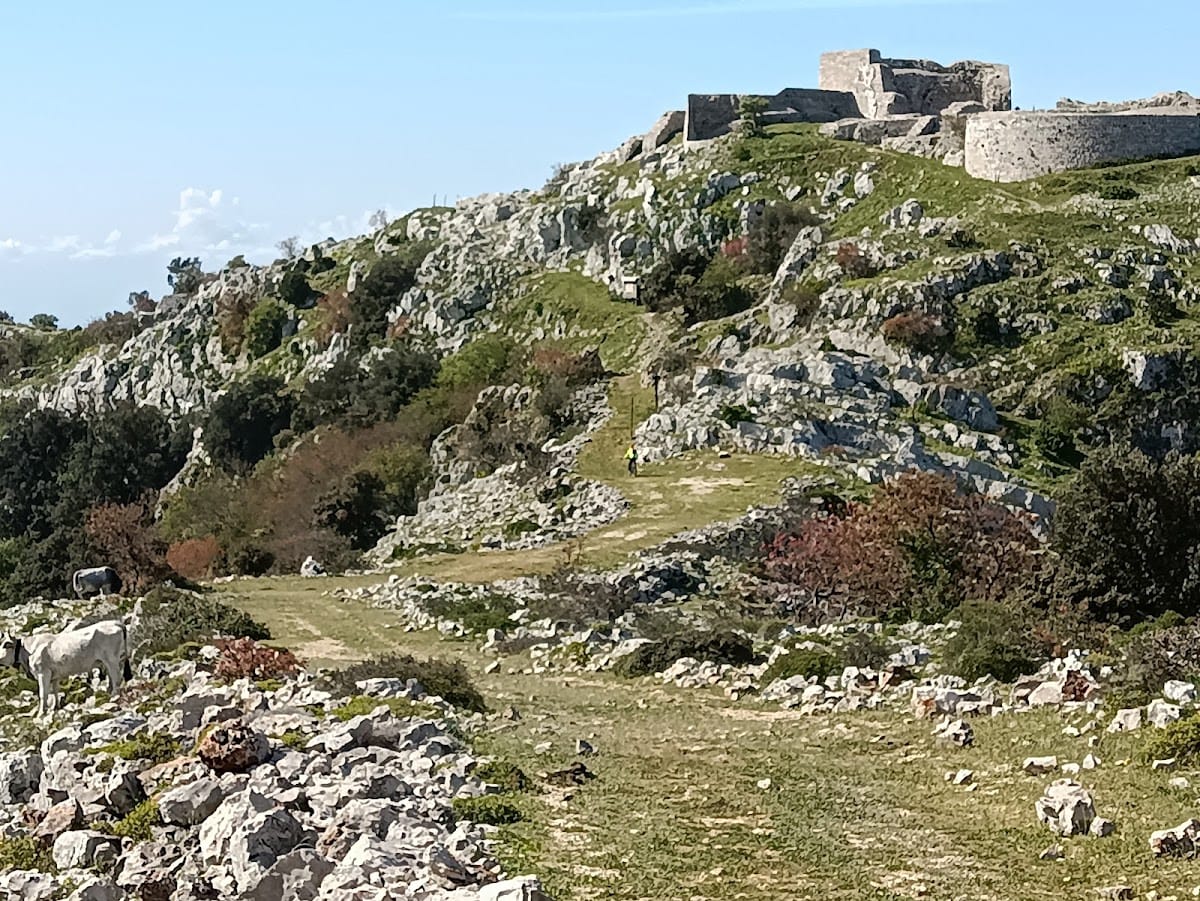
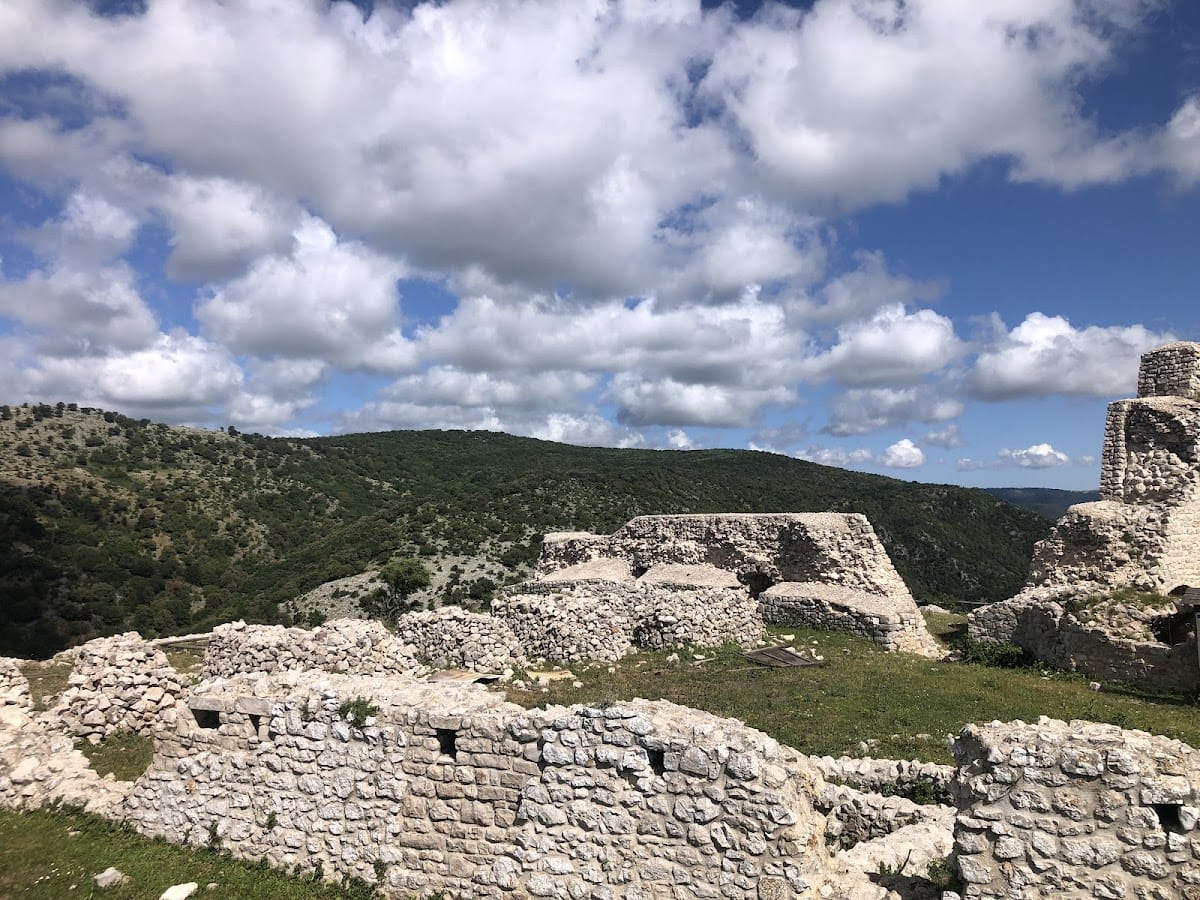
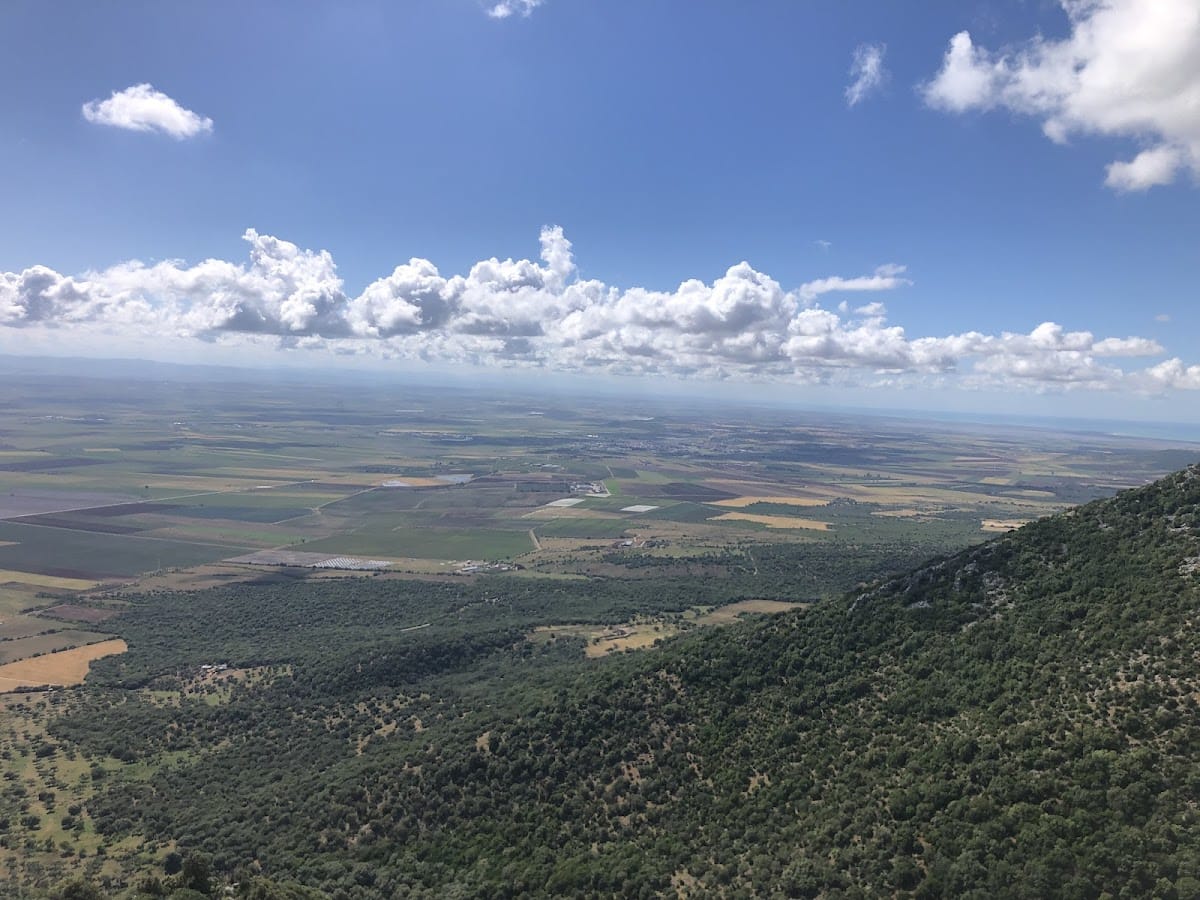
The ruins of Castelpagano reveal a fortified layout that once guarded a strategic spur of the Gargano massif, standing at around 514 to 545 meters altitude. The remains consist chiefly of a partially preserved rectangular enclosure marked by sturdy walls built of local stone. The longest surviving wall measures approximately 50 meters in length and rises to about 1.5 meters high, featuring two doorways framed by carefully worked stone doorposts, indicating carefully planned access points.
This main wall forms a left angle connected to a very short adjacent wall remnant on one side, while on the opposite side it joins a circular tower that still stands around five meters tall. From this tower, a wall gently slopes downward toward the valley below, suggesting defensive adaptation to the terrain. The rectangular enclosure’s southern side is closed by a third wall, completing the basic fortress perimeter.
At one corner, the fortress’s principal tower rises with five facades, reaching between six and seven meters in height. Traces of interior walls within the enclosure suggest the presence of internal divisions or rooms, though the layout inside the fortress remains unclear from the surviving remains. No decorative features or inscriptions have been documented within the ruins.
Nearby on a neighboring elevated plain called Volta Pianezza, before the feature known as Monte della Donna, there are visible remnants of a semicircular watchtower’s perimeter wall. The tower itself has vanished, but local legend links it to Saracen princes associated with Castelpagano’s history.
Archaeological excavations around the site have uncovered numerous wells and cisterns, essential for managing the scarce water resources of this dry region, underscoring the fortress’s need for self-sufficiency. Human remains found near the ruins indicate the former existence of a cemetery, while artifacts dating from before the medieval era confirm that the area was occupied well before the fortress’s construction.
Together, these features provide a clear picture of Castelpagano as a defensible hilltop settlement with extensive water management systems, a complex military history, and connections to the surrounding religious and political landscape from the early Middle Ages through the early modern period.
Nearby sites