Castello svevo angioino: A Medieval and Early Modern Fortress in Manfredonia


Site at a Glance
- Rating
- 4.4
- Popularity
- Medium
- Country
- Italy
- Primary era
- Medieval
- External website
- Open
- Eras represented
- Medieval, Early Modern
- Civilizations
- Crown of Aragon, Kingdom of Naples, Kingdom of Sicily, Spanish
- Site type
- Military
- Remains
- Castle
On this page10 sections
History
Castello svevo angioino is a military fortress in Manfredonia, Italy, developed through Swabian, Angevin, Aragonese, and Spanish periods of rule. Its documented construction began in the Angevin period in the late thirteenth century, following a design associated with Pierre d’Angicourt, a medieval architect and military engineer active in southern Italy. The castle grew through successive alterations rather than a single unified building campaign.
Angevin beginnings
The earliest documents mentioning the castle date from April 1279 and concern the recruitment of laborers to begin construction. The project is associated with Charles I of Anjou, whose French-origin dynasty had established itself in southern Italy after the rule of the Swabian Hohenstaufen dynasty. Earlier structures may have been incorporated into the new fortress. Its first arrangement is thought to have included enclosed rooms surrounded by walls, with doors connecting those rooms to the exterior.
Pierre d’Angicourt’s original design was subsequently modified by extensions, transformations, and reconstructions. The resulting complex therefore reflects changing military and political circumstances rather than one consistent plan.
Aragonese and Spanish fortification
Around 1442, the Aragonese incorporated the earlier castle into a new outer fortified enclosure. This work formed part of a broader effort to strengthen coastal areas under Aragonese rule. In the sixteenth century, when the Kingdom of Naples was governed within the Spanish monarchy, a pentagonal bastion, a projecting defensive platform, was added west of the castle. Known as the Annunziata Bastion, it incorporated one of the circular towers and was intended to protect the complex from attacks originating in the town.
The castle capitulated during a Turkish attack in 1620. The assault revealed weaknesses in its defenses, including inadequate artillery and the complete lack of protective parapets suitable for sheltering defenders. After the fortress lost its defensive role, it served as a barracks during the eighteenth century, while its western tower was used as a prison.
Municipal ownership and museum use
The municipality of Manfredonia acquired the castle in 1901. Under Presidential Decree No. 952 of 21 June 1968, it donated the complex to the Italian state on the condition that an archaeological museum be established within it. The castle now houses the National Archaeological Museum of Manfredonia, which has been managed by the Ministry of Cultural Heritage and Activities through the Regional Museums Directorate since December 2014.
Remains
Inner fortress and outer defenses
Original quadrilateral castle
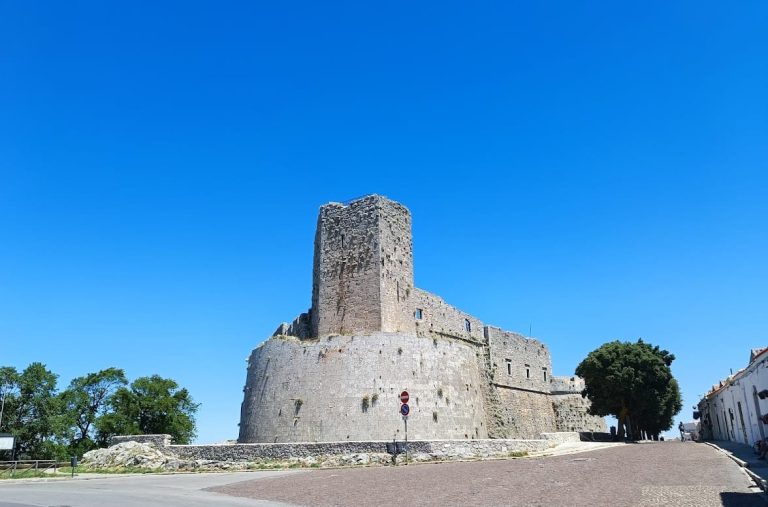
The original castle had a quadrilateral plan enclosed by a fortified circuit. Five square-plan towers formed part of this arrangement, with four positioned at the corners and a fifth probably placed near the main gate on the northeast side. The four corner towers were later incorporated into cylindrical towers, while only a few traces remain of the fifth tower. The regularity and geometric linearity of the design reflect Swabian construction principles.
Aragonese outer enclosure
The outer fortified enclosure belongs to the Aragonese period and contains four cylindrical towers. They are lower than the towers of the inner castle, a form suited to the defensive methods of that period. Together, the inner circuit and the later enclosure show how the fortress was expanded around its earlier core.
Annunziata Bastion
West of the castle stands the pentagonal Annunziata Bastion. It incorporates one of the circular towers and takes its name from a marble panel above the exterior passage. The panel depicts the Annunciation, providing the feature with its identifying association.
Archaeological museum collections
The National Archaeological Museum occupies the interior of the castle, so the museum route passes through the surviving fortress structure. Its collections include Daunian funerary stelae made from limestone and dating from the late eighth to the early fifth century BC. The Daunians were an ancient population of northern Apulia, and these carved monuments were associated with their funerary culture.
The museum also presents finds from excavations in the Siponto Archaeological Park, an ancient settlement and archaeological area within the territory of present-day Manfredonia. Other displays include transport amphorae recovered from the sea, together with architectural and inscribed materials originating mainly from Siponto. The marine amphorae, large ceramic vessels used to carry commercial goods, provide evidence of intensive commercial activity along the Adriatic routes of Roman Daunia.