Burgruine Luftenberg: A Medieval Hilltop Castle in Austria
Site at a Glance
- Rating
- 5
- Popularity
- Very Low
- Country
- Austria
- Primary era
- Medieval
- Eras represented
- Medieval
- Civilizations
- Duchy of Austria, Holy Roman Empire
- Site type
- Military
- Remains
- Castle
On this page9 sections
History
Burgruine Luftenberg is the ruin of a medieval hilltop castle in Austria, in the present municipality of Luftenberg an der Donau in Upper Austria. Luftenberg first appears in records in 1125, while the castle dates from the twelfth century. Its elevated position above the Danube, opposite the mouth of the Traun, gave the site strategic value by overseeing important routes. A late-Bronze-Age hillfort on the Luftenberg represents an earlier phase of fortified activity in the same landscape.
Origins and medieval lordship
Around 1125, the castle belonged to Liutgard, the widow of Ekkerich, who is also named as Eggericus de Luffinberc. Hainericus de Lufftnberg appears in 1207. The early castle was probably built mainly of wood, but it was further fortified in 1220. Members of the Luftenberg family appear for the last time as owners in 1237.
Mechthild of Neidtperg held the castle in 1281. From the following year, control of the fortress was divided into two shares. Duke Albrecht of Austria granted one half, while Heinrich of Weitra, a member of the Kuenringer family, granted the other. After disputes over possession were settled, the Kuenringers surrendered their claim to the territorial ruler in 1287.
During the thirteenth century, Ulrich II of Kapellen acquired the castle along with other possessions and the rights that the Rech family held there as a fief, meaning a possession granted by a superior lord in return for service. From the 1280s, Chunrad and Mechthild Rech held the entire castle as feudal tenants and later adopted the name Luftenberg. The Rechs remained associated with the lordship until 1367, when the Gruber family from the Mühlviertel succeeded them.
Trade, tolls, and changing ownership
The Grubers improperly demanded dues from Danube shipping and created toll-free landing places near Luftenberg. These facilities helped goods move into the Mühlviertel and supported the citizens of Freistadt at the expense of the city of Enns. The castle’s economic importance also rested on the collection of a wine toll from Danube ships, a levy that was later banned. Salt trading along pack-animal routes toward Bohemia provided another important source of income for the lords of Luftenberg.
After 1374, the feudal register of Duke Albrecht III named Jörg of Zwingenstein as one half-holder. Andre Gruber and Siegmund of Steinpach jointly held the other half. When Andre Gruber died, his share passed to his daughter Agnes, who transferred it to her husband, Balthasar of Schallenberg. The other half, together with a church-related benefice, probably belonged at that time to Eustach Brodnacher, also known as Frodnacher. From later in this period until 1679, the Schallenbergers alone appear as lords of the castle.
Reformation and later transformation
During the early sixteenth century, the Schallenbergers established a school at the castle to spread the teachings of Martin Luther, the German reformer whose movement challenged teachings and institutions of the Catholic Church. The school served noble sons from the surrounding area and employed teachers from Wittenberg, including Fridericus Lagus, who was sent by Philipp Melanchthon, a leading Reformation scholar and educational reformer. By 1545 the castle had become too small, so the school moved first to Enns and later to Linz. Luftenberg was consequently linked to the development of the later Protestant regional school of the estates of Upper Austria and to the origins of the Academic Gymnasium in Linz on Spittelwiese.
In 1594, Luftenberg was designated as a refuge for women and children because of the threatened Ottoman danger. In 1635, Martin Aichinger, a Protestant leader of the Machland peasant movement in Upper Austria, emerged from the Luftenberg lordship. The Schallenbergers probably returned to Catholicism during the Counter-Reformation, the Catholic response to the Reformation that sought to strengthen Catholic practice and institutions.
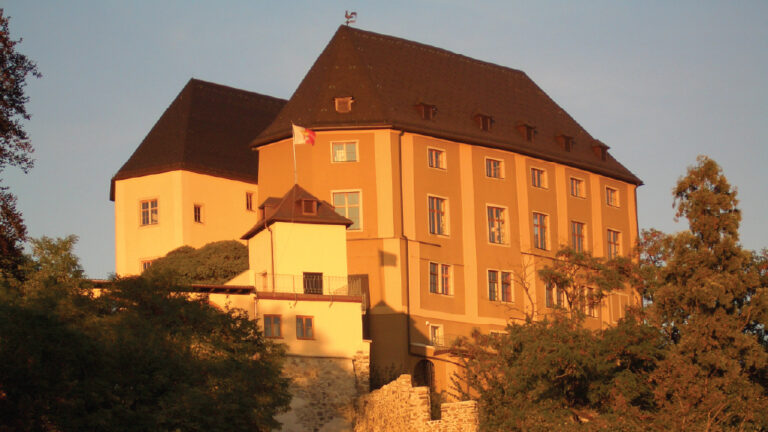
At the end of the sixteenth century, the adjoining Schloss Luftenberg, also called Neu-Luftenberg, was built. Major parts of the older castle were dismantled during the new construction, probably supplying building material for it. Count Christoph of Schallenberg later overextended himself financially through the ambitious palace-like development of the estate at Neu-Luftenberg. In 1679, he sold both the castle and the palace to Helmhart Christoph of Weißenwolff, who united the lordships of Luftenberg and Steyregg.
Ownership of the Luftenberg estate changed again in the modern period. Mariette Weissenwolff transferred it to Helene Szapary in 1923. Henriette Thurn und Taxis became its successor in 1942, and an inheritance agreement transferred the property to Karl and Marietta Mensdorff-Pouilly in 1961. Their daughter, Marie Antoinette Krassay, has owned the estate since 1978.
Remains
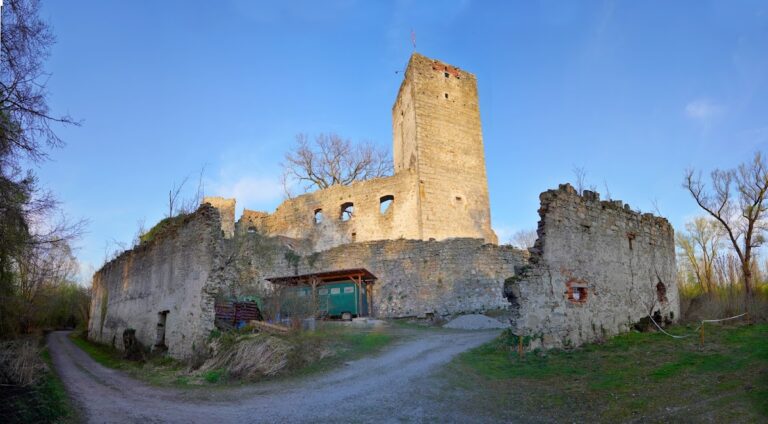
Burgruine Luftenberg was a hilltop castle built on elevated ground for defense, surveillance, and control of surrounding routes. The upper castle occupied a prominent rock measuring approximately 20 by 15 metres. The once extensively developed complex was substantially dismantled at the end of the sixteenth century, and the surviving remains consist principally of sections of its enclosing wall and several masonry elements of the upper castle.
Fortified landscape
Upper castle
The upper castle stood on the exposed rock high above the Danube and opposite the Traun estuary. Its position formed part of the site’s defensive character and placed the main structure within the elevated landscape of the Luftenberg. Several masonry elements survive from this upper area after the later dismantling of the complex.
Enclosing wall
A quadrangular curtain wall enclosed the upper castle. A curtain wall is a continuous defensive wall, and this one included an internal wall-walk, a protected passage from which defenders could move along the fortification. Sections of the wall remain among the principal visible parts of the ruin.
Earlier hillfort
A late-Bronze-Age hillfort on the Luftenberg represents an earlier fortified installation in the same elevated landscape. It places the medieval castle within a location that had already been used for fortified activity before the construction of Burgruine Luftenberg.
Nearby sites