Schloss Steyregg: A Historic Castle Complex in Austria


Site at a Glance
- Rating
- 4.6
- Popularity
- Low
- Country
- Austria
- Primary era
- Early Modern
- External website
- Open
- Eras represented
- Medieval, Early Modern
- Civilizations
- Habsburg, Holy Roman Empire
- Site type
- Domestic
- Remains
- Castle
On this page12 sections
History
Schloss Steyregg is a private castle complex in Austria, situated above the center of Steyregg in the Mühlviertel. Built under the Ottokars in the eleventh or twelfth century, it became a fief of Passau and later developed into the seat of an important lordship. Its surviving buildings reflect centuries of noble ownership, religious conflict, fire, war, and reconstruction.
Medieval foundation and changing lordship
The castle was built under the Ottokars, a medieval ruling dynasty associated with Styria and the Austrian lands. Ottokar of Steyr of the Traungau family, an earlier noble dynasty from the Traun region, is regarded as its builder, although no exact construction date is known.
Schloss Steyregg was mentioned in 1147 as a fief of Passau. Its owner, Hartwik of Hagenau, died that year, and Otto of Lengbach, the cathedral provost, became his successor. Leutold of Wildon held the site from 1235, before Ulrich II of Kapellen purchased it in 1280.
After 1406, marriage brought the castle into the Liechtenstein family. The Liechtensteins expanded both the castle and its associated lordship. Around 1535, the lordship received high judicial jurisdiction, the authority to judge serious crimes that could carry the death penalty.
Renaissance palace and religious conflict
Wolfgang Jörger purchased Schloss Steyregg in 1581. Under the Jörgers, the medieval complex was converted into a Renaissance palace, a building shaped by the architectural and artistic language revived from classical antiquity. The family built the castle chapel, established an extensive library, and assembled a collection of paintings.
In 1594, the castle was one of the refuge castles used during the Turkish threat. The Jörgers were Protestants, and their estates were confiscated in 1620 during the Counter-Reformation, the Catholic reform and political campaign opposing the spread of Protestantism in the Habsburg lands and elsewhere in Europe. Helmhard Jörger recovered the castle five years later.
The Weissenwolff period and eighteenth-century destruction
In 1638, Schloss Steyregg passed to David II Ungnad von Weissenwolff, Helmhard Jörger’s son-in-law and later governor of Upper Austria. In 1679, Helmhart Christoph von Weissenwolff purchased Schloss Luftenberg and united the two lordships. Under Josef Anton Count Weissenwolff, the two castles were placed in a family fideicommiss, an inheritance arrangement intended to keep an estate together within a family rather than allowing it to be divided or freely sold. Around 1750, the lordship had 622 subjects.
Lightning strikes caused major fires in 1770 and 1779, devastating the castle and the town. The damaged sections and the west tower were not rebuilt. After the later fire, the former gardener’s house was converted into a new castle, changing the complex’s form and reducing the extent of its built fabric.
Twentieth-century ownership, damage, and renewal
The male line of the Weissenwolff family died out in 1917, and the related Thurn und Taxis family inherited Schloss Steyregg. Irene Princess of Thurn und Taxis married Altgrave Niklas Salm-Reifferscheidt in 1940, linking the castle to the family that later became its owner.
During the Second World War, aerial bombs severely damaged the castle and destroyed the Baroque section of the new castle. After the war, Steyregg provided emergency accommodation for displaced people, followed by a provisional renovation in 1956. Ownership passed to the Salm-Reifferscheidt family in 1962, and the castle stood completely empty from 1966.
Renovation took place in the late 1980s. A revitalization campaign in 2004 and 2005 made the Knights’ Hall available for events. Schloss Steyregg is now the seat of the Salm-Reifferscheidt family and houses a significant Japanese collection from the estate of Aoki Shūzō, a Japanese foreign minister and an ancestor of the present castle owners.
Remains
The surviving complex consists of a four-storey building formed by the former east wing. It represents about one-third of the castle’s former extent, with fires and wartime destruction accounting for the reduction. The building stands within a nineteenth-century park, while traces of earlier planning survive in the moat, courtyard, entrance arrangements, fountains, chapel, façades, and interior halls.
Castle layout and surviving buildings
Approach, moat, and courtyard
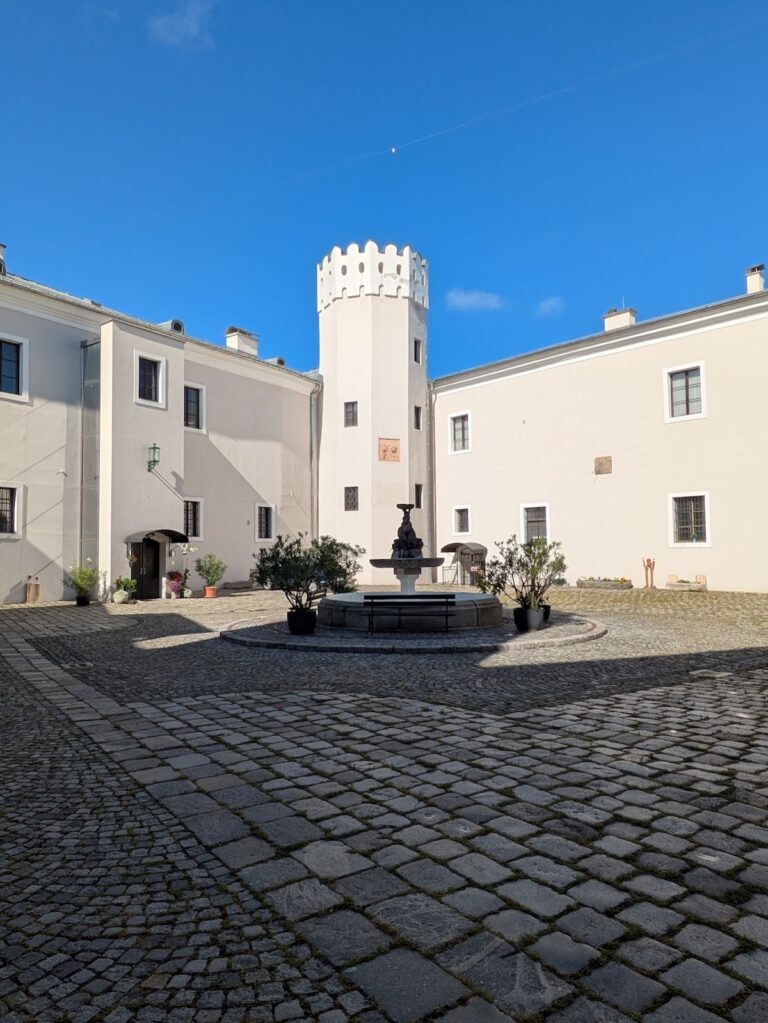
The original approach reached the castle from the town side. A moat protected it from the surrounding countryside. The large courtyard took its present form after the west tower was removed following the 1779 fire. The current main entrance was formerly the connection to the farmyard, preserving part of the relationship between the residential castle and its agricultural area.
Façades and festival hall
The south and east façades are articulated by Tuscan pilasters, flat classical wall elements modeled on the relatively plain Tuscan order. Inside, a two-storey festival hall measures 30 by 20 metres. It is regarded as the largest hall of its type in Upper Austria, and its scale reflects the ceremonial character of the palace formed under the Jörgers.
Castle chapel
The two-storey castle chapel is dedicated to Saint John the Baptist, the Christian prophet and preacher who baptized Jesus and is widely venerated as a saint. The chapel received a Baroque treatment in the seventeenth century, when Baroque architecture was associated with the more elaborate styles of the period. A renovation in 1954 revealed Gothic frescoes, medieval wall paintings executed in or alongside plaster, dating from the fourteenth century.
Park features and surviving decoration
Park fountains
The nineteenth-century park contains two fountains dated 1670 and 1727. Both display the coats of arms of the Weissenwolff and Jörger families, linking the landscape to the noble families who shaped the castle’s ownership and development. The fountains preserve visible evidence of those earlier periods within the later park setting.