Château de Gonneville: A Former Fortified Castle in France


Site at a Glance
- Rating
- 4.3
- Popularity
- Very Low
- Country
- France
- Primary era
- Medieval
- External website
- Open
- Eras represented
- Medieval, Early Modern, Modern
- Civilizations
- French
- Site type
- Military
- Remains
- Castle
On this page16 sections
History
Château de Gonneville is a former fortified castle in France, at Gonneville-Le Theil, whose lordship was known by the beginning of the tenth century. It belonged to the barony of Néhou, one of the oldest feudal lordships in the Cotentin, the peninsula forming northwestern Normandy. The present complex developed through medieval fortification, sixteenth-century rebuilding, and later transformation into an aristocratic residence.
The lordship of Néhou and the Reviers-Vernon family
The connection with Néhou appears in an early tenth-century donation by Richard de Saint-Sauveur to his son Néel. In 1047, Néel II rebelled against William the Conqueror, duke of Normandy and later king of England, and lost the barony after his defeat at Val-ès-Dunes. William granted Néhou to his companion Baudouin, count of Meules. Among Baudouin’s descendants was Richard de Reviers, who became count of Vernon and baron of Néhou. Richard’s marriage to Adelis Paisnel linked the lordship with other powerful families of the Cotentin.
Gonneville belonged to the Reviers-Vernon family during the twelfth and thirteenth centuries. King John of England stayed at the castle in May 1194 and again in late November or early December 1203, accompanied by his wife Isabella of Angoulême and an escort. On 5 December 1203, he left Normandy permanently for England. At that time, Richard II de Reviers-Vernon held Gonneville.
The fourteenth-century rebuilding and the Hundred Years’ War
A second castle was built at the beginning of the fourteenth century by Richard de Courcy. His niece Jeanne de Courcy inherited Gonneville and married Gilbert de Malesmains. Their daughter’s marriage to Olivier IV de Rohan-Montauban transferred the lordship to the Rohan-Montauban family, which retained it for six generations.
The Hundred Years’ War, the prolonged conflict between the English and French monarchies that included the English occupation of Normandy, brought a decisive crisis. In 1417, Robert de Montauban abandoned the castle because he could not defend it against the English occupation. The English king confiscated his property from 1418 and granted it to the knight Thomas Burgh. Guillaume de Montauban recovered the estates after 1450.
One of Guillaume’s descendants, Philippe de Montauban, became chamberlain to Francis II of Brittany and chancellor of Brittany. He helped arrange the marriage of Anne of Brittany to Charles VIII of France, linking the history of Gonneville with the political affairs of Brittany and the French crown.
The Pirou and Jallot de Beaumont families
In 1527, Catherine de Rohan, Baroness of Ruffec, sold Gonneville and Quinéville to Jean de la Guette for 9,500 livres tournois. A deficit of 236,000 livres was later found in his accounts, and the Crown seized his property in 1555. His wife, Marie Saligot, had sought separation of property in 1554. She exchanged the lordship of Gonneville with Henry II, king of France from 1547 to 1559, for land at Montceaux near Meaux, becoming its sole owner. As a widow, she transferred the lordship to Olivier de Pirou in 1559.
The Pirou family built the principal body of the present castle and its gateway during the second half of the sixteenth century. Jean de Pirou remained loyal to the French king during the later Wars of Religion, the civil and religious conflicts between Catholics and Protestants in France. He successfully resisted several sieges by François de La Cour, lord of Tourps and commander of the Catholic League. La Cour was killed at the hamlet of Lemaresquier in Gonneville during the night of 22 to 23 December 1592 by royal troops.
Jean de Pirou died without issue in 1595, and his sister Charlotte inherited the castle. Her marriage to Jean Jallot, lord of Beaumont, in 1584 had already connected Gonneville with the Jallot de Beaumont family. Their son Charles Jallot de Beaumont inherited the lordship and probably continued the restoration of the property. He also built the service buildings along the forecourt.
The eighteenth century and the Revolution
Charles Jallot de Beaumont married Suzanne Gigault de Bellefonds in 1636. Their grandson, Charles du Mesnil-Eury, inherited Gonneville after the deaths of Charles’s children. He raised the lordship to the rank of a marquisate, a noble rank or territory held by a marquis, and built the eastern façade of the vestibule in 1727. After his three sons died without heirs, the estate passed by inheritance to the de Berruyer family in 1777.
Joseph-François-Georges de Berruyer and his wife, Constance Élisabeth de Pardieu, settled at the castle. Their son Jean-Nicolas de Berruyer was a captain of dragoons in the Queen’s Regiment and lord of Gonneville and other estates. He was elected mayor in 1790, but emigrated with his family in March 1792 during the French Revolution. Their property was declared national property, the furnishings were sold and dispersed, and the entrance railings and staircase balustrade were converted into pikes.
In 1794, Antoine Daumas, the contractor who had purchased the castle and its dependencies, settled there after cutting timber on the estate. Bankruptcy and expropriation followed. In 1814, the civil court of Cherbourg awarded the castle, mill, and Gonneville estate to Jean-Nicolas’s daughters, Anne-Louise-Henriette and Louise-Charlotte de Berruyer, who had returned from emigration.
Destruction, restoration, and twentieth-century occupation
The two sisters sold the property to Aglaé Lambert for 100,000 francs in 1842. From 1846, Lambert and her son searched the castle for a treasure they believed was hidden there. Their work destroyed part of the building and left Lambert financially ruined. She sold the property in 1849 to Madame Doynel de La Sausserie, Marquise de Chivré. Her husband, Médéric-Ferdinand de Chivré, restored part of the damaged fabric.
Arthur de Chivré later owned the castle. After his death in 1911, it passed to his three surviving unmarried daughters. German forces occupied the castle and park for almost four years during the Second World War, maintaining a garrison of up to 400 men. American forces occupied the property afterward, and Field Marshal Erwin Rommel visited the castle in May 1944.
When German troops requisitioned the castle in 1940, Madame de Chivré ordered the family silverware to be thrown into the moat. Thirty-eight Second Empire coins were found near the bridge in 1996. A metal-detector team recovered a silver soup-tureen lid bearing the family arms, a dagger, and a medal from the moat in 1997.
The Chivré granddaughters sold the property on 8 December 1954 to Baron Nadalh de Barthes de Montfort and his wife, Régine d’Elbée. Nadal de Barthès de Montfort began renovation and modernization work in 1964. The couple settled permanently at the castle in 1983, after a 27-year life-annuity arrangement. The castle is partially protected as a historical monument under an order dated 27 September 1972. The protection covers the castle façades and roofs, two corner pavilions, parts of the earlier castle, the service buildings, and the moats with their bridge.
Remains
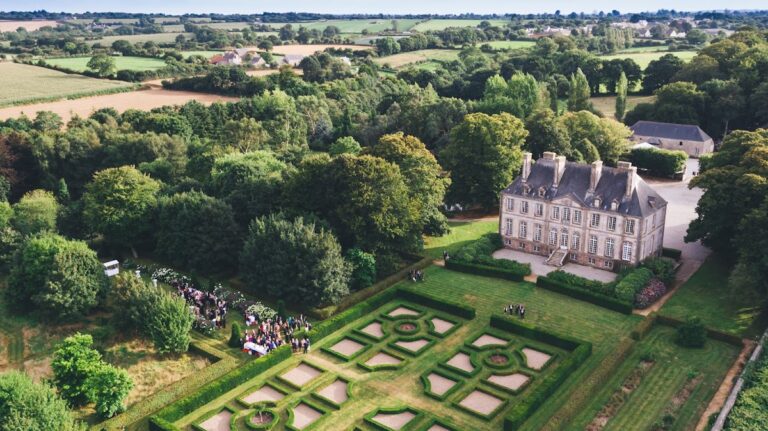
Château de Gonneville occupies a hollow in a wooded valley west of Saint-Martin Church, in the former village of Gonneville. The complex follows a large quadrilateral enclosed by broad, deep moats that still contain water. An outer forecourt leads toward the castle and is bordered by service buildings. The surviving fabric combines fourteenth-century defensive works, sixteenth-century construction by the Pirou family, seventeenth-century additions, and an eighteenth-century residential building.
Medieval defensive structures
The keep
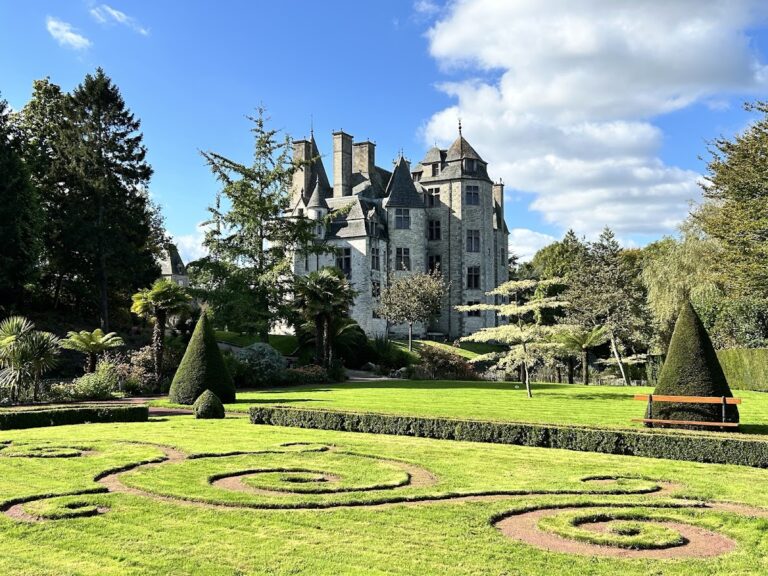
The surviving medieval keep is a square tower from the fourteenth century. It rises 17 metres and contains a staircase. Battlements crown the tower, while machicolations, projecting openings used to drop missiles or other materials onto attackers, reinforce its defensive character. A small pepper-pot turret, a projecting turret often capped by a conical roof, was added in the seventeenth century. The arms of the Pirou family are carved on the lintel of the keep doorway.
The park towers
Two cylindrical towers from the fourteenth century survive in the park. One stands beside the road, while the other is partly ruined in the garden. Both carry the date 1331 and were built by Richard de Courcy as part of the fourteenth-century rebuilding of Gonneville.
The entrance châtelet and moats
The entrance châtelet combines fourteenth- and sixteenth-century work. It formerly had a drawbridge, a bridge that could be raised to obstruct the entrance, and was flanked by massive square corner pavilions. These pavilions are now partly truncated. The curtain walls connecting the towers were demolished. The wider fortified complex also included an enclosed forecourt with crenellated, flanked gates, an outer enclosing defensive wall, water-filled moats, and drawbridges. Two of the outer towers survive within this defensive arrangement, and the bridge across the moat remains part of the protected complex.
Residential and service buildings
The eighteenth-century residence
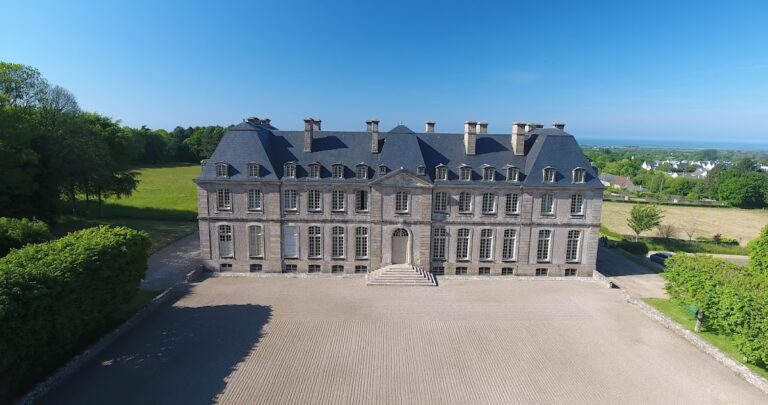
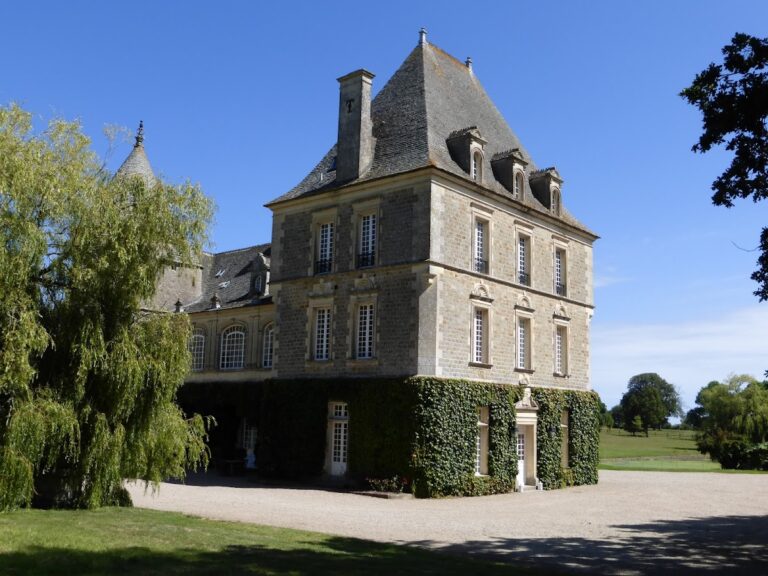
The main residential building dates from 1717 and is flanked by two corner towers. Its entrance pavilion has a porch framed by columns and topped by a triangular pediment. The central projecting section of the west façade, which forms the rear façade, bears the arms of the Jallot and Bellefonds families above the former drawbridge. The arms of the Pirou family also appear inside the residential building, on the right after entering.
The service buildings
The service buildings bordering the forecourt date from 1641. They have a single ground floor beneath steeply pitched roofs with dormer windows, including some with oval-headed openings. One seventeenth-century dormer has a large shell pediment and displays the Jallot arms, together with the date 1641. Charles Jallot de Beaumont probably continued the restoration of the castle and built these structures as part of the property’s service area.
The kitchen
The kitchen retains a central nineteenth-century stove with eleven fire openings, known as a potager, a masonry range designed for cooking pots. It was later converted into a radiator. The room also contains a Gothic fireplace and a limestone interior doorway dating from the late sixteenth century.
Chapel and recovered objects
The castle chapel was served by the priest of Gonneville. His payment for officiating there matched the remuneration for his parish church and included small offerings of wool, flax, lambs, and geese, eight measures of wheat from the granary of the abbot of Montebourg, and an annual rent of thirty sous.
The moat has also preserved objects connected with the later history of the estate. Thirty-eight Second Empire coins were found near the bridge in 1996. The following year, the recovered silver soup-tureen lid carried the family arms, while the dagger and medal added other traces of the material possessions associated with the castle.