Burg Uetersen (I): A Medieval Castle Near the Pinnau River in Germany
Visitor Information
Google Rating: 4.7
Popularity: Medium
Official Website: www.burgkino.de
Country: Germany
Civilization: Unclassified
Site type: Military
Remains: Castle
History
Burg Uetersen (I) was located near the Pinnau river in what is now the municipality of Uetersen, Germany. Its origins trace back to the early 13th century when the knights of Barmstede constructed the castle, marking it as a stronghold of this medieval noble family.
The fortress is known through several early documents, notably first appearing in a 1234 donation deed issued by Heinrich II of Barmstede. The castle also finds mention in the foundation records of the nearby Uetersen monastery dating from 1237, indicating a close connection to religious developments in the region during this time. Around the year 1240, the knights of Barmstede abandoned the castle, suggesting a relatively brief, yet historically important period of occupation.
Later historical accounts, such as the 1738 compilation Otia Jersbecensia by Jürgen Grube, document Burg Uetersen (I) as a notable medieval site, reinforcing the castle’s presence in local history. Over the centuries, successive observers and local historians have contributed to confirming its location and historical role through surviving deeds and archival records. Although physical traces had largely vanished by the mid-18th century, the castle’s role in the early development of Uetersen remains acknowledged.
Remains
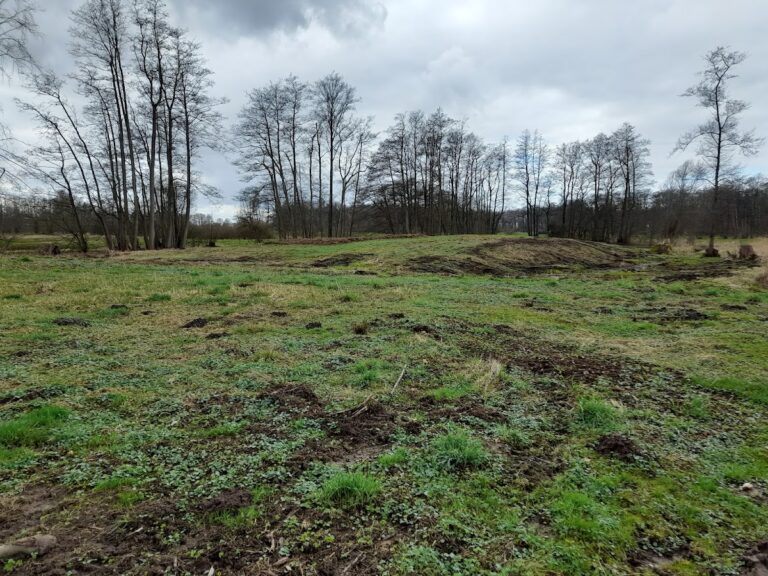
Burg Uetersen (I) was constructed as a lowland fortress featuring a broad, water-filled moat, often referred to locally as the “Burggraben.” This defensive feature surrounded the main structure, providing protection by separating it from the surrounding terrain. Complementing the main moat was an outer bailey or watchtower, itself enclosed by an additional water-filled ditch known as the Bleichengraben. These water defenses underscore the castle’s strategic placement in the flat, riverine landscape.
Material evidence recovered from the site predominantly consists of fragments of 13th-century earthenware pottery. These surface finds emerged during landscaping activities on the grounds of the adjacent Uetersen monastery in 2008. The ceramic shards support the documented occupational period of the early 1200s. The precise architectural details such as building materials used for walls or interiors have not been systematically excavated, as no formal archaeological investigation has yet taken place under the auspices of the Schleswig-Holstein State Archaeological Office.
Historical studies dating back to 1759 attempted to identify structural remains but reported no visible or usable ruins above ground. Subsequent research through the 19th and 20th centuries has relied on documentary evidence rather than physical structures. As a result, the surviving archaeological footprint today is primarily defined by these hydrological defensive features and scattered medieval pottery, providing a tangible link to the castle’s medieval past.
Nearby sites