Burg Reitersdorf: A Medieval Castle in Bad Honnef, Germany
Visitor Information
Google Rating: 4.6
Popularity: Very Low
Official Website: reitersdorf.de
Country: Germany
Civilization: Medieval European
Site type: Military
Remains: Castle
History
Burg Reitersdorf is located in the town of Bad Honnef, Germany. It was built during the medieval period by Germanic nobility and forms the earliest visible remains marking the origin of the city.
The area first appears in historical records in the year 866 under the name “villa rateresthorp,” indicating an established settlement. This name evolved slightly over the next few decades, appearing again in 893 as “Retersdorpht.” By 1222, the settlement gained administrative importance as a messenger station for the local abbey, according to the Prümer Urbar, a record of land holdings and rights.
Construction of the castle began in 1270, initiated by Johann von Heinsberg after being ousted from Löwenburg. It likely served as a new stronghold for him and his followers. By 1288, the castle, then known as “Castrum Reyterstorp,” was under the authority of the Count of Jülich, who undertook enlargements to strengthen its defenses and control.
Military conflict marked the castle’s history in 1317, when the Archbishop of Cologne attacked during hostilities against the Count of Jülich. This assault led to significant destruction of both the castle and its surrounding settlement. Despite this damage, the site continued to be known as “Rettersdorf” into the early 16th century, with records as late as 1517 mentioning the name.
In the centuries that followed, the remains of Burg Reitersdorf transitioned from fortified residence to more utilitarian uses, serving as cellars and stables. Archaeological interest began in the late 19th century with excavations in 1872 during villa construction by General von Seidlitz. Renewed excavations took place in 1980, revealing foundations and enabling partial restoration for public display within what is now Park Reitersdorf. Subsequent efforts in the 21st century have focused on preserving and renovating the castle ruins and surrounding park area to maintain their historical significance.
The former settlement’s legacy endures in local street names such as Reitersdorfer Straße, established in 1948, and in commemorative features including an information plaque installed in 1994, linking the present community to its medieval origins.
Remains
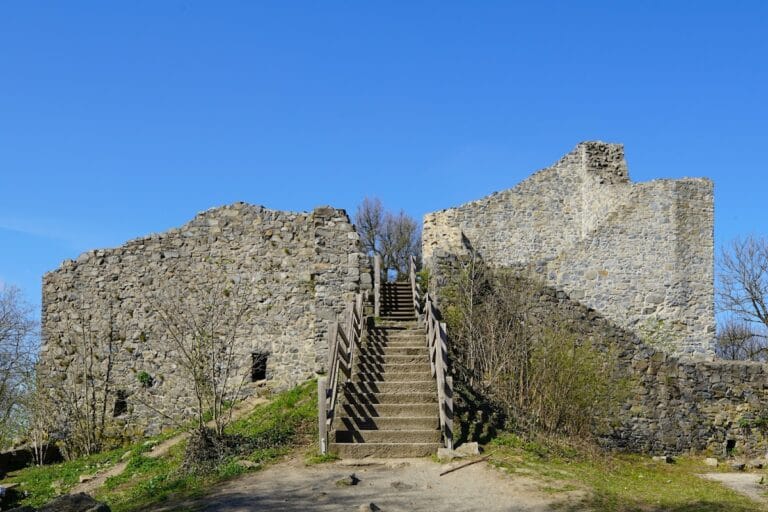
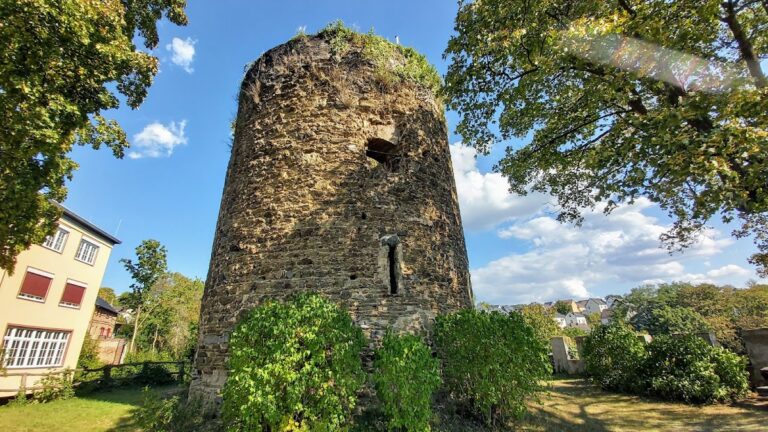
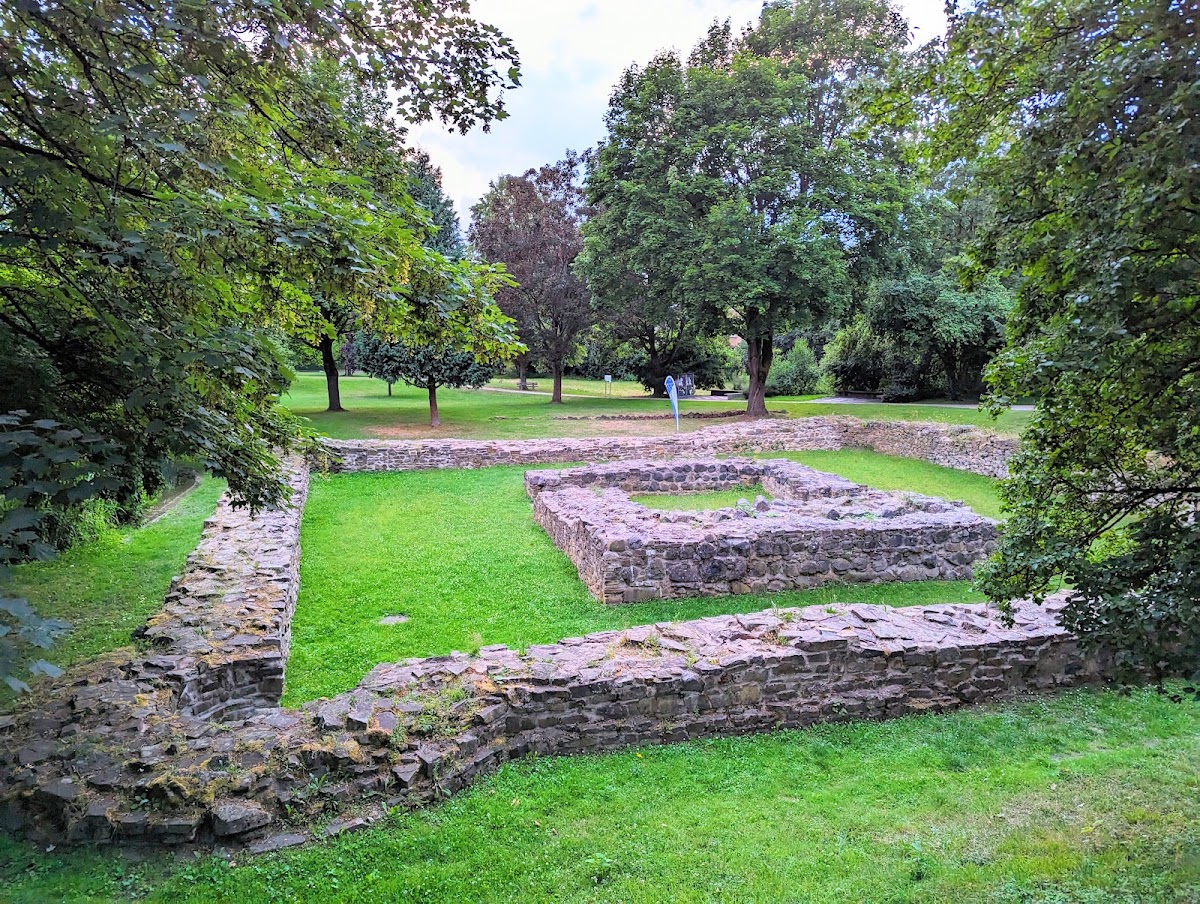
Burg Reitersdorf was structured as a castellum, a small fort or castle, featuring a roughly square enclosure approximately 25 by 25 meters in size. The perimeter was defined by a curtain wall, a defensive outer wall, strengthened by four rounded towers positioned at each corner, likely intended to provide strategic vantage points for guarding the castle’s surroundings. Evidence indicates the castle had an incomplete moat surrounding it, intended as an additional line of defense.
Within the outer walls, a notable square stone residential tower stood as the core living space. This tower was probably surrounded originally by a wooden palisade, a defensive fence made from wooden stakes, adding further protection. The last known standing structure on the site was a rectangular building, its function connected to the castle’s occupation but not specified in records.
Archaeologists have also identified traces suggesting an outer bailey, or enclosed courtyard, on the eastern side of the castle. This annex would have provided space for support functions like storage, stabling of horses, or workshops, serving the castle’s daily needs.
Today, the surviving features consist mainly of foundational remains and partial wall sections. These have been carefully excavated, uncovered, and partly restored to convey a sense of the original layout. The ruins now occupy a position on the western edge of Bad Honnef’s town center, within Park Reitersdorf, which also contains a rare Ginkgo tree, emphasizing the site’s unique blend of cultural and natural heritage.
Recognized for its archaeological value, the site is protected under heritage conservation laws, ensuring continued preservation. Restoration projects have taken place over the years, including work begun in 2017 focused on stabilizing and maintaining the castle ruins themselves, contributing to the ongoing safeguarding of this medieval landmark.
Nearby sites