Ockenfels Castle: A Medieval Ancestral Seat and Rebuilt Hilltop Castle

Site at a Glance
- Rating
- 4.3
- Popularity
- Low
- Country
- Germany
- Primary era
- Medieval
- Eras represented
- Medieval, Modern
- Civilizations
- Holy Roman Empire
- Site type
- Military
- Remains
- Castle
On this page7 sections
History
Ockenfels Castle is a hilltop castle in Germany near Linz am Rhein, built by the Lords of Leyen around 1200–1250 in the early thirteenth century. Originally called Burg zur Leyen, it served as the family’s ancestral seat and was held under the Archbishopric of Cologne, the ecclesiastical territory ruled by Cologne’s archbishop, who was also an elector of the Holy Roman Empire.
The Lords of Leyen and Their Successors
A landed estate at Oberwillscheid was recorded in 1239 as a fief of the Lords of Leyen. A fief was property granted by a feudal lord to a vassal in return for service and allegiance. In 1341, Ockenfels Castle belonged to Johann von der Leyen.
The male line of the von der Leyen family ended in 1420, and the property passed to Rolman von Dattenberg. His daughter Anna von Dattenberg married Dittrich von Monreal in 1439, transferring the castle into the Monreal family. Their descendants retained it until 1623.
Destruction and Feudal Transfers
Troops of Charles the Bold, the fifteenth-century Duke of Burgundy, destroyed the castle in 1475 during the Cologne Stiftsfehde. By 1609, Johann Adam von Hoheneck held the property, which was described at the time as a “strong fortress.” In 1615, Elector Ferdinand of Cologne confirmed that Eberhard Heinrich von Hoheneck alone held the Monreal estates as a fief of the Electorate of Cologne, the territory governed by the elector-archbishop.
Eberhard Heinrich von Hoheneck had no children. In 1623, he sold the castle and its feudal properties to Georg von Gerolt, a councillor and court controller of the Electorate of Cologne who had settled in Linz. The elector granted Georg von Gerolt the castle as a fief in 1624.
Ownership and Reconstruction
After Friedrich von Gerolt died in 1887 and the family became extinct, the castle passed to the cooperative housing association Rheinisches Heim. The incorporation of Linzhausen into Linz in 1912 placed the property within the city’s territory, and the City of Linz became its owner six years later.
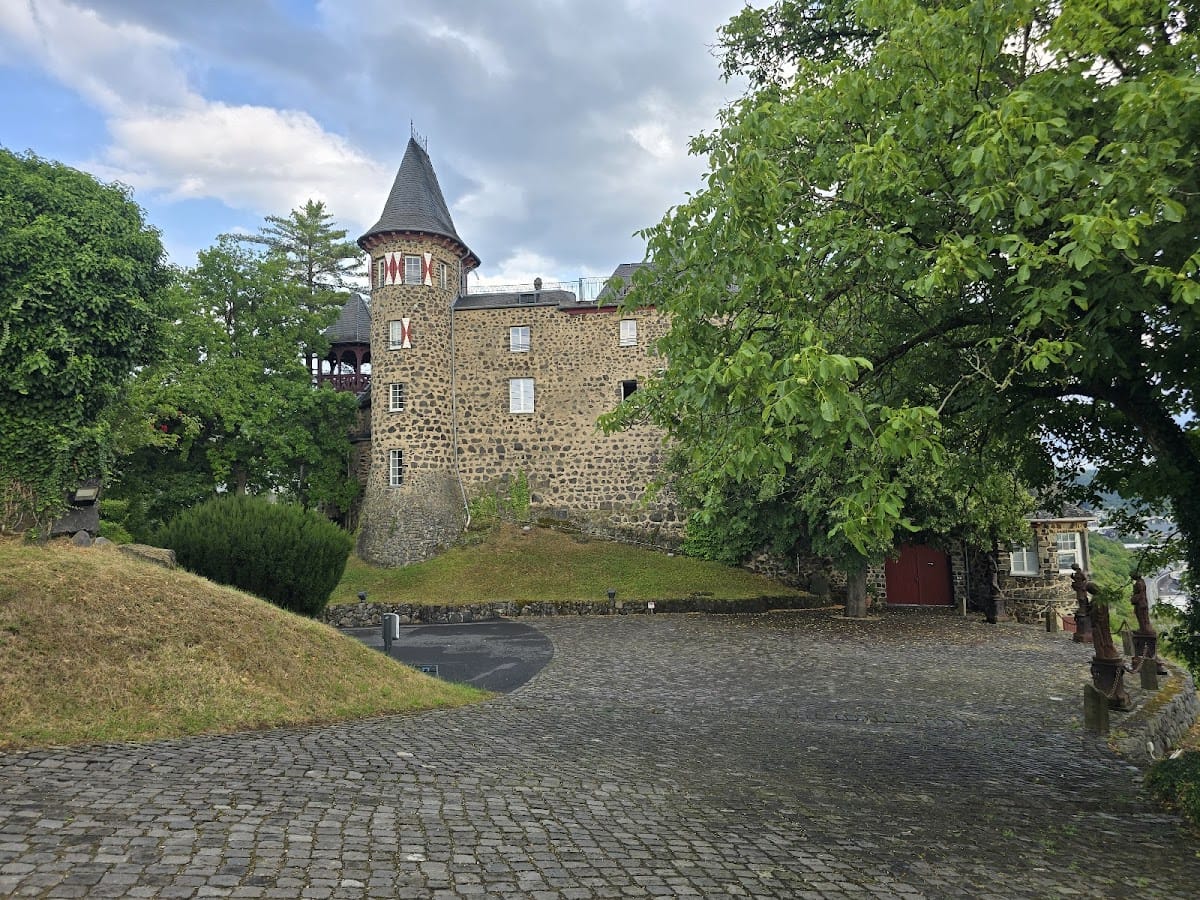
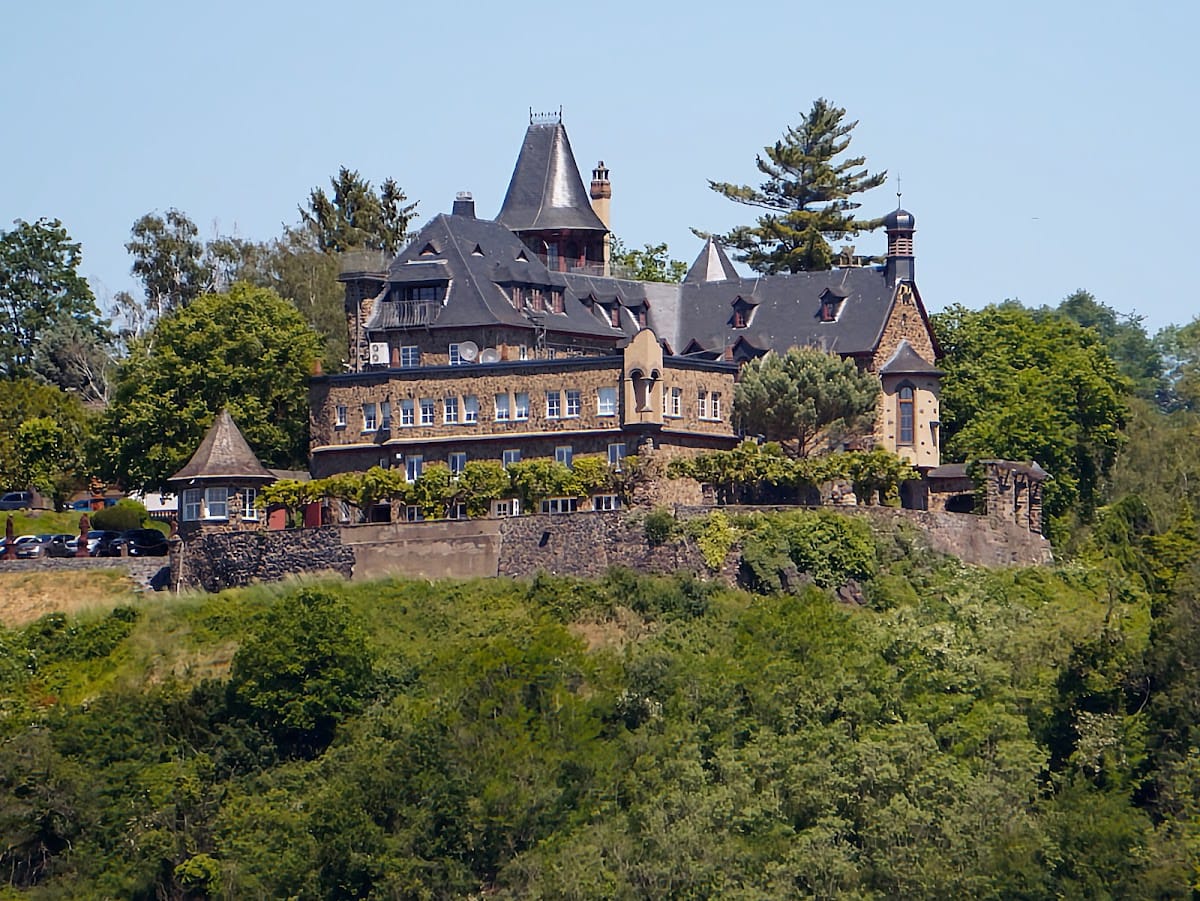
Vice-Consul Franz Delden acquired the ruin in 1924 and commissioned Heinrich Reinhardt to rebuild it by 1927. The work incorporated surviving medieval masonry and used basalt rubble in the Romantic style of the early twentieth century. In 1936, the Cellitines of Saint Mary on Kupfergasse in Cologne acquired the castle and established a rest and retirement home for their sisters. The Cellitines are a Catholic religious community associated with charitable and nursing work. From 1960, the building operated as a castle hotel offering rest and therapeutic stays.
The property later changed hands several times and deteriorated because a suitable use had not been found. Kundenzentrum Burg Ockenfels GmbH acquired it in 1998. After alterations, the castle became the presentation and administrative headquarters of the Betula and Birko Orthopädie footwear brands of the Birkenstock group.
Remains
Hilltop Setting and Rebuilt Layout
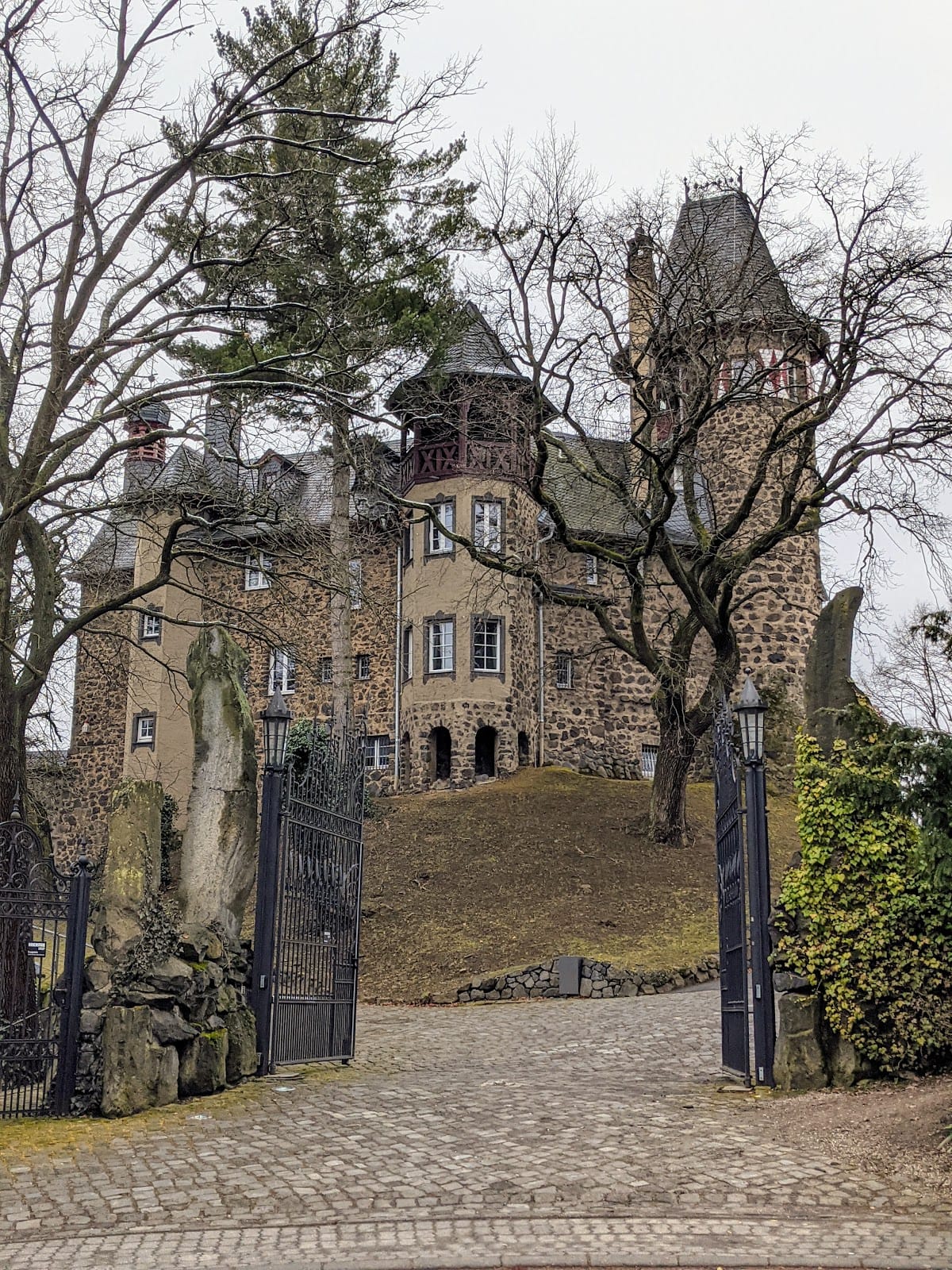
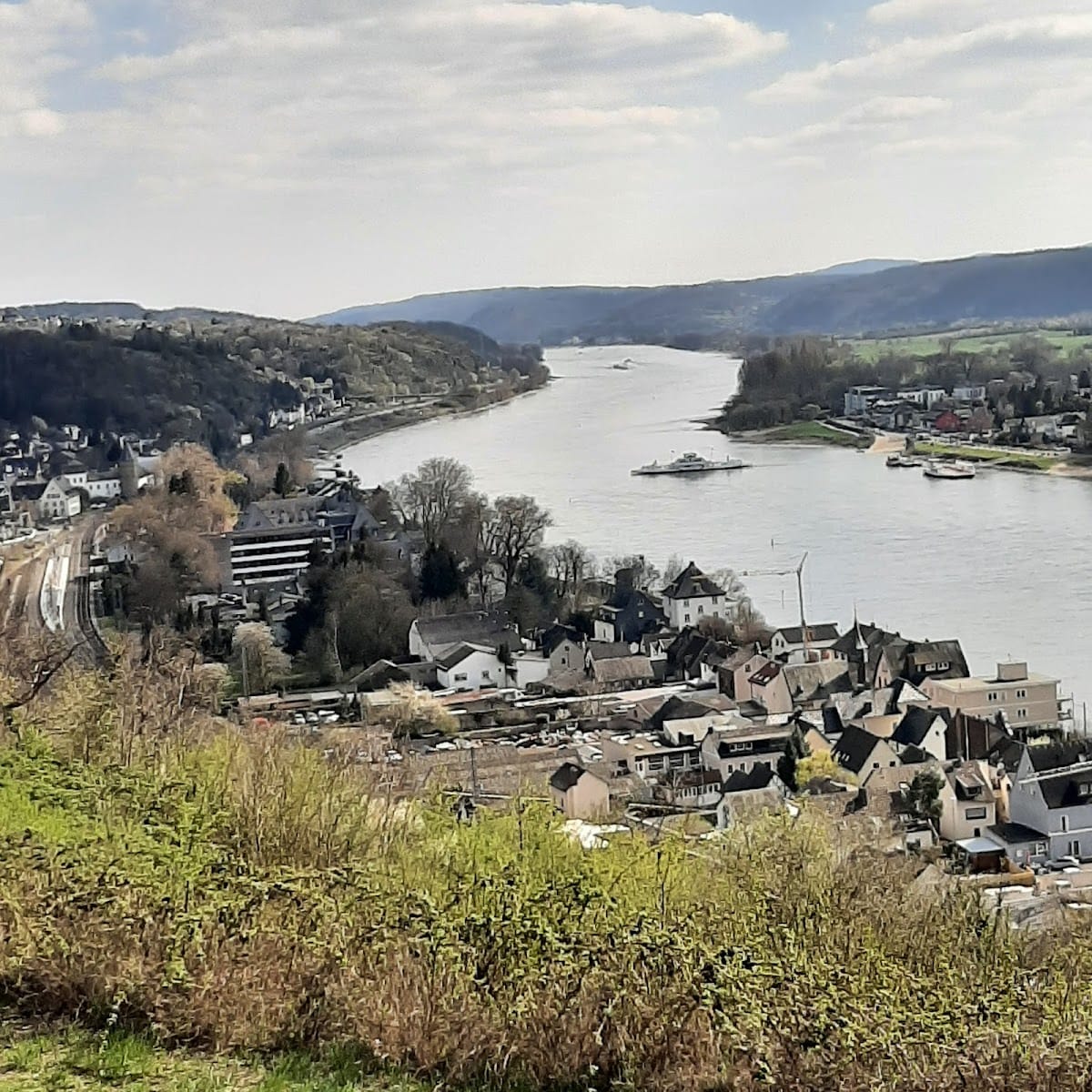
Ockenfels Castle stands on the edge of a moderately rising hill spur near Ockenfels, about 60 metres above the Rhine and approximately one kilometre northwest of central Linz am Rhein. Its elevation is about 110 metres above sea level. The rebuilt complex has three wings, two semicircular towers, and a keep, the principal fortified tower of a castle. The courtyard opens toward the valley.
The reconstruction used basalt rubble masonry and followed the Romantic style of the early twentieth century while incorporating the existing remains. The surviving medieval elements form part of the later building rather than a separate medieval complex.
Surviving Medieval Fabric
By the nineteenth century, stone robbing had reduced the medieval ruin to sections of foundation wall, part of the enclosing defensive wall, and a portion of the keep. These remains were incorporated into the twentieth-century reconstruction. The destruction of 1475 and the subsequent loss of stone mean that the original medieval layout and appearance cannot be determined from the surviving fabric.