Burg Kemnat: A Medieval Castle and Administrative Center in Kaufbeuren, Germany
Visitor Information
Google Rating: 4.6
Popularity: Low
Official Website: de.wikipedia.org
Country: Germany
Civilization: Early Modern, Medieval European
Site type: Military
Remains: Castle
History
Burg Kemnat is located in the town of Kaufbeuren, Germany, and was constructed around the year 1185 by members of the von Apfeltrang family, who were vassals to the Counts of Ronsberg. These founders later adopted the name Herren von Kemnat, after their newly established stronghold. The castle became the center of the medieval lordship known as Großkemnat and closely influenced the development of the adjacent villages Großkemnat and Kleinkemnat.
In the late 12th and 13th centuries, one of the most distinguished lords of the castle was Volkmar II von Kemnat, who earned the nickname “the Wise.” He played significant roles beyond his lordship: he served as the city advocate (a legal and administrative official) for the city of Konstanz, founded the Cistercian nunnery at Oberschönenfeld, and acted as a tutor to Konradin, the last male heir of the Staufer dynasty. Volkmar II’s last recorded mention dates to 1282, and by 1284 his son Markward had assumed control over the castle and its lands.
Ownership of Burg Kemnat changed hands around the year 1300 when it passed to the Ramschwag family, and about a century later it was inherited by the Benzenau family. Remarkably, during the widespread Peasants’ War of 1525, which saw many castles captured or destroyed, Burg Kemnat remained unconquered. This suggests that it retained defensive strength or political significance to withstand the upheaval.
In 1551, the then-owner Simprecht von Benzenau sold Burg Kemnat along with the villages under its jurisdiction and associated judicial rights to the Kempten Abbey. The abbey transformed the site into an administrative center by establishing an office known as an Amtshaus (official residence or manor house). This change marked a shift from a purely feudal stronghold to a center of ecclesiastical governance.
Following the secularization of church properties in 1804, ownership transferred out of religious hands into private possession. At this time, all major buildings except the bergfried (the main tower), the castle tavern, and the Amtshaus were demolished, including a chapel located northeast of the castle courtyard. This marked the beginning of a period of structural decline for parts of the original complex.
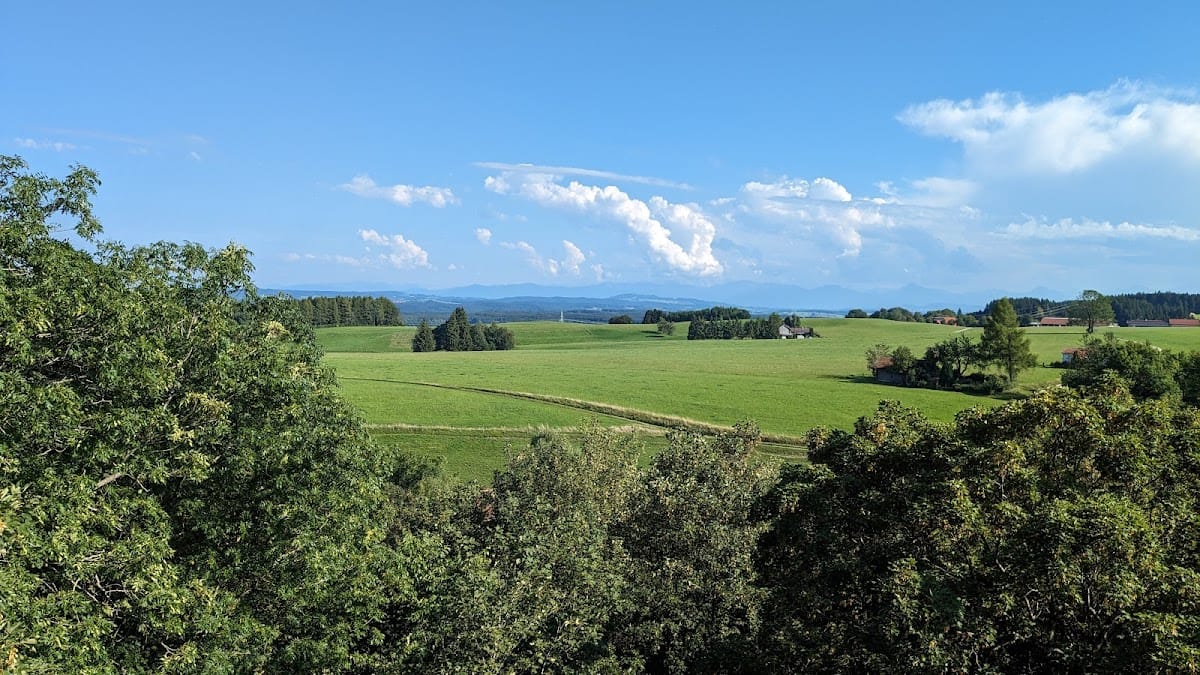
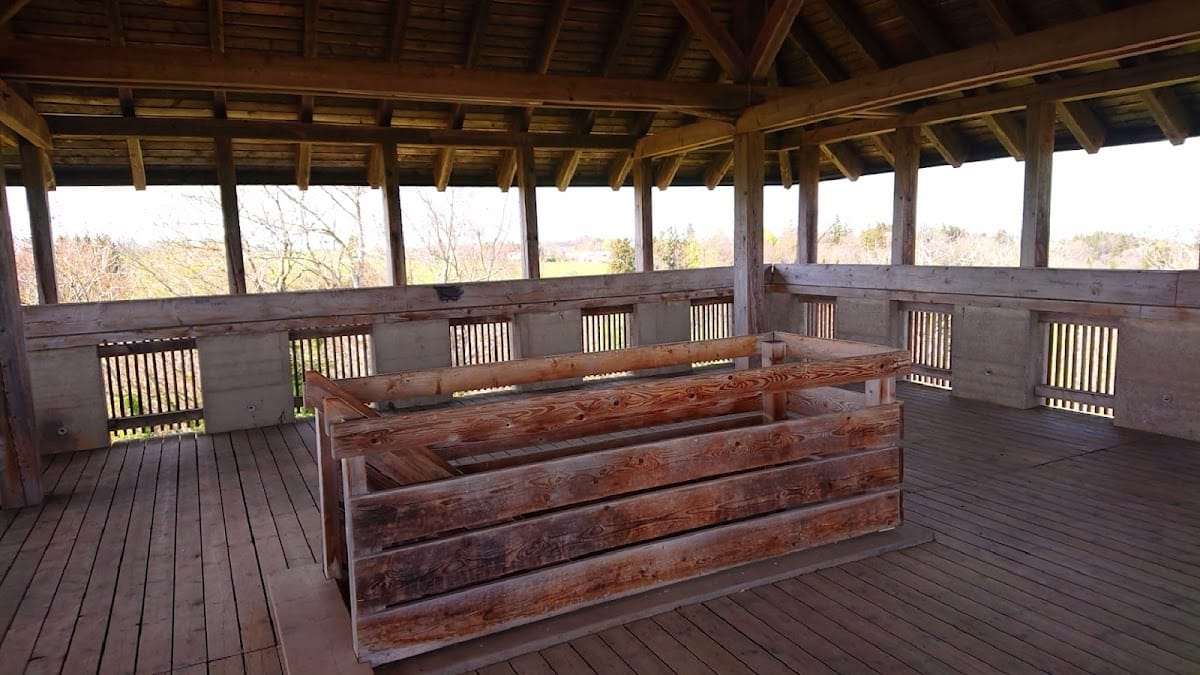
In 1838, the Historical Association of Swabia took ownership of the bergfried and undertook several restoration efforts throughout the 19th and 20th centuries—specifically in 1851, 1884, 1925, and 1957. The castle tavern, which had become dilapidated, was demolished in 1978. In 1984, ownership shifted to the city of Kaufbeuren, which then renovated the bergfried, the Amtshaus, and the surrounding grounds, adding a modern viewing platform to the tower. These renovations coincided with the 800th anniversary of the castle’s founding in 1985, a milestone celebrated by the local community.
Most recently, on September 30, 2023, the roof structure of the bergfried suffered severe damage due to a fire, representing a significant event in the modern history of the site.
Remains
Burg Kemnat is a classic example of a “Zungenburg,” a type of spur castle built on a narrow hill spur that extends from a larger plateau. This particular castle is perched on a roughly triangular plateau with steep, natural rock slopes made from Nagelfluh, a type of conglomerate rock, dropping off sharply to the north and east. The location provided substantial natural defense, augmented by a man-made neck ditch separating the main castle area from the rest of the plateau. This ditch measures up to eight meters deep and twenty meters wide and adds to the site’s defensibility.
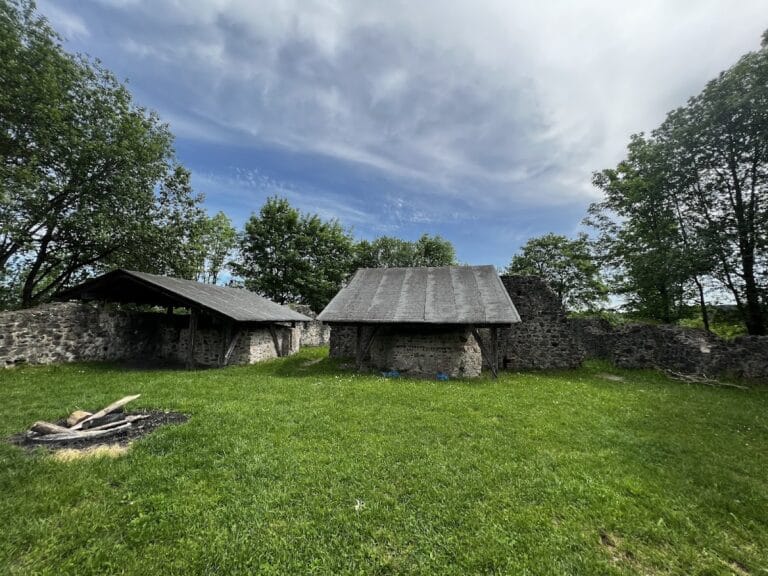
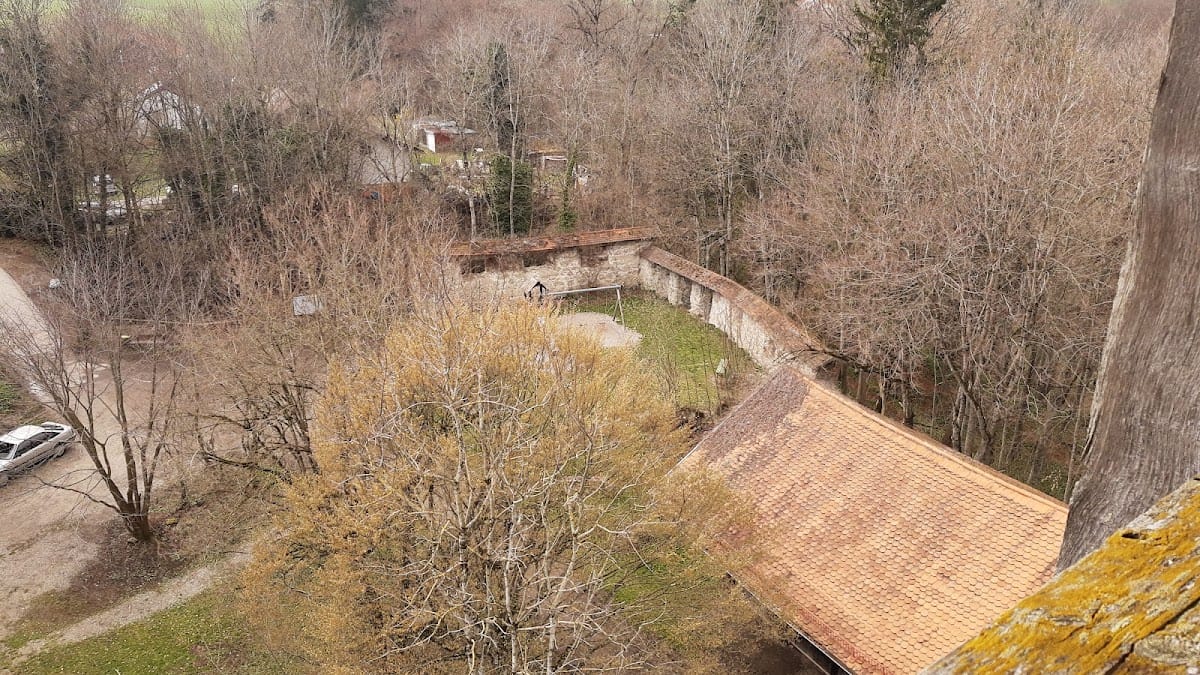
Remnants of the castle’s medieval ring wall remain primarily in the northern and southwestern sectors. These surviving sections now form the outer walls of two buildings: the Amtshaus, which still stands and is privately occupied as a tavern, and the former castle tavern, which was demolished in 1978 due to poor condition. Along the southern and eastern slopes of the spur, a shallow ditch with an embankment traces the perimeter, suggesting an outer layer of defense surrounding the castle plateau.
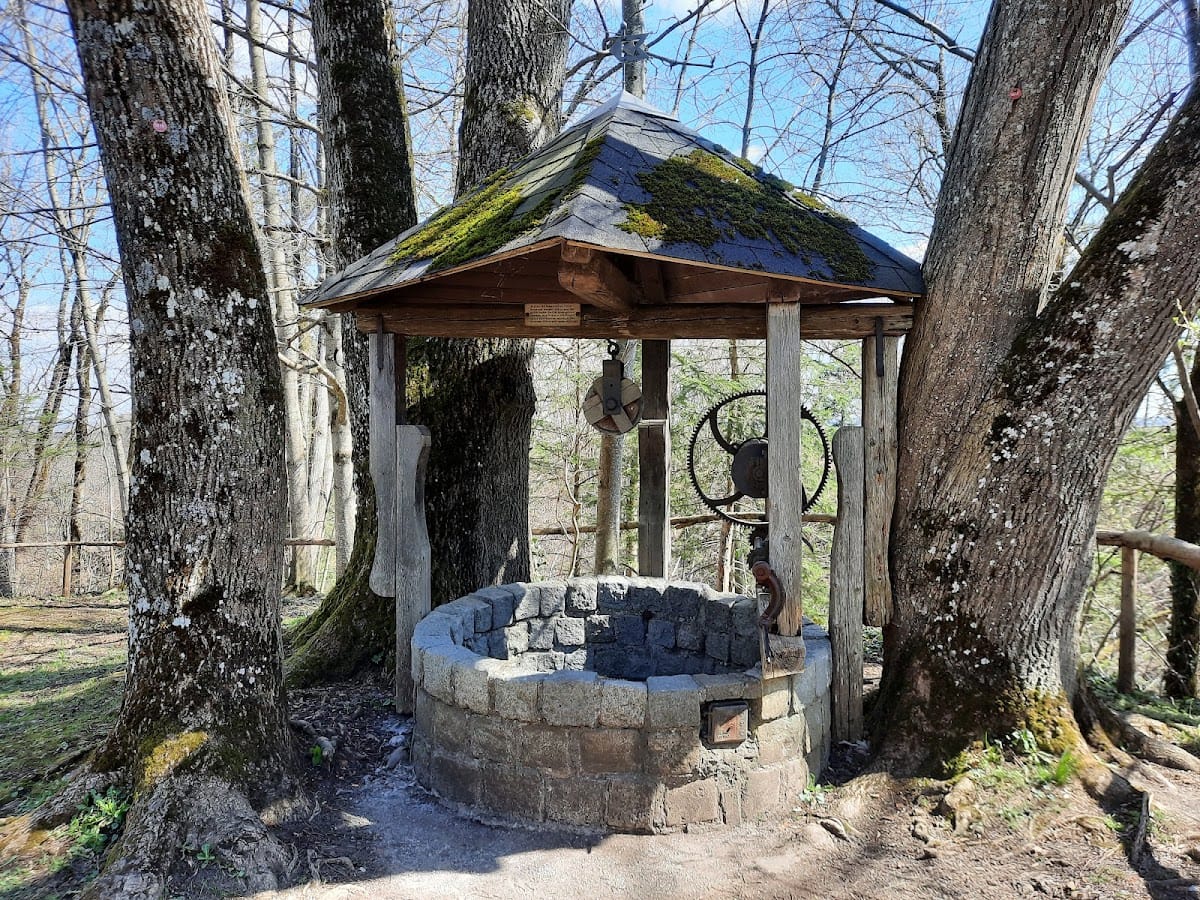
Access to the castle plateau is gained by a footpath climbing from the valley to the southwest. This path runs between the bergfried and a deep well, which reaches about 26 meters in depth and is located approximately 20 meters east of the tower. The well represents a vital resource, ensuring water supply within the castle. Adjacent to the well and westward lies the Amtshaus, positioned close to the artificial neck ditch.
Further out, the area once known as the outer bailey or economic yard has largely been overtaken by modern construction in the village of Großkemnat. However, small fragments of walls survive, and a memorial plaque installed in 1933/34 on the house at number 24 commemorates the historical extent of this outer yard.
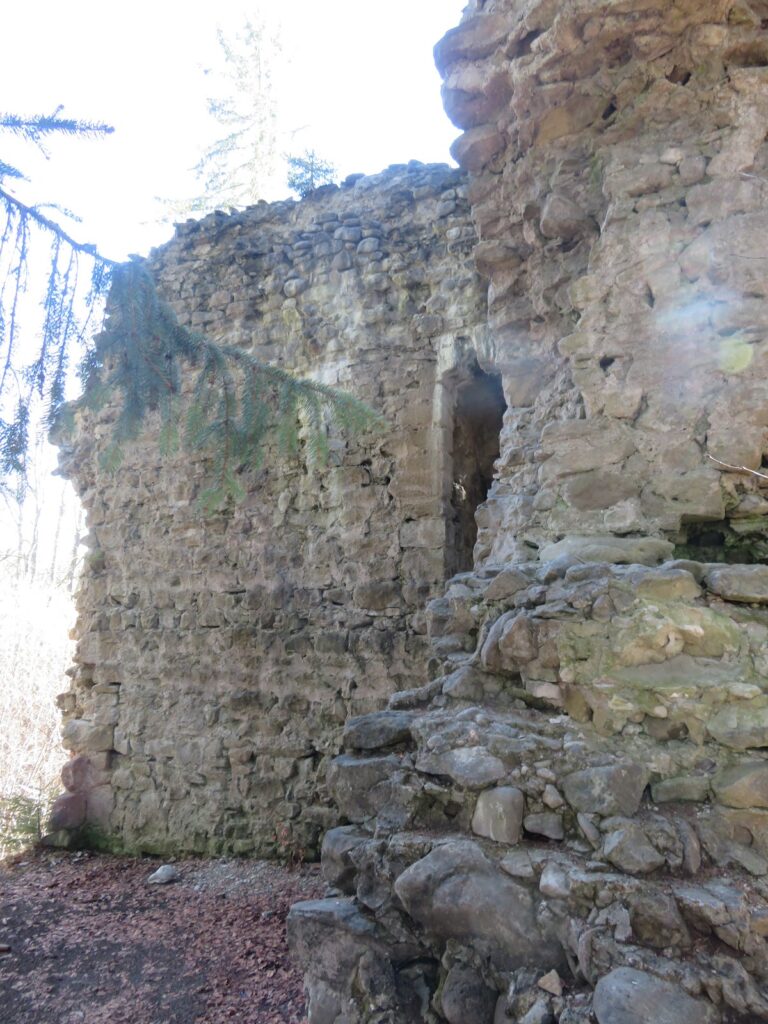
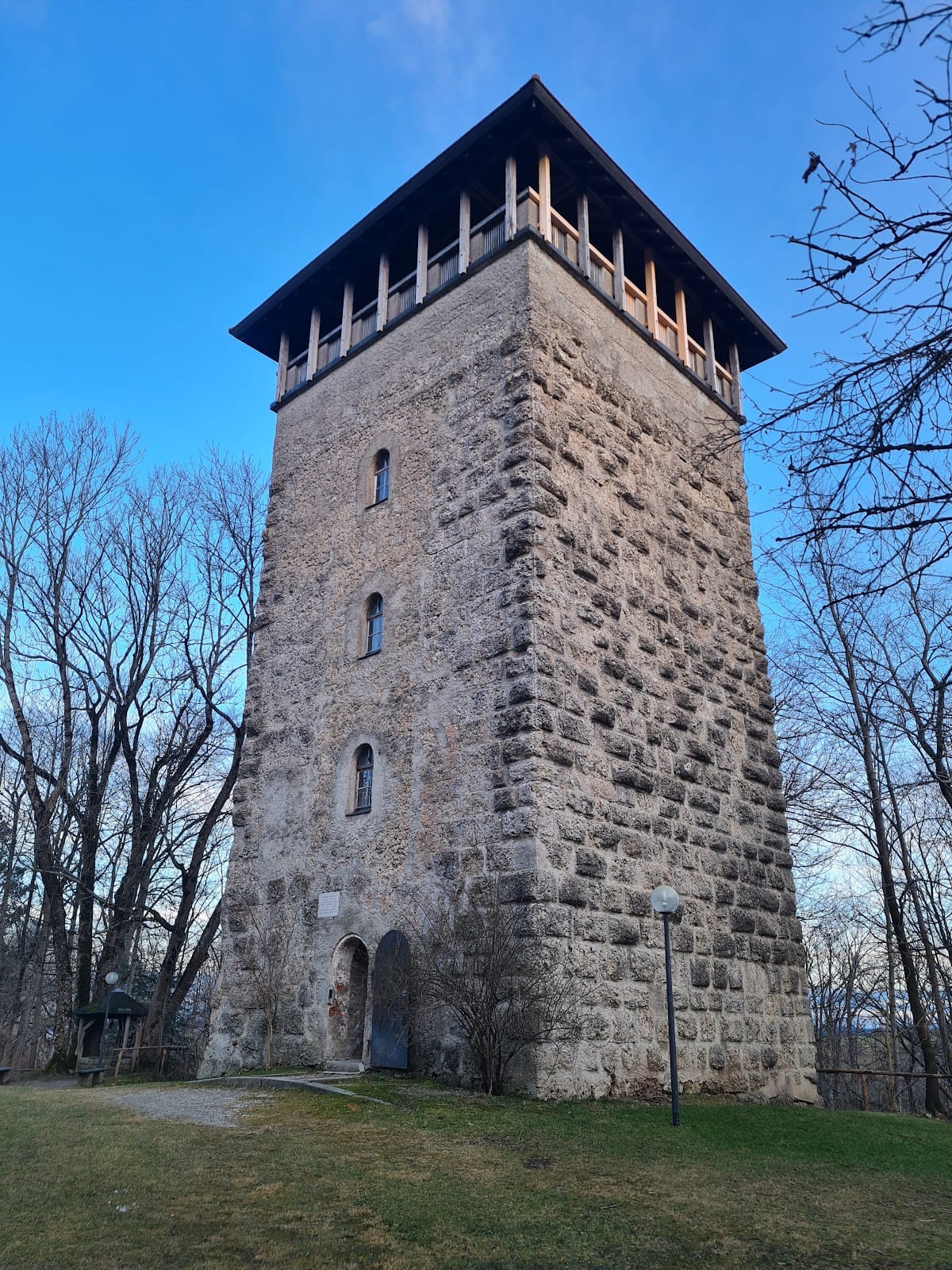
Dominating the castle remains is the bergfried, a large square tower measuring 9.3 meters long on each side. Constructed from substantial rusticated blocks of Nagelfluh stone, this tower stands on a stout base roughly three meters thick, rising to about 23 meters high. In the 20th century, a modern viewing platform with a tent-shaped roof was added atop the bergfried. Despite sometimes being referred to as the “Römer tower,” a local name perhaps inspired by its considerable age or imposing appearance, this designation is historically incorrect.
The bergfried was incorporated into a south wing rebuilt during 16th-century renovations that transformed parts of the castle. The tower’s original high entrance, typically designed for defense, was replaced by a ground-level door, and large window openings were added, signaling a reduced military function and a more residential or administrative purpose. A brick wall sealed the northwest facade of the tower in 1851, closing an opening first made in the 16th century, when the castle briefly housed a poor widow.
The 16th-century modifications converted the castle from a medieval fortress into an administrative center under the rule of Kempten Abbey. The bergfried itself symbolized legal authority rather than serving primarily as a defense structure.
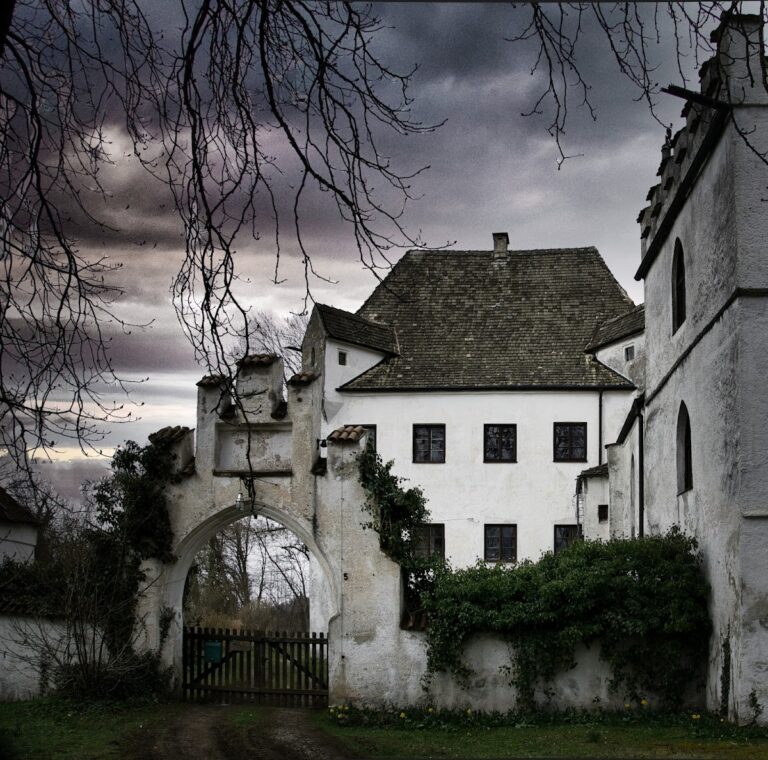
The Amtshaus complex from this period featured a three-story northwest wing and a similarly tall northeast wing, which included the St. Anna chapel on its ground floor, likely replacing the earlier medieval residential building known as the palas. The southern boundary of the courtyard was enclosed by a wall without battlements and topped with roof tiles. Within the courtyard, notable rooms known as the “Tafelzimmer” (dining room) and the “Fürstenzimmer” (prince’s chamber) were situated on the south wing’s second floor, highlighting the building’s representative and administrative functions.
Above the bergfried’s entrance a large stone plaque is embedded into the wall, a feature common in castles of the region. Such plaques often carry inscriptions that are not historically accurate but serve decorative or symbolic purposes.
A detailed reconstruction model created by Marzell Schwarz, displayed in the Kaufbeuren local history museum, illustrates the castle’s layout just before the early 19th-century demolitions, showing not only the main keep and wings but also the topography of the former outer bailey.
Today, the grounds around the castle serve cultural purposes, with open-air theater performances staged on the site. Nearby structures such as the “Theaterstadl” (a theater barn) and other recreational facilities provide additional community functions tied to the historic location.
The bergfried bears resemblance to a similarly built large tower at the nearby Helmishofen castle ruin, which is also referred to locally as a “Roman” or “watchtower.” Like Burg Kemnat’s tower, the Helmishofen structure is constructed of Nagelfluh blocks and serves as an observation point accessible to the public.
Nearby sites