Burg Drachenfels: A Medieval Castle Ruin near Königswinter, Germany
Visitor Information
Google Rating: 4.7
Popularity: Low
Official Website: www.der-drachenfels.de
Country: Germany
Civilization: Medieval European, Modern
Site type: Military
Remains: Castle
History
Burg Drachenfels is a castle ruin situated near the town of Königswinter in Germany, built during the medieval period by the archbishops of Cologne and local nobility. Its origins date back to the early 12th century when Archbishop Arnold I of Cologne began construction in 1138, with completion achieved in 1149 under Gerhard von Are, the provost of the Bonn St.-Cassius collegiate church, who acquired the site from the archbishop.
From the mid-12th century onward, the castle was managed by a hereditary family bearing the title of burgrave, tasked with overseeing the fortress. The earliest known burgrave was Godart von Drachenfels in 1176, who was the son of Rudolf von Wolkenburg. This family line maintained control of the castle, passing it down through successive generations until 1530, when the main lineage ended with Heinrich von Drachenfels. In the following decades, ownership transferred through marriage and inheritance, landing with Dietrich Herr zu Millendonk in 1550. After the extinction of this family branch, control reverted to the Archbishopric of Cologne.
The early 17th century brought further changes when, in 1623, the castle was granted to Imperial Field Marshal Count Johann Jakob von Bronckhorst-Batenburg, who held it until his death in 1630. Subsequently, in 1642, Freiherr Ferdinand Waldbott von Bassenheim purchased the lordship for 11,000 talers, and the estate stayed within his family until they, too, became extinct. Later owners included Freiherr Johann Jakob Waldbott von Bassenheim and Freiherr Clemens August von der Vorst-Lombeck, whose son sold the summit of the mountain to the Schäfer brothers in 1813. In 1827, the site came under the ownership of the Königswinter stonemasons’ guild.
Throughout its existence, the castle experienced several military confrontations. After the walls of nearby Bonn were constructed in the mid-13th century, Burg Drachenfels lost much of its military significance. In 1493, it was the scene of a violent family dispute during which Claus von Drachenfels was killed by his nephew Heinrich. The late 16th century brought further conflict during the Cologne War; from 1583, Catholic forces occupied the castle for five years. During the Thirty Years’ War, Swedish Protestant troops captured the castle in 1632, only to be driven out by Spanish forces the following year.
Recognizing the potential for ongoing strife, Elector Ferdinand of Cologne ordered the demolition of the castle’s outer defensive works in 1634. After this destruction, the fortress was not rebuilt and gradually deteriorated into ruins. At the same time, quarrying activity on the Drachenfels mountain began to intensify, as the valuable local trachyte stone was extracted for construction projects including providing building material for the Cologne Cathedral until work ceased in 1528. Over the centuries, quarrying expanded close to the ruins, eventually threatening the castle’s remaining structures and the summit itself. To protect the site, quarrying was banned in 1807, and the Prussian government acquired the summit in 1836.
In the 19th century, the ruins of Burg Drachenfels became a focal point of Romanticism in art and poetry. The castle inspired figures such as Heinrich Heine, who commemorated a student expedition there in his 1819 poem “Die Nacht auf dem Drachenfels.” Restoration efforts were undertaken, including the addition of a large support pillar in 1855 to halt further collapse, and structural repairs made in 1891 and 1892. In the 20th century, following a major rockfall in 1967, the site underwent geological stabilization by reinforcing the cliff with steel anchors and concrete from 1971 to 1973 under the auspices of the state of North Rhine-Westphalia. Today, the castle remains state property, with its surroundings managed by a conservation association dedicated to maintaining the natural beauty of the Siebengebirge region.
Remains
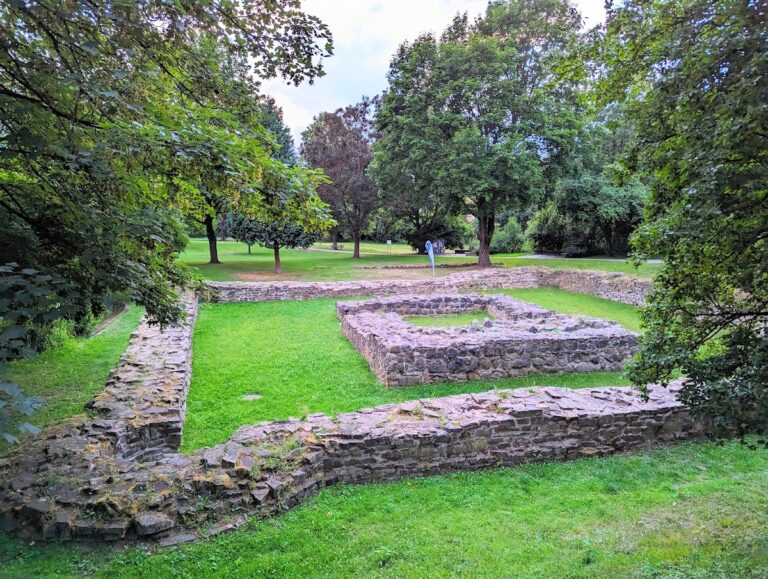
The ruins of Burg Drachenfels encompass three principal areas: the bergfried (a central tower), the main castle (Hauptburg), and the lower castle or outer bailey (Vorburg). Built primarily from local trachyte stone quarried directly from the mountain, the layout and structural details are known largely through historical drawings and paintings, as original construction plans have not survived.
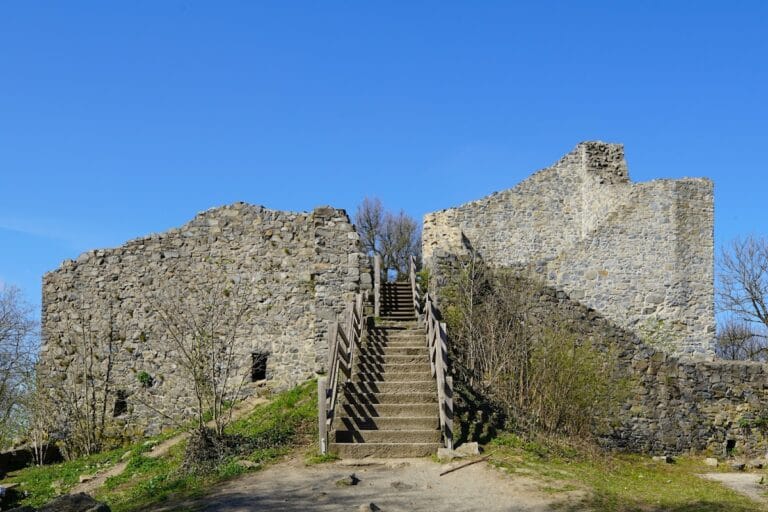
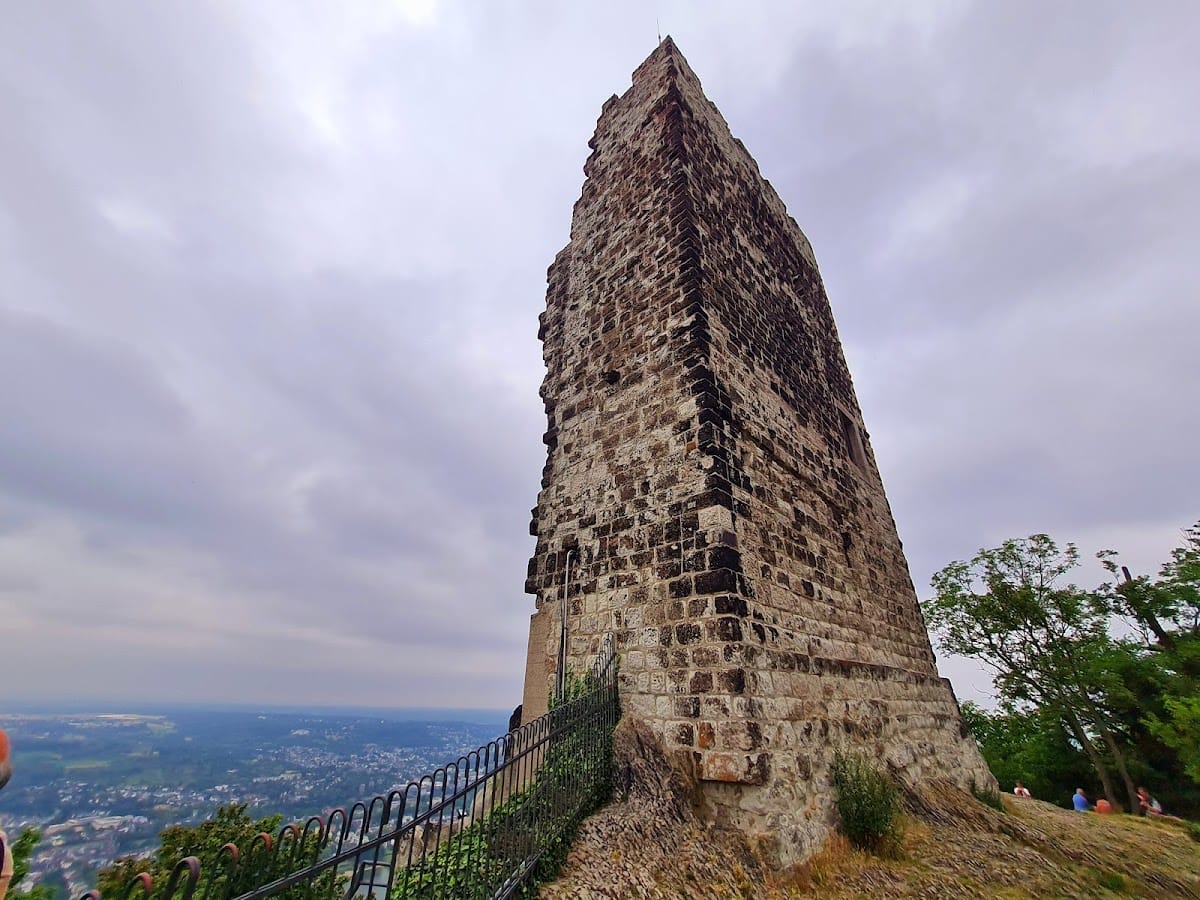
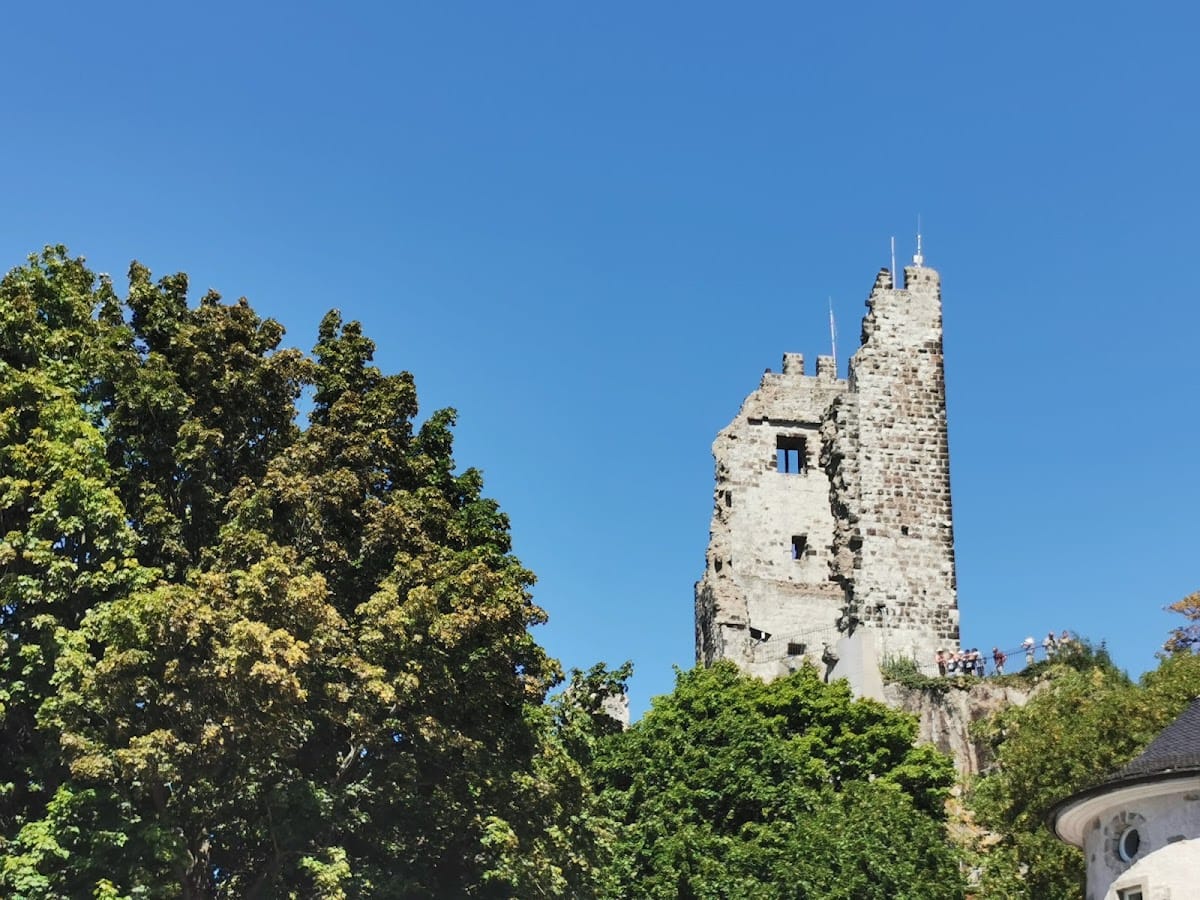
The bergfried is a prominent rectangular tower approximately 25 meters tall, featuring a footprint about 10.5 meters by 9.2 meters. It has three internal floors: the ground level, which was windowless and lacked any entrance, likely designed for defense; the middle floor, accessible by a door on the eastern side; and the upper floor, which originally had three windows, one of which preserves its original form. A staircase once ascended to the tower roof, but part of the southwest section of the bergfried collapsed in 1788, removing about half the south wall and almost all of the west wall. To prevent further deterioration, a substantial support pillar was installed in 1855.
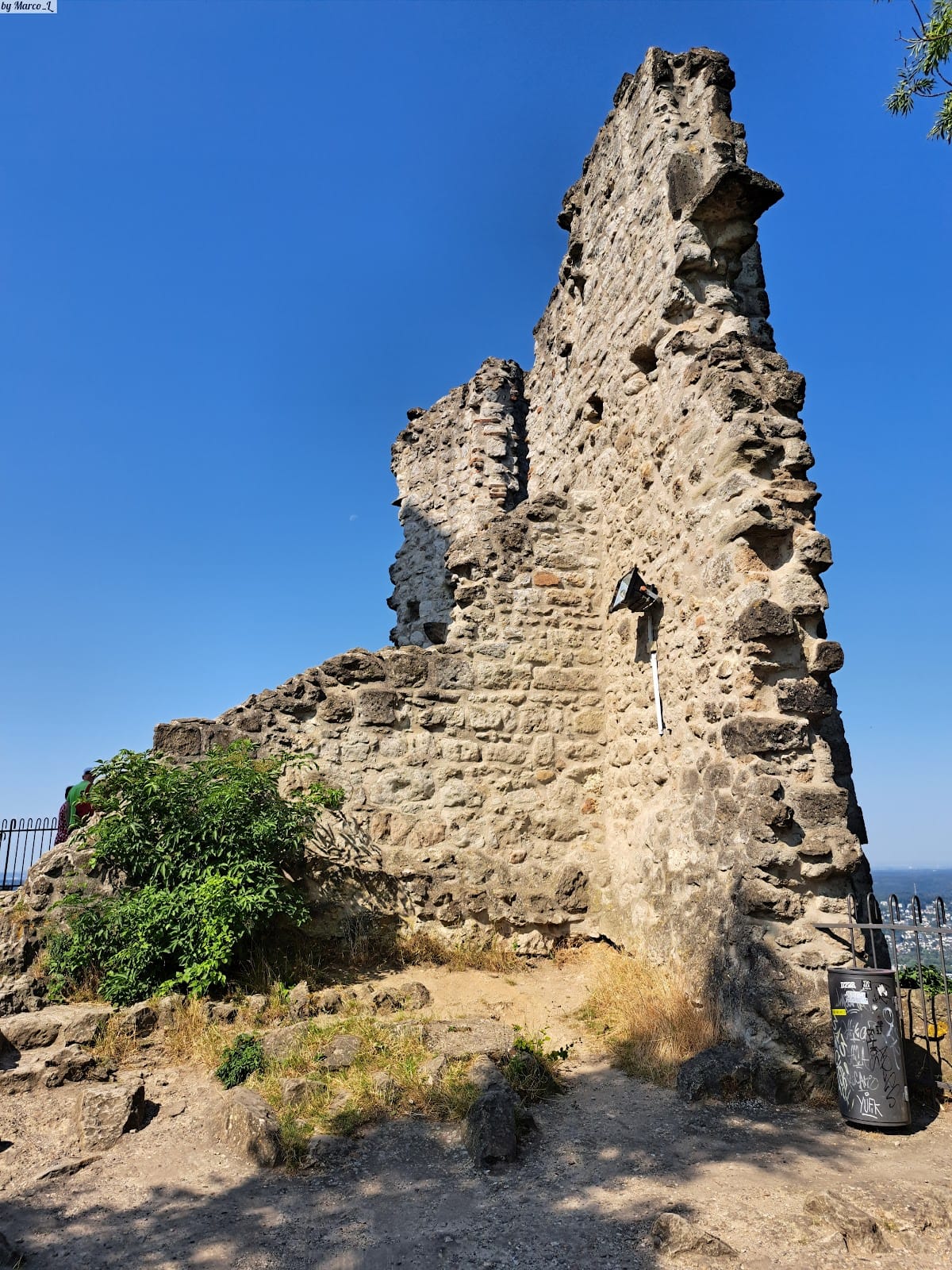
The main castle area sits on the visitor plateau and includes remnants of its walls as well as a notable window called the “Kölner Fenster” (Cologne Window) on the right side, which remains partially intact. A rounded corner turret once overlooked and controlled the approach path to the castle, highlighting its strategic design tailored to defend against attackers ascending the mountain.
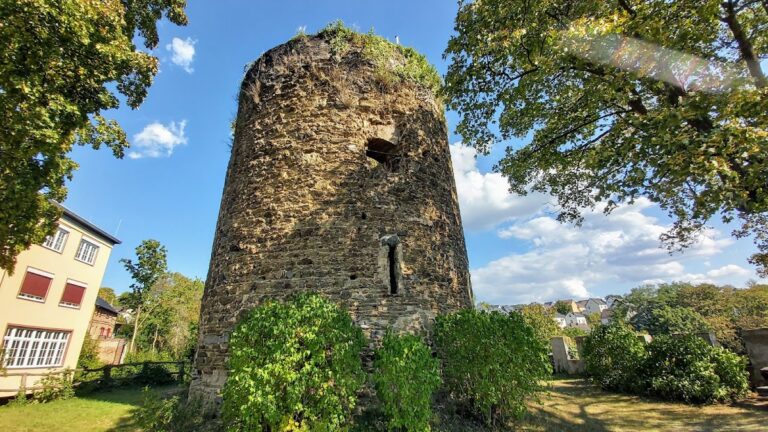
Access to the lower castle is gained near the entrance gate, which is guarded by a round tower that was probably two stories high. Evidence for this comes from remaining corbels that once supported wooden floor beams. The door jamb of the entrance still survives, providing insight into the original gateway. The northern wall of the lower castle contains narrow arrow slits and beam sockets for a defensive walkway located behind battlements, showing the castle’s layered system of fortification.
On a small plateau adjacent to the northern path, archaeological and historic research points to several key structures. These likely included a knights’ hall used for gatherings or feasts, residential buildings for inhabitants, a chapel for religious observance, and possibly stables. On the southern side of the lower castle, the kitchen and service rooms once stood but were destroyed during the 1788 rockfall.
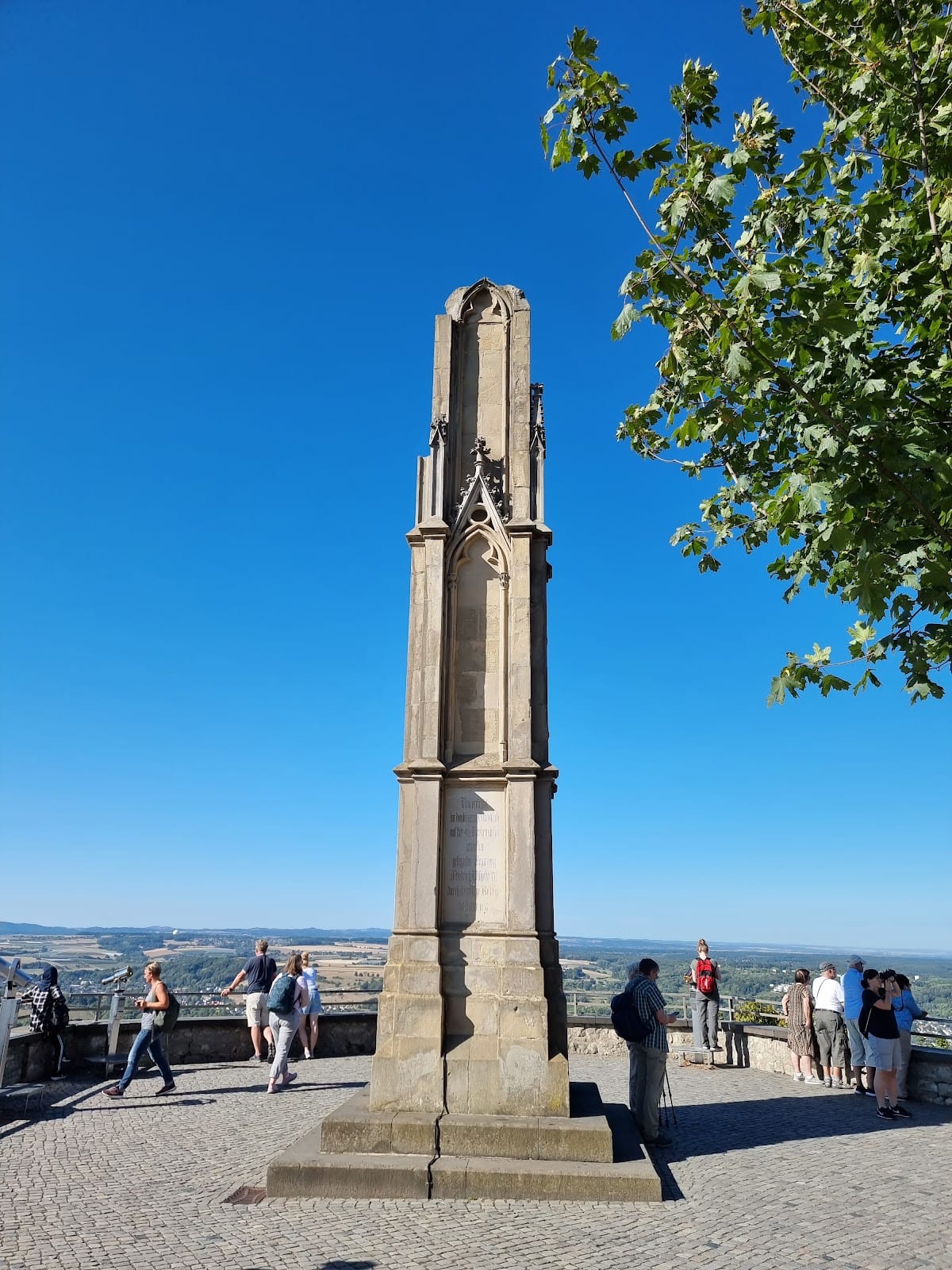
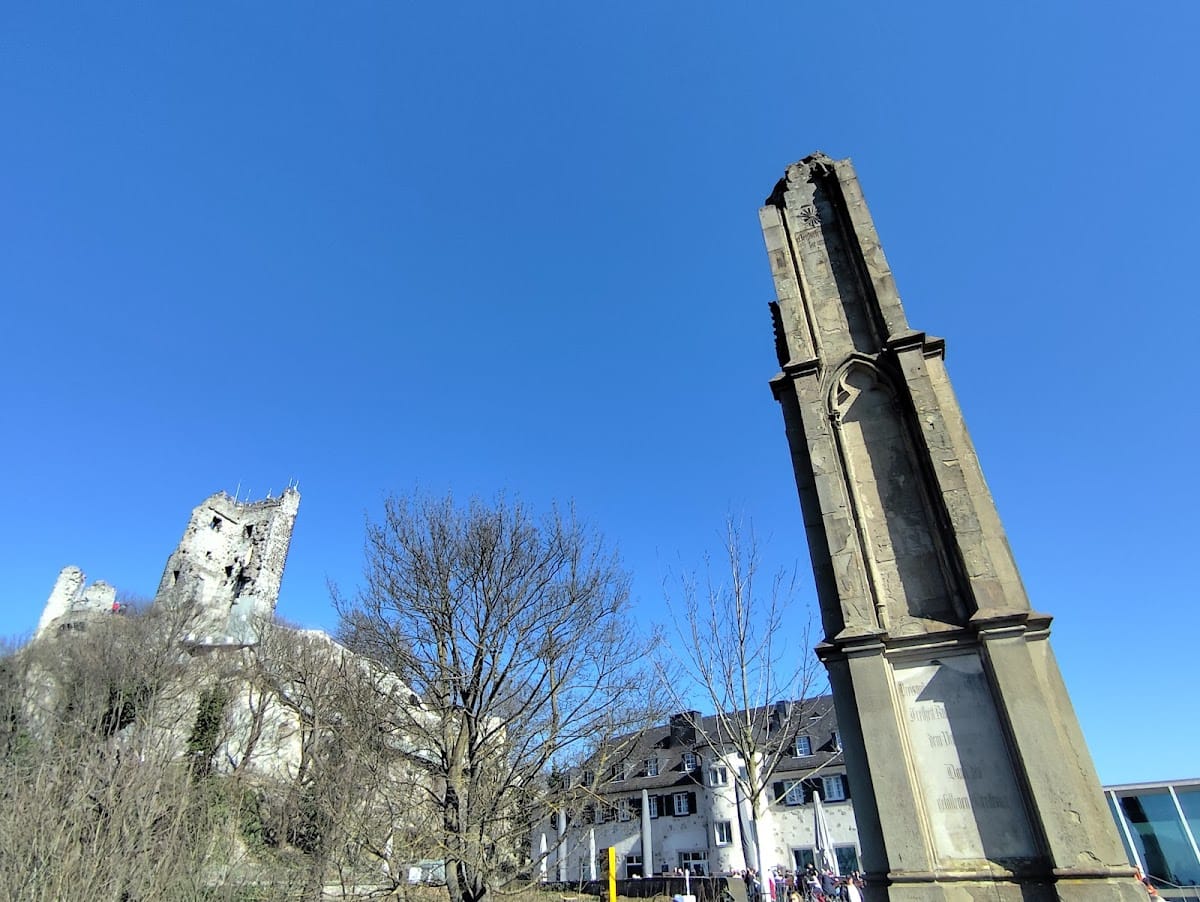
Throughout the site, trachyte stone was the main building material, reflecting the castle’s intimate connection with its natural surroundings. Quarrying activity, however, encroached on the ruins over time, contributing to structural losses and necessitating protective measures in the 19th and 20th centuries. Beyond the ancient walls, the summit bears modern additions such as a 1914 obelisk and a replica of the 1814 Landsturm memorial, honoring regional militia from the Napoleonic era. A restaurant and an amateur radio antenna once occupied the bergfried summit area, though the restaurant building was replaced in 2011.
From the castle remains, visitors can experience expansive views spanning the Rhine valley, with clear sightlines toward the Cologne skyline, the fortress of Godesburg, and numerous surrounding towns extending roughly 50 kilometers across the landscape.
Nearby sites