Burg Braunshorn: A Medieval Motte Castle in Germany
Visitor Information
Google Rating: 3
Popularity: Very Low
Country: Germany
Civilization: Medieval European
Site type: Military
Remains: Castle
History
Burg Braunshorn is located in the heart of the municipality of Braunshorn in Germany. This motte castle was established by the medieval German nobility known as the Freiherren von Braunshorn, who are considered its original builders and occupants.
The exact date when Burg Braunshorn was constructed remains uncertain, but it is generally believed to have been built during the latter part of the 11th century. This estimation aligns with the earliest known record of the Braunshorn family, which mentions a Gundolph von Braunshorn in the year 1098. For several centuries, the castle served as the family’s ancestral home and stronghold.
In 1268, a significant change occurred when the Braunshorn family moved their residence to Beilstein on the Moselle River. Just a few years later, in 1273, Johann I. von Braunshorn along with Gerhard von Wildenberg agreed to sell Burg Braunshorn to Count Palatine Ludwig. The count then used the castle as a strategic base in conflicts involving the nearby Archbishopric of Trier, reflecting the castle’s ongoing military importance in regional power struggles.
By 1314, the castle was pledged by Ludwig the Bavarian, then King of the Romans, to King John of Bohemia and the Archbishop Baldwin of Trier as collateral to finance Ludwig’s election as king. Following the death of Archbishop Baldwin, control of the castle returned to the Palatinate. Beyond this point, documented history provides no clear details regarding the castle’s continued use, modification, or precise date of abandonment.
By the late 18th century, remnants of the castle’s foundations were still observable, as noted in 1787 records, yet by the mid-19th century, much of these remains had disappeared, marking a slow decline from its former prominence.
Remains
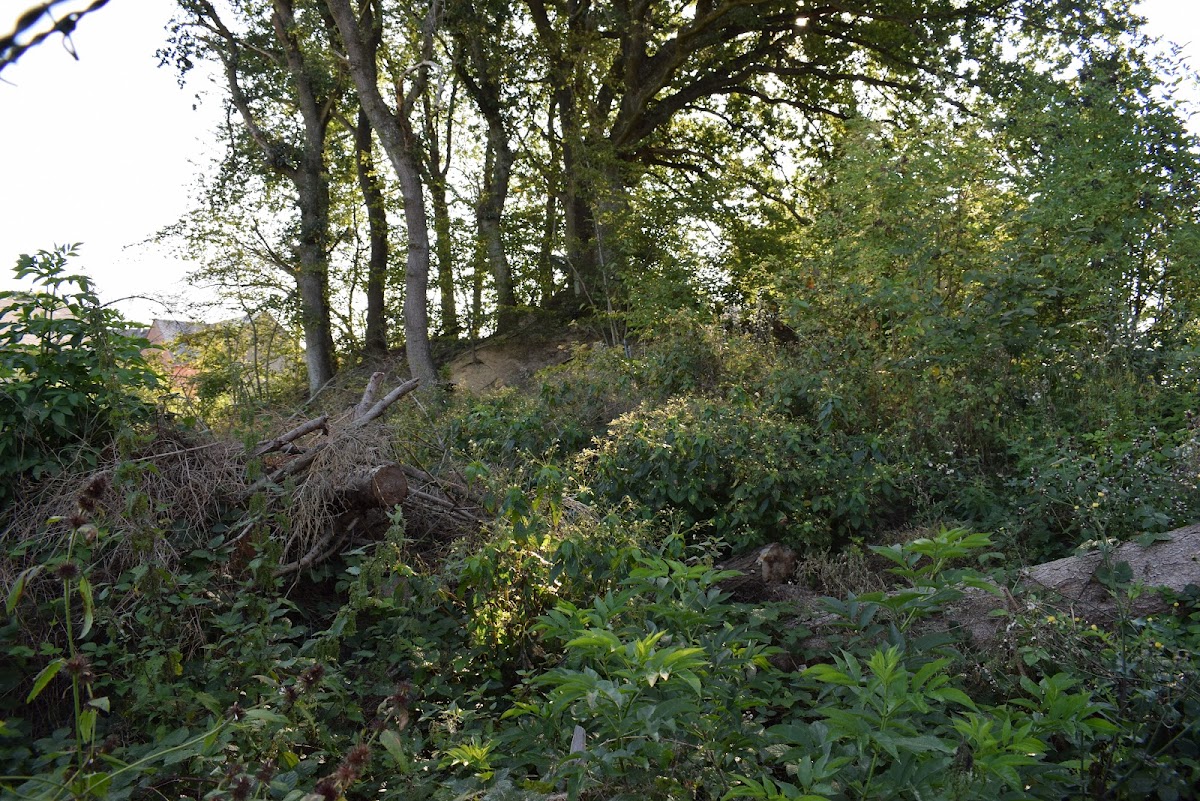
The site of Burg Braunshorn is defined by a rectangular earthen mound known as a motte, measuring roughly 20 meters across and standing between 3.4 and 4 meters high. This elevated mound would have provided a defensible position, likely supporting a central tower-like structure, typical of motte castles from the medieval period. Surrounding the motte is the faint outline of a low embankment about 1.5 meters in height, although whether this feature dates to the original construction phase or was added later is unclear.
The motte occupies an area characterized by marshy terrain, which naturally complicated access and enhanced the defensive qualities of the site. It is believed that the main building atop the mound was protected not only by the raised earth but also by a wooden palisade and a ditch filled with water, forming an early form of moat. These combined defenses would have made the castle difficult to assault.
In the mid-20th century, a residential building was constructed immediately adjacent to the motte. This modern structure appears to incorporate parts of the mound itself, a process that may have altered or removed some of the original earthworks. Due to fencing and property boundaries, the site is currently closed to public access.
Archaeological finds at the location include two pottery fragments discovered in 1936 near the motte. One shard is a modern glazed piece, while the other is a yellow earthenware fragment tentatively linked to the Pingsdorf ceramic tradition, known from the 11th and 12th centuries. However, the absence of typical red decoration on this piece prevents a precise dating. Additionally, aerial photographs taken by British reconnaissance during the 1940s provide a visual record of the site’s layout, though these images remain unpublished and inaccessible to the public.
Nearby sites