Castle Kastellaun: A Medieval Hilltop Castle in Germany
Site at a Glance
- Rating
- 4.5
- Popularity
- Low
- Country
- Germany
- Primary era
- Medieval
- External website
- Open
- Eras represented
- Medieval, Early Modern, Modern
- Civilizations
- Holy Roman Empire
- Site type
- Military
- Remains
- Castle
On this page11 sections
History
Castle Kastellaun is a medieval hilltop castle in Germany, standing above the town of Kastellaun at about 434 metres above sea level. Constructed during the thirteenth century, before 1248, it formed part of the town’s defences through its connection with the former town wall. The castle later served as a residence, administrative centre, and refuge for members of several ruling dynasties.
Origins and Sponheim rule
A document from 1226 names the settlement as “Kestilun” and mentions Hilger and Gerhard of Kestellin. It is uncertain whether their designation came from the castle or from the settlement. By 1248, the castle belonged to the Counts of Sponheim, a medieval comital dynasty whose territories included the county associated with Kastellaun.
In 1301, Castle Kastellaun was the residence of Simon II, Count of Sponheim-Kreuznach. After Walram of Sponheim-Kreuznach left Kastellaun in 1340, bailiffs and castle wardens administered the site. When the Counts of Sponheim died out, Kastellaun and the associated county passed jointly to Bernhard II, Margrave of Baden, and Friedrich, Count of Veldenz. This joint rule continued until the Veldenz succession brought the Rear County of Sponheim, the western division of the former county, into the political sphere of the Palatinate.
Dynastic changes and wartime destruction
The last Count of Veldenz died in 1444. His share passed to his son-in-law Stephen, Count Palatine of Simmern-Zweibrücken, and the resulting political alignment drew the Rear County of Sponheim into wars before it became a possession of the Duchy of Palatinate-Zweibrücken.
From 1594, the castle again served as a residence and refuge for Eduard Fortunat, Margrave of Baden-Baden. A margrave was a high-ranking territorial ruler historically associated with a border march or margraviate. On 18 June 1600, Eduard Fortunat fell down a castle staircase at the age of 35 and died, probably after excessive alcohol consumption. He was first buried at Engelport Monastery near the Moselle and later reinterred in the collegiate church at Baden-Baden between 1622 and 1631.
During the Thirty Years’ War, the major European conflict fought from 1618 to 1648, Kastellaun and its castle were occupied successively by Spanish, Swedish, Lorraine, Hessian, and French forces. In 1689, during the War of the Palatine Succession, a European conflict lasting from 1688 to 1697, French troops blew up the castle. Part of the charge placed at the powder tower failed to detonate, allowing a section of the tower to survive. The castle was not rebuilt.
Ownership, conservation, and interpretation
The ruins entered private ownership in 1820. The town of Kastellaun purchased them in 1884 and began securing the remains. Between 1990 and 1993, the castle hill and ruins were cleared and conserved, while the lower castle and its access were rebuilt. The lower castle was reconstructed again on its historic foundations in 2006 and 2007.
A documentation centre opened in the lower castle on 9 September 2007. Known as the House of Regional History, it presents the Celtic and Roman past of the Kastellaun region, medieval life in Hunsrück castles, the history of the former Pydna missile station, the Hunsrück peace movement, and current regional military and festival uses.
Remains
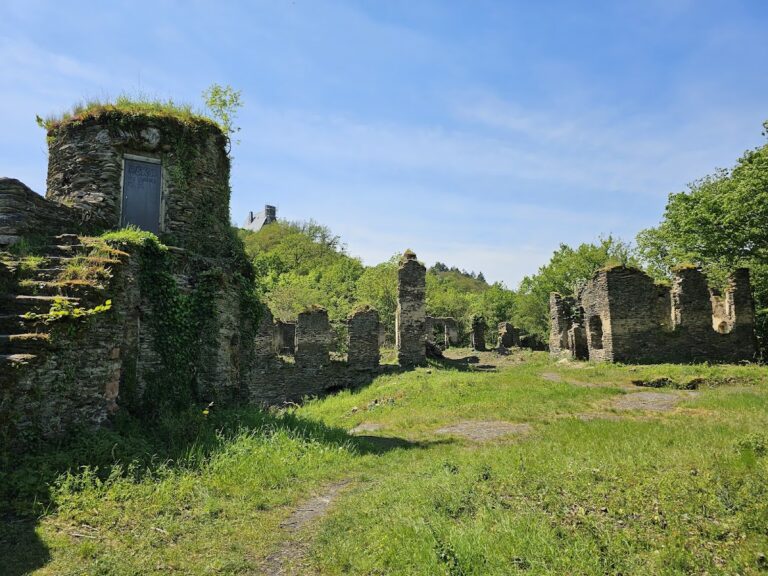
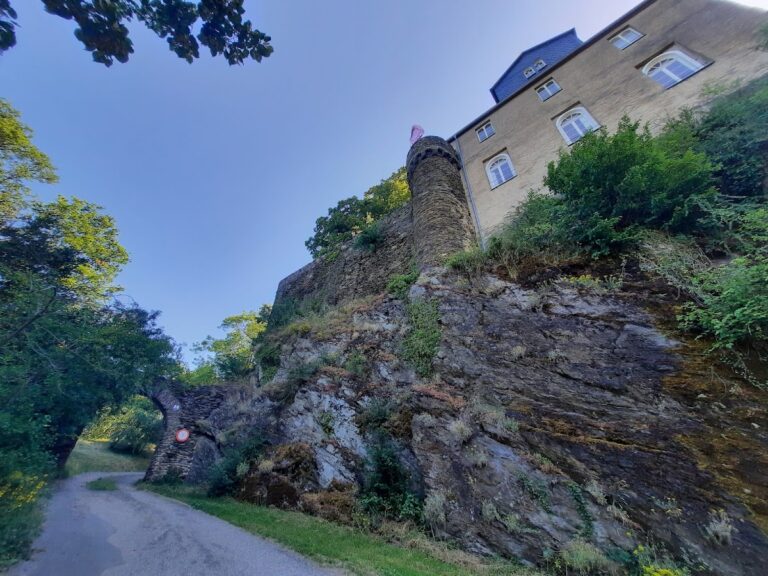
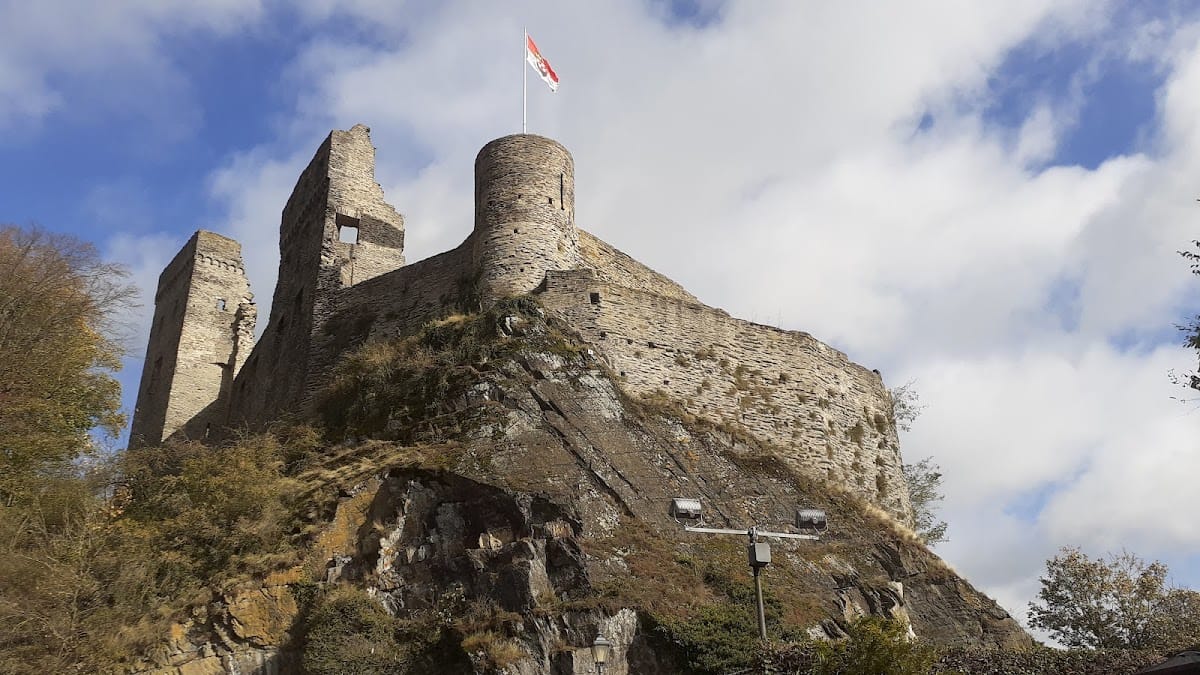
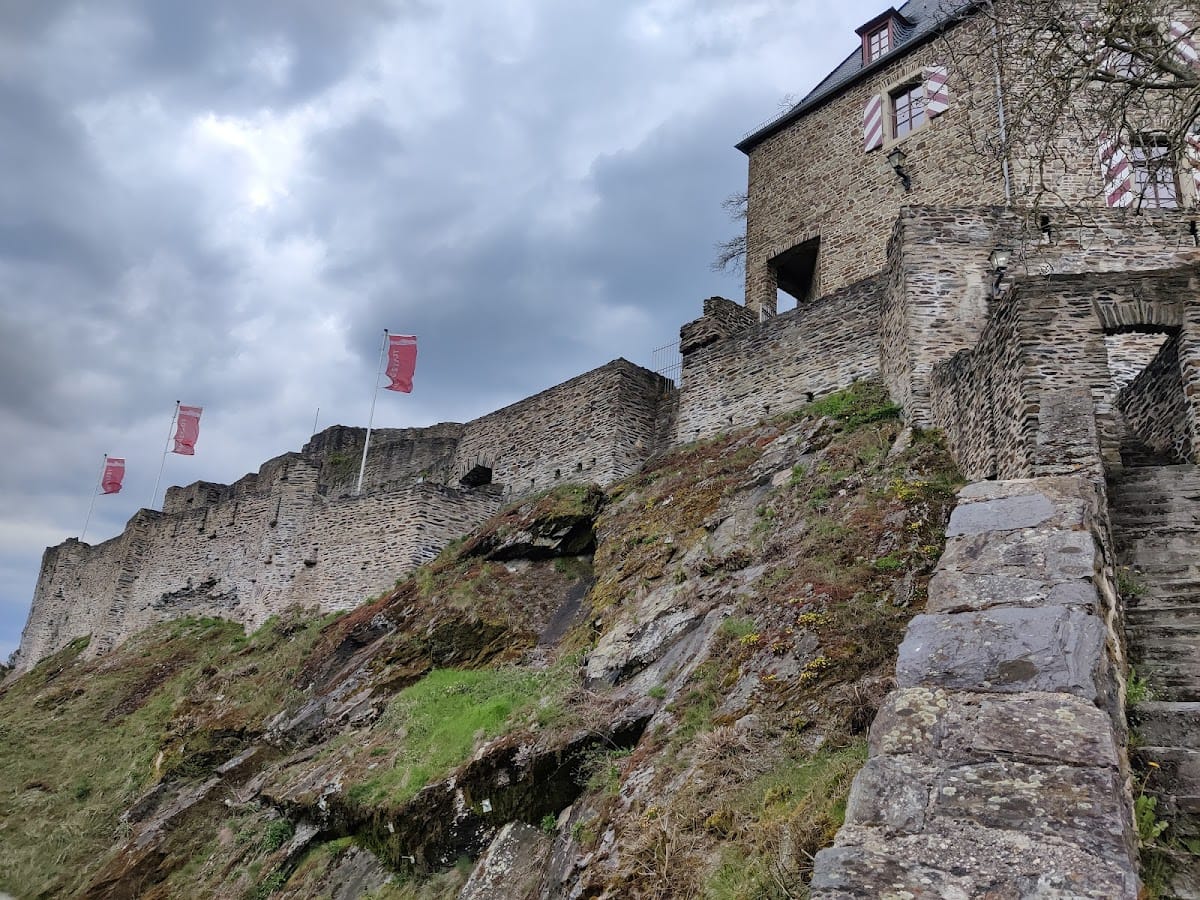
Castle Kastellaun occupies a hilltop site divided into a main castle and an outer bailey. The ruins are physically linked to the former town wall. The surviving complex combines medieval defensive and residential remains with later structures, reconstructed buildings, and spaces adapted for cultural and present-day uses.
Main castle
Defensive and residential remains
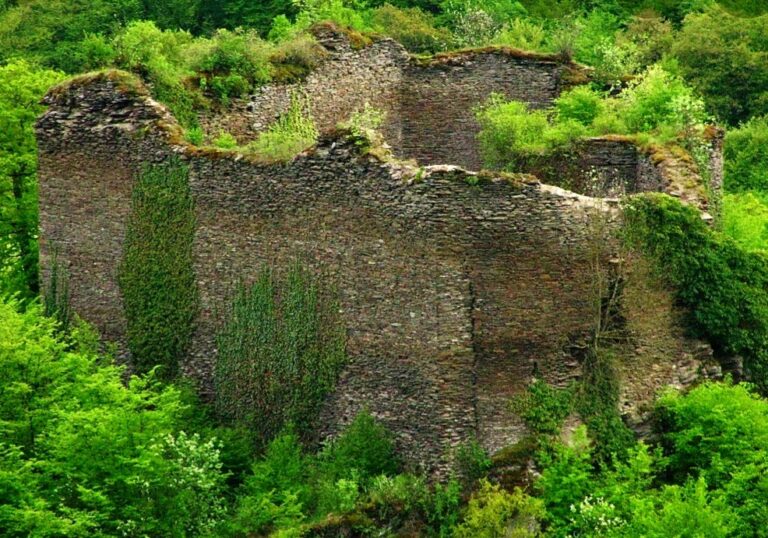
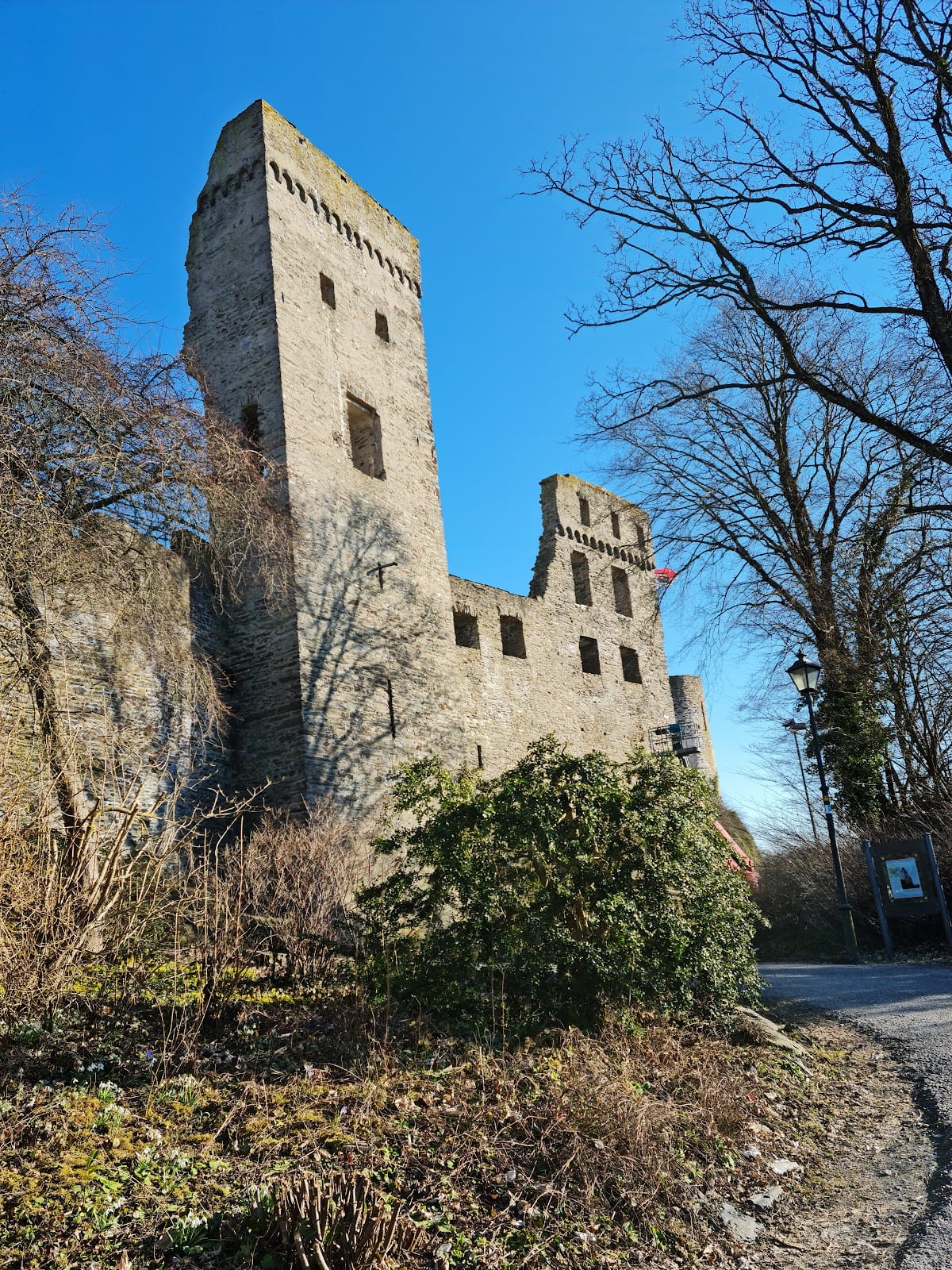
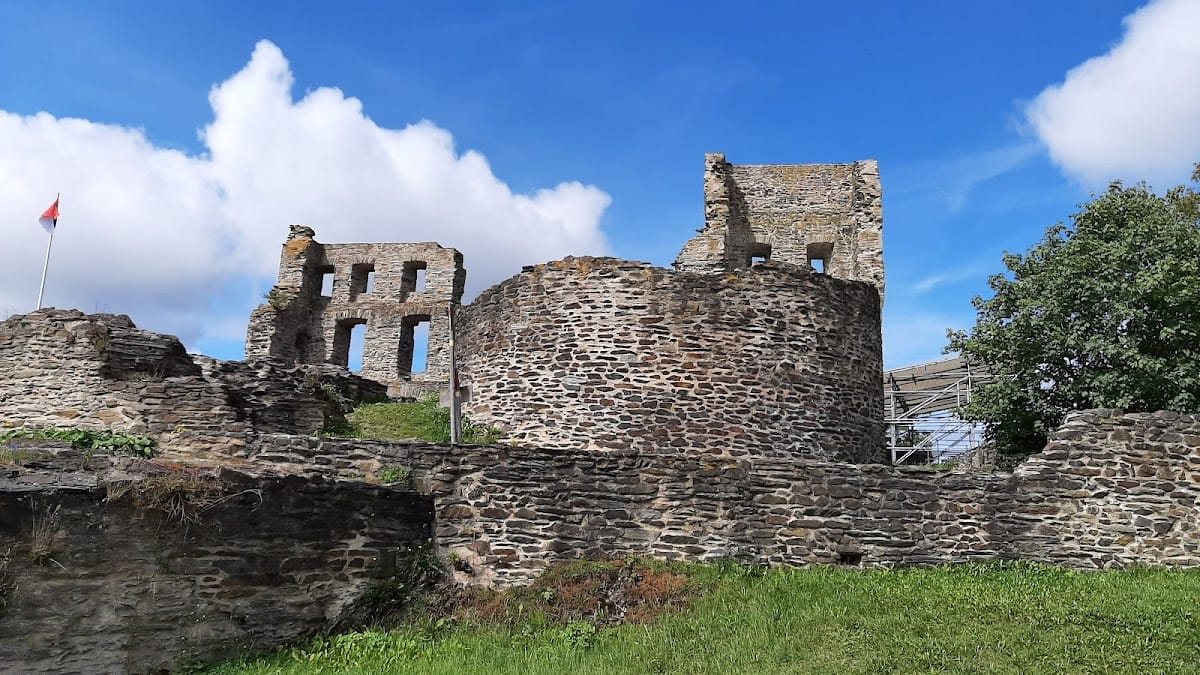
The main castle contains the remains of a bergfried, the principal defensive tower of a medieval German castle, together with the enclosing ring wall and two residential buildings. The older eastern building dates from the fourteenth century, and excavations carried out between 1990 and 1993 rediscovered its cellar. On the eastern side, facing the town, a zwinger, or outer defensive enclosure beyond the main defensive line, added another element to the castle’s fortifications.
Palas and powder tower
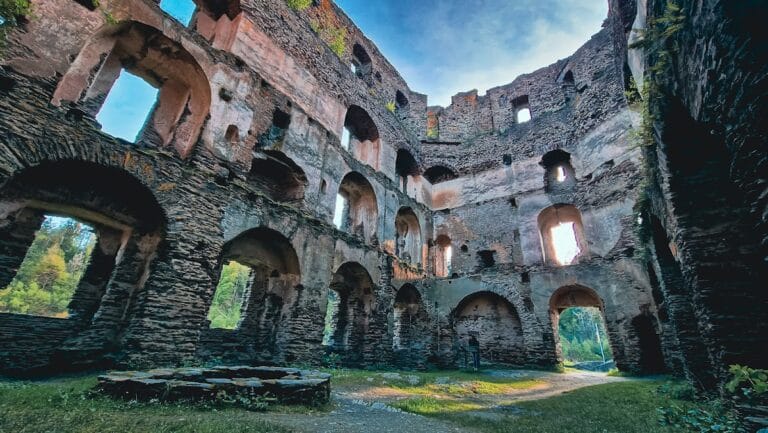
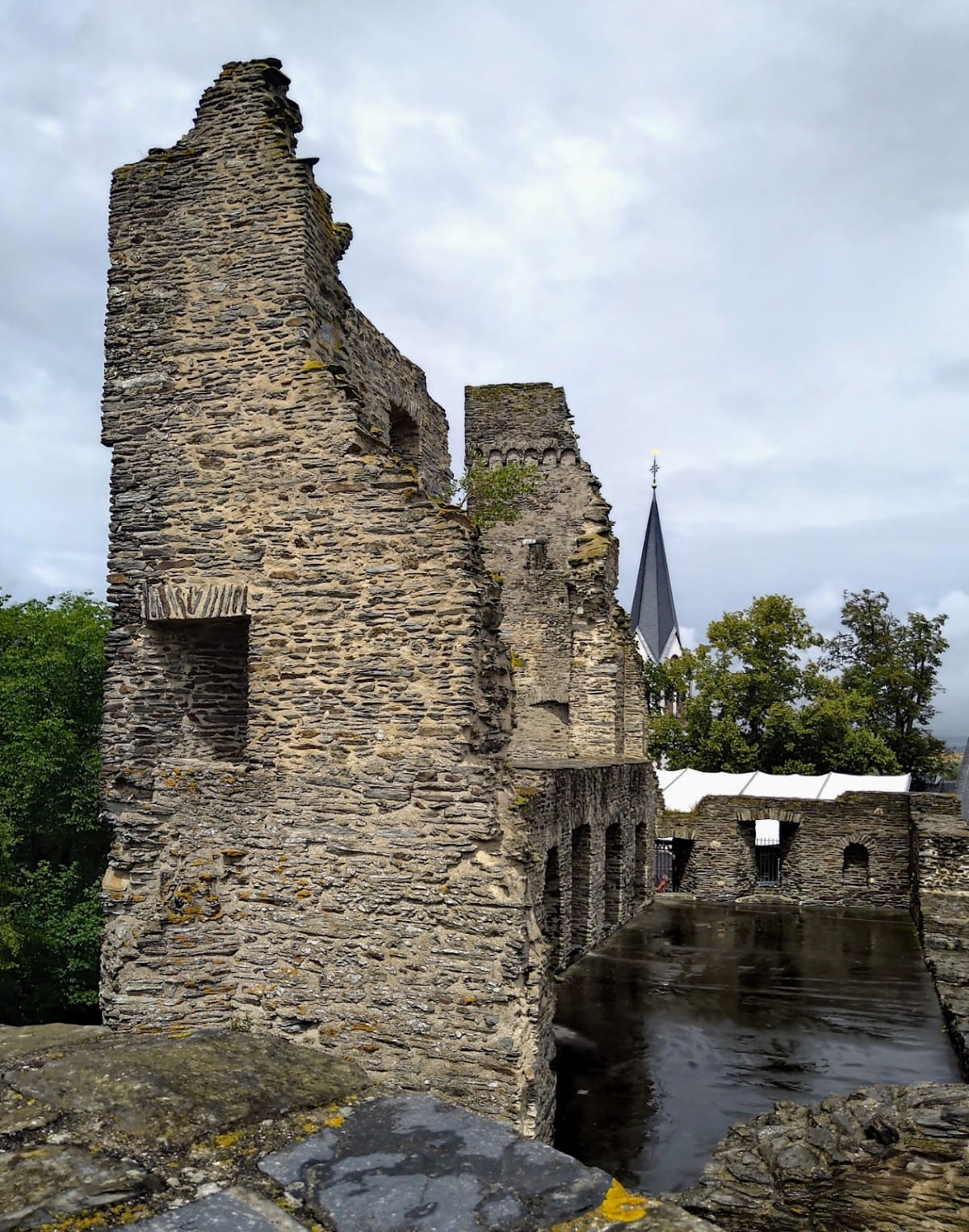
The prominent western ruin consists of the eastern end of the palas, the principal residential building usually containing a great hall, and an adjoining rectangular powder tower. Both structures probably date no earlier than the sixteenth century. The powder tower retains part of its fabric because an explosive charge used in its destruction in 1689 failed to detonate completely. The former palas now serves as an open-air theatre stage.
Outer bailey and lower castle
Entrance and reconstructed buildings
The outer bailey was originally entered through a gate tower at the northern tip of the castle. The present entrance is modern. Two modern buildings stand within the outer bailey on old foundations. The lower castle and its access were rebuilt during the conservation works of 1990 to 1993 and reconstructed again on the historic foundations in 2006 and 2007. The castle cellar and parts of the rebuilt lower castle contain present catering facilities.
Documentation centre
The documentation centre in the lower castle contains a reconstruction of the wagon burial discovered at Bell in 1938, along with Celtic pottery, fibulae, ancient brooches or clothing fasteners, jewellery, and a model of a Roman legionary helmet. Its first floor presents medieval life among the knights and nobility of Hunsrück castles. The upper floor covers the Pydna missile station, a missile base in the Hunsrück region, the Hunsrück peace movement, and current regional military and festival uses.