Sōja Shrine: The Provincial Sōja of Former Ueno Province


Site at a Glance
- Rating
- 4.3
- Popularity
- Medium
- Country
- Japan
- Primary era
- Early Modern
- External website
- Open
- Eras represented
- Early Modern
- Civilizations
- Tokugawa
- Site type
- Religious
- Remains
- Sanctuary
On this page12 sections
History
Sōja Shrine is a Shinto shrine in Maebashi, Japan, rebuilt at its present location between 1570 and 1573 after destruction during warfare. It represents the sōja of former Ueno Province, a shrine where a provincial governor could worship or offer gifts to the province’s principal deities in one place. Ueno Province corresponded broadly to much of present-day Gunma Prefecture, and Sōja Shrine was formerly ranked as a prefectural shrine.
Foundation traditions and the provincial sōja
Tradition attributes the shrine’s origin to Prince Toyoki-iri-hiko, traditionally described as a son of Emperor Sujin. He is said to have enshrined Futsunushi, a deity associated with martial power and the sword. Another tradition places a rebuilding during the reign of Emperor Ankan, when Kamitsukeno no Oguma is said to have reconstructed the shrine buildings. After that rebuilding, the shrine was reportedly called Sōkai Myōjin.
A further tradition states that in 738 the shrine brought together the 549 shrines of Ueno Province and took the name Sōja Myōjin. The formation of provincial sōja institutions, however, is generally associated with the weakening of the ritsuryō system, the centralized administrative order of early Japan. The shrine’s actual establishment is therefore considered later than these foundation traditions suggest.
The institution served the needs of provincial government. Its sacred object was the Ueno Province Register of Deities, a manuscript listing the shrines to which provincial offerings were made. The register remained enshrined there until the Meiji period.
Relocation, destruction, and rebuilding
Before reaching its present site, the shrine stood at Miyanobe, also called Miyanabe, within Sōkai Castle. The poet and Zen monk Banri Shūkyū visited the shrine in 1488 and left a written account. Warfare destroyed the shrine by fire in 1566. It was rebuilt at its current location during the Genki era, between 1570 and 1573.
Akimoto Yasutomo, lord of Sōja Castle, directed major repairs in 1616. During the early-modern period, the shrine received a stipend of 26 koku, a traditional rice-based measure, through the shogunate’s vermilion-seal grant system. In the Meiji period, the modern system for ranking shrines classified Sōja Shrine as a prefectural shrine.
Religious traditions and protection
The principal deities are Iwatsutsunoo, Iwatsutsunome, Futsunushi, Ukanomitama, and Susanoo. Ukanomitama is associated with food and agricultural abundance, while Susanoo is associated with storms and purification. The shrine also preserves the historical blending of Buddhist and Shinto worship through the association of Maitreya, the future Buddha, as the Buddhist true form of a deity.
The annual festival takes place on March 15. Other principal rites include an archery ceremony on January 6 and a tube-porridge-and-charcoal ceremony on January 15. The traditional grand kagura, a sacred Shinto performance combining music, dance, and ritual presentation, is recognized as a Maebashi municipal intangible folk cultural property. The shrine and its associated properties also receive prefectural and municipal protection.
Remains
Shrine buildings
Main hall
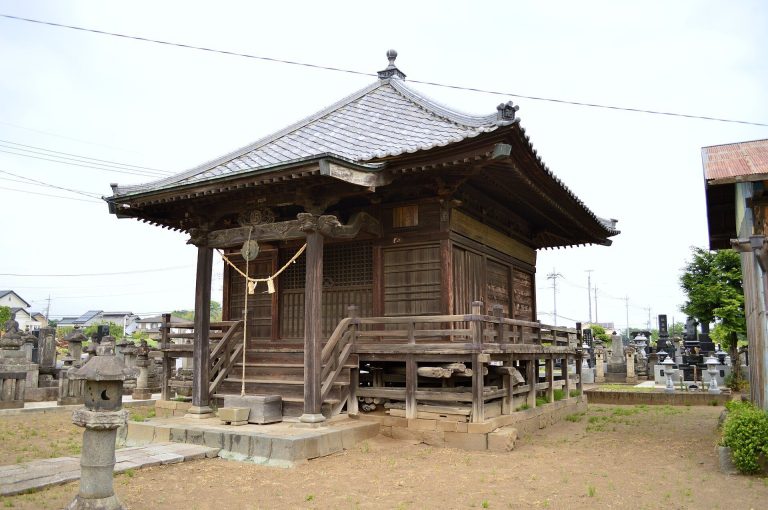
The main hall is a three-bay nagare-zukuri structure, a shrine style with a sloping roof extended over the front entrance. It has a frontage of three bays and a depth of two bays. Built during the Keichō era, it retains stylistic features of Momoyama architecture, the late sixteenth-century style known for rich decoration and bold forms. The main hall is a prefecturally designated important cultural property.
Worship hall
The worship hall was rebuilt in 1843. It forms part of the surviving shrine complex and is protected as a Maebashi municipal important cultural property.
Religious objects and shrine grove
Hanging Buddhist plaques and cloud gong
Two hanging Buddhist plaques survive among the shrine’s religious furnishings. These devotional images were suspended before Buddhist or Shinto sacred spaces, reflecting the historical combination of the two traditions. One plaque is dated 1586 and depicts Maitreya. The other carries an inscription dated 1589 and is carved with Samantabhadra. A cloud gong, a flat suspended metal gong used in religious settings, is also preserved among the shrine’s associated cultural properties.
Ueno Province Register of Deities
The Ueno Province Register of Deities survives as a single manuscript volume. Formerly enshrined as the shrine’s sacred object, it preserves the institutional connection between Sōja Shrine and the provincial shrines whose deities were included in its offering register. The manuscript is a prefecturally designated important cultural property.
Zelkova trees
Six zelkova trees grow in the shrine grove. Protected collectively as a designated natural monument, they form part of the surviving natural setting associated with the shrine.